The Greats

Ship Captain · The last absolute command: one licensed master answerable for ship, crew and cargo, from Zheng He's treasure fleets to today's container giants.

Choosing eight captains from five millennia of seafaring means passing over entire traditions — the Austronesian navigators who settled an ocean without instruments, the monsoon pilots whose knowledge lived and died unwritten, and thousands of working masters who brought their ships home for forty years without a single voyage anyone recorded. The eight here are chosen because their commands are well documented and each changed what the job could be.

They span six centuries and seven countries: an admiral of the largest wooden fleet ever built, the first commander to take a ship around the world, a pirate who out-administered an empire, a liner captain whose finest hours were spent rescuing a rival's passengers, and the woman who broke the profession's oldest barrier. None of them commanded the same kind of ship. All of them commanded the same kind of responsibility.

The all-time podium

Zheng He
Zheng He
China
2
James Cook
James Cook
Britain
1
Juan Sebastián Elcano
Spain
3

The eight who reached the top

1
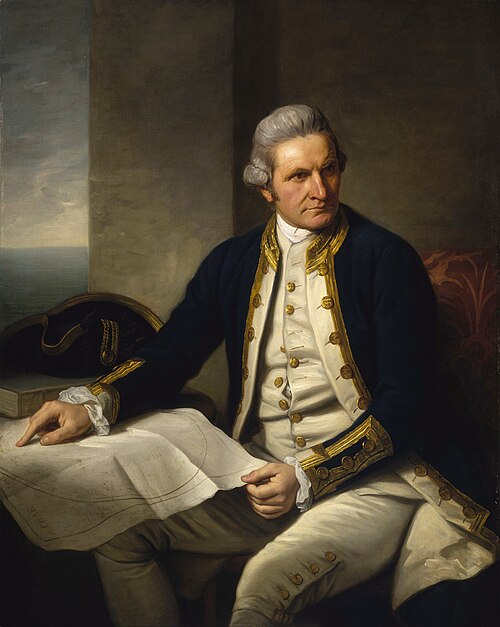
Portrait of Captain James Cook, the Pacific navigator and cartographer. Nathaniel Dance-Holland · Public domain

James Cook

Britain · 1728–1779

A grocer's apprentice who learned the sea on North Sea coal ships, Cook rose through the Royal Navy's sailing-master ranks to command three Pacific voyages between 1768 and 1779, charting New Zealand and Australia's east coast, crossing the Antarctic Circle, and proving the marine chronometer at sea. His charts stayed in use for over a century.

The story

Cook fought scurvy with management as much as medicine. Aboard Endeavour he ordered sauerkraut — which sailors detested — served daily at the officers' table while leaving it merely available to the crew, noting in his journal that whatever the men saw their superiors value, they would soon demand. Within a week the crew asked for rations. On his second voyage, three years and over 100,000 kilometers, he did not lose a single man to scurvy — an unheard-of feat in the 18th century.

“Crews copy what command visibly values; Cook managed his people with the same rigor as his charts.”
Pacific voyages commanded
3 (1768–1779)
Scurvy deaths, 2nd voyage
0 in 3 years
Coastlines first charted
NZ + east Australia
2
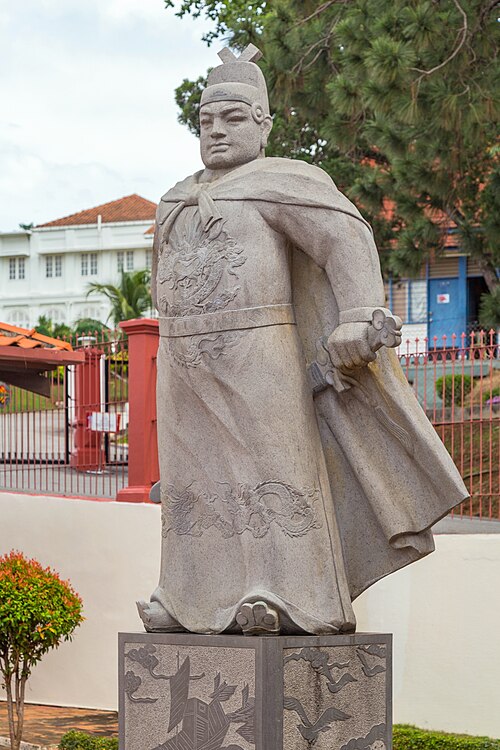
Statue of the Ming dynasty admiral Zheng He, commander of the treasure fleets. Marcin Konsek · CC BY-SA 4.0

Zheng He

China · 1371–1433

A Muslim eunuch captured as a boy and risen through the Ming court, Zheng He commanded seven expeditions between 1405 and 1433 with fleets recorded at over 250 ships and some 27,000 men, reaching Arabia and the Swahili coast of East Africa — command and logistics on a scale no other navy matched for centuries.

The story

In 1414 a giraffe arrived at the Yongle Emperor's court in Nanjing, sent from Bengal and originally a gift from Malindi in East Africa, brought home by the treasure fleets' network. Courtiers hailed it as a qilin, the auspicious beast of Chinese legend, and the court artist Shen Du painted it with a commemorative poem. A creature from a coast 12,000 kilometers away, delivered alive as diplomacy — a logistics achievement disguised as an omen.

“At fleet scale, command is logistics: feeding, watering and coordinating thousands is the real voyage.”

Expeditions commanded
7 (1405–1433)
Ships, first voyage
250+ recorded
Personnel afloat
~27,000
3
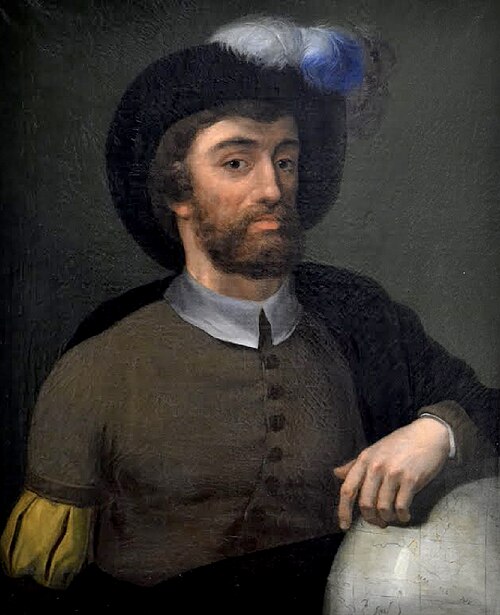
Portrait of Juan Sebastián Elcano, who completed the first circumnavigation of the Earth. Anonymous Unknown author · Public domain

Juan Sebastián Elcano

Spain · c. 1486–1526

A Basque shipmaster who joined Magellan's expedition of 1519 — after once surrendering a ship of his own to creditors — Elcano took command of the Victoria after Magellan was killed in the Philippines and brought her home westward across the Indian Ocean and around the Cape, completing the first circumnavigation of the Earth.

The story

On 6 September 1522, three years after a fleet of five ships and roughly 265 men had sailed, Elcano brought the worm-eaten Victoria into Sanlúcar de Barrameda with 18 survivors, who staggered barefoot in penitence to church. The cloves in her hold covered much of the expedition's cost. Charles V granted Elcano a coat of arms bearing a globe and the Latin motto Primus circumdedisti me — "You were the first to circle me."

“History remembers who started the voyage; the sea only cares who finishes it.”

Survivors brought home
18 of ~265
Voyage length
3 years (1519–22)
Distance closed
~70,000 km
4

Ahmad ibn Majid

Oman / Arabia · c. 1432 – c. 1500

The most famous of the Indian Ocean's mu'allims — the master-navigators who ran the monsoon trade — ibn Majid came from a family of pilots on the Arabian coast and wrote some forty works on navigation, crowning them with the Kitab al-Fawa'id of 1490, an encyclopedia of routes, stars, seasons and ports from East Africa to China.

The story

For centuries ibn Majid carried a strange second reputation: the 16th-century chronicler Qutb al-Din al-Nahrawali blamed him by name for piloting Vasco da Gama from Malindi to Calicut in 1498, letting the Portuguese into the Indian Ocean. Portuguese records, though, mention only an unnamed pilot, possibly Gujarati, and modern historians doubt the elderly master was aboard at all. The greatest navigator of his ocean became its scapegoat — for a voyage he probably never made.

“Write down what the pilots keep in their heads; the books outlive both the ships and the slander.”

Navigation works written
~40 treatises
Masterwork completed
Kitab al-Fawa'id, 1490
Ocean routes codified
E. Africa to China
5
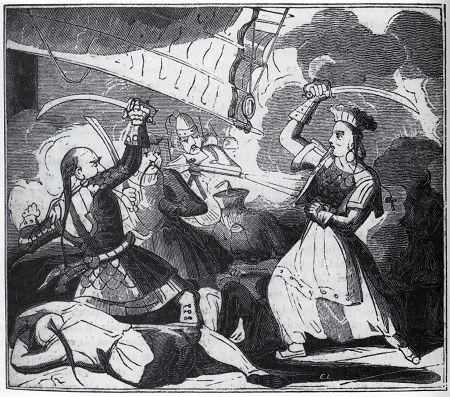
Illustration of Zheng Yi Sao, commander of the Guangdong pirate confederation. Unknown author Unknown author · Public domain

Zheng Yi Sao (Ching Shih)

China · 1775–1844

Widowed in 1807, Zheng Yi Sao took over her husband's pirate confederation on the South China coast and ran it as a navy: hundreds of junks and tens of thousands of followers under a written code, with disciplined squadrons that defeated Qing fleets sent to destroy them. Arguably no one has commanded more ships at once, before or since.

The story

Her exit outclassed her victories. In 1810, with Qing, Portuguese and British forces converging, she sailed unarmed to Canton with a delegation of the fleet's women and children and negotiated directly with the governor-general: amnesty for nearly the whole confederation, her followers keeping their plunder, many enrolling in the imperial forces. She kept her fortune, married her lieutenant Cheung Po Tsai, and ran a Canton gambling house until her death at 68 — one of history's very few pirate commanders to die wealthy, free and in bed.

“Knowing how and when to end a command is command judgment of the highest order.”

Junks under her flag
Hundreds
Followers at peak
Tens of thousands
Years in supreme command
3 (1807–1810)
6
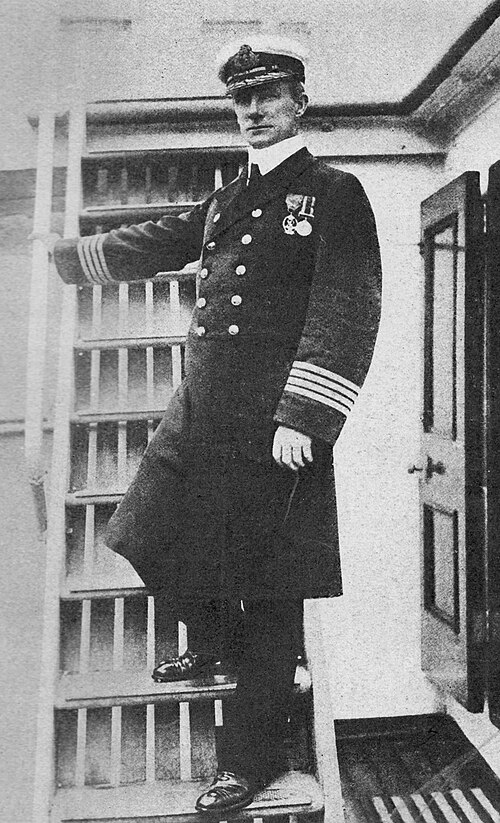
Captain Arthur Rostron of the Carpathia, rescuer of the Titanic's survivors. Unknown author Unknown author · Public domain

Arthur Rostron

Britain · 1869–1940

A Cunard captain of no particular fame until the night of 15 April 1912, Rostron commanded the liner Carpathia when the Titanic's distress call arrived — and turned a routine Mediterranean crossing into the most admired rescue in merchant marine history. He was later knighted, awarded the US Congressional Gold Medal, and made commodore of the Cunard fleet.

The story

Woken after midnight with Titanic's position, Rostron turned his ship instantly, then spent the 58-mile dash preparing rather than hoping: every off-duty stoker sent below to push the 14-knot Carpathia past 17 knots, extra lookouts posted as she dodged icebergs in the dark, and the crew rigging gangway lights, slings for the injured, and hot soup and blankets for survivors who did not yet know they would be rescued. She reached the boats at dawn and took 705 people aboard.

“The rescue is won during the transit: preparation en route, not heroics on arrival, saved 705 lives.”

Survivors rescued
705
Speed coaxed from 14 kn
17+ knots
Icebergs evaded en route
Half a dozen
7

Anna Shchetinina

Soviet Union / Russia · 1908–1999

A fisherman's daughter from Russia's Far East, Shchetinina worked up from deckhand to earn her master's certificate and, in 1935 at age 27, became the first woman in the world to command an ocean-going merchant ship. She sailed through the Second World War, later taught navigation as a professor in Vladivostok, and was named a Hero of Socialist Labour in 1978.

The story

Her first command was a delivery voyage no one could ignore: taking the steamer Chavycha from Hamburg to Kamchatka in 1935, she found the world's press waiting at the docks, wiring home stories about the phenomenon of a "girl captain." She gave the reporters nothing to write about except a ship handled faultlessly across half the planet. Six years later the novelty was long gone: she commanded Soviet merchant ships through wartime waters in the Baltic and the Pacific, including the evacuation operations of 1941.

“Do the job so plainly well that the novelty story runs out of material.”

Age at first command
27 (1935)
Women masters before her
None recorded
Years in the profession
60+ (sea & teaching)
8

Frank Worsley

New Zealand · 1872–1943

A New Zealand merchant officer who learned his trade on South Pacific sailing ships, Worsley captained Shackleton's Endurance on the 1914–16 Antarctic expedition. When the ice crushed the ship, his navigation held all 28 lives: first to Elephant Island in open boats, then across the worst ocean on Earth to fetch help.

The story

In April 1916 Worsley navigated the 6.9-meter open boat James Caird roughly 800 nautical miles from Elephant Island to South Georgia through the Southern Ocean's winter — managing only four sextant sights in 16 days, snatched between gales while two men held him upright against the mast. His landfall had to be nearly perfect: missing the island meant the boat's six men and the 22 left behind would all die. He hit it. Then he crossed South Georgia's unmapped mountains with Shackleton and Crean in a 36-hour push to the whaling station.

“Decades of unglamorous skill-building look like miraculous luck on the one day everything depends on it.”

Open-boat voyage
~800 nm
Sextant sights taken
4 in 16 days
Expedition members saved
28 of 28

Bars are scaled to the leader in this list.

Comparison Lab

Toggle names on and off — every bar rescales to the leader of your selection.

5 / 8

The argument

Ibn Majid's presence on this list rests on his books, not on the da Gama story long attached to his name: the account blaming him for piloting the Portuguese to India comes from a chronicler writing decades later, and most modern historians consider it unlikely. The debate matters because it shows how thin the records are even for the most famous navigator of the world's busiest medieval ocean.

Zheng He's fleet invites its own argument: Ming sources credit the largest treasure ships with lengths over 130 meters, which many naval architects consider structurally implausible for wooden hulls, suggesting 60–70 meters instead. Either figure still leaves them the largest wooden ships of their age — but the gap between them is a reminder that even well-documented commands come with contested numbers.

The deeper dispute is who counts as a captain at all. Zheng Yi Sao held no license; Yi Sun-sin and Nelson were naval commanders, not merchant masters; and the greatest ocean navigators in human history — the Polynesian wayfinders, remembered through men like Mau Piailug, who navigated the Hōkūle'a from Hawaii to Tahiti in 1976 without instruments — left no logbooks for lists like this one to cite. A ranking built on documents will always favor the documented.

Keep exploring

More in Frontier & Field