🧩The Greats

Psychologist · The scientist of mind and behavior, from Wundt's 1879 Leipzig laboratory to the therapy room — trained to hear what a person cannot yet say themselves.

Choosing eight names from a discipline that touches education, medicine, law and industry means leaving out entire branches — no Pavlov, no Skinner, no Milgram or Kahneman here — and favoring, inevitably, the people whose work was published, translated and preserved. The eight below are chosen because their fingerprints are still on daily practice: the tests given, the therapies delivered, the classrooms designed.

They span Germany, Austria, Switzerland, Russia and the United States, and a century and a half. Among them are a woman refused the Harvard doctorate she had plainly earned, a Black psychologist whose experiment reached the US Supreme Court, and a Soviet theorist banned by Stalin and canonized after death. Reaching the top of this field has rarely looked like a straight career ladder.

The all-time podium

William James
William James
United States
2
Wilhelm Wundt
Wilhelm Wundt
Germany
1
Sigmund Freud
Sigmund Freud
Austria
3

The eight who reached the top

1
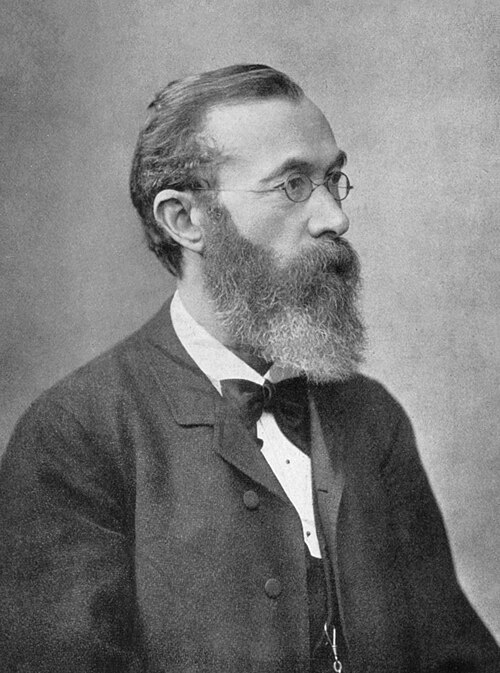
Portrait of Wilhelm Wundt, founder of experimental psychology. Unknown author Unknown author · Public domain

Wilhelm Wundt

Germany · 1832–1920

Wundt turned psychology from a branch of philosophy into a laboratory science, founding the world's first experimental psychology laboratory at Leipzig in 1879 and supervising more than 180 doctorates. His students carried the new discipline home to universities across Europe, America and Japan, founding many of its first departments.

The story

As a young physiologist around 1861, Wundt rigged a swinging pendulum to strike a bell and found observers could not register the bell's sound and the pendulum's position at the same instant — attention shifted between them, costing roughly a tenth of a second. If thought took measurable time, thought could be measured. Eighteen years later he opened his Leipzig laboratory in a modest room in the university's Konvikt building, and psychology had its founding address.

“Turn a philosophical question into a measurable one, and you can found a science on it.”
Doctorates supervised
180+ students
Years the Leipzig lab led the field
~40 years
Volumes of his Völkerpsychologie
10 volumes
2
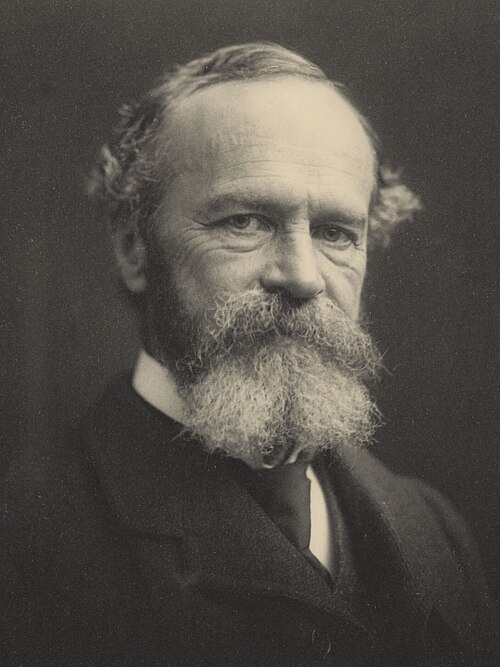
Portrait of William James, author of The Principles of Psychology. Notman Studios (photographer) · Public domain

William James

United States · 1842–1910

James built American psychology almost single-handedly from his Harvard study, teaching the country's first courses in the new science and writing The Principles of Psychology (1890), still the discipline's most quoted founding text. He never loved laboratory work — his instrument was seeing clearly and writing better than anyone in the field since.

The story

In 1878 James signed a contract with publisher Henry Holt to deliver a psychology textbook within two years. He delivered it after twelve — nearly 1,400 pages in two volumes — and sent it off declaring it proof that there was no such thing as a science of psychology yet, privately describing the manuscript to Holt as a bloated, dropsical mass. The book he despised became the most influential psychology text written in English, and chapters like "Habit" are still assigned today.

“A founding work can be honest about how unfinished its field is and still define it.”

Years writing the Principles
12 yrs (1878–90)
Pages in the first edition
~1,400 pages
Years teaching at Harvard
35 years
3
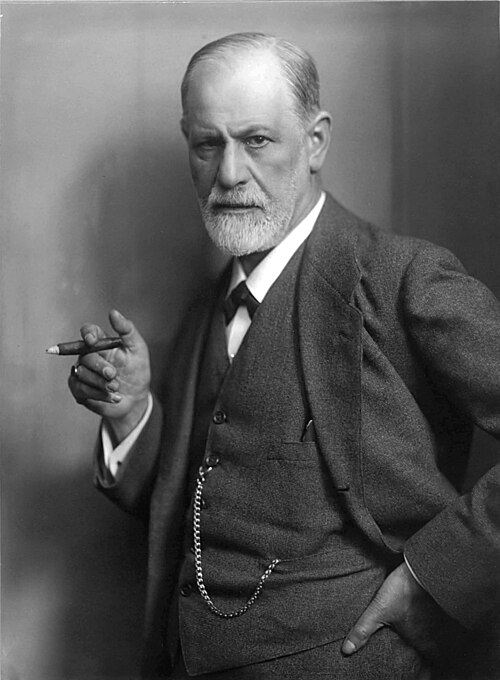
Photograph of Sigmund Freud, founder of psychoanalysis. Max Halberstadt · Public domain

Sigmund Freud

Austria · 1856–1939

A Viennese neurologist rather than a psychologist by training, Freud built the first systematic talking therapy and the vocabulary — repression, projection, denial — the whole culture still uses. Psychoanalysis has lost most of its scientific standing, but the consulting room, the private hour and the listening cure all descend from him.

The story

After Nazi Germany annexed Austria in March 1938, the 81-year-old Freud's Vienna home was searched and his daughter Anna was interrogated by the Gestapo. Princess Marie Bonaparte, a former patient, paid the Reich's punitive flight tax to buy his exit, and on 4 June 1938 Freud left on the Orient Express for London, where he died the following year. Four of his five sisters, left behind in Vienna, were murdered in the Nazi camps.

“Ideas can outrun the century that tried to destroy their author.”

First print run of Dreams
600 copies, 8 yrs
Years practicing at Berggasse 19
47 years
Standard Edition of his works
24 volumes
4

Mary Whiton Calkins

United States · 1863–1930

Calkins studied under William James, invented the paired-associates technique for studying memory, founded one of America's first psychology laboratories at Wellesley College in 1891, and in 1905 became the first woman president of the American Psychological Association — all without the doctorate Harvard refused to grant her.

The story

In 1895 Calkins passed an unofficial doctoral examination at Harvard that William James reportedly called the most brilliant the department had seen; her committee unanimously recommended the degree, and Harvard's governing board refused it because she was a woman. In 1902 Radcliffe, Harvard's affiliated women's college, offered her its own PhD instead. She declined on principle — the work had been done at Harvard — and never accepted any substitute for the degree she had earned.

“Refusing a consolation prize can be a longer-lasting statement than accepting one.”

APA presidency
First woman, 1905
Harvard doctorate granted
Never — refused
Books and papers published
4 books, 100+ papers
5
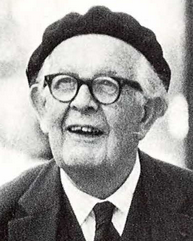
Photograph of Jean Piaget, pioneer of child developmental psychology. Unidentified (Ensian published by University of Michigan) · Public domain

Jean Piaget

Switzerland · 1896–1980

Piaget spent five decades showing that children are not small, faulty adults but systematic thinkers whose logic changes in stages. His observations — many begun on his own three children — rebuilt education worldwide around how children actually reason at each age, and made developmental psychology a science.

The story

Piaget published his first scientific paper at ten — a short note on an albino sparrow he had spotted in a Neuchâtel park. The decisive accident came around 1920, scoring standardized reasoning tests in Théodore Simon's Paris laboratory: he noticed that children of the same age kept giving the same wrong answers. Everyone else was counting correct responses; Piaget saw that the errors themselves had a structure, and spent the next sixty years mapping it.

“The pattern in people's mistakes can teach more than their correct answers ever will.”

Age at first publication
10 years old (1907)
Books published
50+ books
First subjects of his stage theory
His own 3 children
6

Lev Vygotsky

Russia (USSR) · 1896–1934

In barely ten working years, Vygotsky produced a psychology of learning — the zone of proximal development, the social origins of thought — that classrooms on every continent now run on. Suppressed in his own country for two decades, his work reshaped Western education a generation after his death.

The story

Dying of tuberculosis at 37, Vygotsky dictated the final chapter of Thought and Language from his sickbed in the spring of 1934; the book appeared months after his death. Two years later, Stalin's 1936 decree against pedology effectively banned his writings in the Soviet Union, and they were not republished there until 1956. When English translations spread in the 1960s and 70s, the philosopher Stephen Toulmin famously dubbed him the Mozart of psychology.

“Work can wait decades for its readers and still arrive exactly on time.”

Age at death
37 (tuberculosis)
Productive career length
~10 years
Years his work was suppressed
20 yrs (1936–56)
7

Mamie Phipps Clark

United States · 1917–1983

Clark was the first Black woman to earn a psychology doctorate from Columbia University (1943), and with her husband Kenneth designed the doll studies documenting what segregation did to Black children's sense of self — research the US Supreme Court cited in Brown v. Board of Education in 1954.

The story

In the doll tests, which grew out of her master's research at Howard University, the Clarks showed Black children aged three to seven two dolls, identical except for color, and asked which was nice, which looked bad, and which looked like them. Many children in segregated schools called the white doll nice and their own likeness bad. The Supreme Court cited this line of research in Brown v. Board's footnote 11 — yet no university would hire her, so in 1946 she founded Harlem's Northside Center for Child Development and ran it for three decades.

“A simple, careful experiment can put evidence where a society keeps only opinions.”

Cited by the Supreme Court
Brown v. Board, 1954
Columbia psychology doctorate
First Black woman, 1943
Northside Center leadership
1946–1979
8

Aaron Beck

United States · 1921–2021

A psychoanalyst who tested Freud's theory of depression and found his own data contradicted it, Beck built cognitive therapy at the University of Pennsylvania in the 1960s. Its descendant, CBT, is now the most researched psychotherapy in the world, tested across thousands of clinical trials.

The story

In the late 1950s Beck set out to vindicate the psychoanalytic view of depression as hostility turned inward by studying patients' dreams — and found themes of defeat and loss, not anger. Then a patient free-associating on his couch admitted she was simultaneously thinking something else: that she was boring him. Beck began asking every patient for these unspoken "automatic thoughts," found they ran in learnable patterns, and built a therapy around testing them against evidence.

“When your data contradicts your school, follow the data — even out of the school.”

Beck Depression Inventory
1961, still in use
Clinical trials of CBT by 2021
2,000+
Age at death, still working
100 (2021)

Bars are scaled to the leader in this list.

Comparison Lab

Toggle names on and off — every bar rescales to the leader of your selection.

5 / 8

The argument

Freud's place on any psychologists' list is genuinely contested twice over: he was a neurologist who never held a psychology degree, and Karl Popper made psychoanalysis his textbook example of unfalsifiable theory. Yet the profession of talking therapy — the private hour, the trained listener, the idea that speech heals — is unimaginable without him, so he stays, half founder and half cautionary tale.

The list leans heavily Western because the written record does. Shoma Morita was building a distinctly Japanese therapy for anxiety in 1919; Ignacio Martín-Baró founded liberation psychology in El Salvador before soldiers assassinated him in 1989; and centuries of non-European traditions of mind and healing produced practitioners no journal ever recorded. The canon measures preservation as much as merit.

The replication crisis has also made hero-ranking riskier: several of the 20th century's most famous psychological studies — Zimbardo's 1971 Stanford prison experiment chief among them — have been seriously challenged on methods or candor, and a 2015 project managed to reproduce only about a third of 100 published findings. The safest legends here are the ones whose legacy is a working tool, not a single dramatic result.

Keep exploring

More in Education & Humanities