✈️The Greats

Pilot · The professional flyer who turns weather, machinery and 200 lives into a routine arrival — a craft rebuilt after every crash that taught it something.

Any list of eight pilots is unfair to the tens of thousands of instructors, line captains and test pilots who built aviation's safety record without a single headline — the profession's greatest achievement is collective and anonymous. The eight below are chosen because each one changed what the job is, and each left a story specific enough to check.

They span two centuries and five countries, and reached the top by different doors: a bicycle shop in Ohio, a Chicago manicure table, a French mail line over the Sahara, a Bombay flying club, a Hudson River glide. Between them they mark the trade's whole arc — inventing flight, opening it to the excluded, industrializing it, and proving what the humans in row zero are still for.

The all-time podium

Louis Blériot
Louis Blériot
France
2
Wilbur & Orville Wright
United States
1
Bessie Coleman
Bessie Coleman
United States
3

The eight who reached the top

1
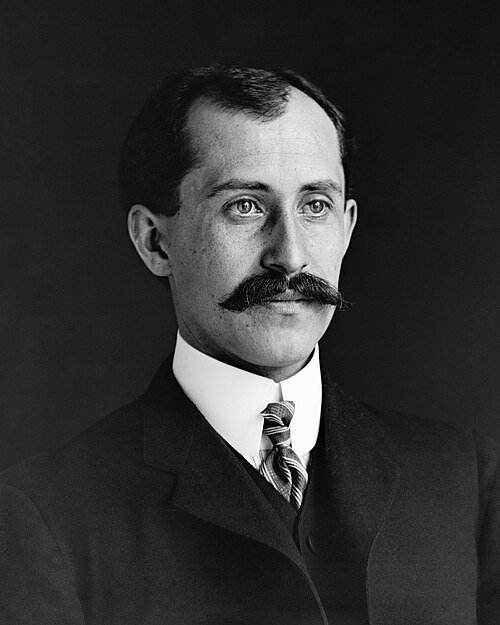
Wilbur and Orville Wright, inventors of the first controllable powered aircraft. Orville Wright and Wilbur Wright (credited as photographers) [1] , [2] · Public domain

Wilbur & Orville Wright

United States · 1867–1912 / 1871–1948

Bicycle manufacturers from Dayton, Ohio who solved flight's real problem — control, not power — through kite experiments, a homemade wind tunnel and three gliding seasons at Kitty Hawk. On 17 December 1903 they made the first controlled, powered, sustained flights, then invented flight training itself, teaching the world's first military pilots.

The story

After the four flights of 17 December 1903 — Orville's first covering 37 metres in 12 seconds, Wilbur's last 260 metres in 59 — the brothers telegraphed their father: "Success four flights Thursday morning... inform press." The telegraph operator leaked it, and the few newspapers that ran the story garbled it so badly that powered flight stayed effectively secret; the Wrights were not widely believed until Wilbur's public demonstrations at Le Mans, France in August 1908 left European aviators stunned and apologizing in print.

“Solve the unfashionable part of the problem — control, not power — and the fashionable part follows.”
First flight duration
12 seconds
Best flight that day
260 m in 59 s
Witnesses present
5 people
2
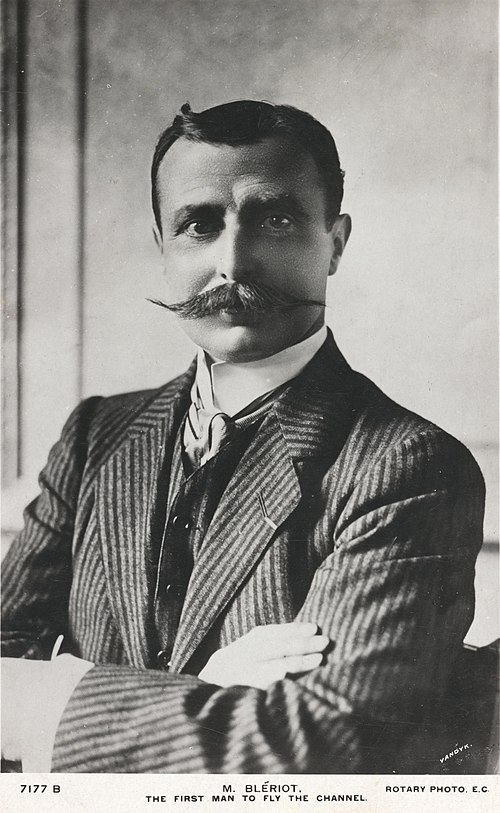
Portrait of French aviator Louis Blériot beside his monoplane. Unknown author Unknown author · Public domain

Louis Blériot

France · 1872–1936

A headlamp manufacturer who spent his fortune crashing a decade's worth of experimental aircraft, Blériot crossed the English Channel in his Type XI monoplane on 25 July 1909 — the first flight between nations over open water — and turned overnight fame into the world's first major aircraft manufacturing business.

The story

Blériot flew the Channel on a badly burned foot, injured in an engine fire weeks earlier, and navigated the 37-minute crossing without a compass; mid-Channel, out of sight of the escorting ships, he later admitted he simply let the aircraft hold its heading. Spotting Dover Castle, he threw the machine down in a gap in the cliffs at Northfall Meadow, smashing the undercarriage, and collected the Daily Mail's £1,000 prize. Orders for more than 100 Blériot machines followed within weeks.

“One public, verifiable demonstration can be worth a decade of private engineering.”

Crossing time
~37 minutes
Prize won
£1,000 (1909)
Orders within weeks
100+ aircraft
3
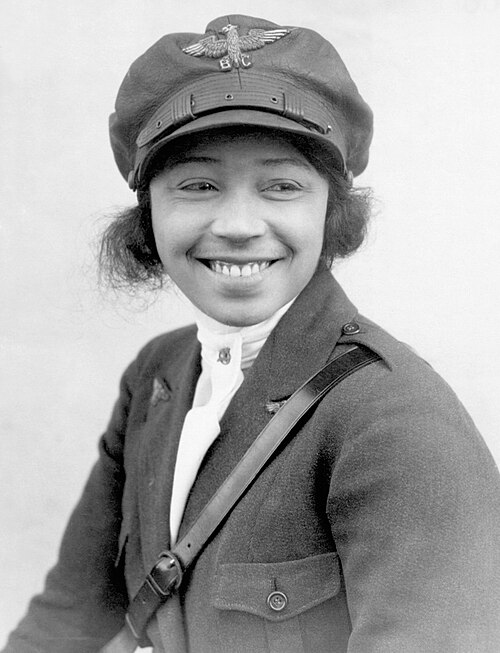
Portrait of aviator Bessie Coleman in her flying uniform. Unknown · Public domain

Bessie Coleman

United States · 1892–1926

A Texas sharecropper's daughter working as a Chicago manicurist, Coleman was refused by every American flight school she approached — Black and a woman. She learned French, sailed to France, and on 15 June 1921 earned an FAI licence from the Caudron brothers' school, becoming the first African-American woman licensed to fly.

The story

Back in the United States as the airshow star "Queen Bess," Coleman used her only leverage — the gate receipts — against segregation. Invited in 1925 to perform in Waxahachie, Texas, the town where she grew up, she refused to fly unless Black and white spectators entered through the same gate, and the organizers gave in; seating beyond the gate remained segregated, but the single entrance stood. She died in 1926, thrown from an open cockpit during rehearsal when a loose wrench jammed her aircraft's controls.

“If the system bars the door, learn its language — literally, if necessary — and enter through another country.”

FAI licence earned
15 June 1921
US schools that accepted her
0 — trained in France
Age at her death
34 years
4
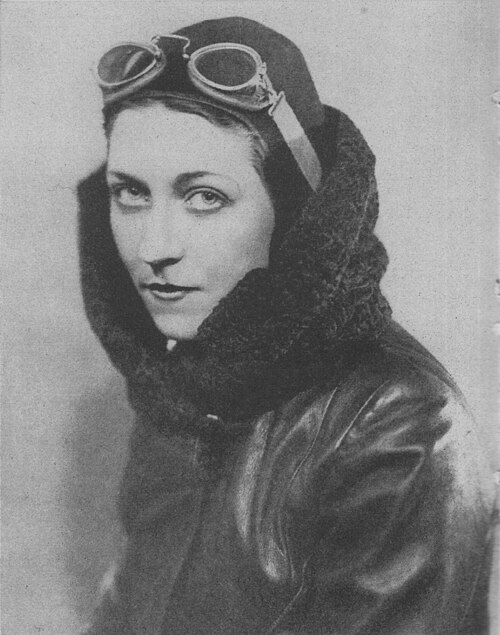
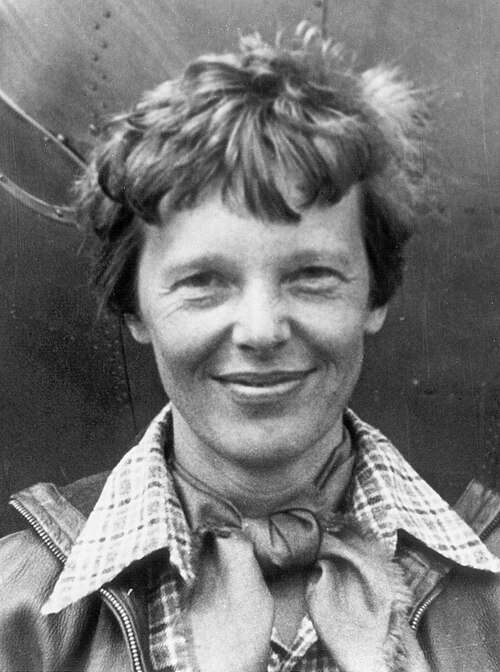
Portrait of Amelia Earhart in flying gear beside an aircraft. Underwood & Underwood (active 1880 – c. 1950) [1] · Public domain

Amelia Earhart

United States · 1897–1937

The first woman to fly the Atlantic solo — and only the second person, after Lindbergh — Earhart set speed and distance records through the 1930s, co-founded and first led the Ninety-Nines, the international organization of women pilots chartered by 99 women in 1929, and vanished over the Pacific in 1937 attempting a round-the-world flight.

The story

On 20–21 May 1932, exactly five years after Lindbergh, Earhart flew her red Lockheed Vega alone from Harbour Grace, Newfoundland toward Paris. Ice loaded the wings, flames streamed from a cracked exhaust manifold, and her altimeter failed, leaving her guessing height over the night Atlantic; after 14 hours 56 minutes she put the Vega down in a sloping pasture at Culmore, Northern Ireland. A farmhand asked whether she had flown far. "From America," she said.

“Records are arguments: each one made "women can't" harder to say aloud.”

Solo Atlantic crossing
14 h 56 m (1932)
People to solo it before her
Only Lindbergh
Ninety-Nines charter members
99 women, 1929
5
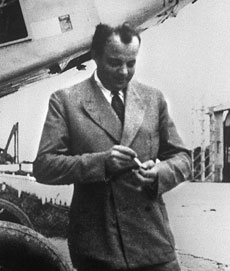
Portrait of pilot and writer Antoine de Saint-Exupéry. Distributed by Agence France-Presse · Public domain

Antoine de Saint-Exupéry

France · 1900–1944

An Aéropostale mail pilot on the Toulouse–Dakar line and station chief at Cape Juby on the Saharan coast, Saint-Exupéry turned the airmail pilot's world into literature — Night Flight, Wind, Sand and Stars, The Little Prince — giving the profession its philosopher. He disappeared on a reconnaissance flight over the Mediterranean on 31 July 1944.

The story

Attempting a Paris–Saigon speed record on 30 December 1935, Saint-Exupéry and his mechanic André Prévot crashed their Caudron Simoun into the Libyan Desert and walked for days on a few grapes, two oranges and dew wiped from the wings, hallucinating rescuers as thirst closed in. A Bedouin on a camel found them on the fourth day. The ordeal became the desert chapters of Wind, Sand and Stars — and the crash scene that opens The Little Prince, written eight years later.

“The trade's experiences are raw material; someone has to carry them out of the cockpit into the culture.”

Days lost in the desert
4 days, 1935
Little Prince translations
500+ languages
Wreck identified off Marseille
2004, 60 yrs later
6
Portrait of British aviator Amy Johnson. Andy Dingley (scanner) · Public domain

Amy Johnson

United Kingdom · 1903–1941

A Hull merchant's daughter working as a London typist, Johnson took up flying at a club, became the first British woman licensed as a ground engineer, and in May 1930 flew a secondhand Gipsy Moth biplane named Jason from Croydon to Darwin — the first woman to fly solo from England to Australia.

The story

When Johnson set off on 5 May 1930 she had logged barely 90 flying hours, and her longest flight ever was London to her hometown of Hull. Over 19 days she crossed deserts and monsoons in an open cockpit, crash-landing near Rangoon on a playing field, where locals and a technical institute's staff helped patch Jason's wing before she flew on. A million-strong crowd greeted her back in London, and "Amy, Wonderful Amy" topped the sheet-music charts. She died in 1941 ferrying aircraft for the Air Transport Auxiliary, bailing out over the Thames Estuary.

“Preparation matters, but so does refusing to wait for permission to be experienced enough.”

England–Australia solo
19 days, 1930
Hours logged beforehand
~90 hours
Longest flight before it
London–Hull
7

J. R. D. Tata

India · 1904–1993

Holder of the first pilot licence issued in India — No. 1, from the Aero Club of India in February 1929 — Tata flew the country's inaugural commercial flight in 1932 and built the airmail venture it launched, Tata Air Lines, into what became Air India, chairing it and the Tata industrial group for decades.

The story

On 15 October 1932, Tata flew a single-engine de Havilland Puss Moth carrying airmail from Karachi to Bombay via Ahmedabad, inaugurating scheduled commercial aviation in India; the airline's entire first-year fleet was two small aircraft. Fifty years later, on 15 October 1982, the 78-year-old chairman marked the anniversary by flying the same route again, solo, in a vintage Leopard Moth — over the objections of colleagues who thought the country's most important industrialist had no business alone in a 1930s aircraft over the Arabian Sea coast.

“The licence and the boardroom are not rivals: the founder who can fly the route understands the airline.”

India pilot licence
No. 1, Feb 1929
Anniversary re-flight
Solo at 78, 1982
First-year airline fleet
2 aircraft, 1932
8

Chesley Sullenberger

United States · b. 1951

A former US Air Force fighter pilot, glider pilot, accident investigator and CRM instructor, Sullenberger ditched US Airways Flight 1549 in the Hudson River on 15 January 2009 after Canada geese destroyed both engines — 155 aboard, no deaths — and became the modern era's defining demonstration of why trained humans sit in row zero.

The story

Three minutes after leaving LaGuardia, the Airbus lost both engines at about 2,800 feet. Sullenberger took control with the words "my aircraft," told controllers "we're gonna be in the Hudson," and touched down 208 seconds after the bird strike; he then walked the flooding cabin twice to confirm no one remained before leaving last. NTSB simulations later showed a return to LaGuardia succeeded only if begun immediately — when pilots were given a realistic 35-second decision delay, the simulated returns crashed, vindicating the river.

“A 208-second masterpiece takes thirty years to prepare; experience is what the routine years quietly bank.”

Strike to touchdown
208 seconds
People aboard, survived
155 of 155
Career hours at the time
~19,700 hrs

Bars are scaled to the leader in this list.

Comparison Lab

Toggle names on and off — every bar rescales to the leader of your selection.

5 / 8

The argument

Who flew first is genuinely contested. Brazil credits Alberto Santos-Dumont, whose 14-bis made Europe's first public powered flight in Paris in 1906 without the launch rail and headwinds the Wrights used, and claims for Gustave Whitehead in 1901 resurface periodically; the Wrights' secrecy between 1903 and 1908 left room for every rival narrative. Most historians accept Kitty Hawk, but the argument is a century old and remains a matter of national pride.

Charles Lindbergh, the most famous pilot who ever lived, is missing from this list deliberately: his 1927 solo Atlantic crossing was a monumental feat of endurance and navigation, but Alcock and Brown had flown the ocean nonstop eight years earlier, and his later prominence in the isolationist America First movement and acceptance of a Nazi decoration in 1938 complicate his standing as the profession's exemplar.

The deeper bias in any such list is toward record-setters. The pilots who actually made flying safe — the anonymous line captains, instructors, union safety representatives and crash investigators who built the procedures this page describes — changed the trade more than any single crossing, and almost none of their names attach to a "first" anyone remembers.

Keep exploring

More in Frontier & Field