📷Origins & Evolution

Photographer · The person paid to decide what a moment looks like — from Niépce's eight-hour exposure in 1826 to two trillion pictures a year, most taken by everyone else.

Photography is the rare profession whose exact birthday is known. Nicéphore Niépce fixed a view from his workroom window onto a pewter plate around 1826, and when France published Daguerre's refined process in 1839, a worldwide trade appeared within months. Every era since has been shaped by the same repeating event: a new tool makes the previous generation's hard-won technical skill available to everyone, and professionals must find a new place to stand.

That cycle — collodion killing the daguerreotypist, Kodak killing the portrait studio's monopoly, digital killing the film lab, the smartphone and now generative AI pressing on everything else — is not a modern crisis but the profession's permanent weather. What each wave has never removed is the value of the person who knows where to stand, when to press the button, and what the resulting picture is for.

Where it began

1826–1839France & England

Around 1826 at Saint-Loup-de-Varennes, Nicéphore Niépce exposed a pewter plate coated with bitumen for at least eight hours to fix the view from his window — the oldest surviving photograph. His partner Louis Daguerre refined the idea into a sharp, practical process, and on 19 August 1839 the French government, having bought the rights, presented the daguerreotype 'free to the world' at the Académie des sciences. In England, William Henry Fox Talbot announced his rival negative-positive process the same year — the branch of the family tree that, unlike the one-of-a-kind daguerreotype, allowed unlimited copies and therefore an industry.

Timeline

c. 1826The first photograph

Nicéphore Niépce fixes 'View from the Window at Le Gras' onto a bitumen-coated pewter plate at Saint-Loup-de-Varennes, France, with an exposure of at least eight hours. The plate was lost for decades, rediscovered in 1952, and now sits in the Harry Ransom Center at the University of Texas.

1839France gives the daguerreotype to the world

After astronomer François Arago championed it, the French state bought Daguerre's process and published it freely on 19 August 1839. Portrait studios opened within months; a sitting that year could take many minutes of rigid stillness, with head clamps hidden behind the sitter's neck.

1851Wet collodion makes photography cheap

London sculptor Frederick Scott Archer publishes the wet collodion process — sharper than a calotype, far cheaper than a daguerreotype — and refuses to patent it. Within a decade it destroys the daguerreotype trade worldwide. Archer himself dies almost penniless in 1857.

1855Fenton photographs the Crimean War

Roger Fenton spends four months at the Crimean front with a horse-drawn darkroom van, bringing back some 360 glass plates including 'The Valley of the Shadow of Death' — the first sustained war photography, though exposures of several seconds meant he could show camps and aftermath, never battle itself.

1888'You press the button, we do the rest'

George Eastman's $25 Kodak No. 1 ships pre-loaded with 100 exposures; owners mail the whole camera back to Rochester for developing. The 1900 Brownie follows at $1. Amateur photography is born at industrial scale, and professional studios lose their monopoly on the family portrait.

1925The Leica shrinks the camera

Leitz unveils Oskar Barnack's Leica I at the Leipzig Spring Fair: a pocketable precision camera using 35mm cinema film. Fast, quiet and inconspicuous, it makes candid, mobile photography possible and becomes the defining instrument of twentieth-century photojournalism.

1936Life magazine and the picture press

Henry Luce's Life launches on 23 November 1936 with Margaret Bourke-White's Fort Peck Dam on the cover, selling out instantly. Alongside Europe's picture weeklies it creates the modern staff photojournalist — salaried, credited and famous — a job category that would dominate the profession's prestige for fifty years.

1947Magnum: photographers take ownership

Robert Capa, Henri Cartier-Bresson, George Rodger and David 'Chim' Seymour found Magnum Photos as a cooperative owned by its photographers, with the radical rule that members keep copyright in their own negatives — inverting the industry standard in which publications owned everything a staffer shot.

1975Kodak builds the digital camera

Kodak engineer Steven Sasson assembles the first self-contained digital camera: 3.6 kilograms, 0.01 megapixels, 23 seconds to write one black-and-white image to cassette tape. Management, protective of film revenue, shelves it — a decision that haunts the company into its 2012 bankruptcy.

2010–2012The smartphone flood

Instagram launches in October 2010 and reaches a hundred million users within three years; Kodak, the company that invented both the amateur snapshot and the digital camera, files for bankruptcy protection in January 2012. Humanity's photographic output climbs toward two trillion images a year, the overwhelming majority taken on phones.

The eras

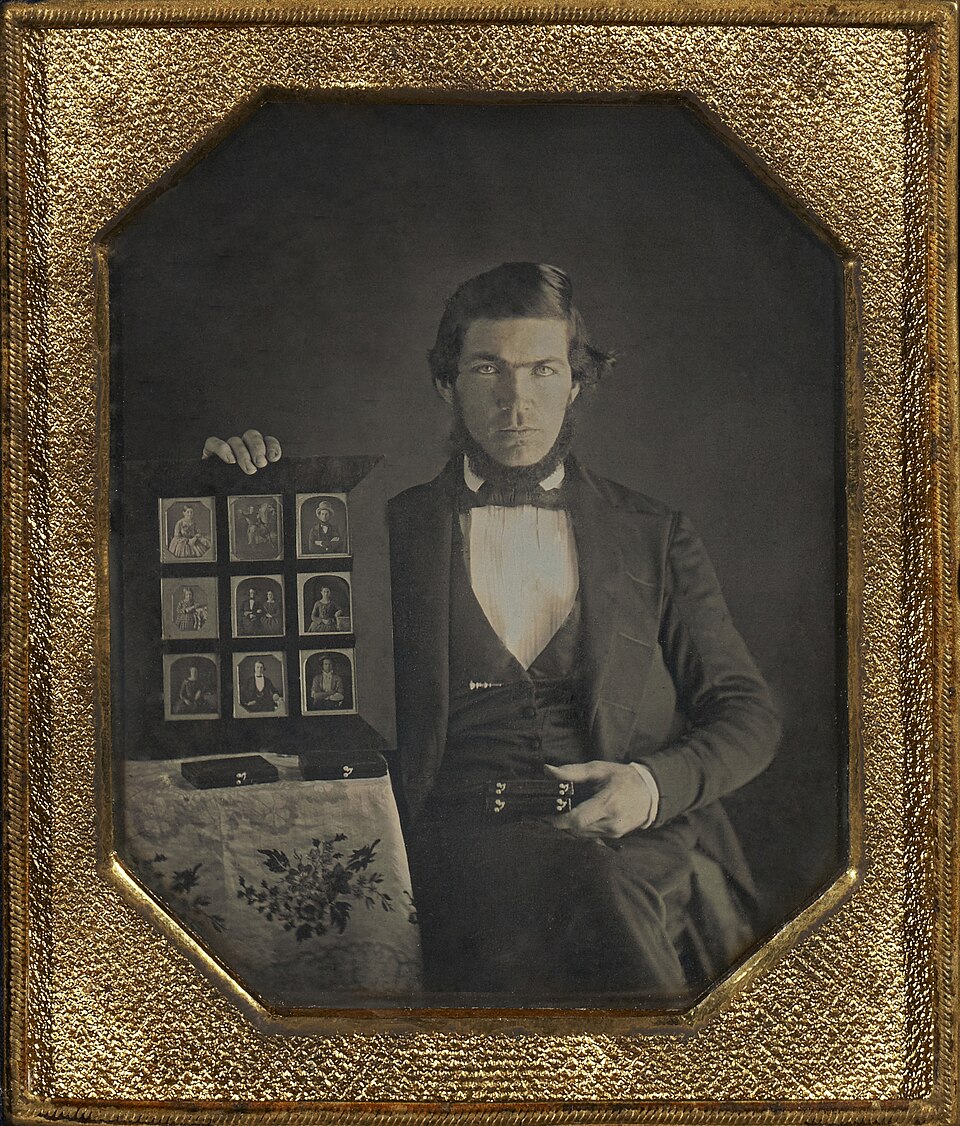
A cased daguerreotype portrait from the mid-nineteenth century.
Unknown Unknown Restored by Wcamp9 · Public domain · Wikimedia Commons
1826–1880

The chemical pioneers

Photography's first professionals were part chemist, part showman: daguerreotypists coating, sensitizing and developing plates by hand for sitters who had never seen their own faces fixed in metal. Studios spread from Paris and New York to Bombay, Cairo and Yokohama within two decades, and by the 1850s American operators alone were making millions of portraits a year. The wet collodion process then destroyed that first trade in turn — cheaper tintypes and paper prints replaced the jewel-like daguerreotype almost completely within a decade of 1851.
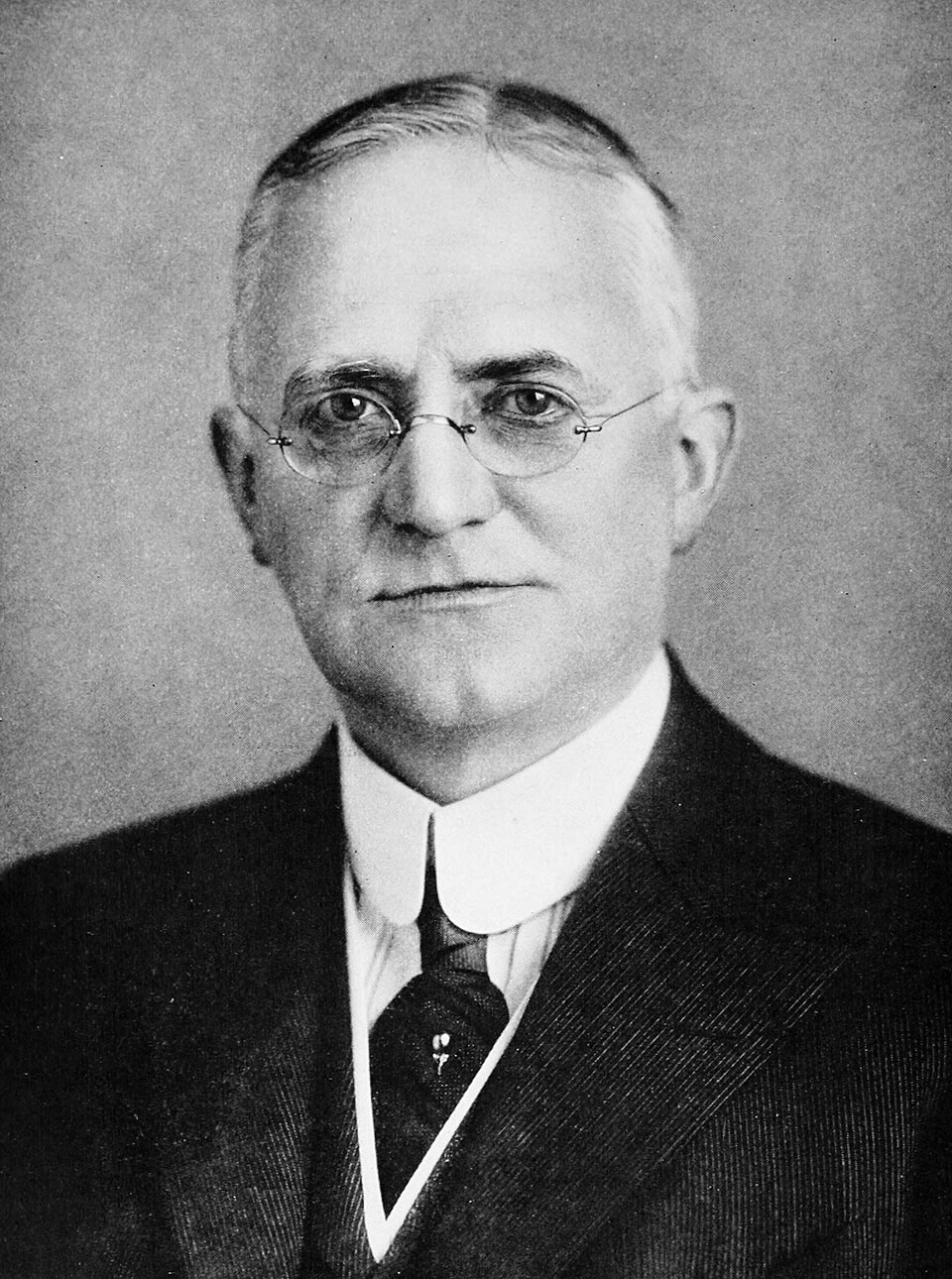
Portrait of George Eastman, founder of Kodak.
Published by B. C. Forbes Publishing Company, New York, 1917 · Public domain · Wikimedia Commons
1880–1925

Photography for everyone

Dry plates freed photographers from portable darkrooms; halftone printing put photographs directly into newspapers from the 1880s; and George Eastman's roll-film Kodaks handed picture-making to amateurs. Professionals responded by specializing — press photography, advertising, society portraiture — while pictorialists fought a parallel battle to have photography accepted as art at all, a claim critics like Baudelaire had dismissed since 1859. The professional's monopoly on making images was gone; the monopoly on making them well was not.

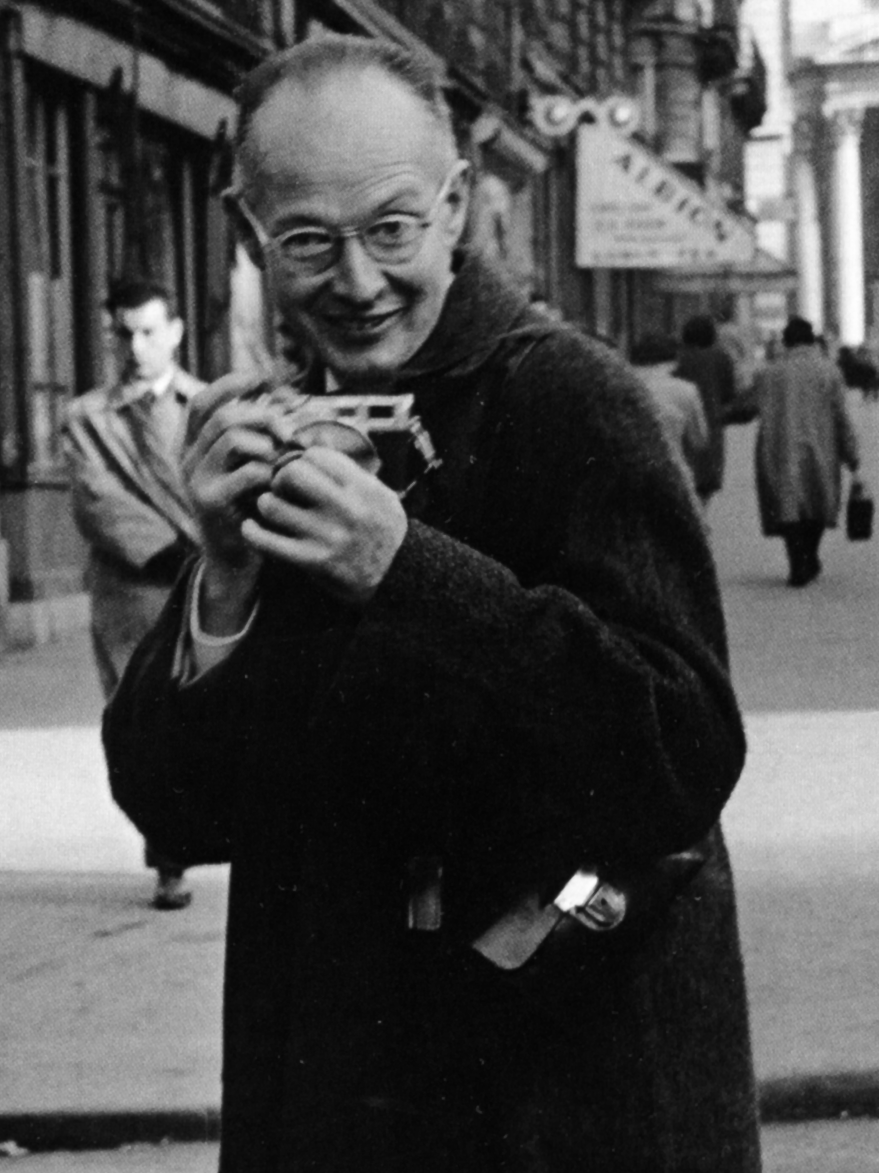
Henri Cartier-Bresson, co-founder of Magnum Photos, with his Leica.
Ihei Kimura · Public domain · Wikimedia Commons
1925–1970

The golden age of photojournalism

The Leica and its 35mm rivals, plus mass-circulation picture magazines — Berliner Illustrirte Zeitung, Vu, Life, Picture Post — created the heroic photojournalist: mobile, credited, sometimes world-famous. Capa waded ashore on D-Day, Lange's Migrant Mother became the face of the Depression, and Magnum's 1947 founding gave photographers ownership of their own work. Staff photographers at big magazines enjoyed salaries, expenses and prestige the profession has rarely matched since.

1970–2000

The art market and the autofocus era

Museums finally embraced the medium — John Szarkowski's MoMA department canonized it, and William Eggleston's 1976 color show, panned at the time, made color photography respectable art. Prices for prints climbed toward the millions. Meanwhile the tools kept automating: Minolta's Maxxum 7000 brought body-integrated autofocus in 1985, color labs industrialized printing, and stock-photo agencies turned images into a licensed commodity traded by catalogue.

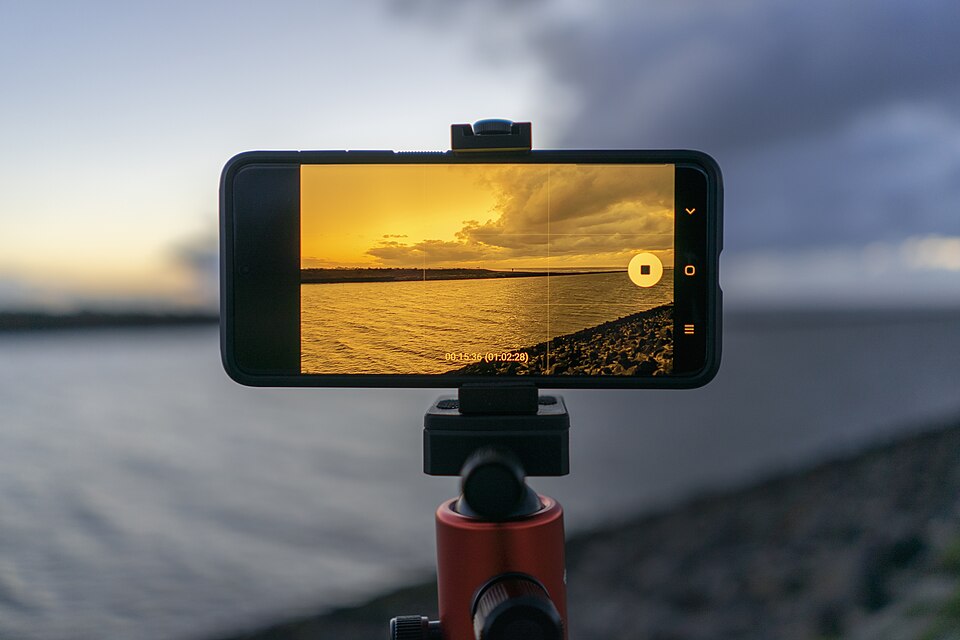
A person taking a photograph with a smartphone camera.
PantheraLeo1359531 · CC BY 4.0 · Wikimedia Commons
2000–present

Digital, the phone and the generated image

Professional digital SLRs arrived with Nikon's D1 in 1999; within a decade film labs, minilabs and most newspaper photo staffs were gone — the Chicago Sun-Times laid off its entire 28-person photography department in one day in 2013. Smartphones made everyone a competent technical photographer, and generative AI now produces commercial-grade imagery from text. The professional's remaining ground: witness, access, direction and a verifiable claim that a picture shows something that actually happened.

What this job replaced

Neighbouring trades that no longer exist — absorbed, automated or regulated away.

Daguerreotypist

1839–c. 1865

The world's first photographic professionals polished silvered copper plates, sensitized them over iodine fumes and developed them over heated mercury — a hazardous chemical performance repeated for every single image, which could not be copied. Itinerant operators carried the trade to small towns and gold-rush camps across America, Europe and Asia. Frederick Scott Archer's unpatented 1851 collodion process, yielding cheaper and reproducible images, wiped out the daguerreotype trade in barely a decade.

Street box-camera photographer

c. 1890–2000s

For a century, while-you-wait street portraitists worked plazas and pilgrimage sites with wooden cameras that were darkrooms inside — Spain's minuteros, Afghanistan's kamra-e-faoree operators, India's Yamuna-side wedding photographers. A paper negative was shot, developed inside the box in minutes, then re-photographed to make a positive. Cheap ID-photo booths, one-hour labs and finally the smartphone erased the trade; Kabul's last practitioners were documented as a dying breed in the 2010s.

One-hour photo lab operator

c. 1980–2010

Automated minilab machines put a complete color darkroom in shopping malls and pharmacies, and by the 1990s tens of thousands of one-hour photo counters worldwide employed technicians who calibrated chemistry, corrected color and printed the world's family snapshots. Digital cameras and home printing collapsed film volume within a single decade of 2000; the surviving remnant prints from files, and the trade of judging a negative by eye is effectively gone.

Trades that vanished →

Every generation of photographers has watched a machine absorb something that used to be the hard part: coating plates, focusing, exposing, developing, even choosing the sharpest frame. And every generation's survivors have discovered that the hard part was never really the machine's part — it was knowing what to point it at, and why.

The generated image is only the newest turn of a very old wheel. A profession that outlived the death of the daguerreotype, the studio monopoly, the film lab and the staff job is now being asked to prove that a photograph shows something real. That is a job description, not an obituary.

Keep exploring

More in Media & Performance