📷The Greats

Photographer · The person paid to decide what a moment looks like — from Niépce's eight-hour exposure in 1826 to two trillion pictures a year, most taken by everyone else.

Any list of eight from a profession practiced by millions across two centuries is an argument, not a census. The names below are chosen for documented, checkable influence on how the job itself is done — its doctrines, its economics, its ethics — rather than print prices alone, and they lean deliberately toward the photographer-as-witness tradition that shaped the profession's core identity.

They span six countries and a century and a half, and reached the top by wildly different routes: a painter with a Leica, a polio survivor with a government contract, a Budapest exile who invented his own name, an economist who picked up his wife's camera. What they share is that photographers everywhere still work inside rules these eight wrote.

The all-time podium

Dorothea Lange
Dorothea Lange
United States
2
Henri Cartier-Bresson
France
1
Robert Capa
Robert Capa
Hungary
3

The eight who reached the top

1
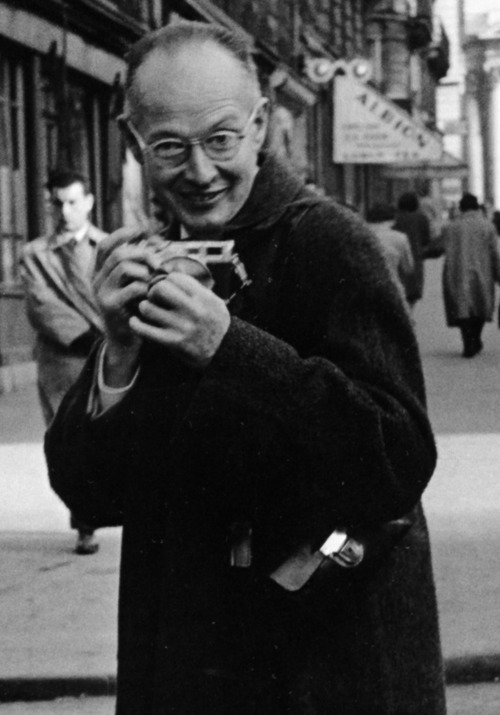
Henri Cartier-Bresson holding his Leica camera. Ihei Kimura · Public domain

Henri Cartier-Bresson

France · 1908–2004

The painter-trained Frenchman who defined candid photography's doctrine — the 'decisive moment' — and co-founded Magnum Photos in 1947, giving photographers ownership of their own work. Shooting almost exclusively with a small Leica and a 50mm lens, he covered Gandhi's death, China's revolution and postwar Europe while insisting he was merely a craftsman with good timing.

The story

On 30 January 1948 in Delhi, Cartier-Bresson showed Gandhi the catalogue of his recent Museum of Modern Art exhibition. Gandhi paused at a photograph of the poet Paul Claudel beside a hearse and said, 'Death, death, death.' Less than an hour later Gandhi was assassinated on his way to prayer. Cartier-Bresson's photographs of the funeral and the mourning crowds ran across Life and the world's press — reportage made possible only because he was already inside.

“Compose first, then wait: the photograph is taken at the moment the world agrees with the frame.”
Magnum co-founded
1947
Years behind the Leica
~40 (1932–70s)
MoMA retrospective
1947, aged 38
2
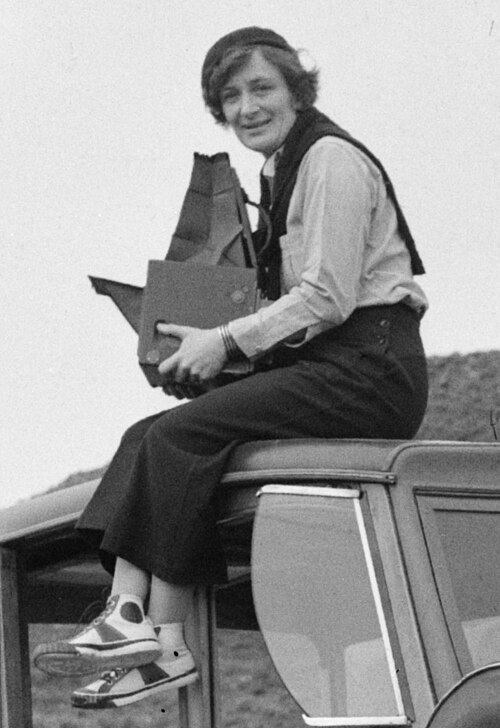
Portrait of documentary photographer Dorothea Lange atop a car with her large camera. Rondal Partridge · Public domain

Dorothea Lange

United States · 1895–1965

The Depression's great documentarian, whose work for the US Farm Security Administration put faces on economic catastrophe and helped invent the government-funded documentary tradition. Childhood polio left her with a lifelong limp she credited with forming her empathy; in 1941 she became the first woman awarded a Guggenheim Fellowship for photography.

The story

In March 1936, driving home after a month photographing field labor, Lange passed a crude sign reading 'PEA-PICKERS CAMP' at Nipomo, California — and kept driving. Twenty miles on, arguing with herself, she turned around. In ten minutes she made six exposures of Florence Owens Thompson and her children in a lean-to tent. Within days the San Francisco News ran the pictures, and the federal government rushed 20,000 pounds of food to the starving camp. The final frame became 'Migrant Mother.'

“Turn the car around: the picture you almost didn't stop for can outlive everything else you make.”

Exposures for Migrant Mother
6, in 10 min
Food aid triggered
20,000 lbs
Guggenheim first (women, photo)
1941
3
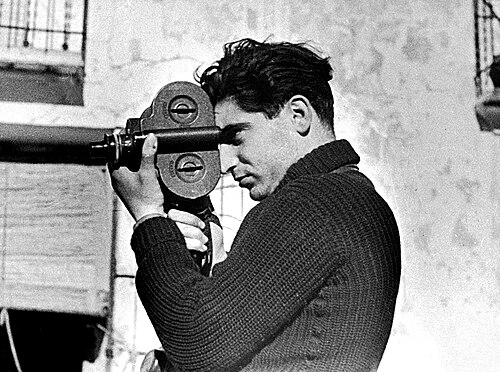
War photographer Robert Capa with a cigarette and camera. Gerda Taro · Public domain

Robert Capa

Hungary · 1913–1954

Born Endre Friedmann in Budapest, he invented the glamorous persona 'Robert Capa' with his partner Gerda Taro in 1930s Paris and became the template of the war photographer, covering five wars from Spain to Indochina. He co-founded Magnum in 1947 and died in 1954 after stepping on a landmine while photographing French troops in Vietnam.

The story

On 6 June 1944 Capa landed with the first assault wave on Omaha Beach, photographing in chest-deep water under machine-gun fire. By the traditional account, a darkroom assistant in London then overheated the films in the drying cabinet, melting the emulsion of all but eleven frames — the 'Magnificent Eleven,' whose smeared urgency later shaped the look of Saving Private Ryan's landing sequence. Capa shrugged that the pictures were 'slightly out of focus' and titled his memoir exactly that.

“Proximity is the price of meaning — but survival and the pictures both depend on knowing when to leave.”

Wars covered
5
Surviving D-Day frames
11
Magnum co-founded
1947
4
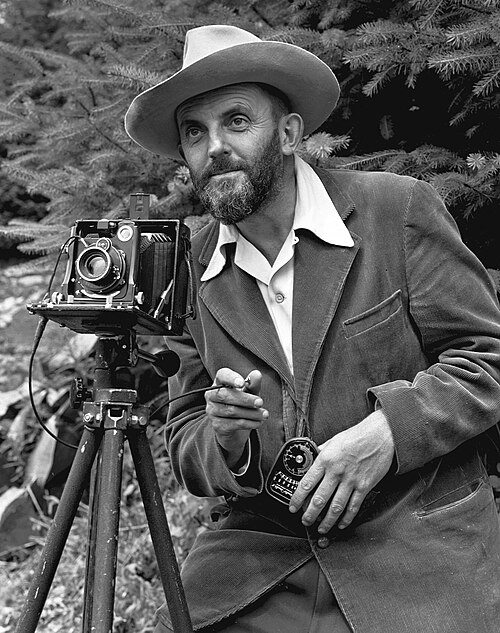
Ansel Adams with a large-format camera on a tripod. J. Malcolm Greany · Public domain

Ansel Adams

United States · 1902–1984

The technician-poet of the American landscape, co-founder of the purist Group f/64 in 1932 and co-inventor, with Fred Archer, of the Zone System that turned exposure from guesswork into engineering. His Yosemite prints made photography a tool of the conservation movement and his textbooks trained generations of darkroom workers.

The story

Driving through New Mexico's Chama Valley on 1 November 1941, Adams saw the moon rising over the village of Hernandez, its churchyard crosses catching the last sun. He could not find his light meter — so he recalled that the moon's luminance is 250 candles per square foot, computed the exposure in his head, and made one frame. Before he could insert a second plate, the light on the crosses was gone. 'Moonrise, Hernandez, New Mexico' became his most famous photograph; single prints now bring six-figure sums at auction.

“Craft memorized in advance is what turns one unrepeatable minute into a picture instead of a story.”

Frames of Moonrise made
1
Group f/64 founded
1932
Zone System scale
11 zones, 0–X
5
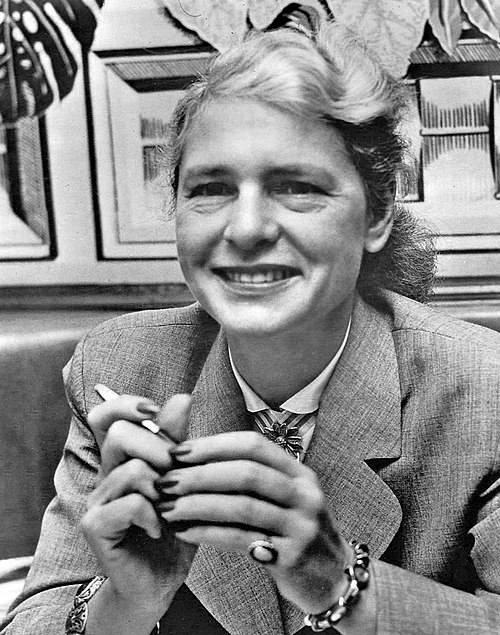
Margaret Bourke-White with her camera atop a skyscraper gargoyle. Bureau of Industrial Service. This was a division of advertising agency Young & Rubicam and was widely used for distribution of publicity materials in early television. · Public domain

Margaret Bourke-White

United States · 1904–1971

The first photographer hired by Life magazine — her Fort Peck Dam shot its inaugural 1936 cover — and a serial breaker of barriers: first Western photographer allowed into Soviet industry in 1930, first American woman accredited as a war correspondent, and the first woman to fly on a US combat mission, over North Africa in 1943.

The story

In July 1941 Bourke-White was the only foreign photographer in Moscow when Germany broke the Nazi–Soviet pact and the Luftwaffe began bombing the city. Ordered like everyone else into shelters during raids, she repeatedly hid from the wardens, then worked from her hotel balcony and the roof of the US embassy, photographing anti-aircraft fire arcing over the Kremlin — some of the war's most famous images, made by refusing, politely and repeatedly, to go to the basement.

“Access is a skill: being the only photographer in the room is rarely an accident.”

Life's first cover
23 Nov 1936
Into Soviet industry
First, 1930
Combat mission flown
1943, first woman
6

Malick Sidibé

Mali · 1936–2016

'The Eye of Bamako,' who documented the exuberant youth culture of newly independent Mali in the 1960s and ran Studio Malick's portrait business for decades. In 2007 he became both the first African artist and the first photographer ever awarded the Venice Biennale's Golden Lion for lifetime achievement, after winning the Hasselblad Award in 2003.

The story

In 1960s Bamako, the surprise parties of newly independent Mali's teenagers ran all night, and Sidibé covered as many as four or five in an evening, shuttling between them with his flash and Rolleiflex, then developing until dawn and pinning numbered proof sheets outside his studio so the dancers could find and buy their pictures. One frame from Christmas night 1963 — a barefoot couple dancing, 'Nuit de Noël (Happy Club)' — became one of the century's most celebrated photographs.

“Photograph your own world as if history depends on it, because eventually it does.”

Venice Golden Lion
2007, first photographer
Hasselblad Award
2003
Parties covered a night
4–5 (1960s)
7

Sebastião Salgado

Brazil · 1944–2025

A trained economist who abandoned the profession around thirty after borrowing his wife Lélia's camera, then spent five decades on epic black-and-white surveys of labor, migration and wilderness — Workers, Migrations, Genesis. With Lélia he founded Instituto Terra in 1998, replanting millions of trees on his family's exhausted Brazilian farmland.

The story

On 30 March 1981 Salgado was outside the Washington Hilton photographing Ronald Reagan's routine departure when John Hinckley opened fire; he kept shooting through the chaos, and his frames of the assassination attempt ran worldwide. Salgado later said the licensing windfall helped bankroll the long self-directed documentary work he actually cared about — including the 1986 Serra Pelada series, where he photographed some 50,000 mud-caked miners hauling ore sacks up ladders out of a vast open pit.

“Let the lucky picture fund the important one — and give the important one years, not days.”

Career switch age
~29, economist
Serra Pelada miners
~50,000 (1986)
Trees planted, Instituto Terra
2M+ since 1998
8

Daidō Moriyama

Japan · b. 1938

Tokyo's restless street photographer, central to the Provoke movement's 'are, bure, boke' — grainy, blurry, out-of-focus — assault on photographic good manners around 1969. Working with cheap compact cameras, often shooting one-handed from the hip in Shinjuku's alleys, he has published more than 150 photobooks and received the 2019 Hasselblad Award.

The story

In 1971, in the northern town of Misawa, Moriyama photographed a stray dog turning to glare sideways at the camera — matted, wary, unowned. 'Stray Dog' became his emblem, and he embraced it literally, describing himself as a stray dog roaming cities with a camera. The image's snarling looseness — everything classical photography called a mistake — became a legitimate aesthetic that street photographers worldwide still work inside.

“A so-called flaw, committed to absolutely and repeatedly, becomes a style; committed to halfway, it stays a flaw.”

Photobooks published
150+
Provoke era
1968–70
Hasselblad Award
2019

Bars are scaled to the leader in this list.

Comparison Lab

Toggle names on and off — every bar rescales to the leader of your selection.

5 / 8

The argument

Capa's legend is genuinely contested: researchers led by A.D. Coleman have argued the 'melted D-Day negatives' story is a myth concealing that he shot far fewer frames, and the authenticity of his 1936 'Falling Soldier' — staged exercise or real death — has been debated for decades, with location analysis by José Manuel Susperregui placing it away from the reported battlefield.

This list leans toward reportage. Fashion and art photography have equal claims through Richard Avedon, Irving Penn, Helmut Newton and Cindy Sherman — whose staged self-portraits made her one of the most influential and expensive artists alive — and the nineteenth century could nominate Julia Margaret Cameron, Nadar or Talbot as founders who shaped everything after.

The deepest bias is archival: the canon was written by Western magazines, museums and print markets. Studio masters of the Global South — Seydou Keïta's Bamako portraits, reproduced and traded in the West amid bitter posthumous rights disputes, are the emblematic case — did work of equal stature that entered 'history' only when Western institutions noticed it decades later.

Keep exploring

More in Media & Performance