📰The Greats

Journalist · The witness who finds out what is happening and tells the public — from Rome's Acta Diurna to the Panama Papers, still asking questions power would rather skip.

Any list of eight journalists is an argument, not a census. The trade's history is disproportionately written about its English-language and bylined practitioners, while most of the reporters who paid the highest price for the work — the local journalists who make up the great majority of those killed for it — never became names outside their own countries.

The eight below span two centuries, six countries and most of the craft's forms: the war dispatch, the undercover exposé, the documented atrocity, the broadcast, the lone scoop, the literary reportage, the investigative magazine and the accountability beat that cost its writer her life. Each changed how the work itself is done.

The all-time podium

Ida B. Wells
Ida B. Wells
United States
2
William Howard Russell
Ireland / United Kingdom
1
Nellie Bly
Nellie Bly
United States
3

The eight who reached the top

1
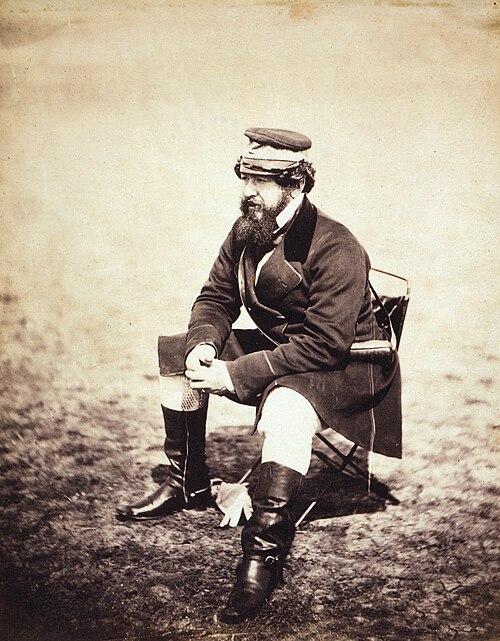
Portrait of William Howard Russell, The Times's Crimean War correspondent. Roger Fenton · Public domain

William Howard Russell

Ireland / United Kingdom · 1820–1907

The Times sent Russell to the Crimean War in 1854, making him the first civilian correspondent to report a war for a mass newspaper audience. His dispatches on cholera, frostbite and official incompetence outraged Britain, helped bring down a government and prompted Florence Nightingale's nursing mission.

The story

At Balaclava on 25 October 1854, Russell watched the 93rd Highlanders hold off Russian cavalry and described them as 'a thin red streak topped with a line of steel' — compressed by readers into 'the thin red line,' a phrase English never gave back. His account of the disastrous Charge of the Light Brigade in the same battle inspired Tennyson's poem within weeks, and in January 1855 the Aberdeen government, battered by his reports on the army's freezing winter camp, fell.

“Precise eyewitness description, published where the powerful cannot ignore it, can outlast the battle it records.”
Government felled by his dispatches
Aberdeen, Jan 1855
Wars covered
6+, 1854–79
Phrase given to English
'The thin red line'
2
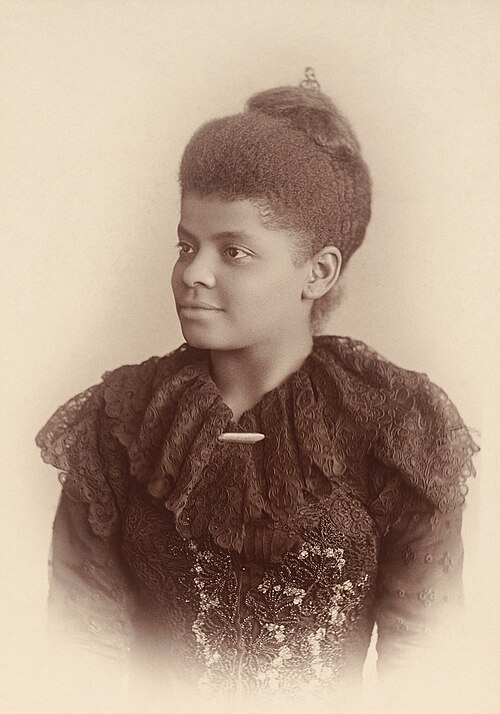
Portrait of investigative journalist and anti-lynching campaigner Ida B. Wells. Adam Cuerden · Public domain

Ida B. Wells

United States · 1862–1931

Born into slavery in Mississippi, Wells co-owned the Memphis Free Speech and turned lynching from an unexamined Southern routine into a documented national scandal, counting cases by name, date and pretext in Southern Horrors (1892) and The Red Record (1895). A 2020 Pulitzer special citation honored her posthumously.

The story

After a mob lynched her friend Thomas Moss and two other Memphis grocers in March 1892, Wells investigated dozens of lynchings across the South and concluded in print that the usual rape charge was mostly pretext. While she was away in New York that May, a mob destroyed her newspaper's office and promised to kill her if she returned. She never lived in the South again — and kept publishing the evidence, case by named case, from New York and Chicago.

“Counting and naming every case turns what power calls isolated incidents into an undeniable pattern.”

Lynchings tabulated in The Red Record
100s, named & dated
Age when co-owner of a paper
27 (Free Speech, 1889)
Pulitzer special citation
2020, 89 yrs after death
3
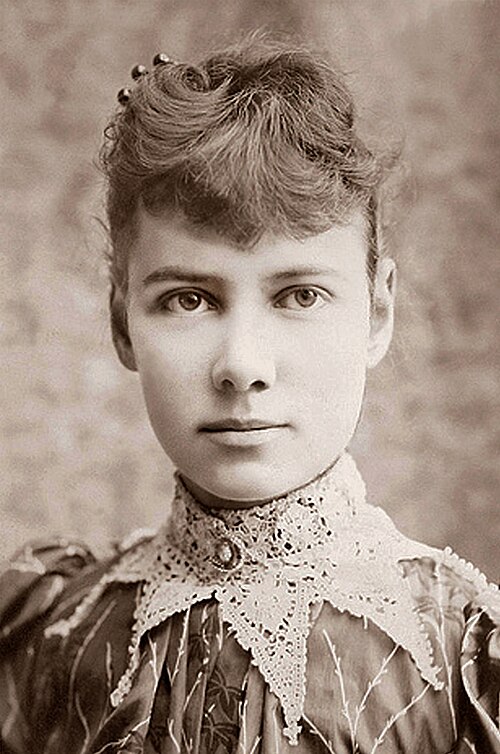
Portrait of Nellie Bly, pioneer of undercover investigative journalism. H. J. Myers, photographer · Public domain

Nellie Bly

United States · 1864–1922

Bly invented the undercover exposé as a repeatable method: at 23 she feigned madness to get inside New York's Blackwell's Island asylum for Joseph Pulitzer's New York World, then in 1889–90 raced Jules Verne's fictional record around the world in 72 days, filing dispatches the entire way.

The story

In 1887 Bly practiced deranged expressions in a boarding-house mirror, got herself committed, and spent ten days inside the Blackwell's Island asylum, where doctors pronounced her hopelessly insane while she quietly took notes on ice-cold baths, spoiled food and sane immigrant women trapped by their poor English. Ten Days in a Mad-House prompted a grand jury investigation that invited her testimony, and New York's asylum funding rose in its wake.

“Go where the story is locked away; the price of admission is the report no one else can write.”

Days inside the asylum
10 (1887)
Around the world
72 days, 6 hours
Age at the asylum exposé
23
4
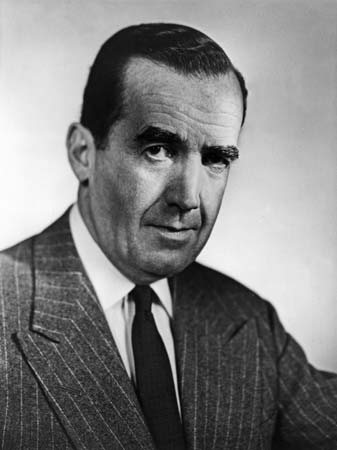
Edward R. Murrow at a CBS broadcast microphone. US Information Agency · Public domain

Edward R. Murrow

United States · 1908–1965

Murrow narrated the London Blitz live to America from rooftops for CBS radio, built the reporting team known as the Murrow Boys, and in 1954 used his television program See It Now to confront Senator Joseph McCarthy at the height of McCarthyism — still the reference point for broadcast courage.

The story

On 9 March 1954, See It Now built its case against McCarthy almost entirely from the senator's own filmed words, Murrow closing: 'We must not confuse dissent with disloyalty.' CBS declined to promote the broadcast, so Murrow and producer Fred Friendly paid for a newspaper advertisement out of their own pockets. McCarthy's filmed rebuttal in April fell flat, and the Senate voted to censure him that December.

“Let the record speak: a subject's own words, accurately assembled, can be the strongest indictment.”

Blitz rooftop broadcasts began
1940, live to CBS
The McCarthy broadcast
9 March 1954
Senate censure followed
December 1954
5

Wilfred Burchett

Australia · 1911–1983

An Australian correspondent for London's Daily Express, Burchett slipped away from the official Japanese-surrender coverage in September 1945 and became the first Western journalist to reach Hiroshima after the atomic bomb, reporting an 'atomic plague' that occupation officials denied. His later cold-war sympathies made him fiercely controversial.

The story

While more than six hundred correspondents covered the surrender ceremony aboard USS Missouri on 2 September 1945, Burchett rode trains for roughly twenty hours to Hiroshima carrying rations, a pistol and a Baby Hermes typewriter. Sitting in the rubble, he typed a dispatch describing survivors dying of an unexplained sickness — radiation poisoning that occupation authorities dismissed as propaganda. The Daily Express ran it on 5 September 1945 under the words 'I write this as a warning to the world.'

“The story is where the pack is not; go alone if you must.”

Correspondents at the surrender
600+; one in Hiroshima
The scoop published
5 September 1945
Years denied an Australian passport
17 (1955–72)
6
Polish reporter and author Ryszard Kapuściński. Mariusz Kubik, http://www.mariuszkubik.pl · CC BY 2.5

Ryszard Kapuściński

Poland · 1932–2007

As the Polish Press Agency's lone correspondent for the whole of Africa, and often Latin America and Asia besides, Kapuściński witnessed — by his own count — twenty-seven revolutions and coups, then distilled them into books like The Emperor and Shah of Shahs that stretched reportage toward literature.

The story

In 1975 Kapuściński stayed in Luanda as Portuguese settlers crated the city into shipping containers and fled Angola's independence war, remaining for three months as one of the only foreign correspondents in the capital and filing by telex whenever the line held. The book that grew from it, Another Day of Life, opens with the city emptying around him — the sustained, solitary witness that made his reputation, and that his critics would later scrutinize line by line.

“Stay after the others leave; the story usually starts when the airport empties.”

Revolutions and coups witnessed
27 (his count)
Continents covered for PAP
Africa, Asia, Latin America
Languages his books reached
30+
7

Hu Shuli

China · b. 1953

Hu founded the Beijing business magazine Caijing in 1998 and pushed investigative journalism further than almost anyone inside China's censorship system, exposing stock-market fraud and the SARS cover-up; BusinessWeek called her 'the most dangerous woman in China.' In 2009 she left to found Caixin Media.

The story

In November 2009, after Caijing's owners moved to rein in both its investigations and its business operations, Hu resigned — and most of her newsroom, reported at the time as roughly 140 of about 180 editorial staff, walked out with her. Within weeks she had launched Caixin Media and rebuilt the operation. A newsroom following its editor out the door en masse is nearly unheard of anywhere; under a press system where such jobs were scarce, it was an extraordinary vote of trust.

“An editor's real capital is the newsroom's trust; it can be carried out the door.”

Caijing founded
1998, Beijing
Staff who followed her out
~140 of ~180 (2009)
SARS cover-up coverage
2003
8

Anna Politkovskaya

Russia · 1958–2006

A reporter for Moscow's Novaya Gazeta, Politkovskaya made dozens of trips into Chechnya during the second war there, documenting torture, disappearances and the suffering of civilians when almost no one else would. She was poisoned en route to the Beslan siege in 2004 and murdered in Moscow in 2006.

The story

When Chechen fighters seized a Moscow theater with about 850 hostages in October 2002, they asked for Politkovskaya by name as someone both sides could trust; she walked in, carried water and juice to the hostages, and relayed the gunmen's demands. Four years later, on 7 October 2006, she was shot dead in the elevator of her apartment building. Five men were eventually convicted of the killing; whoever ordered it has never been identified.

“Credibility with all sides is built one accurate story at a time — and it can cost everything.”

Reporting trips to Chechnya
Dozens, 1999–2006
Hostages in the siege she entered
~850 (2002)
Who ordered her murder
Never identified

Bars are scaled to the leader in this list.

Comparison Lab

Toggle names on and off — every bar rescales to the leader of your selection.

5 / 8

The argument

Kapuściński's place is genuinely contested: Artur Domosławski's 2010 biography documented invented and embellished details across his books, and the trade still argues whether they are flawed journalism or honest literature that should never have been shelved as reportage. His defenders note the reporting behind them was real; his critics answer that the reader was never told where it stopped.

Burchett's Hiroshima scoop sits beside a career his own country long treated as treasonous — he reported the Korean War from the communist side, amplified germ-warfare allegations against the US that remain unproven, and was refused an Australian passport for seventeen years. Whether he was a fearless outsider or a fellow traveler who bent the trade's rules is still fought over in Australian print.

Any such list favors journalists whose work was written in or translated into English and attached to a byline. The Committee to Protect Journalists' records show most journalists killed for the work since 1992 were local reporters covering their own communities — the trade's real martyrology is overwhelmingly made of names that never reached a list like this one.

Keep exploring

More in Media & Performance