🚀The Greats

Entrepreneur · The person who starts the company — spotting the gap, bearing the risk and answering for payroll, from Assyrian caravan financiers to venture-backed founders.

Choosing eight entrepreneurs from four thousand documented years of the trade is harder than it looks, because the most famous names are not necessarily the ones who changed the craft. This list favors founders who invented something about how business itself is done — a marketing playbook, a quality principle, a financing model — and whose creations demonstrably outlived them.

They span three centuries and six countries: a potter, a cotton-mill visionary, a washerwoman, a carpenter's son, a beauty saleswoman, an economics professor, a wastepaper trader and a cement dealer. Three are women; none inherited the business that made them. Together they are an argument that the craft travels across every border and starting condition.

The all-time podium

Jamsetji Tata
Jamsetji Tata
India
2
Josiah Wedgwood
Josiah Wedgwood
England
1
Madam C. J. Walker
Madam C. J. Walker
United States
3

The eight who reached the top

1
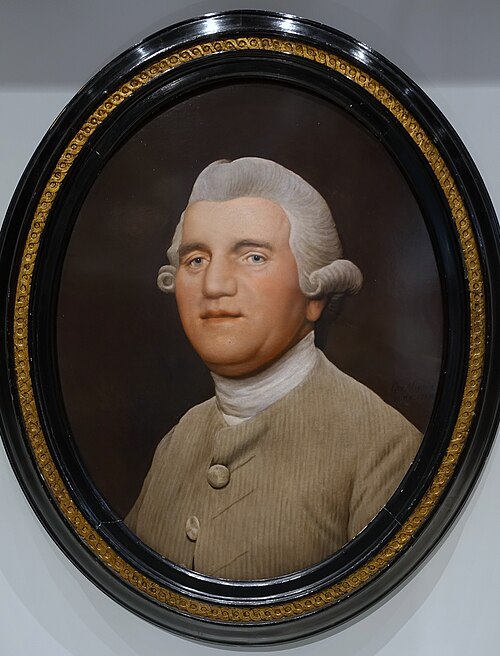
Portrait of English potter and industrialist Josiah Wedgwood. Daderot · Public domain

Josiah Wedgwood

England · 1730–1795

The twelfth child of a Staffordshire potter, Wedgwood industrialized ceramics and, along the way, invented much of modern marketing: money-back guarantees, free delivery, illustrated catalogues, traveling salesmen and showroom retail. His Etruria factory pioneered division of labor and cost accounting a generation before the textbooks existed.

The story

In 1765 Wedgwood completed a tea service for Queen Charlotte and immediately asked permission to style himself "Potter to Her Majesty" — then renamed his cream-colored earthenware "Queen's Ware" and advertised the royal connection across Europe, arguably the first celebrity-endorsement campaign. Aristocratic orders followed, capped by Catherine the Great's 952-piece "Frog Service" in 1774, which Wedgwood exhibited to ticketed London crowds before shipping it to Russia: the product launch event, two centuries early.

“Demand can be manufactured as deliberately as the product itself, if you treat marketing as part of the craft.”
Years building the firm
36 yrs (1759–95)
Marketing firsts credited
Guarantee, catalogue+
Brand still trading
265+ years on
2
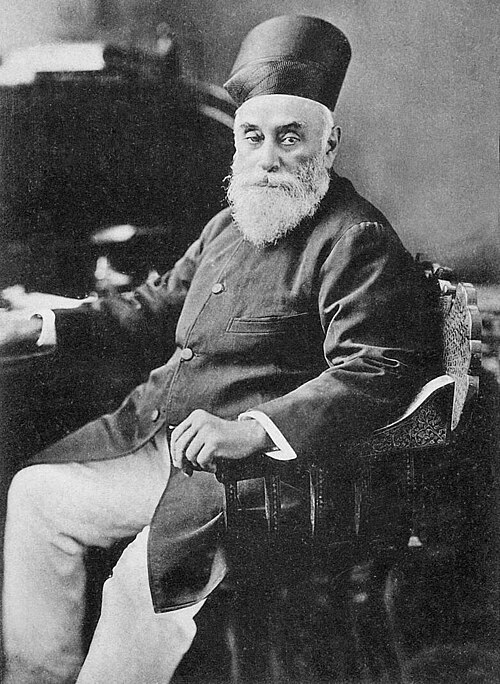
Portrait of Indian industrialist Jamsetji Tata, founder of the Tata Group. Unknown Publisher · CC BY 4.0

Jamsetji Tata

India · 1839–1904

A Bombay cotton trader who built India's industrial foundations under colonial rule, Tata founded the Empress Mills in 1877 and spent his last decades seeding four projects he knew he would not finish: a steel plant, a hydroelectric scheme, a science institute and a grand hotel. All four happened; the group bearing his name now spans continents.

The story

In 1902, five years before a site had even been found for his steel plant, Tata wrote to his son Dorab with instructions for the future factory town: lay wide streets planted with shade trees, reserve large areas for lawns and gardens, and set aside space for temples, mosques and churches. He died in 1904; the plant at Sakchi poured its first steel in 1912, and the city that grew around it — renamed Jamshedpur in his honor in 1919 — today holds over a million people, laid out much as the letter asked.

“Build for a future you will not live to see, in enough detail that others can finish it.”

Ventures seeded, realized later
Steel, power, IISc
Tata Group revenue
$165B+ (FY2024)
First steel after his death
1912, Sakchi
3
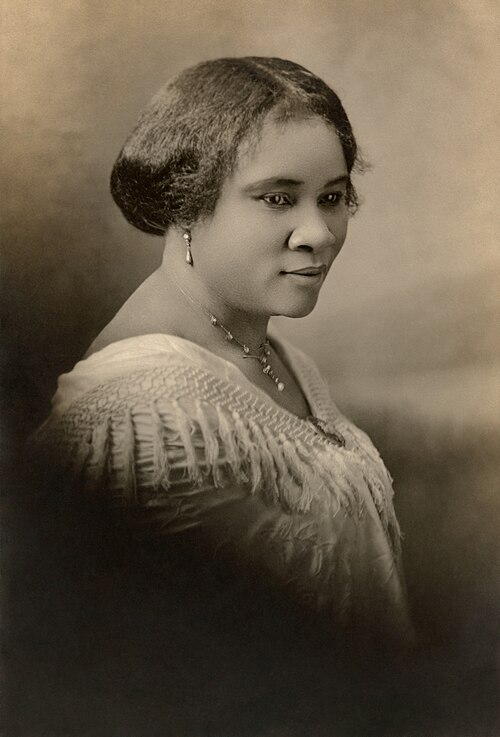
Photograph of Madam C. J. Walker, American haircare entrepreneur. Addison Norton Scurlock / Adam Cuerden · Public domain

Madam C. J. Walker

United States · 1867–1919

Born Sarah Breedlove on a Louisiana plantation to formerly enslaved parents, orphaned at seven and widowed at twenty, she spent years as a washerwoman before building a hair-care company for Black women from 1905. Guinness World Records cites her as America's first female self-made millionaire; her sales-agent system trained some 40,000 women.

The story

At the National Negro Business League convention in Chicago in 1912, Booker T. Washington repeatedly passed over her requests to speak. On the final day Walker stood up from the floor and addressed the hall anyway, telling the delegates she had come from the cotton fields, been promoted to the washtub and the cook's kitchen, and from there promoted herself into manufacturing. The room was won; the following year Washington invited her back as a featured speaker.

“If the platform will not invite you, stand up and take the floor; results make the argument.”

Sales agents trained
~40,000 women
Self-made millionaire
1st US woman cited
Washerwoman to magnate
~14 years (1905–19)
4
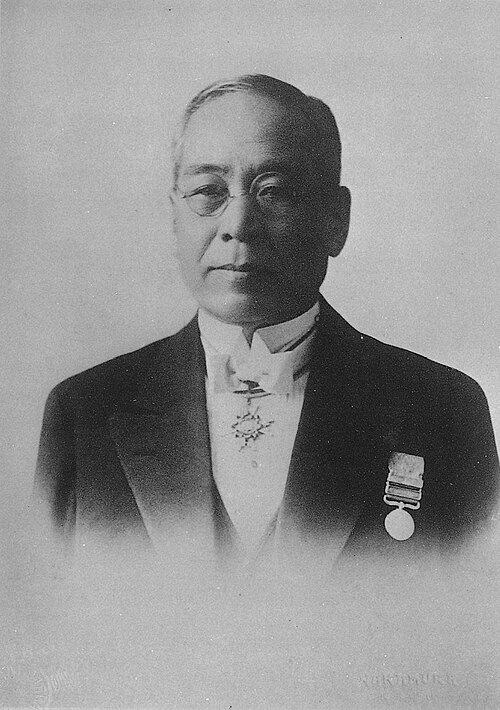
Photograph of Japanese inventor and industrialist Sakichi Toyoda. Unknown author Unknown author · Public domain

Sakichi Toyoda

Japan · 1867–1930

A carpenter's son from rural Shizuoka, Toyoda patented his first wooden loom in 1891 and spent four decades perfecting weaving machinery. His Type G automatic loom of 1924 stopped itself the instant a thread broke — the principle of jidoka, building quality inspection into the machine, that still anchors the Toyota Production System.

The story

In 1929, Platt Brothers of Oldham — then the world's leading textile-machinery maker — paid £100,000 for the foreign patent rights to the Type G loom, the licensor and licensee of the industrial revolution trading places. Toyoda directed that the money fund his son Kiichiro's research into automobiles, a field Japan's establishment considered hopeless against Ford and GM. The automobile department opened inside the loom works in 1933; it became Toyota Motor Corporation in 1937.

“Build the quality check into the machine, and sell even your masterpiece to fund the next leap.”

Patent-rights sale, 1929
£100,000 (Platt)
Jidoka principle in use
100+ yrs, Toyota
Company his loom seeded
Toyota Motor, 1937
5
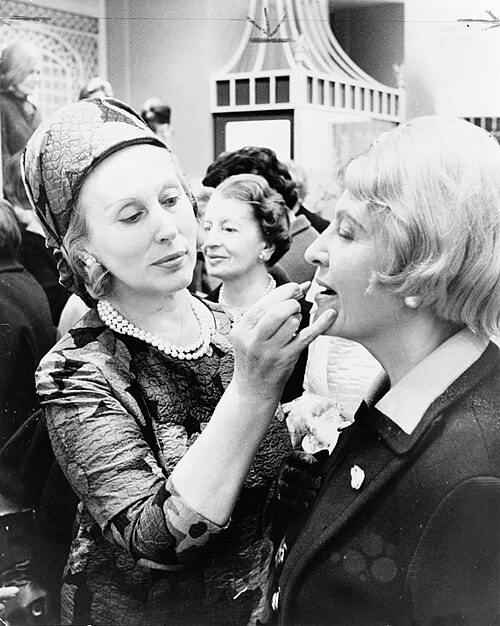
Photograph of cosmetics entrepreneur Estée Lauder. New York World-Telegram and the Sun staff photographer: Sauro, Bill, photographer. · Public domain

Estée Lauder

United States · 1908–2004

Josephine Esther Mentzer of Queens, New York, began selling her chemist uncle's skin creams to beauty salons, founding her company with husband Joseph in 1946 with four products. She invented the free sample and the gift-with-purchase — giveaway marketing her competitors called ruinous — and personally trained saleswomen with the motto "telephone, telegraph, tell-a-woman."

The story

By her own often-told account, when a Paris department store refused her a counter in the years after the war, Lauder poured her Youth-Dew bath oil onto the floor mid-demonstration, and the fragrance drew customers asking where to buy it — winning her the order on the spot. The story, like much of her legend, was polished by the teller herself; the strategy behind it was documented fact: Youth-Dew, launched in 1953 as an affordable everyday scent women bought for themselves, multiplied her company's revenues.

“Let the customer try before buying — a sample given away is advertising money cannot match.”

Company founded
1946, 4 products
Marketing invention
Gift with purchase
Company net sales
~$15.6B (FY2024)
6
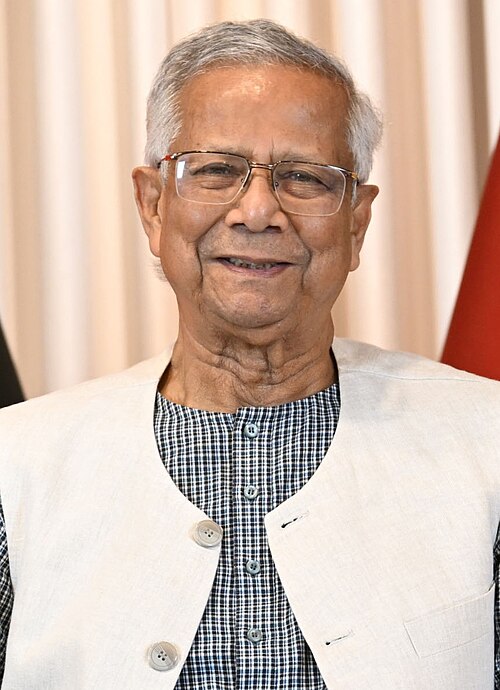
Photograph of Grameen Bank founder and Nobel laureate Muhammad Yunus. Press Information Department · Public domain

Muhammad Yunus

Bangladesh · 1940–

An economics professor at Chittagong University during Bangladesh's 1974 famine, Yunus concluded his elegant theories explained nothing in the villages outside his classroom. His answer — tiny collateral-free loans to the poor, organized through borrower groups — became Grameen Bank in 1983, made microcredit a global industry, and won the 2006 Nobel Peace Prize, shared between founder and bank.

The story

In 1976, in the village of Jobra, Yunus had a student compile a list of everyone trapped in debt to moneylenders: 42 people — bamboo-stool weavers and mat-makers among them — owed a combined total of about $27. He lent them the sum from his own pocket, and all of it came back. The discovery that the poor repay, and that the amounts locking them in poverty were trivially small, became the founding demonstration behind a bank that has since lent billions of dollars, overwhelmingly to women.

“Test a big idea at the smallest possible scale: twenty-seven dollars proved what banking said was impossible.”

First loan, 1976
$27 to 42 people
Grameen borrowers, women
~97%
Nobel Peace Prize
2006, with Grameen
7

Zhang Yin

China · 1957–

A factory accountant's training and 30,000 yuan of savings took Zhang Yin into the Hong Kong wastepaper trade in 1985, then to Los Angeles in 1990, where she and her husband built America Chung Nam into the largest exporter of container freight from the United States — all of it scrap paper bound for China's mills, including her own Nine Dragons Paper, founded in 1995.

The story

In October 2006, months after Nine Dragons listed in Hong Kong, the Hurun Rich List named Zhang China's richest person — the first woman ever to top it, with a fortune then estimated around $3.4 billion, and by some accounts the world's richest self-made woman at the time. The empire rested on a closed loop she had seen before anyone else: America's discarded cardboard, nearly worthless where it lay, shipped cheaply in containers returning empty to China, pulped into new boxes for the exports filling those same ships back.

“Value hides in what others throw away; logistics can be the whole business.”

Starting capital, 1985
30,000 yuan
China rich list, 2006
No. 1 — first woman
US container exports
No. 1 by volume, 2000s
8

Aliko Dangote

Nigeria · 1957–

Born into a Kano trading family descended from West Africa's most famous merchant, Alhassan Dantata, Dangote started his own commodity-trading firm in 1977 with a loan of 500,000 naira from his grandfather, reportedly repaid within months. His decisive move came later: abandoning import trading to manufacture at scale, making Dangote Cement Africa's largest producer.

The story

Nigeria, for decades Africa's largest oil producer, imported nearly all of its refined fuel — a national paradox Dangote decided to end privately. The refinery he built on reclaimed land outside Lagos was announced in 2013 at an estimated $9 billion and opened in 2023 having cost roughly twice that, with a capacity of 650,000 barrels per day — the largest single-train refinery in the world, with its own port, power plants and a granite quarry, because the infrastructure it needed did not exist to buy.

“Trade builds capital, but owning production — and the port it ships from — builds an empire.”

Startup loan, 1977
₦500,000, repaid
Refinery investment
~$20B (Lagos)
Refining capacity
650,000 bpd

Bars are scaled to the leader in this list.

Comparison Lab

Toggle names on and off — every bar rescales to the leader of your selection.

5 / 8

The argument

The most contested omissions are the famous ones: Jobs, Gates, Bezos, Ma, Musk. They are excluded not because their impact is doubted but because their stories are already told everywhere, and because this list weights inventions in the craft of business itself — Wedgwood's marketing, Toyoda's jidoka, Yunus's collateral-free lending — over the scale of any single fortune. Rockefeller and Carnegie fall to the same test plus a harder one: historians still argue whether their methods should be taught or prosecuted.

Some individual stories carry disputed edges. The tale that Jamsetji Tata built the Taj Mahal Hotel after being turned away from a whites-only hotel is widely repeated and poorly evidenced — historians note the earliest sources are decades later. Estée Lauder's Paris perfume-spill is her own telling. This list keeps such stories where the underlying achievement is documented, and flags the polish.

Microcredit itself is genuinely contested: randomized trials by development economists, including Nobel laureates Banerjee and Duflo, found modest average effects on poverty rather than transformation, and Bangladesh's government forced Yunus out of Grameen in 2011 before recalling him to lead the country's interim government in 2024. His place here rests on what he demonstrably invented and spread, not on the claim that it ended poverty — a reminder that a founder's creation can outgrow both its evidence and its inventor.

Keep exploring

More in Business & Finance