💱The Greats

Economist · The scholar of scarcity — from Adam Smith's pin factory to the central-bank decision room, still asked to predict what no model fully captures.

Ranking economists is itself an economics problem: influence is easy to claim and hard to measure, and the discipline's history has been written mostly in English, which flatters some traditions and buries others. The eight below are chosen because their ideas demonstrably changed both the field and the world outside it — and because each left a story specific enough to check.

They span three centuries and five countries: a Scottish philosopher, a London stockbroker, a stateless revolutionary, a Cambridge duo separated by a generation, a Chicago counter-revolutionary, an Indian moral philosopher and a French experimentalist. Between them they invented the discipline's founding text, its trade theory, its sharpest critique, macroeconomics, monetarism, welfare economics and its experimental method.

The all-time podium

David Ricardo
David Ricardo
England
2
Adam Smith
Adam Smith
Scotland
1
Karl Marx
Karl Marx
Germany / United Kingdom
3

The eight who reached the top

1
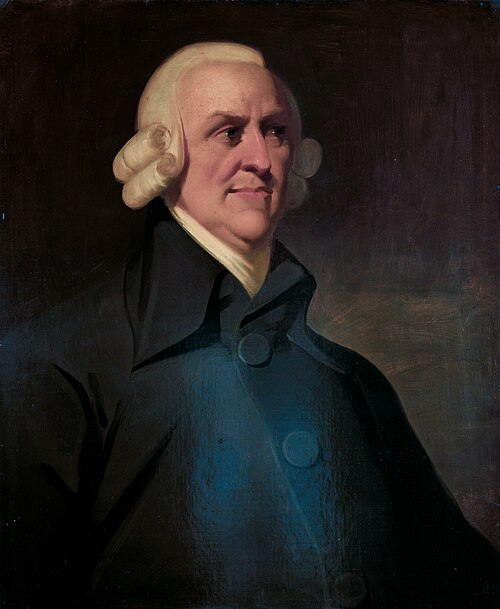
Portrait medallion of Adam Smith, author of The Wealth of Nations. Unknown author Unknown author · Public domain

Adam Smith

Scotland · 1723–1790

A Glasgow moral-philosophy professor who never used the word economist, Smith spent roughly a decade writing An Inquiry into the Nature and Causes of the Wealth of Nations (1776). Its arguments — the division of labor, the invisible hand, deep suspicion of merchants lobbying government — became the discipline's founding text.

The story

In January 1764 Smith resigned his Glasgow chair mid-term to become traveling tutor to the young Duke of Buccleuch and insisted on refunding his students' fees for the unfinished course. The students refused to take the money back; Smith, by his biographer John Rae's account, physically pressed it into the nearest student's pocket. The tutoring post paid £300 a year for life — the pension that bought him the ten quiet years in Kirkcaldy in which The Wealth of Nations was written.

“Secure income bought Smith a decade of unhurried thinking; the discipline's founding text was financed by a pension, not a publisher.”
Years writing the book
~10 (1766–76)
First edition sold out
6 months
Editions in his lifetime
5 (1776–89)
2
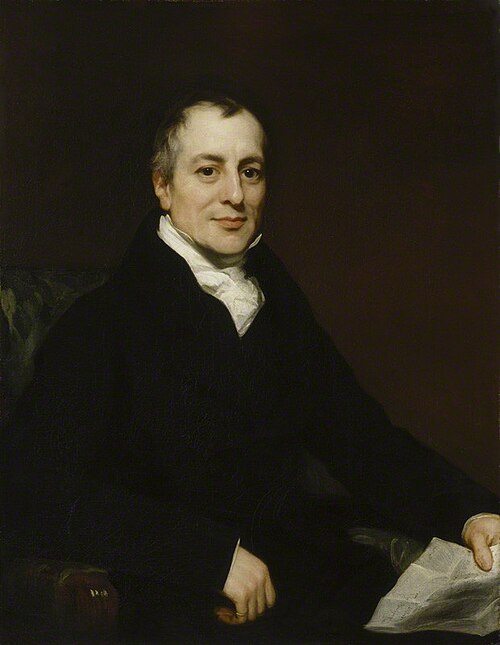
Portrait of David Ricardo, stockbroker and theorist of comparative advantage. Thomas Phillips · Public domain

David Ricardo

England · 1772–1823

Disinherited at 21 for marrying outside his family's faith, Ricardo built a stockbroking fortune from almost nothing, retired rich at 42, and turned to theory. His 1817 Principles gave economics comparative advantage — the still-standard argument that trade benefits both countries even when one produces everything more efficiently.

The story

Ricardo was a loan contractor for the British government's war debt, and his 1815 syndicate held large positions in government stock when news of Waterloo arrived. The victory sent prices surging and completed the fortune of a man who had started with a few hundred pounds after his family cut him off in 1793. Contemporaries marveled that he then walked away from the market at its feet, bought a country estate and a seat in Parliament, and spent his remaining years arguing about the theory of rent and currency.

“Ricardo mastered the market before theorizing it; economics has trusted practitioners-turned-theorists ever since.”

Estate at death
~£700k (1823)
Age he retired to theory
42
Comparative advantage's run
200+ yrs standard
3
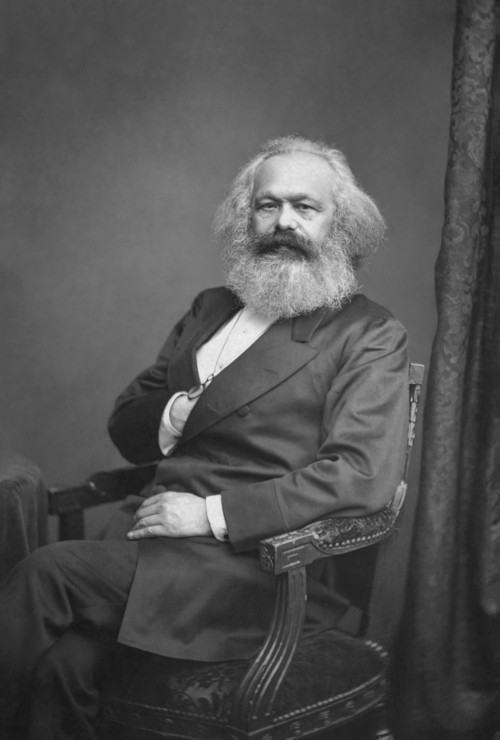
Photograph of Karl Marx, author of Das Kapital. John Jabez Edwin Mayall · Public domain

Karl Marx

Germany / United Kingdom · 1818–1883

A stateless exile who did his research in the British Museum's Reading Room, Marx subtitled Das Kapital (1867) a "critique of political economy" — an attack on the discipline that nonetheless permanently joined it. No economist's ideas have moved more of the twentieth century's actual history.

The story

In 1872 the Russian imperial censorship committee approved the first foreign translation of Das Kapital, reasoning in its report that the book was a "strictly scientific" work that few in Russia would read and fewer would understand. The Russian edition of 3,000 copies sold out faster than the German original had, and Russia became the unlikely first stronghold of Marx's readership — the censors' confident forecast standing as one of history's worst risk assessments.

“Ideas judged too difficult to be dangerous can be exactly the dangerous ones; obscurity is not containment.”

First print run, 1867
1,000 copies
Years in the Reading Room
~30 (1850s–83)
Mourners at his funeral
About 11 (1883)
4
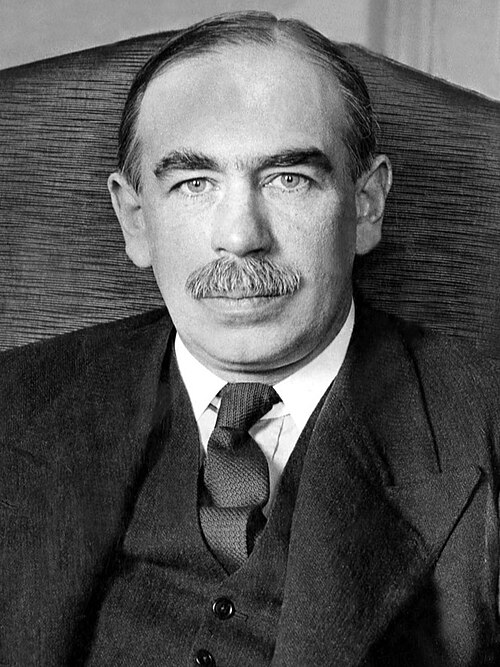
Photograph of John Maynard Keynes, founder of macroeconomics. Unknown, dedicated to Bettmann Archive · Public domain

John Maynard Keynes

United Kingdom · 1883–1946

Keynes invented macroeconomics with The General Theory (1936), arguing that slumps are not self-correcting and governments must spend against them. He also ran King's College's endowment, advised the Treasury through two world wars, and led Britain's delegation at Bretton Woods in 1944, co-designing the IMF and World Bank.

The story

Attached to the British delegation at the 1919 Paris peace conference, Keynes resigned in disgust that June and, in a matter of weeks, wrote The Economic Consequences of the Peace, predicting that the reparations imposed on Germany would wreck Europe's economy and its peace. The book sold on the order of a hundred thousand copies within months, was translated across Europe, and made the 36-year-old Treasury official world-famous — while shutting him out of official British policy circles for years.

“A well-argued resignation can outweigh a decade of loyal service — if the prediction attached to it comes true.”

Consequences early sales
~100k copies
King's College Chest
£30k → £380k
Nations at Bretton Woods
44 (1944)
5
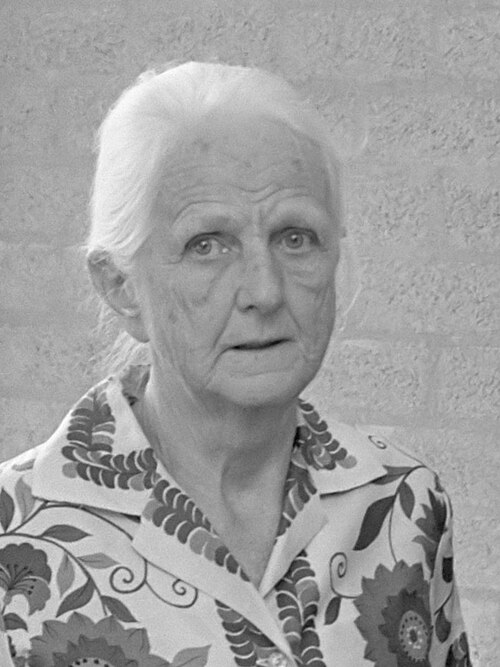
Photograph of Cambridge economist Joan Robinson. W. Punt for Anefo · CC0

Joan Robinson

United Kingdom · 1903–1983

A central member of the Cambridge "Circus" that argued Keynes toward the General Theory, Robinson published The Economics of Imperfect Competition in 1933 at twenty-nine, giving the field its standard analysis of markets between monopoly and perfect competition. She is routinely called the greatest economist never awarded the Nobel.

The story

In 1975 — International Women's Year — Business Week ran a piece effectively predicting Robinson would win that year's economics Nobel, and much of the profession agreed she was overdue. The committee instead honored Kantorovich and Koopmans for allocation theory, and Robinson, by then famous for her combative heterodoxy and her provocations about Maoist China, was never chosen before her death in 1983. The snub is still cited whenever the prize's politics are debated.

“Prizes measure a profession's comfort as much as its judgment; lasting influence and official honor are different currencies.”

Age at first major book
29 (1933)
Nobel prizes awarded
0
Years teaching at Cambridge
40+ (1931–71)
6
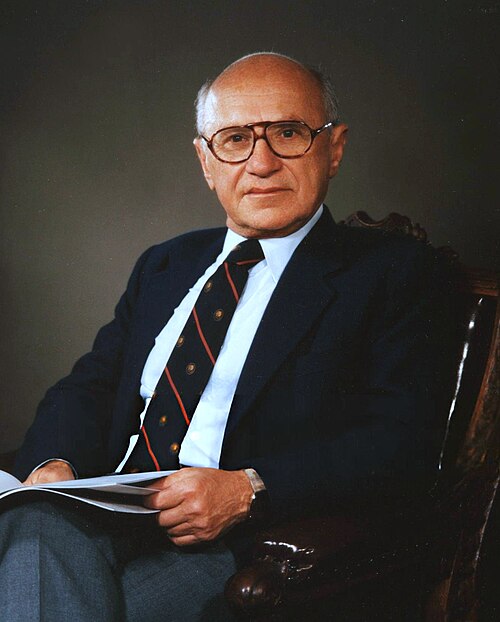
Photograph of Chicago economist Milton Friedman. Bachrach Studios · Public domain

Milton Friedman

United States · 1912–2006

Leader of the Chicago school and the century's most effective advocate of free markets, Friedman rewrote the history of the Depression with Anna Schwartz in A Monetary History of the United States (1963), blaming the Federal Reserve's monetary collapse. He won the 1976 Nobel and reached mass audiences through television.

The story

In his December 1967 presidential address to the American Economic Association, Friedman argued that the Phillips-curve trade-off between inflation and unemployment was an illusion that would break down if exploited: expectations would adjust, leaving both inflation and unemployment high. The stagflation of the 1970s delivered his prediction almost exactly, vindicating a claim that had contradicted the profession's reigning consensus — and it stands among the most cited successful predictions in the discipline's history.

“Stake a precise, falsifiable prediction against the consensus; being right in public compounds like no other academic asset.”

Address to vindication
~8 yrs (1967–75)
Monetary History length
860 pages (1963)
Free to Choose
PBS series, 1980
7

Amartya Sen

India · 1933–

Sen's Poverty and Famines (1981) showed that famines — including the 1943 Bengal famine he lived through as a child — arise from collapsed entitlements, not just missing food, and rarely occur in democracies with a free press. His capability approach, developed with Mahbub ul Haq, underlies the UN's Human Development Index. He won the 1998 Nobel, the first Asian laureate in the prize's history.

The story

Sen has often retold a scene from his childhood in Dhaka during the Hindu-Muslim riots of the 1940s: a Muslim day-laborer named Kader Mia staggered into the family garden, knifed for working in a hostile neighborhood, and explained before he died that his family's hunger had left him no choice but to seek work there. Sen cites the memory — economic unfreedom costing a man his life — as the origin of a career spent measuring deprivation in terms of what people are actually free to do.

“A single witnessed injustice, taken seriously for fifty years, can reorganize how the whole world measures poverty.”

Nobel year
1998, first Asian
Bengal famine deaths
~3 million (1943)
Honorary degrees
90+
8

Esther Duflo

France · 1972–

A Paris-trained economist who co-founded MIT's Abdul Latif Jameel Poverty Action Lab (J-PAL) in 2003, Duflo made randomized controlled trials the standard tool of development economics — testing anti-poverty policies the way medicine tests drugs. Her 2019 Nobel, shared with Abhijit Banerjee and Michael Kremer, made her the prize's youngest laureate ever and its second woman.

The story

In Udaipur district, Rajasthan, Duflo and Banerjee's team randomized immunization delivery across villages: reliable monthly camps alone raised full immunization modestly, but adding a small incentive — a kilogram of lentils per visit — lifted full immunization from around 6 percent to 39 percent, and cut the cost per immunized child because the nurses' fixed costs spread over far more children. Published in the BMJ in 2010, the lentil trial became the signature demonstration that small, tested nudges can outperform grand programs.

“Test the policy, not the theory of the policy; a bag of lentils, measured honestly, can beat a ministry's plan.”

Age at Nobel
46 — youngest ever
J-PAL evaluations
1,000+ studies
Immunization result
6% → 39%

Bars are scaled to the leader in this list.

Comparison Lab

Toggle names on and off — every bar rescales to the leader of your selection.

5 / 8

The argument

Whether Marx belongs on a list of economists at all is itself a century-old argument: mainstream economics absorbed almost none of his apparatus, while his followers reshaped half the world's governments. He is ranked here for influence on economic history, not on economic technique — a distinction some economists accept and others find evasive.

Robinson's missing Nobel remains the profession's most-cited prize controversy, but the deeper bias is structural: the prize began only in 1969 and goes only to the living, so the entire classical era is ineligible, and the discipline's long Anglo-American concentration means figures like Quesnay, Walras, Kautilya and Ibn Khaldun — or twentieth-century giants like Paul Samuelson and Kenneth Arrow, crowded out here by space — carry less public fame than their influence warrants.

Any such list also undercounts the profession's institution-builders: the national accountants, statistical-office heads and central-bank staff economists whose frameworks — GDP itself among them — shaped policy more than most famous theorists, but who worked anonymously inside committees and left no name attached to the numbers everyone uses.

Keep exploring

More in Business & Finance