🌉Origins & Evolution

Civil Engineer · The profession that turns rivers, rock and gravity into bridges, roads and clean water — civilization's quiet load-bearing trade since Imhotep.

Civil engineering existed for four and a half thousand years before it had a name. Whoever organized stone, water and labor at Saqqara, at Dujiangyan or along the Appian Way was doing recognizably the same job as a modern engineer — estimating loads and flows, choosing materials, managing an enormous workforce against a deadline — without calculus, steel or any formal theory of why structures stand.

The profession's real hinge points are therefore less about individual monuments than about changes in method: the moment engineering separated from the military and acquired schools, societies and licenses in the 18th and 19th centuries, and the moment in the 20th when materials science, soil mechanics and computing finally let engineers calculate what their predecessors could only judge from experience and proportion.

Where it began

c. 2650 BCEEgypt & Mesopotamia

At Saqqara around 2650 BCE, Imhotep, chancellor to Pharaoh Djoser, directed the first monumental building made of cut stone — the Step Pyramid, six tiers rising some 60 metres from the desert — and became the first engineer in history whose name survives. Mesopotamia, meanwhile, ran on engineered canals and levees and wrote the profession's first liability law: Hammurabi's Code, around 1754 BCE, ordered that a builder whose house collapsed and killed its owner be put to death. Accountability for structural failure is older than iron tools.

Timeline

c. 2650 BCEImhotep builds the Step Pyramid

At Saqqara, Djoser's chancellor Imhotep directs the world's first monumental cut-stone structure, a six-tiered pyramid rising roughly 60 metres. A statue base of the pharaoh found at the site carries Imhotep's name and titles — an almost unheard-of honor for a commoner, and the first time an engineer's name was attached to a work.

312 BCERome opens the Appian Way and its first aqueduct

The censor Appius Claudius Caecus drives the Via Appia south from Rome and brings the city its first aqueduct, the Aqua Appia, in the same year. Over the following centuries Rome builds eleven aqueducts and a road network that made 'all roads lead to Rome' literal — infrastructure as an instrument of state power.

c. 256 BCELi Bing completes Dujiangyan

Qin governor Li Bing divides the Min River with an artificial levee and cuts an intake channel through Mount Yulei — cracking the rock by heating it with fire and dousing it with water, years of work in the age before explosives. The damless system still irrigates the Chengdu Plain more than 2,200 years later.

1747The first engineering school opens in Paris

France founds the École des ponts et chaussées — the school of bridges and roads — with Jean-Rodolphe Perronet as its first director, creating the world's first formal school of civil engineering and the model of the state-trained engineer that France exported across Europe and its empire.

1759Smeaton lights the Eddystone and names the profession

John Smeaton completes a lighthouse on the wave-swept Eddystone rocks using interlocking dovetailed granite and a hydraulic lime that set underwater, then takes to calling himself a 'civil engineer' to distinguish his civilian works from military engineering. In 1771 he founds the Society of Civil Engineers, the profession's first body.

1818The Institution of Civil Engineers is founded

Three young engineers meeting in a London coffee house found the Institution of Civil Engineers; Thomas Telford becomes its first president in 1820 and wins it a Royal Charter in 1828. Engineering acquires the machinery of a modern profession — membership standards, journals and examinations.

1824Aspdin patents Portland cement

Joseph Aspdin, a Leeds bricklayer, patents 'Portland cement,' named for its resemblance to the prestigious Portland building stone. Combined with steel reinforcement later in the century, it becomes concrete as the world knows it — today the most-used manufactured material on Earth.

1883The Brooklyn Bridge opens

The 486-metre main span, the world's longest and the first great steel-wire suspension bridge, opens after fourteen years of construction that killed its designer John Roebling and crippled his son Washington. Washington's wife, Emily Warren Roebling, had by then spent over a decade effectively running the project, and crossed first at the opening.

1940The Tacoma Narrows Bridge tears itself apart

Four months after opening, the third-longest suspension span in the world twists itself to destruction in a 68 km/h wind, captured on film that engineering students still watch. 'Galloping Gertie' forces aerodynamics into bridge design and becomes the profession's standing lesson that a structure can satisfy every static calculation and still fail.

2010The Burj Khalifa opens at 828 metres

Dubai's tower nearly doubles the height record held by Taipei 101, carried on the 'buttressed core' devised by structural engineer Bill Baker at SOM — a Y-shaped plan whose three wings brace one another and confuse the wind vortices that govern supertall design. Height is now limited less by structure than by money and elevators.

The eras

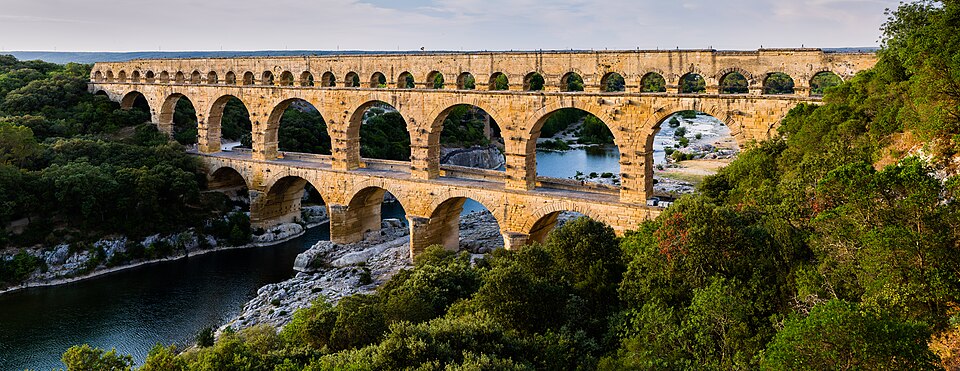
The three-tiered Roman aqueduct bridge of the Pont du Gard in southern France.
Benh LIEU SONG ( Flickr ) · CC BY-SA 3.0 · Wikimedia Commons
c. 3000 BCE – 500 CE

Empires built by engineers without a name for it

Egypt, Mesopotamia, China, Persia, India and Rome all ran on engineered works — irrigation, flood control, roads, water supply — organized by state officials who commanded armies of laborers. Rome professionalized the work furthest: eleven aqueducts totalling hundreds of kilometres fed the city, the water commissioner Frontinus wrote a technical treatise on them around 97 CE, and Vitruvius's De architectura preserved the era's engineering knowledge for the Renaissance to rediscover.
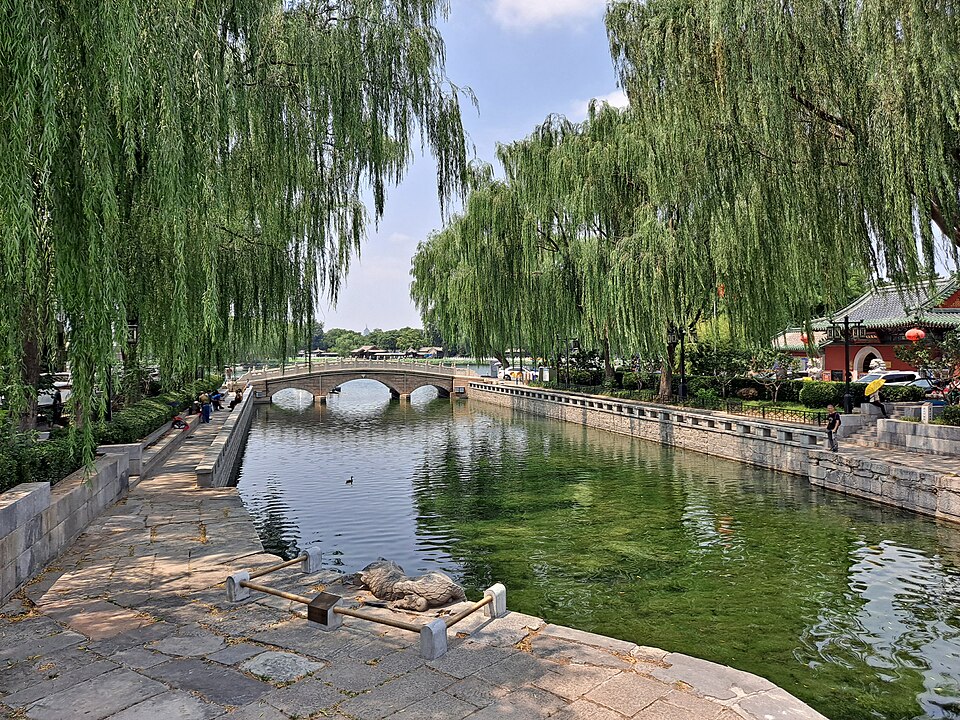
A stretch of China's Grand Canal, the world's longest artificial waterway.
EditQ · CC BY-SA 4.0 · Wikimedia Commons
500 – 1750

Masons, water masters and the military engineer

After Rome, large-scale engineering survived in fragments: anonymous master masons raised Gothic cathedrals by rule of proportion, Chinese dynasties extended the Grand Canal into the longest artificial waterway on Earth, and the Dutch organized water boards that turned a flooding delta into farmland. The word 'engineer' itself belonged to war — designers of fortifications and siege engines — and it took until 18th-century France, with its state road and bridge corps, for the civilian branch to become a career.

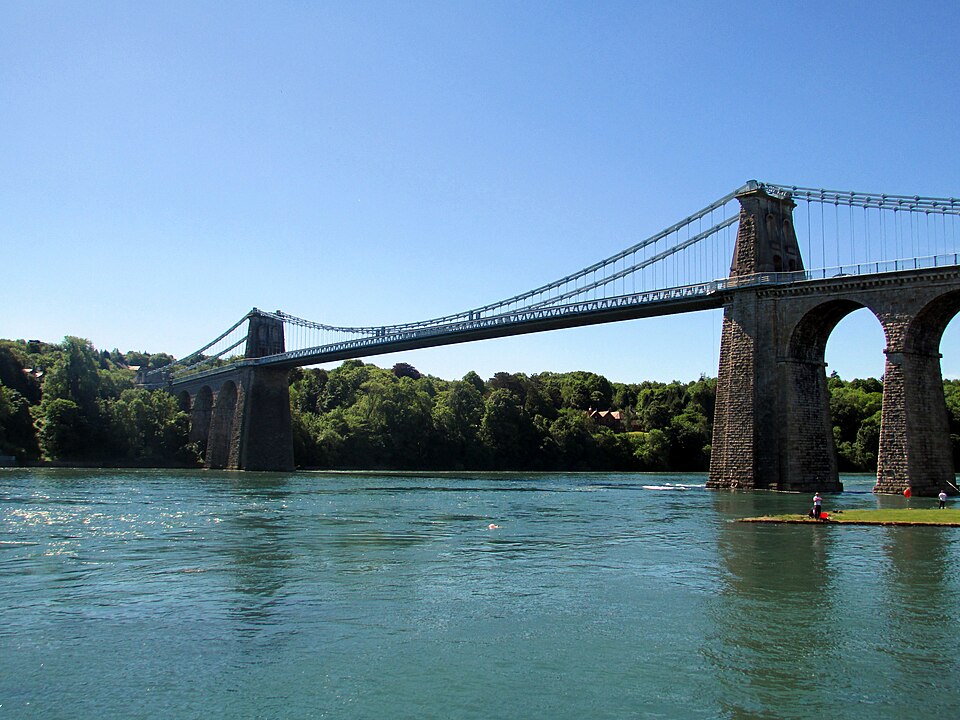
Thomas Telford's Menai Suspension Bridge linking Anglesey to the Welsh mainland.
Reading Tom from Reading, UK · CC BY 2.0 · Wikimedia Commons
1750 – 1900

The heroic age of canals, railways and iron

Smeaton named the profession, France schooled it and Britain's industrial revolution made it famous: Telford's roads and aqueducts, the Stephensons' railways, Brunel's Great Western Railway and steamships, Bazalgette's London sewers, the Roeblings' Brooklyn Bridge. Engineers became public heroes — Telford was buried in Westminster Abbey in 1834 — while new institutions, journals and university courses turned a craft learned by apprenticeship into a taught, examined discipline.

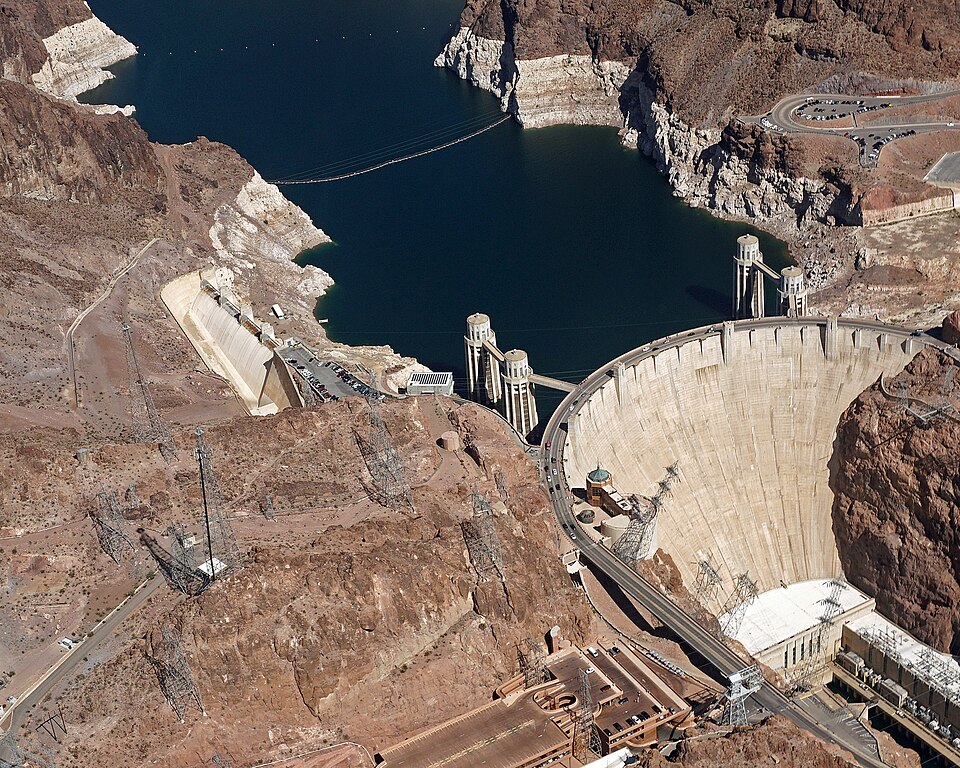
The concrete arch-gravity wall of Hoover Dam spanning the Black Canyon of the Colorado River.
Mariordo (Mario Roberto Durán Ortiz) · CC BY-SA 4.0 · Wikimedia Commons
1900 – 1970

Concrete, dams and the science of the ground

Reinforced concrete, developed from Joseph Monier's 1867 patent into a universal material, and Karl Terzaghi's founding of soil mechanics in 1925 gave the century its tools, and states supplied the ambition: the Panama Canal opened in 1914, Hoover Dam poured 2.5 million cubic metres of concrete cooled by embedded pipes in the 1930s, and postwar decades added interstate highways, the Netherlands' Delta Works and Japan's bullet-train viaducts. Failures like Tacoma Narrows in 1940 taught as much as the successes.

1970 – present

Computers, megaprojects and a warming climate

Finite-element software let engineers analyze what earlier generations could only approximate, enabling Fazlur Khan's tubular skyscrapers, the 1,991-metre span of Japan's Akashi Kaikyō Bridge in 1998, France's Millau Viaduct standing taller than the Eiffel Tower in 2004, and the Burj Khalifa in 2010. The profession's center of gravity is now shifting from building new to managing old and adapting to climate — the 2018 Morandi Bridge collapse in Genoa, which killed 43, made aging infrastructure a political issue across Europe.

What this job replaced

Neighbouring trades that no longer exist — absorbed, automated or regulated away.

Navvy

c. 1760–1950

The 'navigators' who dug Britain's canals and then its railways by pick, shovel and barrow were the muscle of the heroic age — roughly 200,000 worked on British railways at the 1840s peak, living in shanty camps with a fearsome reputation and a death rate to match. Steam excavators, and later diesel plant, ended the trade; the modern machine operator moves in a day what a navvy gang moved in a season.

Human computer

c. 1850–1970

Before electronic computing, engineering offices employed rooms of 'computers' — increasingly, from the early 20th century, women — grinding through stress tables, survey reductions and hydraulic calculations by hand and slide rule. Electronic computers and finite-element software erased the job title within a generation, though its holders' work sits silently inside every dam and bridge designed before 1960.

Drawing-office tracer

c. 1880–1990

Every engineering drawing once had to be copied in ink onto linen or film before it could be blueprinted, a precision trade — again largely staffed by women — with its own apprenticeships, pens and pride. Computer-aided design killed tracing outright in the 1980s: AutoCAD shipped in 1982, and within a decade the drawing office's ranks of tracing tables were gone.

Trades that vanished →

Civil engineering's history runs in a loop: a society invests massively in infrastructure, grows rich on it, forgets it, and is reminded — by a flood, a collapse, a water crisis — that the built world needs continuous engineering, not one-time heroics. Rome's aqueducts failed not from bad design but from the disappearance of the institution that maintained them.

What has never changed since Saqqara is the shape of the bargain: someone competent must answer, by name, for whether the structure stands, the water flows and the ground holds. The tools went from ramps and levers to finite-element models, but Hammurabi's clause — personal accountability for public safety — is still recognizably the core of the license every civil engineer works under.

Keep exploring

More in Engineering & Technology