🌉The Greats

Civil Engineer · The profession that turns rivers, rock and gravity into bridges, roads and clean water — civilization's quiet load-bearing trade since Imhotep.

Civil engineering is the worst possible profession for a list like this, because its defining works are collective: thousands of hands, decades of time, and — for most of history — no recorded names at all. Nobody knows who engineered the Pantheon's dome or the qanats of Persia. The eight people below are those whose individual contribution is documented well enough to be checkable.

They span 4,600 years and seven countries: a deified Egyptian official, a Qin governor, the Englishman who named the profession, a Scottish stonemason buried in Westminster Abbey, two American women the institutions tried to overlook, the Austrian who made the ground a science, and a Bangladeshi-American who reinvented the skyscraper. Each changed not just what got built, but how the profession works.

The all-time podium

🥈
Li Bing
China (Qin)
2
Imhotep
Imhotep
Egypt
1
John Smeaton
John Smeaton
England
3

The eight who reached the top

1
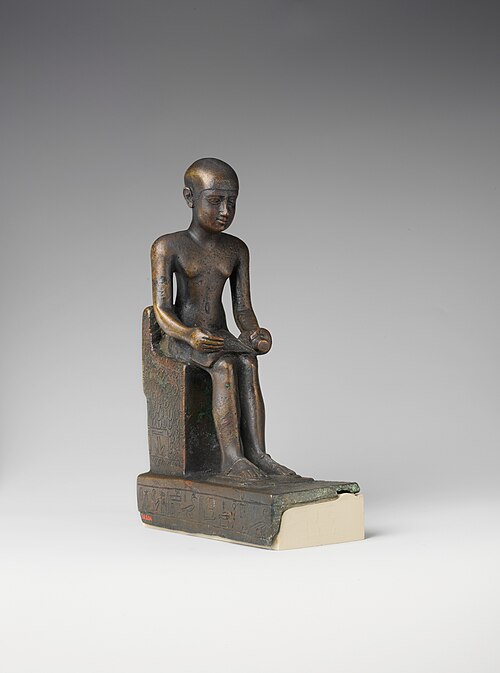
Ancient Egyptian bronze statuette of Imhotep, seated with a papyrus scroll. Unknown author · CC0

Imhotep

Egypt · fl. c. 2650 BCE

Chancellor to Pharaoh Djoser and director of the Step Pyramid at Saqqara — the first monumental building of cut stone — Imhotep is the earliest engineer, and arguably the earliest professional of any kind, whose name history preserves. Egyptians later venerated him for two millennia, eventually as a god of wisdom and healing.

The story

A statue base of Pharaoh Djoser excavated at Saqqara carries, beside the king's names, the titles of a commoner: Imhotep — chancellor of the King of Lower Egypt, high priest of Heliopolis, chief sculptor. Sharing a royal monument's inscription was an almost unheard-of honor, and it is why we know the builder's name at all. Some two thousand years after his death, Egyptians were worshipping Imhotep as a god, and the Greeks identified him with Asclepius, their god of medicine.

“Build something without precedent well enough and your name can outlast the state that commissioned it.”
Years his name has survived
~4,700 years
Step Pyramid height
~60 m, 6 tiers
Deified after death
~2,000 yrs later
2

Li Bing

China (Qin) · fl. c. 250 BCE

As Qin governor of Shu, Li Bing solved the Min River's annual flooding not with a dam but by dividing the river with an artificial levee and cutting an intake channel through a mountain — the Dujiangyan system, which has irrigated the Chengdu Plain continuously for more than 2,200 years and still works today.

The story

Gunpowder lay a millennium in the future, so to cut the Baopingkou intake channel through the rock of Mount Yulei, Li Bing's crews heated the cliff face with burning straw and doused it with water, cracking the stone seam by seam — years of labor for a gap tens of metres wide. The finished system needs no dam: the Yuzui 'fish mouth' levee splits the Min so that flood water spills over a sacrificial weir while irrigation water flows on to the plain. UNESCO listed Dujiangyan as a World Heritage Site in 2000, still in service.

“Work with the river's own behavior and the structure can outlive every empire that maintains it.”

Years in continuous service
2,200+ years
Farmland irrigated today
~5,300 km²
Dams in the design
Zero
3
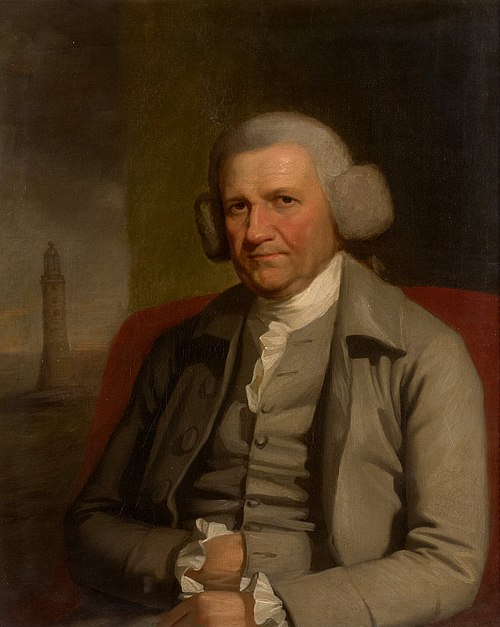
Portrait of John Smeaton, the first self-described civil engineer, with the Eddystone Lighthouse behind him. User Magnus Manske on en.wikipedia · Public domain

John Smeaton

England · 1724–1792

The trained instrument-maker who called himself a 'civil engineer' — deliberately, to mark civilian works off from military engineering — and made the title stick. His 1759 Eddystone Lighthouse pioneered interlocking masonry and hydraulic lime, he won the Royal Society's Copley Medal for waterwheel research the same year, and in 1771 he founded the profession's first society.

The story

For a lighthouse on the wave-swept Eddystone rocks — where one predecessor had burned and another vanished in a storm with its builder inside — Smeaton modeled his tower on the trunk of an oak, flaring wide at the base, and cut every granite block with dovetail joints so the sea would lock the masonry tighter. He also worked out a lime mortar that cured underwater, re-solving a problem lost since Rome. The tower stood from 1759 until 1882, when the rock beneath it — not the tower — began to fail; Plymouth re-erected it on the Hoe by public subscription, where it still stands.

“Naming a discipline matters: Smeaton turned scattered practice into a profession that could organize, meet and teach.”

Lighthouse's working life
123 yrs (1759–1882)
Copley Medal
1759, waterwheels
Coined the title
'Civil engineer'
4
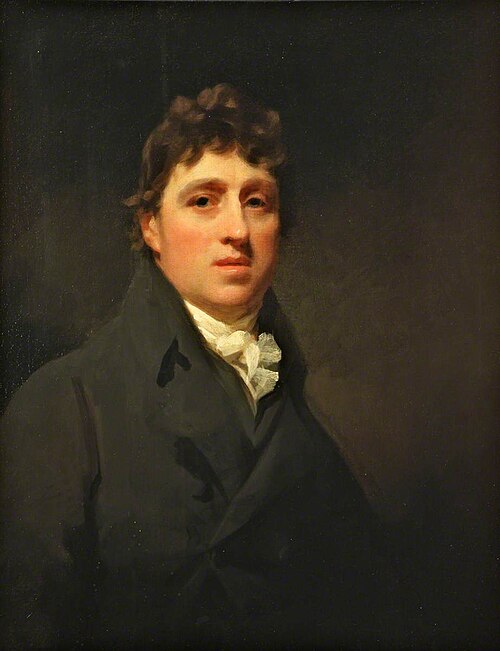
Portrait of the Scottish engineer Thomas Telford. Henry Raeburn · Public domain

Thomas Telford

Scotland · 1757–1834

A shepherd's son from Eskdale who began as an apprentice stonemason carving gravestones and ended as the age's master builder: the Pontcysyllte Aqueduct carrying a canal in an iron trough 38 metres above the River Dee, the Caledonian Canal, some 1,500 kilometres of Highland roads, and the Menai Suspension Bridge — at 176 metres the world's longest span when it opened in 1826.

The story

Telford's friend the poet Robert Southey nicknamed him 'the Colossus of Roads,' and the joke carried real weight: his Highland commissions re-engineered the infrastructure of an entire region, and his London-to-Holyhead road set standards a national highway agency would recognize. In 1820 the young Institution of Civil Engineers recruited him as its first president, and his lobbying won it the 1828 Royal Charter that made engineering a chartered profession. When he died in 1834 he was buried in Westminster Abbey, and in 1968 Britain named a new town — Telford — after him, the only British new town named for an engineer.

“Institutions are infrastructure too: Telford's charter for the profession outlasted even his bridges.”

Highland roads built
~1,500 km
Menai span, 1826
176 m, world record
First ICE president
1820–1834
5
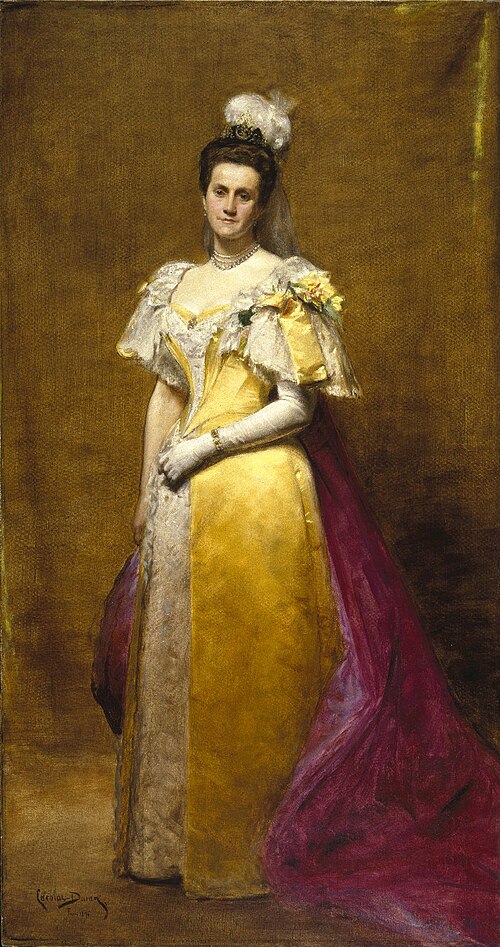
Portrait of Emily Warren Roebling, who saw the Brooklyn Bridge through to completion. Carolus-Duran · Public domain

Emily Warren Roebling

United States · 1843–1903

When Brooklyn Bridge chief engineer Washington Roebling was crippled by caisson disease in 1872, his wife Emily taught herself cable construction, materials strength and bridge engineering and spent the next eleven years as his voice on the works — negotiating with contractors, politicians and trustees on a project that defined American engineering.

The story

Washington Roebling could watch the bridge only by telescope from his Brooklyn Heights window, so Emily carried the chief engineer's instructions to the site daily — and increasingly wrote them, fielding engineers' technical questions herself until contractors assumed she was the mind behind the answers. When trustees moved in 1882 to remove her ailing husband, she addressed the American Society of Civil Engineers' allies and argued the case that kept him — and effectively her — in charge. At the opening in May 1883, Emily crossed first by carriage, carrying a rooster as a sign of victory.

“Titles lag reality: the work decides who the engineer actually is, long before the institutions admit it.”

Years effectively running the works
11 yrs (1872–83)
Main span at opening
486 m, world record
Order across the bridge
First, May 24, 1883
6
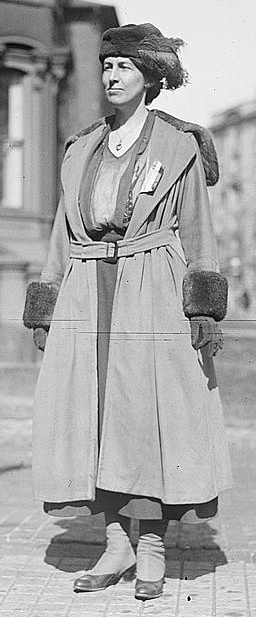
Photograph of civil engineer and suffragist Nora Stanton Blatch Barney. Unrecorded · Public domain

Nora Stanton Barney

United States (b. England) · 1883–1971

Granddaughter of suffragist Elizabeth Cady Stanton, Barney graduated in civil engineering from Cornell in 1905 and became the first woman admitted to the American Society of Civil Engineers, working on the Catskill Aqueduct and for the American Bridge Company while campaigning for women's votes.

The story

The ASCE admitted the 22-year-old as a 'junior member' in 1905 — then, in 1916, when she passed the age limit for junior status and applied for the associate grade her experience plainly merited, the society refused and struck her from the rolls. She sued; the court declined to force a private society's hand. Barney went on practicing as an engineer, architect and developer anyway. In 2015 — 99 years later — the ASCE posthumously elevated her to Fellow, conceding, a century late, the standing it had denied her in life.

“Being right early is expensive; institutions can take a century to catch up with a member's competence.”

Cornell CE degree
1905, first woman
ASCE's correction
99 yrs (1916–2015)
Signature project
Catskill Aqueduct
7

Karl Terzaghi

Austria / United States · 1883–1963

Before Terzaghi, foundations rested on rules of thumb; his 1925 book Erdbaumechanik founded soil mechanics — the science of how ground actually carries load and consolidates under it — and made geotechnical engineering a discipline. He became the first president of its international society and consulted on dams, subways and foundations across four continents.

The story

Teaching in Istanbul during and after the First World War, Terzaghi had almost no laboratory, so he built his own apparatus largely from scrap — improvised containers and hand-made cells — and ran hundreds of methodical experiments on how water-saturated clays compress over time. The result, his theory of consolidation, finally explained why buildings keep settling for years after completion, and became the core of Erdbaumechanik in 1925. The American Society of Civil Engineers awarded him its Norman Medal an unmatched four times.

“A science can be founded with scrap equipment; what matters is measuring what everyone else only guessed at.”

ASCE Norman Medals
4 — a record
Founding text
Erdbaumechanik, 1925
ISSMFE presidency
1936–57, first
8

Fazlur Rahman Khan

Bangladesh / United States · 1929–1982

Born in Dhaka and a Fulbright scholar at Illinois, Khan invented the tubular structural systems — framed, trussed and bundled tubes — that made supertall buildings economical, engineering Chicago's John Hancock Center and the Sears Tower, the world's tallest building for over two decades. He was also an early champion of computer-aided structural design.

The story

For the 100-story John Hancock Center, completed in 1969, Khan and architect Bruce Graham put the structure on the outside: giant X-braces turning the whole facade into a rigid tube against the wind. The heresy paid for the building — it used roughly 145 kilograms of steel per square metre where the Empire State Building's generation had needed around 200, making a tower that tall commercially viable for the first time. Khan died of a heart attack in Jeddah in 1982, at 52, while working on the tented Hajj Terminal that later won the Aga Khan Award for Architecture.

“The cheapest structure is a new idea: Khan cut the steel, and the skyline followed his economics.”

Sears Tower height, 1973
442 m
Years as world's tallest
20+ (1973–96)
Steel saved vs. rivals' era
~30% less/m²

Bars are scaled to the leader in this list.

Comparison Lab

Toggle names on and off — every bar rescales to the leader of your selection.

5 / 8

The argument

Imhotep's engineering role rests on titles and later tradition rather than contemporary construction records, and Egyptologists caution that 'architect of the Step Pyramid' is an inference — a strong one — from his unique standing at Djoser's court; his medical fame, by contrast, is almost entirely a legend of later millennia.

How much of the Brooklyn Bridge's engineering Emily Warren Roebling personally performed is genuinely uncertain: she left few technical documents under her own name, and historians range from crediting her with liaison and management to treating her as de facto chief engineer. That the project could not have finished without her is not seriously disputed.

Khan is claimed by structural engineering, a licensed specialty distinct from civil engineering in some countries, and any such list must also answer for who is missing: the Roman, Persian, Ottoman, Mughal and Chinese engineers whose names were never recorded, and contemporaries like Michel Virlogeux or the engineers of Japan's Akashi Kaikyō Bridge, whose reputations are still being written.

Keep exploring

More in Engineering & Technology