501 up, straight start, double finish — 170 (treble 20, treble 20, bullseye) is the highest possible three-dart checkoutStandard game
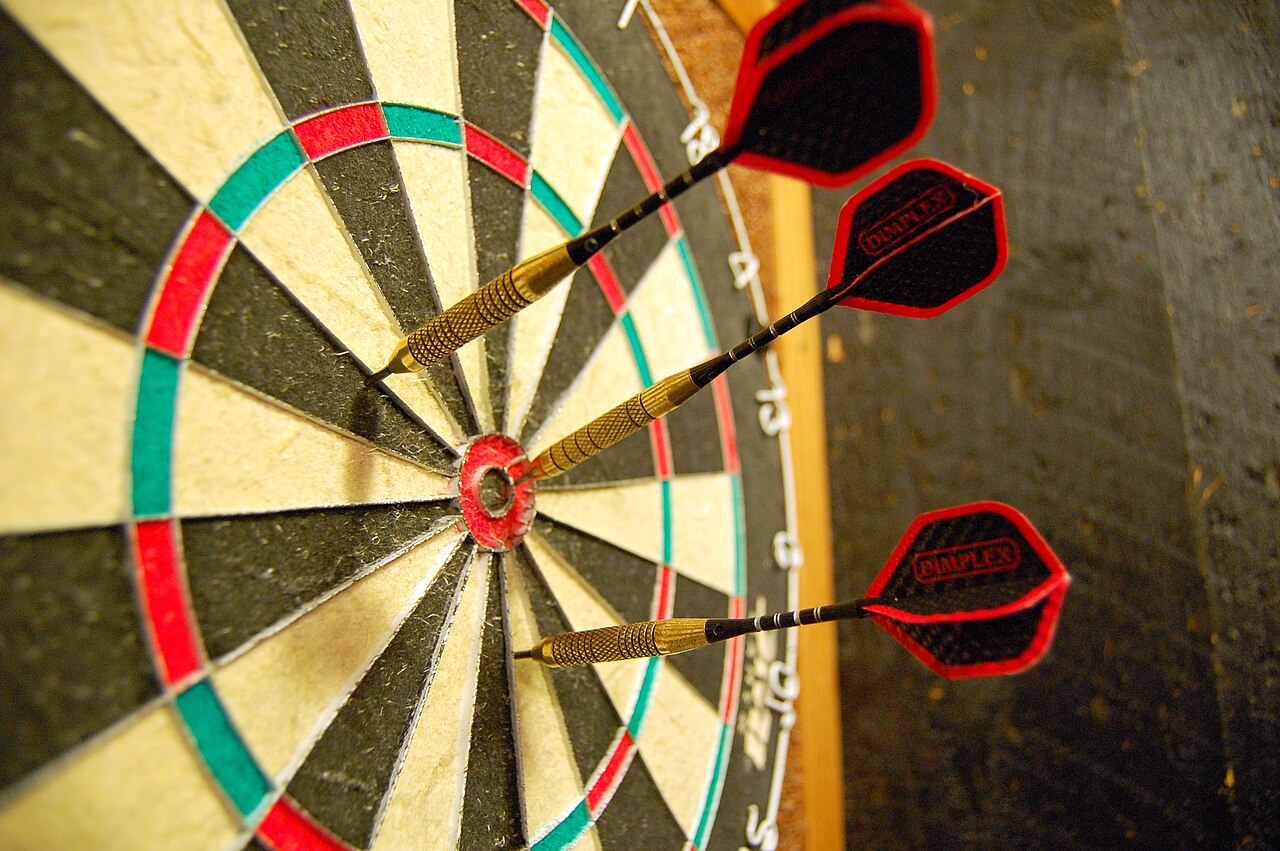
451 mm bristle board, 20 numbered segments plus a 25 outer ring and a 50 inner bull; the treble ring pays three times the segmentThe board
2.37 m (7 ft 9.25 in) from the oche to the board face, with the bullseye 1.73 m off the floorThrowing distance
Nine darts — first achieved on television by John Lowe on 13 October 1984 for a £102,000 prizePerfect leg
The PDC, founded in 1992 as the World Darts Council, and the World Darts Federation, founded in 1976, with member bodies in more than 70 countriesGoverning bodies
Phil Taylor, 16 (two BDO, fourteen PDC) between 1990 and 2013Most world titles
Darts compresses elite sport into an area smaller than a dinner plate. The scoring surface is 340 millimetres across, the treble 20 bed is roughly 8 millimetres wide, and a professional stands 2.37 metres away and hits it three times in a row often enough that a 180 barely raises an eyebrow. Everything else follows from that geometry. There is no defence, no contact and no way to hurry an opponent; there is only your own arm, a fixed target and a running subtraction from 501 that must land exactly on a double. Few sports expose a competitor so completely, and none does it in such a confined space.
The game grew out of English and Welsh pubs, where it was a wager and a way to pass a wet evening long before it was a profession. That inheritance still shapes it: the walk-on music, the fancy dress and the singing crowds at Alexandra Palace are not a marketing overlay but the sport's actual origin, industrialised. What has changed is the standard. A three-dart average of 90 was world class in the mid-1980s; in the 2020s a player who cannot average in the mid-90s will struggle to keep a PDC Tour Card, and the best routinely finish televised matches above 105.
Darts is also, quietly, one of the most international minority sports in Europe and Asia. The Netherlands produced two of the greatest players in history and treats the game as a mainstream television property; Germany fills arenas for European Tour weekends; Belgium, Austria, Wales and Scotland punch far above their populations; Japan and South Korea sustain an enormous soft-tip machine culture that feeds players onto the professional steel-tip circuit. Add a women's game finally receiving structure and prize money, and a teenage world champion in Luke Littler, and the sport's audience is younger and broader than at any point in its history.
The sequence — 20, 1, 18, 4, 13, 6, 10, 15, 2, 17, 3, 19, 7, 16, 8, 11, 14, 9, 12, 5 clockwise from the top — is designed to punish inaccuracy. Every high number is flanked by two of the lowest, so a dart that drifts a few millimetres off the 20 lands in the 5 or the 1, and a wayward visit can score under 10. That arrangement is what makes darts a skill sport rather than a lottery: precision is rewarded disproportionately and near misses are penalised harder than a deliberately safe shot at a middling number. The design is traditionally credited to Brian Gamlin, a carpenter from Bury, in 1896, though no documentary evidence has ever confirmed it.
What is a nine-dart finish?
A nine-darter is a perfect leg: 501 checked out in the minimum possible nine darts. The classic route is 180, 180, then treble 20, treble 19, double 12 to finish 141. Alternatives include 167, 167, 167, each of treble 20, treble 19 and bullseye. John Lowe threw the first on television on 13 October 1984 and collected £102,000. It remains the sport's signature achievement, though it has become far less rare: professionals now throw several a season across the circuit, and Phil Taylor holds the record of eleven on television, including two in a single match in the 2010 Premier League final against James Wade.
Why do you have to finish on a double?
The double-out rule exists to stop legs ending by accident and to place the hardest shot at the most pressurised moment. Without it a player could simply scrape to zero with any dart, and the finish would carry no risk. Requiring an exact landing in a bed roughly eight millimetres wide means that scoring your way to a finish is only half the job — the best scorers in the world convert only about 35 to 45 per cent of their double attempts in televised matches. It also creates the game's arithmetic: what you leave yourself matters as much as what you score, which is why professionals engineer finishes toward 32 and 40 rather than simply taking the biggest available number.
How far do you stand from a dartboard?
The throwing line, called the oche, is 2.37 metres (7 feet 9.25 inches) from the face of the board, measured horizontally along the floor. The centre of the bullseye sits 1.73 metres (5 feet 8 inches) above the floor, which puts it at roughly eye level for an average adult male — the height was standardised from pub practice rather than designed. Both measurements were fixed internationally by the World Darts Federation in the 1970s, ending decades of local variation in which distances were paced out rather than measured. A player may lean over the oche as far as balance allows but must not step on or beyond it, and the diagonal distance from the throwing point to the bull is 2.93 metres.
What is a three-dart average and what counts as good?
It is total points scored divided by darts thrown, multiplied by three — the sport's headline measure of scoring power. A casual pub player might average in the 40s or 50s, a good league player in the 70s, and a county-standard player in the 80s. A PDC Tour Card holder needs to average in the mid-90s to survive on the circuit. Above 100 in a televised match is a strong performance, above 105 is exceptional, and the all-time televised record is Michael van Gerwen's 123.40 against Michael Smith in 2016. Because the average includes the darts thrown at doubles, missed checkouts drag it down, which is why a player can average higher than an opponent and still lose comfortably.
Why do some players aim at treble 19 instead of treble 20?
Because the punishment for missing is smaller. The treble 20 pays 60 but sits between the 5 and the 1, so a slight drift costs almost everything. The treble 19 pays 57 — only three fewer — and sits between the 3 and the 7, so a miss costs roughly half as much. Over a long match, players who favour the 19s argue the reduced variance outweighs the lower ceiling. The counter-argument is that 180 only exists at the top of the board and a twelve-dart leg usually needs it. Most professionals score on the 20 by default and switch to the 19 when their darts are consistently dropping into the 5, which signals a mechanical fault rather than bad luck.
What is the difference between the PDC and the BDO or WDF?
The British Darts Organisation, founded in 1973, ran the sport in Britain and staged the original world championship from 1978. In 1992 sixteen leading players broke away to form the World Darts Council, renamed the Professional Darts Corporation in 1997, seeking commercial control of their own events. After years of litigation the two bodies coexisted, each with its own world champion, until the PDC's Sky Sports deal, prize money and star players made it dominant. The BDO entered liquidation in 2020. The World Darts Federation, founded in 1976, is the international governing body for the amateur game and now runs the successor world championship to the BDO's, while the PDC runs the professional circuit.
Are darts players athletes, and are they drug tested?
Professional darts players are subject to anti-doping testing under the sport's regulatory framework, and beta blockers — which suppress the hand tremor that ruins a throw — are specifically banned. Alcohol has been prohibited in the playing area since the late 1980s, when the sport's association with drinking on stage helped cost it its television deals. Whether darts is a sport is a semantic argument the players have largely stopped having; what is not in dispute is that it demands elite fine motor control under sustained psychological pressure, that matches at the World Championship can last four hours, and that the condition known as dartitis — a yips-like block preventing release — has ended major careers, including Eric Bristow's peak.