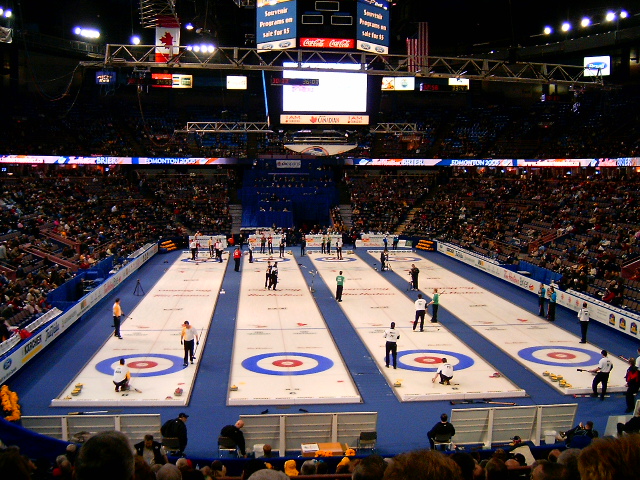
About 1.5 million registered curlers, spread across more than 70 national associationsPlayers worldwide
World Curling, founded in 1966 as the International Curling Federation; 74 member associationsGoverning body
45.72 m long and up to 5 m wide; the house is 3.66 m (12 feet) across, with hog lines 21 feet from each tee lineThe sheet
Polished granite, 17.24 to 19.96 kg, maximum circumference 91.4 cm; most of it quarried on Ailsa Craig, ScotlandThe stone
Full medal sport since Nagano 1998; also contested at the first Winter Games in Chamonix in 1924Olympic status
Canada leads with 36 men's and 19 women's; Niklas Edin holds the individual record with 8 (2013-2026)Most world titles
Curling looks like the gentlest thing on ice until you understand what is actually being asked. A player pushes out of a rubber foothold called the hack, releases a 20-kilogram block of polished granite before his hand crosses a line ten metres down the ice, then expects it to keep travelling another 28 metres and stop within a few centimetres of a target the size of a dinner plate, while two teammates scrub the ice ahead of it to steal back the last metre. Eight stones a side, ten ends, only one team scoring in each end. The whole sport is a negotiation between physics you cannot fully control and geometry you can.
Its origins are Scottish and medieval. A stone inscribed 1511 was pulled from a drained pond near Dunblane, and a notary at Paisley Abbey recorded a challenge on ice in February 1541. Scots emigrants carried the game to Canada, where the Royal Montreal Curling Club, founded in 1807, is the oldest active sports club in North America, and Canada has been the sport's centre of gravity ever since. But the modern map is genuinely global. Sweden, Switzerland, Scotland, Norway, Italy and the United States have all won world or Olympic gold this century, and Japan and South Korea have reached Olympic finals.
The culture is as distinctive as the rules. Curlers call their own infractions, concede when a game is beyond saving rather than play it out, and traditionally buy the opposition a drink afterwards, a code written down as the Spirit of Curling and still printed at the front of the rulebook. That courtesy sits on top of ferocious precision: at world level, teams are graded stone by stone on a percentage scale and the best of them shoot above 85 percent for a week. Television discovered all of this in 1998, when curling became a full Olympic sport, and has never let go of it.
Why do curlers sweep the ice in front of the stone?
Sweeping briefly melts the frozen droplets, called pebble, that cover a curling sheet, creating a microscopic film of water that reduces friction under the stone. Two things follow. The stone travels further, by several metres if it is swept hard for its whole journey, and it curls less, holding a straighter line. Sweepers are therefore correcting two errors at once: a shot thrown a little light can be carried to the target, and a shot drifting too wide can be kept straight. The skip watches from the house and calls when to sweep; the sweepers judge speed themselves, usually against a stopwatch time taken between the hog lines.
What is the hammer and why does everyone talk about it?
The hammer is the last stone of an end, and having it is worth roughly a point at elite level because you get to react to everything the opposition has already done. It is decided before the game by the last stone draw, where each team throws to the button and the closer average wins, and after that it goes to whichever team did not score in the previous end. That rule is the strategic heart of curling: scoring a single point with the hammer is often a bad outcome, because you hand last stone back for only one point. Teams would rather blank the end, keep the hammer, and try again for two.
Why does a curling stone curl?
Because it is released with a slow rotation, two or three turns over its whole 30-metre journey, and that rotation makes it drift sideways by about a metre. The strange part is the direction: a clockwise-rotating stone curls to the right, which is the opposite of what a spinning ball does on a table. Physicists have argued about the mechanism for decades, with competing explanations involving asymmetric friction at the front and back of the contact ring, and tiny scratches the stone leaves on the pebble that later stones follow. There is still no single accepted theory, which makes curling one of the few sports whose central phenomenon remains genuinely unexplained.
Are curlers actually athletes?
The delivery itself demands balance, flexibility and repeatable precision rather than power, but sweeping is straightforwardly hard physical work. A sweeper covers a couple of kilometres over a game while pushing down hard on a brush, in short bursts that drive the heart rate close to maximum. Elite teams train for that specifically, with gym programmes built around core stability, single-leg balance and upper-body endurance. The mental load is comparable to golf: every shot is planned, discussed and executed under a running clock, and a world championship is nine days of two-hour games where a centimetre decides the result.
What is mixed doubles and how does it differ?
Mixed doubles is a separate Olympic discipline played by two people, one of each gender, over eight ends instead of ten. Each team delivers five stones rather than eight, and one stone of each colour is placed on the ice before every end, one in the house and one as a guard, so six stones per team are in play. One player throws the first and last stone of the end, the other the middle three, and both sweep. Once per game a team may call a power play, shifting the pre-placed stones to one side of the sheet to open up a bigger score. It is faster, higher scoring and far more volatile than the four-player game.
Where do curling stones come from and why are they expensive?
Nearly all competition stones are cut from one of two granites: Blue Hone and Common Green from Ailsa Craig, an uninhabited islet in the Firth of Clyde, or a granite from the Trefor quarry in north Wales. Ailsa Craig rock is prized because it absorbs almost no water, so it does not crack when repeatedly frozen and thawed. The island is a bird sanctuary, so quarrying happens rarely and in bulk, with a 2,000-tonne harvest in 2013 and another in 2020, and Kays of Scotland has held exclusive rights for well over a century. A matched set of sixteen championship stones costs several thousand pounds but lasts for decades.
What is the difference between the Brier, the Scotties, the worlds and the Olympics?
The Brier, founded in 1927, and the Scotties Tournament of Hearts, founded in 1961, are Canada's national men's and women's championships, and because Canada's playing base is so deep they are usually harder to win than the world title itself. Their winners represent Canada at the world championships each spring, which are contested by thirteen nations over nine days. The Olympic tournament is separate again, held every four years with ten teams per event, qualified through world championship results and a dedicated qualification event, and each country selects its Olympic team through its own trials rather than sending its national champion automatically.
What is the Spirit of Curling?
It is a written code, printed at the front of the rulebook, that describes how the game is meant to be played: honourably, without deliberate distraction, and with respect for the opposition. In practice it means several things you will actually see. Players call their own infractions, including admitting when they have accidentally touched a moving stone, even when nobody else noticed. Teams concede when a game is beyond saving rather than force the opposition to finish it. And winners traditionally buy the losers a drink afterwards, a custom called broomstacking. It is not sentimentality; curling has almost no on-ice officiating, so the code is the enforcement mechanism.