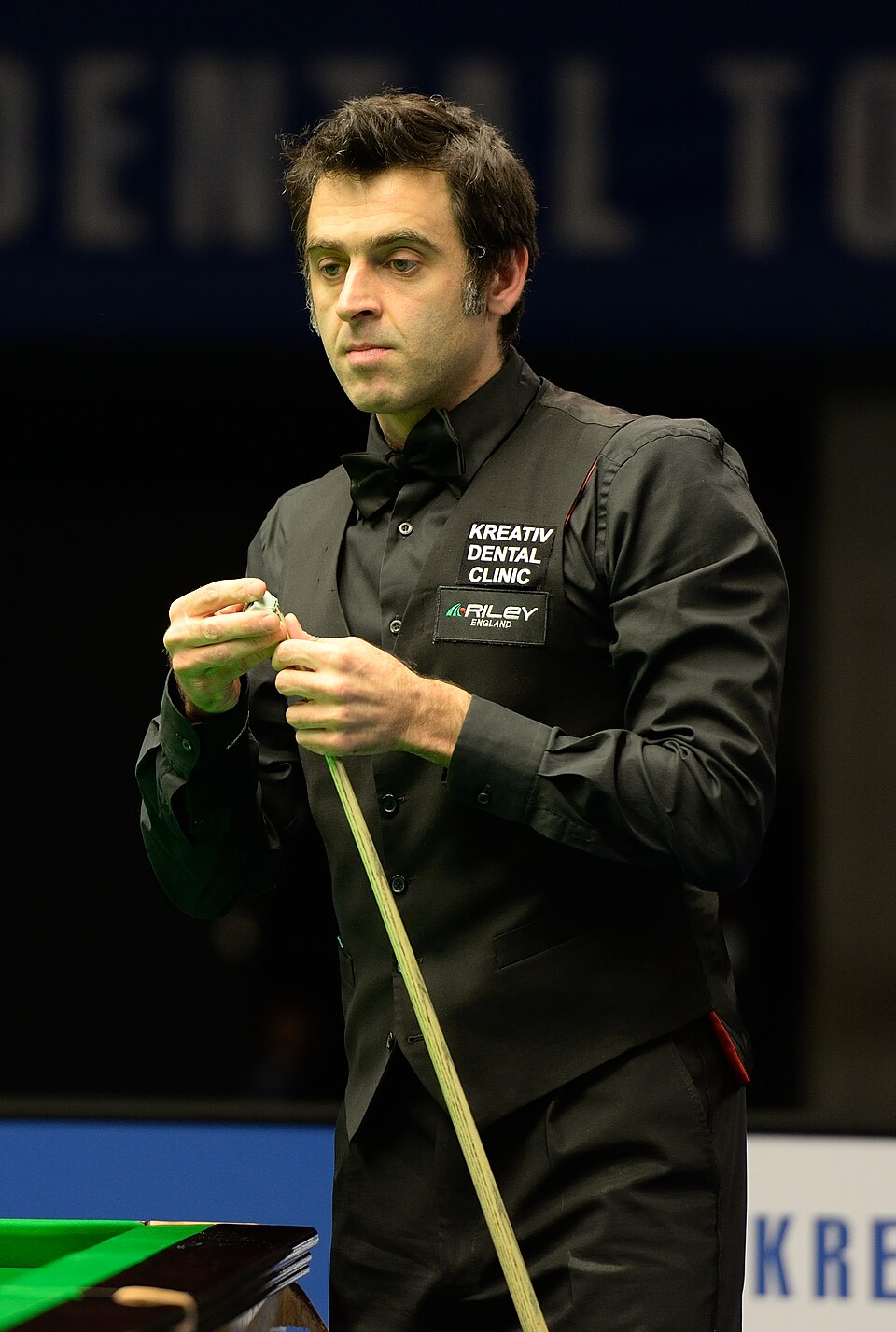
Ronnie O'Sullivan
Joe Davis
Stat by stat
Bars are scaled to the leader in this list.
The verdict
Dead even across the measured categories. Our all-time ranking places Ronnie O'Sullivan at #1 and Joe Davis at #3.
Head-to-head FAQ
Who leads more shared metrics?
How do the published ranks compare?
Are these live stats?
The case for Ronnie O'Sullivan
The most complete resume in the sport's history, assembled over four decades. O'Sullivan won the 1993 UK Championship at 17 years and 358 days, still the youngest winner of a ranking event, and was still winning majors in his late forties. He holds seven world titles (2001, 2004, 2008, 2012, 2013, 2020, 2022), eight UK Championships and eight Masters, giving him 23 Triple Crown titles, more than anyone. He has more ranking titles than any player, having passed 40, and more career centuries than anyone, having become the first to 1,000 in 2019 and pushed past 1,200 since. His 15 official maximum breaks are a record, including the 5 minute 8 second 147 against Mick Price at the Crucible in 1997. His 2022 world title, won at 46, made him the oldest Crucible champion. Naturally left-handed and able to play to a high standard right-handed, he combines the fastest execution in the game with the finest cue ball control of his era.
The case for Joe Davis
Snooker's founder, first champion and first theorist. Davis co-created the World Championship in 1927 with promoter Bill Camkin, beat Tom Dennis 20-11 in the inaugural final for a purse of roughly six pounds ten shillings, and then won all fifteen stagings held up to 1946 before withdrawing permanently. He never lost a World Championship match. He was also a leading billiards professional, taking four world billiards titles between 1928 and 1932, and it was his understanding of positional play in that game that he transplanted into snooker. On 22 January 1955 at Leicester Square Hall he made the first officially ratified maximum break of 147. His instructional books taught a generation that snooker was a scoring game rather than a defensive one, establishing break-building from the black as orthodoxy. Comparisons across eras are impossible in his case: he faced a tiny professional field on slower equipment, but he invented the standards everyone since has been measured against.