Milestones in order. This is history, not a weekly activity grid.
- The game is invented in India
- Snooker reaches Britain
- The rules are standardised
- The first World Championship
- Joe Davis retires undefeated
- The professional split
- The first ratified 147
- Colour television saves the sport
- Alex Higgins wins the title
- The Crucible era begins
- The first overseas champion of the modern era
- The first televised maximum
- The black-ball final
- Hendry begins his decade
Last reviewed Sources & creditsMedia creditsMethodology
Quick answers
What is a maximum break and why is it 147?
A maximum is the highest break available in normal play. There are fifteen reds on the table, each worth one point, and after every red the striker may nominate a colour. Taking the black, worth seven, after all fifteen reds gives 15 times 8, or 120 points. When the reds are gone, the six colours must be potted in order for another 27 points: yellow 2, green 3, brown 4, blue 5, pink 6, black 7. That totals 147. Breaks above 147 are possible only when a free ball is awarded after a foul while reds remain, which is how Jamie Burnett made a 148 in 2004.
Why is the World Championship played at the Crucible?
The tournament moved to the Crucible Theatre in Sheffield in 1977, at the suggestion of promoter Mike Watterson, whose wife had seen a play there. It was a practical choice for a sport with a small audience, but the venue turned out to suit television perfectly. It seats fewer than a thousand people, places the front row within a few feet of the table, and for the first week splits the arena so two matches run side by side. That intimacy makes it intensely uncomfortable to play in and compelling to watch, and it has become inseparable from the event's identity despite regular speculation about a move to a bigger or better-paying venue.
What does it actually mean to be snookered?
You are snookered when another ball blocks your path, so that no part of any ball you are allowed to hit can be struck in a direct straight line from the cue ball. Because jump shots are illegal in snooker, the only escape is to bounce the cue ball off one or more cushions and still make first contact with a legal ball. Fail, and you concede at least four points, and the opponent can hand the same shot straight back. Laying snookers is how players recover large deficits: each failed escape adds points and usually another chance to lay the snooker again.
How long does a professional snooker match last?
It depends entirely on the round. Early rounds of ranking events are often best of seven and can finish in under ninety minutes. The World Championship starts at best of nineteen and escalates to a best-of-35 final played over four sessions across two days, typically finishing late on a Monday night. A single frame usually takes fifteen to twenty-five minutes, but there is no shot clock in standard competition, and tactical exchanges can extend one enormously. The record is a frame between Fergal O'Brien and David Gilbert in 2017 that lasted 123 minutes 41 seconds on its own.
Who is the greatest snooker player of all time?
The two candidates are Ronnie O'Sullivan and Stephen Hendry, who share the modern record of seven world titles. O'Sullivan leads on every other measure: more than 40 ranking titles to Hendry's 36, 23 Triple Crown titles to 18, more than 1,200 career centuries to 775, and 15 maximum breaks to 11, achieved across a career spanning four decades. Joe Davis's fifteen world titles between 1927 and 1946 are numerically unmatched, but he invented the championship and faced a professional field of a few dozen. Most modern assessments place O'Sullivan first, Hendry second and Davis in a category of his own.
What is the difference between snooker, pool and billiards?
They are three separate games played on different tables. Snooker uses a twelve-foot table, twenty-two balls and rounded pocket openings barely wider than a ball, and requires alternating reds and colours in a fixed sequence. Pool, in its American forms, uses a smaller table, larger balls, wider cut pockets and fewer balls, and rewards shot-making over long sequences. English billiards is played with just three balls on a snooker table and scores through cannons, pots and in-offs, and it was the dominant professional cue sport in Britain until snooker overtook it in the 1930s. Snooker demands the finest cue ball control of the three because of the table size and the pocket templates.
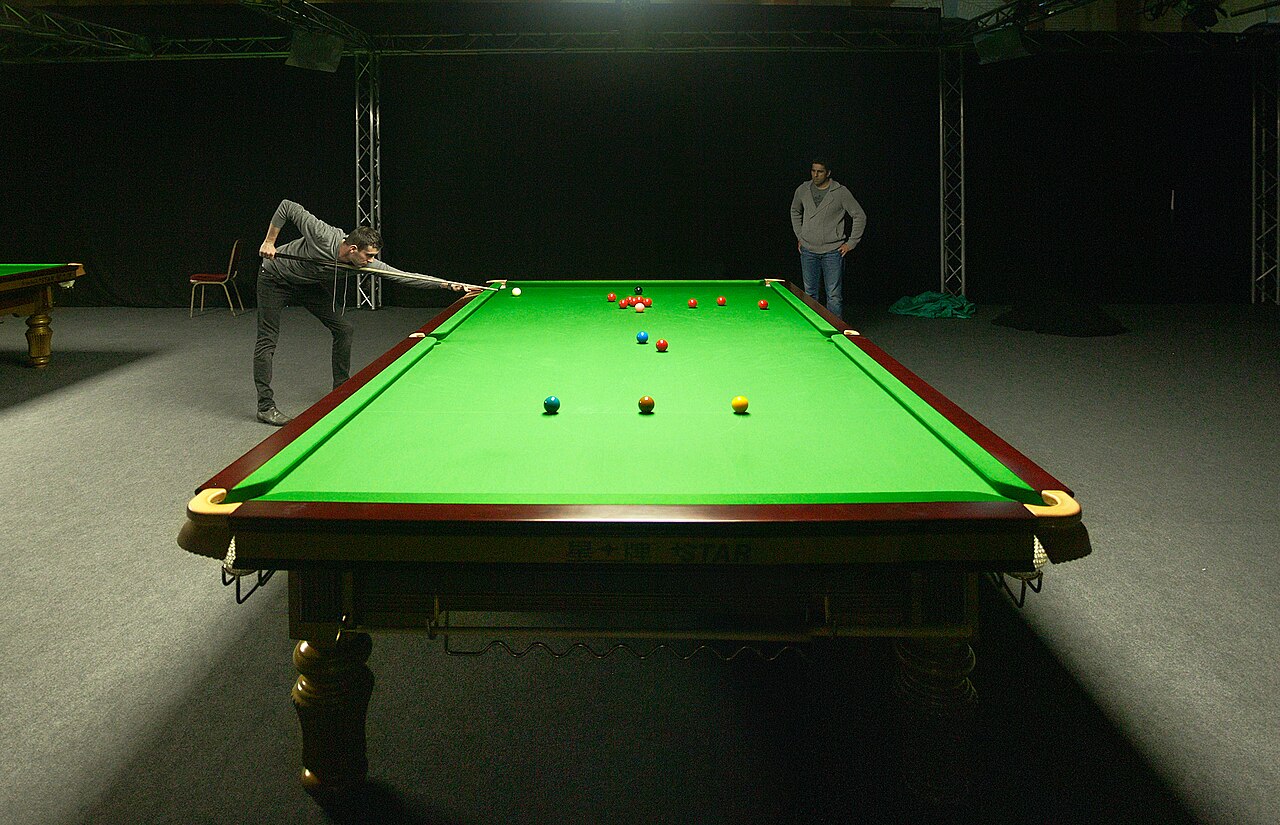
Snooker began as an idle variation on an existing game. British Army officers stationed in India in the 1870s already played black pool and pyramids on billiard tables; the innovation, credited to Neville Chamberlain of the Devonshire Regiment at Jabalpur in 1875, was to combine them by adding coloured balls of different values to the fifteen reds. The name came from military slang for a first-year cadet at Woolwich, applied to a player who left a ball hopelessly blocked. The game reached Britain through returning officers and gentlemen's clubs, and for fifty years it was regarded as a frivolous alternative to English billiards.
Its history since divides into unusually sharp phases: a founding monopoly under Joe Davis, who invented the World Championship in 1927 and then won all fifteen stagings; a near-death collapse in the late 1950s when the championship simply stopped being held; a spectacular rescue by colour television in 1969; the Sheffield boom that turned players into household names in the 1980s; a leaner, more technical professional era; and, since 2010, a deliberate expansion of the calendar that has pushed the sport into China, continental Europe and the Gulf.
Timeline
Officers of the Devonshire Regiment at Jabalpur combine pyramids and black pool by adding coloured balls to the fifteen reds. Neville Chamberlain is credited with the idea and with borrowing the cadet slang 'snooker' for the new game.
English billiards champion John Roberts junior meets Chamberlain in India and brings the game home. Roberts's promotion turns it from a mess-room diversion into a fixture of British billiard halls and gentlemen's clubs.
The Billiards Association and Control Council is formed by merger and issues a single official code for snooker, fixing ball values, spot positions and foul penalties in a form still recognisable today.
Joe Davis and Birmingham promoter Bill Camkin organise a professional championship with a five-pound entry fee. Davis beats Tom Dennis 20-11 in the final at Camkin's Hall and collects roughly six pounds ten shillings.
Davis wins the first post-war championship, his fifteenth title in fifteen stagings, and never enters again. He remains the only player never to lose a World Championship match.
A dispute with the governing body prompts almost every leading professional to boycott the official championship and stage a rival World Professional Match-play event, fracturing the sport's authority for years.
Joe Davis makes the first officially recognised maximum break at Leicester Square Hall in London on 22 January, playing Willie Smith. It takes another 27 years before one is seen on television.
The BBC launches Pot Black to showcase its new colour service, and the World Championship returns to a knockout format won by John Spencer. A game built on six differently coloured balls turns out to be perfect television.
At 22, the Belfast player becomes the youngest world champion to that point and gives snooker its first genuinely charismatic star, drawing audiences who had no interest in the game's clubbable past.
The World Championship moves to the 980-seat Crucible Theatre in Sheffield, where John Spencer wins the first title. The same year the UK Championship is founded, completing the Triple Crown alongside the Masters.
Canada's Cliff Thorburn beats Alex Higgins 18-16 to become world champion, the first player from outside the British Isles to win the title in the television age.
Steve Davis makes a 147 against John Spencer at the Lada Classic in Oldham, winning a car for it. Weeks later Alex Higgins takes his second world title in the sport's most emotional final scene.
Dennis Taylor beats Steve Davis 18-17 on the final black at 12:19am. An estimated 18.5 million people in Britain are still watching, a record for BBC2 and for any post-midnight broadcast in the country.
Stephen Hendry wins the world title at 21 years and 106 days, still the youngest champion. He goes on to take seven titles in ten years, including five in a row from 1992 to 1996.
Ronnie O'Sullivan compiles a 147 against Mick Price at the Crucible in 5 minutes 8 seconds, the fastest maximum ever recorded and still the shorthand for his speed of execution.
An 18-year-old Ding wins the China Open on home soil, defeating Stephen Hendry 9-5 in front of a vast domestic television audience and triggering a wave of Chinese investment in academies and junior play.
Neil Robertson becomes the first Australian world champion, and Barry Hearn assumes commercial control of World Snooker, beginning an aggressive expansion from a handful of ranking events to more than twenty a season.
At 46, Ronnie O'Sullivan beats Judd Trump 18-13 for a seventh world title, matching Hendry and becoming the oldest Crucible champion in the tournament's history.
Belgium's Luca Brecel becomes the first world champion from mainland Europe. The same year, ten Chinese professionals are sanctioned in the sport's largest match-fixing case, with two banned for life.
Zhao Xintong beats Mark Williams 18-12 at the Crucible to become the first world champion from China and from Asia, completing a run that began in the qualifying rounds.
The eras
From an Indian mess room to the British billiard hall
For its first half-century snooker was an afterthought. English billiards was the serious professional game, with its own world championship, its own stars and enormous unbroken breaks that could last hours; snooker was what officers and club members played when billiards became tedious. The invention at Jabalpur in 1875 spread through Indian garrisons over the following decade, and John Roberts junior, the dominant billiards professional of the age, carried it back to Britain after meeting Neville Chamberlain. Equipment manufacturers, who sold tables and ball sets, had every reason to promote a game that used more balls and appealed to social players, and by the Edwardian period snooker was a standard offering in commercial halls. What it lacked was structure. Ball values varied from club to club, the rules on free balls and fouls were inconsistent, and there was no competition worth entering. The merger that created the Billiards Association and Control Council in 1919 supplied the missing code, fixing the values, the spots and the penalty scale. That single act of standardisation made a professional championship conceivable, and within eight years one existed.
The Joe Davis monopoly
Joe Davis did not merely dominate early professional snooker; he designed it. Together with promoter Bill Camkin he created the World Championship in 1927, entered it, and won every one of the fifteen stagings held before he withdrew after 1946. He was also a serious billiards player, taking four world billiards titles between 1928 and 1932, and he understood that snooker's future lay in scoring rather than defence. Davis systematised break-building, positional play and the idea of working the pack from the black, publishing instructional books that taught a generation how the game should actually be played. His 1955 exhibition 147 at Leicester Square Hall was the first maximum the sport ever ratified. The monopoly had costs. With no rival capable of beating him, the championship's competitive interest depended on his participation, and when he stepped away the event lost its centre. A bitter dispute in 1952 sent most professionals into a breakaway match-play championship, leaving the official title contested by a handful of entrants. By 1957 the professional game was so weak that the championship simply lapsed, and it would not be staged in recognisable knockout form again for twelve years.
Collapse, revival and the colour boom
The late 1950s were snooker's nadir. There was no world championship at all between 1957 and 1964, professional ranks shrank to a few dozen ageing players, and the sport survived on club leagues and exhibition tours. A revival on a challenge basis from 1964 kept the title alive, with John Pulman defending it repeatedly, but it attracted little attention outside the trade. Rescue came from an unlikely direction. In 1969 the BBC needed programming that justified its new colour service, and producer Philip Lewis proposed a snooker series in which each match lasted a single frame. Pot Black was cheap, visually perfect for colour and improbably popular, running for years and turning previously anonymous professionals into recognisable faces. In the same year the World Championship reverted to a straight knockout, won by John Spencer. The 1970s consolidated the recovery: Ray Reardon won six titles in nine years, Alex Higgins supplied showmanship and controversy, the Masters was founded in 1975, tobacco sponsorship arrived, and in 1976 the sport introduced a world ranking system. Snooker was ready for the venue that would define it.
The Crucible boom and the Steve Davis decade
Moving the World Championship to Sheffield's Crucible Theatre in 1977 was a promoter's gamble that turned into the sport's identity. The room seats fewer than a thousand people, places spectators within a few feet of the table and forces two matches to share one arena, producing an intimacy that television amplified rather than diluted. From 1978 the BBC covered the event daily, and viewing figures climbed through a decade in which snooker became a British mainstream obsession. Steve Davis was its metronome: six world titles between 1981 and 1989, twenty-eight ranking titles, seven consecutive seasons as world number one, and a style built on relentless percentage safety and flawless positional play. He also supplied the era's defining defeats, losing the 1985 final 18-17 on the last black to Dennis Taylor in front of an estimated 18.5 million viewers, and losing to Joe Johnson at 150-1 in 1986. Around him the professional tour expanded from a closed shop into a genuine circuit, tobacco money underwrote prize funds, and the first maximum breaks appeared on television, Davis in 1982 and Cliff Thorburn at the Crucible in 1983.
Hendry, the century era and the technical arms race
Stephen Hendry rewrote what a good visit looked like. Where Davis's game was built on control and attrition, Hendry attacked from distance, potted long reds that his predecessors would have played safe on, and treated the blue and pink as legitimate break-building balls when the black was tied up. He won the world title at 21, took seven in ten years, held the number one ranking for eight consecutive seasons and finished with 36 ranking titles and 775 career centuries. The response was an arms race in scoring. John Higgins matched him for all-round technique, Mark Williams added the finest long potting of the era, and Ronnie O'Sullivan brought a speed and fluency that made 147s look routine, including the 5 minute 8 second maximum of 1997. Off the table the period was harder. Tobacco sponsorship was legislated away by 2005, the calendar shrank to a handful of ranking events, and prize money stagnated even as standards rose. The one clear growth signal came from Asia: Ding Junhui's 2005 China Open win in Beijing put snooker in front of an audience the British game could not match.
Expansion, globalisation and a Chinese champion
Barry Hearn's arrival at the head of World Snooker's commercial arm in 2010 changed the sport's economics before it changed its geography. The calendar was rebuilt around a 128-player tour with flat draws, qualifying open to amateurs, and more than twenty ranking events a season, so that a professional could earn a living without reaching the Crucible. Prize funds rose steadily, with the world champion's cheque reaching 500,000 pounds. The competitive consequence was a broader elite: Judd Trump, Mark Selby and Neil Robertson traded major titles while O'Sullivan, Higgins and Williams, all born in the same year and all professional since 1992, kept winning into their late forties and fifties. The geographic consequence was larger. China became the sport's second home, supplying more professionals than any country but England and hosting multiple ranking events; Luca Brecel's 2023 title was mainland Europe's first; Zhao Xintong's 2025 win, achieved from the qualifying rounds after serving a suspension in the 2023 match-fixing case, made him the first Asian world champion. Saudi Arabia's arrival in 2024, with the richest event outside Sheffield, opened a new and contested funding source.
Snooker's history is a repeated argument about whether the sport should be scarce or abundant. Joe Davis made it scarce by winning everything; television made it abundant by putting it in every living room; the post-tobacco 2000s made it scarce again by shrinking the calendar; Barry Hearn made it abundant by rebuilding one. The same tension now runs through its geography, as a game invented by British officers in India, popularised in Sheffield and sustained by a British audience is asked whether its future belongs in China and the Gulf. What has not changed is the object on which all of it rests: a twelve-foot table with pockets that barely accept a ball, and the fact that one loose shot still hands everything to the other man.
Keep exploring
More in this category
Golf
A six-century test of nerve where the only opponent is the ground, the wind, and yourself.
🎯Darts
A sport played on a target the size of a dinner plate, where the arithmetic never stops and the last dart is always the hardest.
🥌Curling
Twenty kilograms of Scottish granite, a sheet of pebbled ice, and a game that is almost always decided by the final stone.