Milestones in order. This is history, not a weekly activity grid.
- The Stirling Stone
- First written reference
- Bruegel paints the ice games
- Kilsyth Curling Club
- Duddingston Curling Society
- Curling reaches Canada
- The Grand Caledonian Curling Club
- Ailsa Craig granite
- Curling at the first Winter Olympics
- The first Brier
- The Scotch Cup
- An international federation
- First European Championships
- A world championship for women
Last reviewed Sources & creditsMedia creditsMethodology
Quick answers
Why do curlers sweep the ice in front of the stone?
Sweeping briefly melts the frozen droplets, called pebble, that cover a curling sheet, creating a microscopic film of water that reduces friction under the stone. Two things follow. The stone travels further, by several metres if it is swept hard for its whole journey, and it curls less, holding a straighter line. Sweepers are therefore correcting two errors at once: a shot thrown a little light can be carried to the target, and a shot drifting too wide can be kept straight. The skip watches from the house and calls when to sweep; the sweepers judge speed themselves, usually against a stopwatch time taken between the hog lines.
What is the hammer and why does everyone talk about it?
The hammer is the last stone of an end, and having it is worth roughly a point at elite level because you get to react to everything the opposition has already done. It is decided before the game by the last stone draw, where each team throws to the button and the closer average wins, and after that it goes to whichever team did not score in the previous end. That rule is the strategic heart of curling: scoring a single point with the hammer is often a bad outcome, because you hand last stone back for only one point. Teams would rather blank the end, keep the hammer, and try again for two.
Why does a curling stone curl?
Because it is released with a slow rotation, two or three turns over its whole 30-metre journey, and that rotation makes it drift sideways by about a metre. The strange part is the direction: a clockwise-rotating stone curls to the right, which is the opposite of what a spinning ball does on a table. Physicists have argued about the mechanism for decades, with competing explanations involving asymmetric friction at the front and back of the contact ring, and tiny scratches the stone leaves on the pebble that later stones follow. There is still no single accepted theory, which makes curling one of the few sports whose central phenomenon remains genuinely unexplained.
Are curlers actually athletes?
The delivery itself demands balance, flexibility and repeatable precision rather than power, but sweeping is straightforwardly hard physical work. A sweeper covers a couple of kilometres over a game while pushing down hard on a brush, in short bursts that drive the heart rate close to maximum. Elite teams train for that specifically, with gym programmes built around core stability, single-leg balance and upper-body endurance. The mental load is comparable to golf: every shot is planned, discussed and executed under a running clock, and a world championship is nine days of two-hour games where a centimetre decides the result.
What is mixed doubles and how does it differ?
Mixed doubles is a separate Olympic discipline played by two people, one of each gender, over eight ends instead of ten. Each team delivers five stones rather than eight, and one stone of each colour is placed on the ice before every end, one in the house and one as a guard, so six stones per team are in play. One player throws the first and last stone of the end, the other the middle three, and both sweep. Once per game a team may call a power play, shifting the pre-placed stones to one side of the sheet to open up a bigger score. It is faster, higher scoring and far more volatile than the four-player game.
Where do curling stones come from and why are they expensive?
Nearly all competition stones are cut from one of two granites: Blue Hone and Common Green from Ailsa Craig, an uninhabited islet in the Firth of Clyde, or a granite from the Trefor quarry in north Wales. Ailsa Craig rock is prized because it absorbs almost no water, so it does not crack when repeatedly frozen and thawed. The island is a bird sanctuary, so quarrying happens rarely and in bulk, with a 2,000-tonne harvest in 2013 and another in 2020, and Kays of Scotland has held exclusive rights for well over a century. A matched set of sixteen championship stones costs several thousand pounds but lasts for decades.
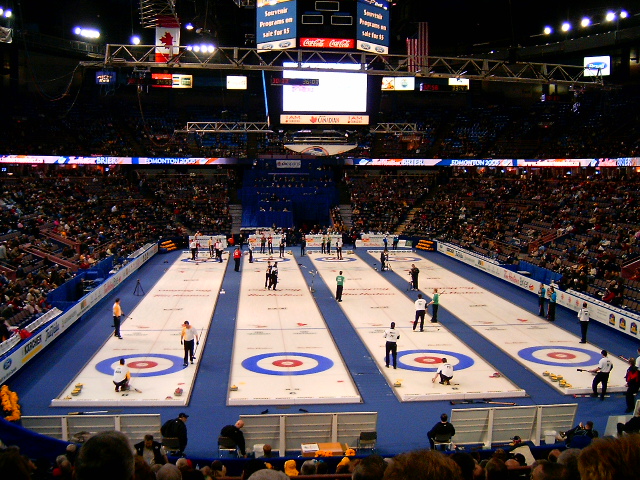
Curling is one of the few sports with physical evidence older than its written rules. A granite stone bearing the date 1511 was recovered from a drained pond at Dunblane in Scotland, and the earliest written record is a notary's note from Paisley Abbey in February 1541 describing a challenge on ice. Pieter Bruegel the Elder painted people throwing stones on frozen ponds in the Low Countries in 1565, which is why the question of whether the game is purely Scottish has never quite been settled.
What is not in doubt is where it was organised. Scotland founded the clubs, wrote the first laws, and exported both. The Grand Caledonian Curling Club, formed in Edinburgh in 1838, standardised the game; Scottish emigrants, soldiers and engineers took it to Canada, the United States, Scandinavia, Switzerland and beyond. Canada then industrialised it, building indoor rinks, a national championship and a professional culture that would supply most of the sport's early world champions and much of its technical vocabulary.
Timeline
A curling stone inscribed with the date 1511 is later recovered from a drained pond near Dunblane, Scotland. It remains the oldest physical evidence of the game anywhere in the world.
A notary at Paisley Abbey in Renfrewshire records a challenge to play on ice in February 1541, the earliest surviving documentary mention of curling.
Pieter Bruegel the Elder's winter landscapes show Flemish villagers sliding stones across frozen ponds, evidence that similar games existed on the continent as well as in Scotland.
The Kilsyth club in Stirlingshire is formally constituted and claims to be the oldest curling club in the world, with a purpose-built pond to match.
Founded on the loch below Arthur's Seat in Edinburgh, Duddingston becomes an early attempt to write down consistent rules for a game that varied from parish to parish.
The Royal Montreal Curling Club is founded by Scottish merchants and soldiers. It is the oldest sports club of any kind still active in North America.
Formed in Edinburgh as the sport's governing body, it becomes the Royal Caledonian Curling Club in 1843 and is recognised by the IOC as author of curling's first official rules.
Kays of Scotland begins making curling stones and eventually secures exclusive rights to quarry Ailsa Craig, the volcanic islet in the Firth of Clyde that still supplies most of the world's stones.
Great Britain wins the curling event at Chamonix, beating Sweden and France. The IOC does not formally recognise the medals as Olympic until 2006.
Canada's national men's championship is launched in Toronto and won by Nova Scotia's Murray Macneill rink. It becomes the sport's most demanding domestic title.
Ernie Richardson's Saskatchewan rink beats Scotland in the inaugural international championship, the direct ancestor of the world championships, and wins three more by 1963.
Representatives of Canada, France, Norway, Scotland, Sweden and Switzerland create what becomes the International Curling Federation, renamed the World Curling Federation in 1990.
The European Curling Championships are launched, giving continental nations a serious annual competition and, in time, a qualification route to the worlds.
The first World Women's Curling Championship is held in Perth, Scotland, and won by Switzerland, twenty years after the men's equivalent began.
Russ Howard's idea of protecting early guards is trialled at a Moncton cashspiel. Adopted internationally as the four-rock free guard zone in 1993, it transforms curling strategy.
Curling joins the Nagano programme as a medal sport. Switzerland's Patrick Hurlimann wins the men's gold and Canada's Sandra Schmirler the women's.
Rhona Martin's last-stone draw wins Britain's first Winter Olympic gold in 18 years, watched by close to six million viewers after midnight and turning curling into mainstream British television.
Brad Gushue wins Canada's first Olympic men's gold and Anette Norberg the first of Sweden's women's titles. The IOC also retroactively ratifies the 1924 Chamonix results.
After a season in which directional brush heads let sweepers steer stones, World Curling and its members ban every fabric but a single approved standard from 2016-17.
Brad Jacobs becomes the first male skip with two Olympic golds and Anna Hasselborg the second woman; Niklas Edin then wins a record eighth world title in Ogden and retires.
The eras
Parish ice and channel stones
For three centuries curling was a village winter pastime rather than a sport with rules. Players used whatever granite the local riverbed offered, so-called channel stones of wildly varying size and shape, some with a handle bolted on and some simply gripped by a hollow worn into the rock. The heaviest recorded specimens weighed more than 50 kilograms. Games were between parishes, played on frozen lochs and mill ponds, with the target and the number of stones settled by local convention rather than any authority. Scotland's climate did the rest: a run of hard winters through the seventeenth and eighteenth centuries gave reliable ice, and the game spread across the Lowlands and into the Borders. Clubs began to organise from 1716, when Kilsyth constituted itself, and by 1795 Duddingston Curling Society in Edinburgh was trying to write down a consistent code. The one surviving physical thread from the earliest period is the Stirling Stone, dated 1511, dredged from a pond at Dunblane, and it is the reason curling can claim documented existence a century before Scotland's own game of golf was formally regulated.
Codification and emigration
The Grand Caledonian Curling Club, founded in Edinburgh in 1838 and given royal patronage five years later, did for curling what the Football Association did for football: it standardised the stone, fixed the length of the rink, defined the house and made a single rulebook authoritative. Weight limits arrived, ending the era of enormous channel stones, and Kays of Scotland began cutting matched pairs from Ailsa Craig granite, a rock so dense and non-porous that it remains the sport's preferred material almost two centuries later. The Grand Match, an outdoor spectacle in which hundreds of rinks played simultaneously on a frozen loch, became the game's showpiece. At the same time Scots were leaving in large numbers, and they took curling with them. Montreal had a club by 1807, the United States by 1830, and by the end of the century the game was established in Sweden, Switzerland, Norway and New Zealand. Curling appeared at the first Winter Olympics in Chamonix in 1924, where Great Britain won, though the IOC would not recognise those medals as official for another 82 years.
Canada builds the modern game
The Brier, launched in Toronto in 1927, changed curling from a social club activity into a national obsession. Canada had something Scotland did not: covered rinks with artificial ice, which meant a long, reliable season and a competitive culture that ran from small-town clubs up to a genuinely brutal national championship. Provincial playdowns fed the Brier, and winning it made ordinary tradesmen famous. The single most important product of that system was the Richardson rink from Saskatchewan, four relatives skipped by Ernie Richardson, who won the Brier and then the new Scotch Cup international championship in 1959, 1960, 1962 and 1963. Their sliding delivery, their willingness to hit rather than draw, and their sheer consistency set the technical template that the rest of the world spent two decades copying. Canadian coaches and instructional books, several written by Richardson himself, exported that template. By the time the international federation was formed in 1966 by six nations, it was already obvious who would be favourites at any event they organised: in the first twenty world championships Canada won thirteen.
The world catches up
The Air Canada Silver Broom era gave the world championship a proper global stage from 1968, and gradually the results stopped being predictable. Sweden's Kjell Oscarius won in 1973, and Sweden, Switzerland, Norway and the United States all took men's titles before 1990. The women's world championship began in 1979 and was competitive from the start, with Switzerland winning the first edition and Canada, Sweden, Norway, Germany and Denmark all lifting it in the years that followed. The technical revolution of the period was strategic rather than physical. Russ Howard's Moncton rule of 1990 protected early guards from being removed, and when the four-rock free guard zone was adopted internationally in 1993 it ended the era in which a superior team could simply peel every stone off the sheet and grind out a 3-2 win. Ends filled up, comebacks became possible, and television found the sport far more watchable. That mattered because curling was campaigning hard for Olympic inclusion, granted after demonstration appearances in 1988 and 1992 and confirmed for Nagano in 1998.
Olympic legitimacy
Full medal status transformed curling's economics and its geography. Nations that had barely funded the sport suddenly had Olympic programmes: Great Britain, Japan, China, South Korea, Denmark and Italy all built high-performance systems around the four-year cycle. The results were immediate and international. Switzerland and Canada won the first golds in 1998, Norway's Pal Trulsen and Scotland's Rhona Martin in 2002, and Martin's last-stone draw, replayed endlessly in Britain, made curling a household word there overnight. Turin in 2006 delivered Canada's first men's gold through Brad Gushue and the first of Anette Norberg's two Swedish women's titles; Norberg repeated in 2010, the same Games in which Kevin Martin's Canadian rink went unbeaten. Jennifer Jones matched that with a perfect run in Sochi in 2014. Off the ice, the players organised: the Grand Slam of Curling, launched in 2001 after a boycott of the Brier by most of Canada's leading men's teams, created a professional circuit with six-figure purses and eventually a women's tour to match, giving elite curlers something close to a living.
Equipment wars, analytics and a global field
The most disruptive event of the modern era was not a rule change but a broom. In 2015-16, brush heads made of directional fabric let a single sweeper effectively steer a stone, undermining the value of the throw itself; after a moratorium and a testing summit involving Canada's National Research Council, the governing bodies banned every fabric but one from 2016-17. Rules kept moving too: the five-rock free guard zone arrived for 2018-19 and the no-tick rule for 2023-24, both designed to keep stones in play and reduce blowouts. Mixed doubles, an Olympic discipline from PyeongChang 2018, became the sport's globalisation engine, cheap to run and open to nations with two good players rather than four. Competitively, Europe took over. Niklas Edin's Sweden won eight world titles between 2013 and 2026 and Olympic gold in 2022; Switzerland's team around Alina Patz and Silvana Tirinzoni won four straight women's world championships from 2019 to 2023. Canada answered through Rachel Homan and, at Milano Cortina 2026, Brad Jacobs, who became the first male skip with two Olympic golds.
Curling in 2026 is a sport in visible transition. Niklas Edin retired in May after his record eighth world title, Silvana Tirinzoni stepped away weeks later, and Jennifer Jones had already played her last four-player game in 2024, which removes three of the defining figures of the past two decades within a single season. Meanwhile the entry lists keep growing, with a record 33 teams at the 2026 mixed doubles qualification event, and World Curling is rebuilding its qualification pyramid around new B and C divisions from 2026-27. A 500-year-old parish pastime has rarely looked less settled or more healthy.
Keep exploring
More in this category
Golf
A six-century test of nerve where the only opponent is the ground, the wind, and yourself.
🎯Darts
A sport played on a target the size of a dinner plate, where the arithmetic never stops and the last dart is always the hardest.
🎱Snooker
Twenty-two balls, six pockets barely wider than they are, and the most pitiless scoreboard in sport.