Skip to content Skip to a section

🥌GOAT Rankings

Curling · Twenty kilograms of Scottish granite, a sheet of pebbled ice, and a game that is almost always decided by the final stone.

At a glance
All-time shape

#1 Niklas Edin

#2 Anette Norberg

#3 Sandra Schmirler

Last reviewed Sources & creditsMedia creditsMethodology

Quick answers

Why do curlers sweep the ice in front of the stone?

Sweeping briefly melts the frozen droplets, called pebble, that cover a curling sheet, creating a microscopic film of water that reduces friction under the stone. Two things follow. The stone travels further, by several metres if it is swept hard for its whole journey, and it curls less, holding a straighter line. Sweepers are therefore correcting two errors at once: a shot thrown a little light can be carried to the target, and a shot drifting too wide can be kept straight. The skip watches from the house and calls when to sweep; the sweepers judge speed themselves, usually against a stopwatch time taken between the hog lines.

What is the hammer and why does everyone talk about it?

The hammer is the last stone of an end, and having it is worth roughly a point at elite level because you get to react to everything the opposition has already done. It is decided before the game by the last stone draw, where each team throws to the button and the closer average wins, and after that it goes to whichever team did not score in the previous end. That rule is the strategic heart of curling: scoring a single point with the hammer is often a bad outcome, because you hand last stone back for only one point. Teams would rather blank the end, keep the hammer, and try again for two.

Why does a curling stone curl?

Because it is released with a slow rotation, two or three turns over its whole 30-metre journey, and that rotation makes it drift sideways by about a metre. The strange part is the direction: a clockwise-rotating stone curls to the right, which is the opposite of what a spinning ball does on a table. Physicists have argued about the mechanism for decades, with competing explanations involving asymmetric friction at the front and back of the contact ring, and tiny scratches the stone leaves on the pebble that later stones follow. There is still no single accepted theory, which makes curling one of the few sports whose central phenomenon remains genuinely unexplained.

Are curlers actually athletes?

The delivery itself demands balance, flexibility and repeatable precision rather than power, but sweeping is straightforwardly hard physical work. A sweeper covers a couple of kilometres over a game while pushing down hard on a brush, in short bursts that drive the heart rate close to maximum. Elite teams train for that specifically, with gym programmes built around core stability, single-leg balance and upper-body endurance. The mental load is comparable to golf: every shot is planned, discussed and executed under a running clock, and a world championship is nine days of two-hour games where a centimetre decides the result.

What is mixed doubles and how does it differ?

Mixed doubles is a separate Olympic discipline played by two people, one of each gender, over eight ends instead of ten. Each team delivers five stones rather than eight, and one stone of each colour is placed on the ice before every end, one in the house and one as a guard, so six stones per team are in play. One player throws the first and last stone of the end, the other the middle three, and both sweep. Once per game a team may call a power play, shifting the pre-placed stones to one side of the sheet to open up a bigger score. It is faster, higher scoring and far more volatile than the four-player game.

Where do curling stones come from and why are they expensive?

Nearly all competition stones are cut from one of two granites: Blue Hone and Common Green from Ailsa Craig, an uninhabited islet in the Firth of Clyde, or a granite from the Trefor quarry in north Wales. Ailsa Craig rock is prized because it absorbs almost no water, so it does not crack when repeatedly frozen and thawed. The island is a bird sanctuary, so quarrying happens rarely and in bulk, with a 2,000-tonne harvest in 2013 and another in 2020, and Kays of Scotland has held exclusive rights for well over a century. A matched set of sixteen championship stones costs several thousand pounds but lasts for decades.

Start with this section - GOAT Rankings

Ranking curlers across eras is complicated by the fact that the sport's showcase events changed shape twice. There was no world championship before 1959, none for women before 1979, and no Olympic medal until 1998, so a Canadian great of the 1960s was competing for a trophy that half the modern field would not recognise. The list below weighs world titles most heavily, because they are the one honour that has existed continuously and been contested by the best available teams, with Olympic golds treated as the scarcer and therefore heavier prize.

It is a mixed list by design. Men and women have played the same game on the same ice under the same rules for the whole modern era, and there is no coherent reason to separate them. The names run from Saskatchewan in the 1950s to Sweden and Switzerland in the 2020s, which is roughly the arc of the sport itself: invented in Scotland, perfected in Canada, and now won more often than not by Europeans.

All-time podium

🥈
Anette Norberg
Anette Norberg
Sweden
2
🥇
Niklas Edin
Niklas Edin
Sweden
1
🥉
Sandra Schmirler
Canada
3

Comparison Lab

Toggle athletes on and off — every bar rescales to the leader of your selection.

Peak keeps each athlete’s strongest metrics; Career averages the full published set. Both stay editorial teaching marks.

5 / 12

Drag only reorders the cosmetic shortlist — it does not change teaching scores.

Default shortlist below works without JavaScript. Toggle chips after load to rebuild bars.

Compare · in selection · Career

  1. 1Niklas Edin90
  2. 2Anette Norberg75
  3. 3Alina Patz61
  4. 4Rachel Homan60
  5. 5Sandra Schmirler40

World titles

Niklas Edin8
Alina Patz6
Anette Norberg3
Rachel Homan3
Sandra Schmirler3

World championship medals

Niklas Edin11
Anette Norberg9
Alina Patz8
Rachel Homan5
Sandra Schmirler3

Olympic golds

Anette Norberg2
Niklas Edin1
Sandra Schmirler1

Olympic medals

Niklas Edin3
Anette Norberg2
Alina Patz1
Rachel Homan1
Sandra Schmirler1

European titles

Niklas Edin8
Anette Norberg7
Alina Patz2

Consecutive world titles

Alina Patz4

National championships

Rachel Homan5
Sandra Schmirler3

Grand Slam titles

Rachel Homan20

The top 10

1
Niklas Edin

Niklas Edin

Sweden · 2007-2026

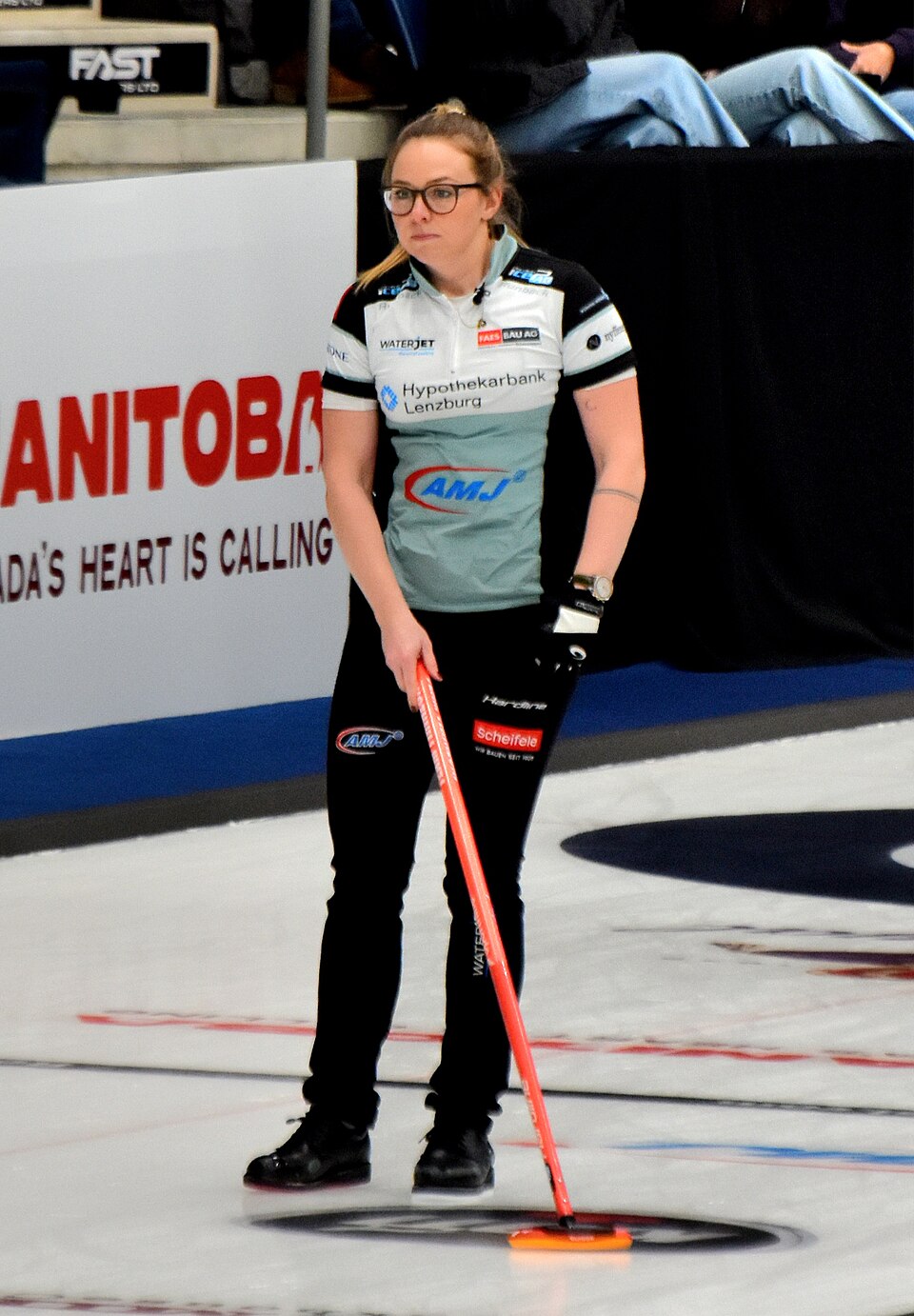
The most decorated curler in history by any measure. Edin skipped Sweden to eight world titles between 2013 and 2026, including four in a row across 2018, 2019, 2021 and 2022, and closed his career by beating Canada 9-6 in the 2026 final in Ogden to break his own record. He is also the only skip to win three Olympic medals, taking bronze at Sochi 2014, silver at PyeongChang 2018 and finally gold in Beijing 2022, plus eight European Championship titles. Six of his eight world finals were won against Canadian rinks, which is the statistic that best captures what he did to the sport's balance of power: he took a country with a fraction of Canada's playing base and made it the default favourite for a decade. He retired in May 2026, weeks after the eighth title, with a combined 38 championship medals on World Curling's recognised list.

World titles
8
World championship medals
11
Olympic golds
1
Olympic medals
3
European titles
8
2
Anette Norberg

Anette Norberg

Sweden · 1982-2013

The first curler of either sex to win two Olympic gold medals as a skip, taking Turin 2006 and then defending in Vancouver 2010, a feat no man matched until Brad Jacobs in 2026. Her career is remarkable for its length as much as its peaks: she won a silver at the 1988 Calgary demonstration event and was still winning world gold in 2011, twenty-three years later. That 2011 title in Esbjerg came after her Olympic double and gave her three world championships in total, alongside two silvers and four bronzes, plus seven European titles between 1988 and 2007. She competed at fifteen European Championships. In Sweden she is the figure who made curling a mainstream televised sport, and the pipeline that produced Anna Hasselborg and the current generation runs directly back through her.

World titles
3
World championship medals
9
Olympic golds
2
Olympic medals
2
European titles
7
3

Sandra Schmirler

Canada · 1987-1999

The most influential women's skip the sport has produced, and the reason curling had a face when it entered the Olympic programme. Schmirler's Regina rink of Jan Betker, Joan McCusker and Marcia Gudereit won the Canadian championship and then the world title in 1993, 1994 and 1997, a treble no other women's team had managed, and in 1998 she skipped Canada to the first Olympic women's gold at Nagano, finishing 8-1 and beating Denmark in the final. Her shot-making under pressure, particularly a series of last-stone doubles in Canadian playoffs, is still used as coaching footage. She died of cancer in March 2000, aged 36, less than two years after the Olympic title. The foundation established in her name has since raised millions for neonatal intensive care units across Canada, and the Sandra Schmirler Foundation broadcast remains a fixture of the Canadian curling calendar.

World titles
3
World championship medals
3
Olympic golds
1
Olympic medals
1
National championships
3
4

Rachel Homan

Canada · 2010-present

The dominant women's skip of the 2020s and the most prolific winner in the professional era of the sport. Homan won the world championship in 2017 with an undefeated run, then took back-to-back titles in 2024 and 2025, making her Canadian rink the first to defend the women's world crown since Schmirler in 1993-94. Domestically she has five Scotties Tournament of Hearts titles, and her 2023-24 season produced a 67-7 overall record widely described as the best any women's team has posted. She won 22 consecutive Scotties games across 2024 and 2025 and shot a perfect 100 percent in the 2025 final. Her 20 Grand Slam titles are the most by any woman. The one gap closed only partly at Milano Cortina 2026, where she took bronze at her third Olympics after finishing sixth in 2018.

World titles
3
World championship medals
5
Olympic medals
1
National championships
5
Grand Slam titles
20
5
Alina Patz

Alina Patz

Switzerland · 2011-present

Six world women's championships, more than any other Canadian or European skip has managed, and won with four different teams, which is the detail that separates her from every other multiple champion. Patz was the alternate on Mirjam Ott's winning Swiss rink in 2012, skipped her own team to gold in 2015 at 25, and then threw last stones for Silvana Tirinzoni's team through four consecutive titles from 2019 to 2023, adding silvers in 2024 and 2025. She also won the world mixed doubles title in 2011. Her hitting accuracy is the technical hallmark, but the four-peat was built on draws into congested houses under the five-rock rule. Three Olympic appearances brought two fourth places before she finally reached the podium with silver at Milano Cortina 2026, and she returns to skipping her own team afterwards.

World titles
6
World championship medals
8
Consecutive world titles
4
Olympic medals
1
European titles
2
6
Jennifer Jones

Jennifer Jones

Canada · 1993-2024

The most durable competitor in the modern women's game and the only skip to go through an Olympic curling tournament unbeaten in the women's event, finishing 11-0 at Sochi 2014. Jones won six Scotties Tournament of Hearts titles between 2005 and 2018, tying Colleen Jones's record, and world championships in 2008 and 2018, ten years apart. Her single most replayed shot came at the 2005 Scotties, where she hit an opposition stone outside the house and rolled to the button for four to win the final with the last stone of the game, a shot the broadcast analyst called the best he had ever seen. She reached eighteen Scotties in all before retiring from four-player curling after the 2024 season, then continued competing in mixed doubles with her husband Brent Laing.

World titles
2
World championship medals
2
Olympic golds
1
Olympic medals
1
National championships
6
7

Kevin Martin

Canada · 1985-2014

For twenty years the standard against which Canadian men's teams measured themselves, and the skip who best exploited the professional circuit that emerged in the 2000s. Martin won Olympic gold at Vancouver 2010 with a flawless tournament, 9-0 through the round robin and 11-0 overall, the first side to sweep an Olympic curling event since Great Britain in 1924, having taken silver at Salt Lake City in 2002. He added the world championship in 2008 and four Brier titles across three decades, in 1991, 1997, 2008 and 2009, going 11-0 and 13-0 in the last two. His fifteen Grand Slam titles and two Olympic trials wins reflect a career built as much on tour earnings as on national championships, and his teams' relentless takeout game defined Canadian men's curling before the five-rock rule arrived.

World titles
1
Olympic golds
1
Olympic medals
2
National championships
4
Grand Slam titles
15
8

Ernie Richardson

Canada · 1955-1964

The first international dynasty and the team that set the technical template for everyone who followed. Richardson skipped a rink of his brother Garnet and cousins Arnold and Wes from Regina to four Briers and four Scotch Cup world championships in 1959, 1960, 1962 and 1963, a period in which the international championship was effectively a Canadian export. Their 1959 Brier win made them the youngest team to take the title at that time. What made them historically important was method rather than results: the sliding delivery, the willingness to play takeouts as a matter of course rather than as a last resort, and a level of practised consistency that European teams did not yet have. Richardson wrote several instruction books that carried that method abroad, and was appointed to the Order of Canada in 1978.

World titles
4
World championship medals
4
Consecutive world titles
2
National championships
4
9
Silvana Tirinzoni

Silvana Tirinzoni

Switzerland · 2005-2026

Skip of the only women's team to win four consecutive world championships, taking gold in 2019, 2021, 2022 and 2023 with Alina Patz throwing last stones, then adding silvers in 2024 and 2025 when Rachel Homan's Canada finally stopped them. The arrangement itself was unusual and much discussed: Tirinzoni called the game and held the broom while Patz delivered the fourth pair, a split of the skip's role that several elite teams have since copied. She also won European titles in 2023 and 2024 and a long run of Swiss national championships, and finally took an Olympic medal at Milano Cortina 2026, silver after a 6-5 loss to Sweden in the final. She announced her retirement in the summer of 2026, ending the most successful sustained run any women's team has assembled.

World titles
4
World championship medals
6
Consecutive world titles
4
Olympic medals
1
European titles
2
10

Elisabet Gustafson

Sweden · 1988-2002

For two decades the benchmark for a women's career, with four world championships in 1992, 1995, 1998 and 1999, a total not beaten until the Swiss teams of the 2020s. Gustafson added two world bronzes and four European titles, and skipped Sweden to bronze at Nagano 1998, the first Olympic curling tournament with full medal status, finishing sixth at Salt Lake City in 2002. Her teams were built on a European style of aggressive draw play that ran counter to the takeout-heavy Canadian orthodoxy of the era, and they proved that a nation with a few thousand curlers could beat one with hundreds of thousands. She did all of it while training and working as a surgeon, and was inducted into the World Curling Federation Hall of Fame in 2012.

World titles
4
World championship medals
6
Consecutive world titles
2
Olympic medals
1
European titles
4
11

Eve Muirhead

Great Britain · 2007-2022

The most successful British curler of the modern era and the one who converted Rhona Martin's 2002 moment into a sustained programme. Muirhead won four world junior titles before she was 21, took the world championship in 2013, and won three European titles, the first at 19, which made her the youngest skip to do so. Her Olympic career was a long argument with near-misses: bronze at Sochi 2014, a fourth place at PyeongChang 2018 decided by a missed last stone, and finally gold at Beijing 2022, when Great Britain beat Japan 10-3 in the final for the country's only gold of those Games. She added the world mixed doubles title the same year with Bobby Lammie, then retired in August 2022 at 32 with eight Scottish championships to her name.

World titles
1
World championship medals
3
Olympic golds
1
Olympic medals
2
European titles
3
12

Anna Hasselborg

Sweden · 2011-present

The second woman after Anette Norberg to win two Olympic gold medals as a skip, taking PyeongChang 2018 and then Milano Cortina 2026 with a 6-5 win over Switzerland, and adding bronze in Beijing 2022 for three Olympic medals in total. That Olympic record is the strongest in the current women's game, and it sits oddly alongside a world championship record of two silvers and no gold, which is the main argument used against her. She has three European titles, six Swedish championships and eight Grand Slam wins, and in 2022 her team became the first women's rink to complete a career Grand Slam by winning all four majors. Her calm, low-risk endgame management is the most studied aspect of her play, particularly her willingness to take a single when the alternative carries steal risk.

Olympic golds
2
Olympic medals
3
European titles
3
National championships
6
Grand Slam titles
8

Bars are scaled to the leader in this list.

The debate

The hardest omissions are Canadian. Glenn Howard won four world championships across 25 years, twice as a third for his brother Russ and twice as a skip, and Randy Ferbey's Alberta team with Dave Nedohin throwing last stones won three world titles in four years and six Briers between them. Brad Gushue has the strongest case of all on longevity: Olympic gold in 2006, a world title in 2017, six Briers, 23 Brier appearances and the record for most Brier wins by a skip. Colleen Jones matched Jennifer Jones's six Canadian titles and won two world championships. Any of them would displace the bottom of this list on a different set of weightings.

The other live argument is about the Olympics versus the worlds. Anna Hasselborg has two Olympic golds and no world title; Alina Patz has six world titles and one Olympic silver. Which résumé is better depends on whether you value the scarcer prize or the more competitive field, since the world championship is contested annually by thirteen teams while the Olympic tournament runs once every four years with ten. Among active players, Bruce Mouat is the name most likely to force his way onto this list: world champion in 2025, Olympic silver medallist in 2026 and mixed doubles silver in 2022, with a decade still ahead of him.

Embed this ranking

Paste this code into your blog or site — the ranking stays up to date.

Keep exploring

More in this category