The Greats

Watchmaker · The craftsman who builds and revives the tiny machine on the wrist — a trade that survived the quartz crisis and now has more work than trained hands.

Any list of eight watchmakers is an argument starter, and this one leans deliberately toward people whose influence a reader can still see and verify: an escapement in production, a company on the stock exchange, a technique taught in schools, a book on the shelf. Thousands of equally skilled hands — the anonymous finishers, régleuses and repairers of the Jura valleys — left their work everywhere and their names nowhere.

The eight span four centuries and five countries, and reached the top by every route the trade offers: royal patronage, a government prize, mass production, corporate rescue, monastic independence and scholarly rediscovery. Together they map what excellence in this craft has actually meant in each era.

The all-time podium

John Harrison
John Harrison
England
2
Abraham-Louis Breguet
Switzerland / France
1
🥉
George Daniels
United Kingdom
3

The eight who reached the top

1
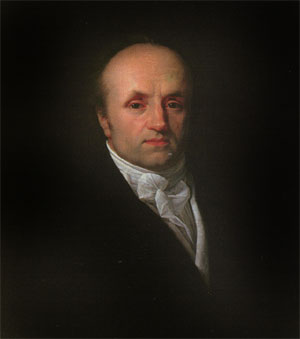
Portrait of Abraham-Louis Breguet, inventor of the tourbillon. Unidentified painter · Public domain

Abraham-Louis Breguet

Switzerland / France · 1747–1823

Born in Neuchâtel and established in Paris, Breguet invented or perfected much of the modern watch: the tourbillon (patented 1801), the pare-chute anti-shock device, self-winding 'perpétuelle' watches and the overcoil balance spring that bears his name. Napoleon, Talleyrand and half the courts of Europe were clients.

The story

In 1783 an admirer of Queen Marie Antoinette ordered from Breguet the most complicated watch possible — every known function, gold wherever possible, no limit on price or time. The queen was executed a decade later, and Breguet himself died in 1823 with the watch unfinished; his son completed No. 160 in 1827, forty-four years after the order. Stolen from Jerusalem's L.A. Mayer Museum in 1983, the 'Marie-Antoinette' stayed missing for a quarter century until it resurfaced in 2007, after the thief's death.

“Set the specification at 'everything possible' and the object can outlive its maker, its client and its century.”
Tourbillon patented
1801, Paris
Marie-Antoinette watch
44 yrs, 1783–1827
Inventions still in production
Tourbillon, overcoil
2
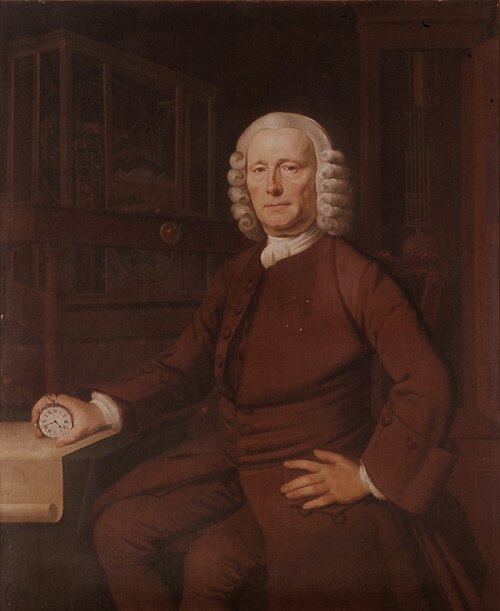
Portrait of John Harrison, who solved the longitude problem with his marine timekeepers. Thomas King († circa 1796 date QS:P,+1796-00-00T00:00:00Z/9,P1480,Q5727902 ) · Public domain

John Harrison

England · 1693–1776

A self-taught carpenter's son from Lincolnshire, Harrison spent over thirty years building the marine timekeepers H1 through H4 to win the £20,000 prize of Britain's 1714 Longitude Act — proving, against the astronomical establishment, that a watch could locate a ship at sea.

The story

H4, a 1.4-kilogram watch thirteen centimetres across, sailed to Jamaica aboard HMS Deptford in 1761 and lost about five seconds in 81 days — accuracy so far beyond belief that the Board of Longitude demanded repeat trials, disclosure of the mechanism and copies by rival makers before paying. Harrison received his final award only in 1773, aged 80, after King George III took up his case, reportedly declaring, 'By God, Harrison, I will see you righted.'

“A decisive demonstration does not end an argument with an establishment; endurance does.”

Prize at stake
£20,000 (1714 Act)
H4 error at sea, 1761
~5 s in 81 days
Years H1 to final award
1730–1773
3

George Daniels

United Kingdom · 1926–2011

London-born and self-taught out of a brutal childhood, Daniels made a few dozen watches entirely by his own hands from his Isle of Man workshop, mastering all of the roughly thirty separate trades a watch contains. His co-axial escapement became the first new escapement industrialized since the lever of the 1750s.

The story

Daniels spent the better part of two decades trying to convince the Swiss industry to adopt his co-axial escapement, which nearly eliminates the sliding friction — and therefore the oil dependency — of the lever. He fitted demonstration versions into other makers' movements and was politely refused across Switzerland, until Nicolas Hayek's Omega finally industrialized it in the 1999 De Ville Co-Axial. Omega has built its mechanical range on co-axial calibers ever since — vindication delivered when Daniels was 73.

“If the industry refuses the idea, build it yourself so completely that refusal becomes embarrassing.”

Trades mastered solo
~30 ('the Method')
Co-axial campaign
~20 yrs to adoption
Industrialized by Omega
1999, cal. 2500
4

Philippe Dufour

Switzerland · b. 1948

Working alone in a former schoolhouse in Le Solliat, Vallée de Joux, Dufour presented the world's first grande et petite sonnerie wristwatch in 1992 and the deceptively plain Simplicity in 2000. Among watchmakers he is the consensus reference for hand-finishing — the standard others are measured against.

The story

Dufour built grande sonnerie pocket-watch movements for Audemars Piguet in the 1980s, anonymously, before deciding his work would carry his own name. The market eventually agreed with him about what that name was worth: in November 2020 at Phillips in Geneva, the twentieth-anniversary Simplicity numbered 00/20 sold for about CHF 1.36 million — more than thirty times what the model cost when he launched it, for a watch with no complication at all, valued purely for its finishing.

“Perfect execution of something simple can outvalue clever execution of something complicated.”

First grande sonnerie wristwatch
World first, 1992
Simplicity 00/20 at auction
CHF 1.36M (2020)
Workshop headcount
One man
5
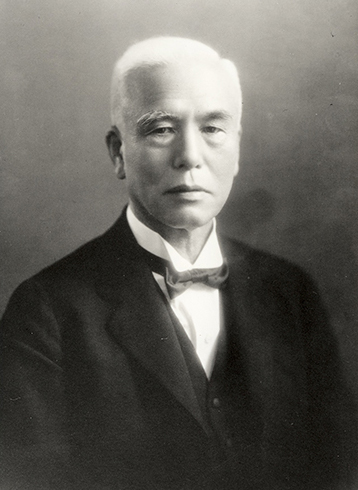
Kintarō Hattori, founder of Seiko, photographed in later life. Public domain. Photo from 1916. https://www.seikowatches.com/us-en/products/astron/special/kintaro_160th/ · CC0

Kintarō Hattori

Japan · 1860–1934

Hattori opened a Tokyo clock-repair shop in 1881 at age 21, founded the Seikosha factory in 1892, and produced Japan's first wristwatch, the Laurel, in 1913. The company he built — Seiko, 'precision' — would launch the quartz Astron in 1969 and shake the world industry he had studied so carefully.

The story

When the Great Kantō earthquake and fires of September 1923 destroyed the Seikosha factory, roughly 1,500 customers' watches left in for repair burned with it. Hattori announced he would replace every single one with a new watch — an enormous voluntary liability for a company that had just lost its plant. The gesture became a foundation of the firm's reputation in Japan, and the following year, 1924, the first watches bearing the name Seiko went on sale.

“Reputation is bought in the disaster, not the catalogue; pay for it there and it compounds for a century.”

Shop opened at age
21 (Tokyo, 1881)
Watches replaced, 1923
~1,500 after quake
Company he founded
Seiko (1892– )
6
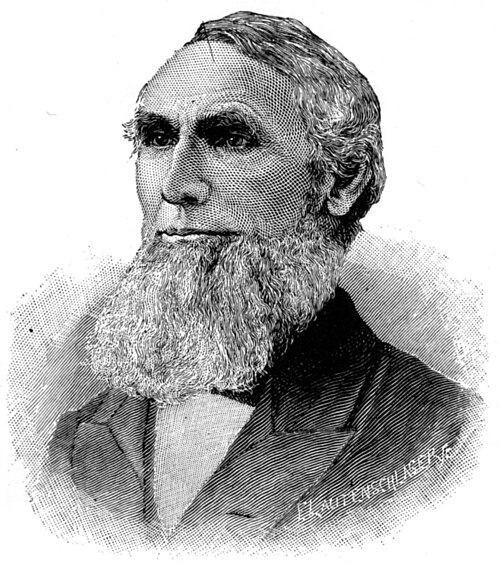
Aaron Lufkin Dennison, called the father of American watchmaking. Henry Abbott · Public domain

Aaron Lufkin Dennison

United States · 1812–1895

A Maine shoemaker's son apprenticed to a jeweler, Dennison saw interchangeable-parts gunmaking at the Springfield Armory and asked why watches could not be built the same way. The company he co-founded in 1850 became the Waltham Watch Company — the start of machine-made watches, and of the end of hand-fitting.

The story

Waltham's inexpensive, robust 'Wm. Ellery' model — around thirteen dollars in the early 1860s — became the Union soldier's watch of the American Civil War, selling in the tens of thousands; Abraham Lincoln owned one. Dennison himself profited little: forced out of the struggling company he had founded, he eventually settled in Birmingham, England, where the watch-case works bearing his name outlived him by decades. The Swiss delegation that studied Waltham's machines at the 1876 Philadelphia exhibition went home and rebuilt their industry around his idea.

“The person who industrializes a craft rarely captures its rewards; the idea pays everyone else first.”

Waltham founded
1850, Massachusetts
Soldier's Ellery, 1860s
~$13 a watch
Swiss wake-up call
Philadelphia, 1876
7

Nicole-Reine Lepaute

France · 1723–1788

Married into the Lepaute dynasty of royal clockmakers, Nicole-Reine Lepaute was horology's great calculator in an age when the mathematics of oscillation was watchmaking: she computed the table of pendulum beats per length published in Jean-André Lepaute's Traité d'horlogerie (1755), the era's standard French treatise.

The story

Through 1758 Lepaute worked alongside Alexis Clairaut and the young Jérôme Lalande on one of the century's great computations: how much Jupiter and Saturn would delay Halley's comet. Their forecast — perihelion in spring 1759, within about a month's margin — was vindicated when the comet arrived in mid-March. Clairaut omitted her from the credit; Lalande spent the rest of his life correcting the record, writing that hers was the era's most distinguished female scientific mind. A lunar crater now bears the Lepaute name.

“The mathematics of timekeeping is watchmaking; credit, then as now, followed power more readily than work.”

Pendulum tables published
Traité, 1755
Halley's comet forecast
Within a month, 1759
Lunar crater
Lepaute
8

Rebecca Struthers

United Kingdom · b. 1984

A Birmingham watchmaker and historian, Struthers became in 2017 the first watchmaker in British history to earn a PhD in horology. With her husband Craig she restores antiquarian watches and builds new ones on restored Victorian machine tools; her 2023 book Hands of Time carried the craft's story to a global readership.

The story

Struthers' doctoral research took on an unglamorous corner of the trade's past: the eighteenth-century flood of 'Dutch forgeries' — cheap watches bearing fake London makers' signatures that damaged English watchmaking's reputation in its golden age. By examining surviving movements as physical evidence, she traced how and where the counterfeits were actually produced, showing the trade's history can be read from the objects themselves when the paper archives lie. The approach — watchmaker as forensic historian — was exactly what a bench-trained scholar could do and a pure archivist could not.

“Mastering a craft creates evidence-reading powers no archive grants; the object is a document.”

First UK horology PhD
2017, Birmingham
Book published
Hands of Time, 2023
Workshop tooling
Restored Victorian

Bars are scaled to the leader in this list.

Comparison Lab

Toggle names on and off — every bar rescales to the leader of your selection.

5 / 8

The argument

Peter Henlein's traditional title of 'inventor of the watch' is largely a nineteenth-century nationalist construction — portable spring-driven timepieces emerged across several German and Italian cities around the same time, and the famous 'Pomander watch' dated 1505 is of disputed authenticity. Likewise the balance spring: Robert Hooke demonstrated spring regulation years before Christiaan Huygens' 1675 watch, and the priority fight between them was never cleanly settled.

The deeper bias in any such list is structural. Guilds barred women from mastership for centuries, so women's work in the trade — the régleuses who hand-adjusted balance springs in Swiss factories, the home finishers of the Jura, the dial painters — was ubiquitous and almost never signed. And the quartz revolution's true authors, the engineering teams at Seiko and at Switzerland's CEH laboratory, worked in corporate anonymity: the most consequential horological invention of the twentieth century has no famous name attached to it at all.

Keep exploring

More in Craft & Trade