🎞️Origins & Evolution

Animator · The artist who decides what happens between the drawings — from Reynaud's hand-painted Paris projections to a Latvian Oscar winner made in free software.

Animation is older than cinema. The devices that made drawings move — the phenakistiscope, the zoetrope, the praxinoscope — were built and sold as scientific novelties decades before anyone photographed a moving image, and the first person to project moving pictures to a paying audience was projecting paintings, not photographs. The medium's history therefore starts in physics lectures and fairground booths rather than in a film studio.

What changed over the next century was not the underlying trick, which is unchanged since 1832, but who did the labour and how much of it there was. Every major turning point in this history is really a turning point in the division of work: the patent that split drawing from painting, the sound track that forced everything onto a fixed frame count, the television schedule that priced the drawings, and the software that erased three whole departments.

Where it began

1832–1892Belgium, Austria & France

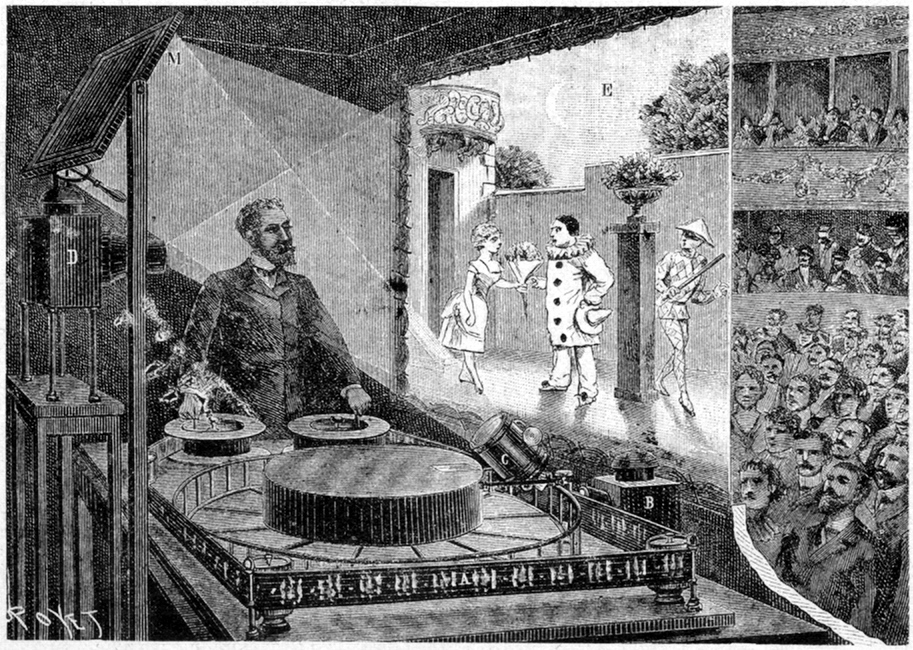
In the winter of 1832–33 the physicist Joseph Plateau in Ghent and Simon Stampfer in Vienna independently built spinning slotted discs that turned a ring of drawn phases into continuous motion; William Horner in Bristol described the drum version, later sold as the zoetrope, in 1834. Charles-Émile Reynaud in France patented the praxinoscope in 1877 and then scaled it into the Théâtre Optique, which opened at the Musée Grévin in Paris on 28 October 1892 with hand-painted picture bands hundreds of frames long. It ran for eight years and roughly 12,800 performances. In 1910, broke and superseded, Reynaud destroyed the machine and threw most of the bands into the Seine; two survive.

Timeline

1892Reynaud projects the first moving pictures

Charles-Émile Reynaud's Théâtre Optique opened at the Musée Grévin in Paris on 28 October 1892 with Pauvre Pierrot and two other pantomimes, each hand-painted frame by frame onto a perforated band and projected behind a live piano accompaniment. It predates the Lumière brothers' first paying screening by three years, which makes projected animation, strictly speaking, older than projected film.

1908Fantasmagorie and the first drawn film

Émile Courtet, working as Émile Cohl, premiered Fantasmagorie at the Théâtre du Gymnase in Paris on 17 August 1908: roughly seven hundred ink drawings on paper, shot one frame at a time and printed as a negative so the black lines read as chalk on a blackboard. Cohl was fifty-one, a caricaturist with no film background, and had been at Gaumont barely a year.

1914Gertie the Dinosaur takes the stage

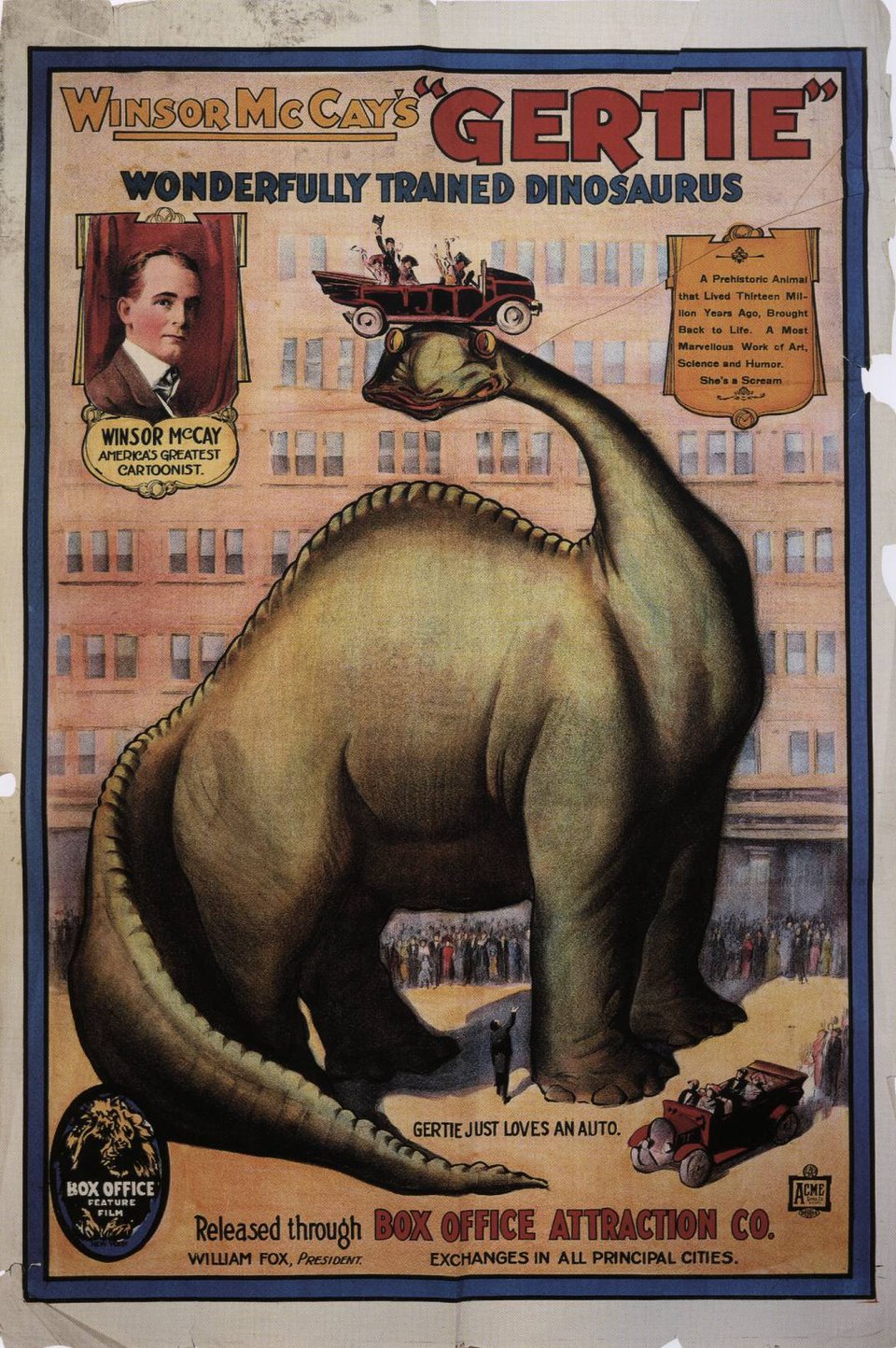
Winsor McCay premiered Gertie as a vaudeville act at Chicago's Palace Theater in February 1914, standing beside the screen with a whip, coaxing and scolding a dinosaur who obeyed, sulked and wept on cue. He drew about ten thousand sheets himself while an assistant, John Fitzsimmons, traced the background onto every one. At the finish McCay walked behind the screen and reappeared, drawn, riding on Gertie's back.

1915The cel patent industrialises the craft

Earl Hurd filed a patent in December 1914, granted the following year, for drawing characters on transparent celluloid sheets laid over a single painted background; John Randolph Bray pooled it with his own registration patents. Overnight, animation stopped being one artist redrawing everything and became an assembly line of key animators, in-betweeners, inkers, painters and camera operators — the structure the trade still uses.

1926Lotte Reiniger's Prince Achmed

The Adventures of Prince Achmed, made in Potsdam over three years with roughly a quarter of a million frames exposed, is the oldest surviving feature-length animated film. Reiniger cut every silhouette freehand from black card, holding the scissors still and turning the paper, and with Carl Koch built a layered glass trick table that produced depth effects a decade before Disney's multiplane camera.

1928Steamboat Willie locks picture to sound

Premiered at New York's Colony Theater on 18 November 1928, the third Mickey Mouse short but the first released, it synchronised action to a pre-recorded track using a click-based bar sheet. Ub Iwerks had animated its predecessor, Plane Crazy, almost single-handed at a reported seven hundred drawings a day. From this point every animator worked to an exposure sheet counted in twenty-fourths of a second.

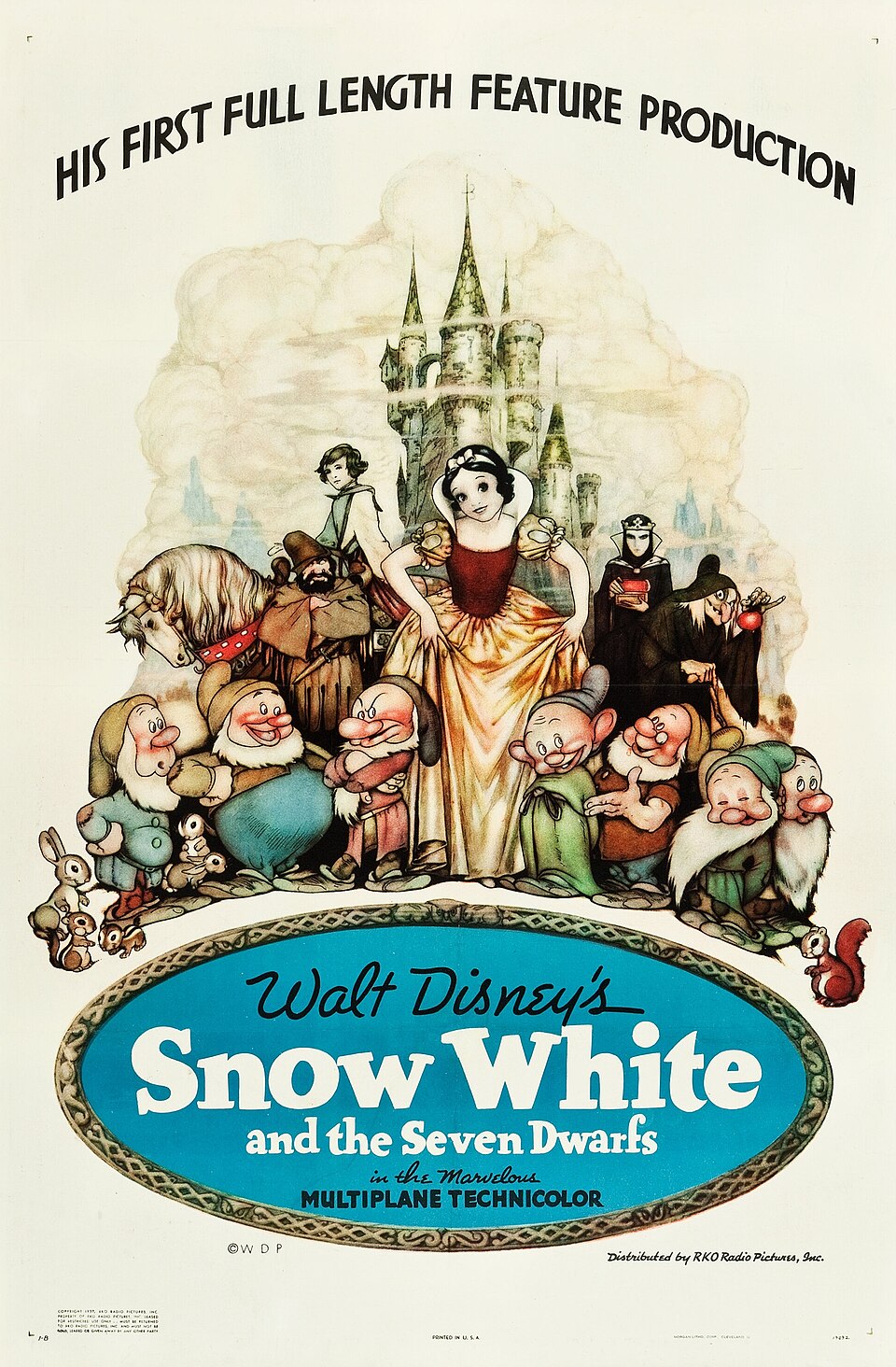
1937Snow White proves the feature

Premiered at the Carthay Circle Theatre in Los Angeles on 21 December 1937, Disney's first feature cost about $1.5 million, was nicknamed Disney's Folly across the industry, and used around a quarter of a million finished drawings. Its multiplane camera work, rotoscoped human figures and in-house life-drawing classes under Don Graham set the standard other studios spent thirty years chasing.

1963Astro Boy invents the weekly schedule

Osamu Tezuka's Mushi Production put Astro Boy on Fuji TV on 1 January 1963 and had to deliver a new episode every week on a television budget. The answer was limited animation: held drawings, reused cel banks, three-frame mouth cycles, and as few as eight drawings a second. It created the industry that now employs most of the world's animators, on terms it has never fully escaped.

1995Toy Story, and the end of ink and paint

Disney's Computer Animation Production System, built with Pixar, replaced hand inking and painting outright on The Rescuers Down Under in 1990. Five years later Toy Story, directed by John Lasseter at Pixar and released in November 1995, became the first entirely computer-animated feature. Within a decade most Western studios had closed their hand-drawn units; Disney shut its Florida animation building in 2004.

2018–2025Style returns, and the tools get cheap

Spider-Man: Into the Spider-Verse in 2018 deliberately animated its lead on twos while other characters ran on ones, and layered hand-drawn line work over CG, ending the assumption that computer animation had to look smooth and photoreal. In March 2025 Flow, made in Latvia by a small team using the free, open-source Blender, won the Academy Award for Best Animated Feature.
The eras

Reynaud's Théâtre Optique projection apparatus.
Louis Poyet · Public domain · Wikimedia Commons
1832–1905

Optical toys and the fairground

For seventy years animation was a physics demonstration that became a parlour toy and then a paid attraction. Plateau's and Stampfer's spinning discs sold in their thousands across Europe; Horner's zoetrope drum let several people watch at once; Reynaud's praxinoscope put a mirror drum in middle-class living rooms before he scaled it into a Paris theatre. The people making the pictures were not called animators and mostly were not credited at all, but the core discipline — draw the phases of a motion in order, at a fixed interval — was already fully formed.

A frame from Winsor McCay's Gertie the Dinosaur, 1914.
unknown (Box Office Attraction Co.) · Public domain · Wikimedia Commons
1906–1927

The newspaper cartoonist's cinema

Animation entered film through the comic strip. J. Stuart Blackton in New York, Émile Cohl in Paris and Winsor McCay, already famous for Little Nemo, all came from newspapers, and their early films are signed personal performances. Ladislas Starevich in Moscow independently invented puppet animation by wiring beetle carcasses into position after failing to film live ones under hot lights. Then Bray and Hurd's patents arrived, studios formed around them, and by the mid-1920s the individual signature had largely been replaced by an unnamed production line turning out one Felix or Koko short a fortnight.

Publicity artwork from Snow White and the Seven Dwarfs, 1937.
Gustaf Tenggren · Public domain · Wikimedia Commons
1928–1960

The studio golden age and its strike

Sound, three-strip Technicolor and the multiplane camera arrived within a decade of each other, and Disney's Snow White in 1937 proved audiences would sit through ninety minutes of drawings. Warner Bros., Fleischer, MGM, Toei in Japan and the Wan brothers in Shanghai all built feature or short-film units. The other half of the story is labour: the Disney animators' strike that began in May 1941, led by Art Babbitt, ended in federal mediation, scattered talent across the industry and seeded UPA, whose flat, graphic Gerald McBoing-Boing won an Academy Award in 1951 by rejecting Disney's realism entirely.

1960–1994

Television economics and the festival counter-current

Hanna-Barbera's The Flintstones reached prime time in 1960 and Astro Boy reached Japanese television in 1963, both built on limited animation and both wildly profitable; the cost was a generation of work priced by the drawing. Against that, a festival culture grew up around Annecy, founded in 1960, and ASIFA, founded the same year with Norman McLaren as its first president. Jiří Trnka's puppets in Prague, Dušan Vukotić's Zagreb school — the first non-American winner of the animated short Oscar, in 1962 — and Yuri Norstein's glass-level cut-outs in Moscow kept the medium's other half alive.

1995–present

Computers, collapse and cheap tools

Toy Story in 1995 made computer animation commercially inevitable, and within a decade the Western hand-drawn feature was effectively extinct as a studio product. Anime went the other way, expanding on streaming money until Japan's industry passed ¥3 trillion in 2023 while its in-between rung stayed among the worst-paid skilled work in a rich country. Meanwhile the tools collapsed in price: Blender is free, Grease Pencil draws 2D inside 3D space, and Flow won an Academy Award in 2025 on a budget a major studio would spend on a trailer.

What this job replaced

Neighbouring trades that no longer exist — absorbed, automated or regulated away.

Ink-and-paint artist

1915–1990s

After the cel patent, an entire department traced each animator's pencil line in ink onto celluloid and painted the reverse side in opaque colour, matching custom-mixed shades across thousands of frames. At Disney and Fleischer the department was almost entirely women, on lower pay and with no promotion path into animation — a 1938 Disney form letter told applicant Mary V. Ford that women were not considered for creative work. The Computer Animation Production System replaced the whole department outright on The Rescuers Down Under in 1990.

The in-betweener

1915–2004 in Western studios

The entry rung of the craft drew the frames between a key animator's poses, matching another person's line exactly while learning timing from the inside. It was badly paid but it was a real apprenticeship, and almost every great animator passed through it. Western studios shed the role when hand-drawn features collapsed after 2004; vector in-betweening software and, since the 2020s, AI frame interpolation absorbed most of what remained. In Japan the rung survives, still paid per drawing.

Rostrum camera operator

c. 1915–1998

Someone had to photograph the artwork one frame at a time on a downshooter stand — an Oxberry or a Soviet or Japanese equivalent — following the exposure sheet line by line, sliding cel levels, cranking the table, holding registration to a fraction of a millimetre. A single misread row meant reshooting the scene. Digital compositing, first through CAPS and then through desktop software after After Effects appeared in 1993, removed the camera and the job with it.

Trades that vanished →

Nothing in this history was ever undone by nostalgia. Cel painting did not come back, the rostrum camera did not come back, and the hand-drawn Western feature has returned only as an occasional prestige project. What survived every one of those losses is the specific decision the job is made of: how far apart to put the next two positions.

At a dinner held in his honour in 1927, Winsor McCay told a room of studio animators that they had turned an art into a trade. He was right about what had happened and wrong about what it meant — the trade is what let hundreds of thousands of people make a living at it, and it is inside that trade, not outside it, that the craft has kept getting better.

Keep exploring

More in Media & Performance