Milestones in order. This is history, not a weekly activity grid.
- The first world championship
- Geoff Duke and Norton
- MV Agusta's first premier title
- Hailwood's four in a row
- Agostini arrives
- The Isle of Man revolt
- The two-stroke breakthrough
- The TT loses championship status
- Kenny Roberts, rookie champion
- Spencer's double
- Lawson switches and wins
- Rainey's career ends at Misano
- Doohan's dominance
- MotoGP replaces 500cc
Last reviewed Sources & creditsMedia creditsMethodology
Quick answers
What is the difference between MotoGP and World Superbike?
MotoGP is a prototype championship: every bike is a purpose-built racing machine that cannot be bought and has no road-going equivalent. Current MotoGP machines run 1,000cc four-cylinder engines producing well over 300 horsepower at a minimum weight of 157 kilograms. World Superbike, by contrast, uses heavily modified versions of motorcycles you can buy from a dealer, with regulations that limit how far they can be altered and balancing rules that equalise performance between manufacturers. MotoGP is faster and technically far more advanced, but Superbike racing is often closer because the machinery is more constrained. The two series have distinct rider markets, and moving between them is common in both directions.
How does the MotoGP Sprint race work?
Since 2023, every Grand Prix weekend has included a Sprint on Saturday afternoon, run over roughly half the Sunday race distance, typically 10 to 14 laps and around 20 minutes. It uses the same grid set by Saturday morning qualifying, and there is no separate session for it. Points go to the top nine finishers only: 12 for the win, then 9, 7, 6, 5, 4, 3, 2 and 1. The Sprint result does not change Sunday's grid, and riders are free to choose different tyres for each race, though the shorter distance pushes almost everyone onto softer compounds. A perfect weekend is worth 37 points.
Who has won the most MotoGP world championships?
Giacomo Agostini holds the record with 15 world championships, eight of them in the premier 500cc class and seven in the 350cc class, won between 1966 and 1975. In the premier class specifically, Agostini's eight titles lead Valentino Rossi and Marc Marquez, who have seven each. Mike Hailwood also won nine world championships across the 250cc, 350cc and 500cc classes. For race wins, Agostini leads all classes with 122, while Rossi holds the premier-class record with 89 victories from 2000 to 2017. Marquez passed Agostini's premier-class total of 68 during the 2025 season and now sits second behind Rossi.
How fast do MotoGP bikes go?
The outright record is 368.6 km/h, set by Jorge Martin on an Aprilia RS-GP during practice at Mugello in May 2026, beating the 366.1 km/h Brad Binder recorded at the same circuit in 2023. Mugello's kilometre-long main straight makes it the usual venue for speed records, though Sepang, Phillip Island and Losail also produce numbers above 350 km/h. More impressive than the top speed is the deceleration: a MotoGP bike sheds more than 250 km/h in around four seconds and roughly 250 metres, generating over 1.5g through carbon brake discs that only work properly above about 250 degrees Celsius.
What changes in MotoGP in 2027?
Four major things happen at once. Engine capacity drops from 1,000cc to 850cc with maximum bore reduced from 81mm to 75mm, and the engine allocation falls from seven to six per rider per season. Fuel capacity falls from 22 litres to 20 for a Grand Prix, and all fuel must be 100 percent non-fossil in origin, up from the 40 percent minimum in force since 2024. Aerodynamics are cut back, with narrower fairings and restricted rear devices, and ride-height and holeshot systems are banned outright. Finally, Pirelli replaces Michelin as sole tyre supplier after eleven seasons. The combined intent is slower, cheaper bikes that are easier to follow and overtake.
Why do MotoGP riders drag their knees and elbows?
Hanging off the inside of the bike moves the combined centre of mass of rider and machine inwards, which means the motorcycle itself can stay more upright for a given cornering speed and keep a larger, safer contact patch on the tyre. Knee sliders came first, in the 1970s, as riders such as Kenny Roberts began moving their bodies off the seat. As tyres and chassis improved, lean angles increased past 60 degrees and the elbow started reaching the tarmac too, a style Marc Marquez normalised in the 2010s. The contact also provides feedback: a rider can feel exactly how far the bike is leaned and, in a front-end slide, sometimes use knee and elbow to prop the machine back up.
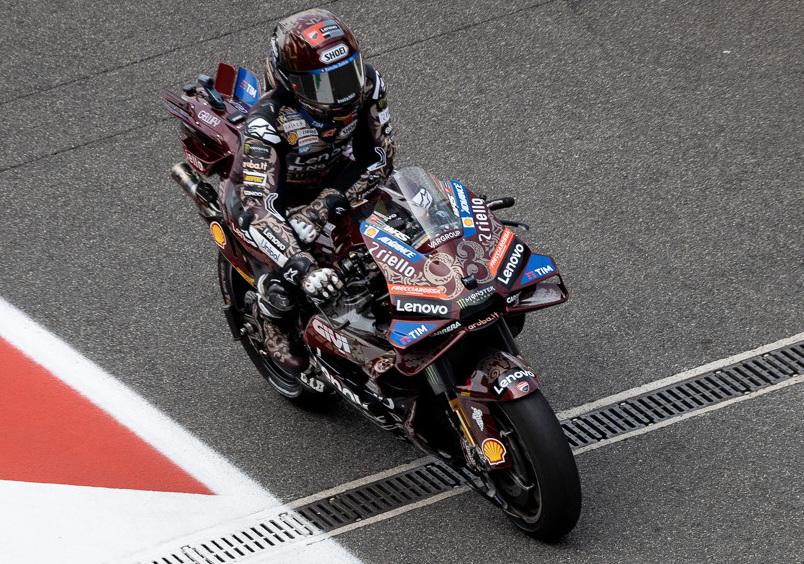
The world championship began in 1949, a year before Formula 1, with six rounds and five classes. Les Graham took the first 500cc crown on an AJS Porcupine, the only twin-cylinder machine ever to win the premier title. For its first two decades the championship was a European affair contested on closed public roads: the Isle of Man Mountain Course, Spa-Francorchamps, the Clady circuit in Ulster, Bremgarten in Switzerland. A mistake was frequently fatal. British single-cylinder Nortons gave way to Italian multi-cylinder Gileras and MV Agustas, and the balance of power moved to Lombardy for a generation.
Everything since has been a sequence of technical resets. Two-strokes displaced four-strokes in the 1970s and ruled for a quarter of a century; four-strokes returned in 2002 at 990cc, shrank to 800cc in 2007 and settled at 1,000cc in 2012. Electronics arrived, then were standardised in 2016. Aerodynamic wings appeared, were banned, returned in enclosed form and were then progressively regulated. Each reset redistributed the advantage and produced a different kind of champion, from Geoff Duke's smooth Norton lines to Kenny Roberts sliding a two-stroke sideways to Marc Marquez catching front-end slides on his elbow.
Timeline
The FIM launches a six-round series across five classes. Les Graham wins the inaugural 500cc title on an AJS Porcupine, the only twin ever to take the premier crown.
Duke wins the 350cc and 500cc titles in the same year on Norton singles. He adds three more premier crowns with Gilera in 1953, 1954 and 1955.
John Surtees gives MV Agusta the first of a long run of 500cc championships. He later becomes the only person to win world titles on two and four wheels.
Mike Hailwood begins a run of four consecutive 500cc titles for MV Agusta. He retires from Grand Prix racing in 1967 with nine world championships and 76 wins.
Giacomo Agostini takes the first of seven straight 500cc titles on the MV Agusta three-cylinder, adding seven 350cc crowns in the same period.
After Gilberto Parlotti is killed at the TT, Agostini refuses to return and leads a riders' boycott of the 60-kilometre Mountain Course.
Agostini wins the 500cc title on a Yamaha, the first two-stroke premier crown and the end of MV Agusta's seventeen-year hold on the class.
The Isle of Man TT is dropped from the world championship calendar after 1976, closing a 68-year association and marking the sport's turn towards purpose-built circuits.
The American wins the 500cc title at his first attempt, importing dirt-track technique and deliberately spinning the rear tyre to steer the motorcycle.
Freddie Spencer wins the 250cc and 500cc world championships in the same season for Honda, a feat nobody has repeated.
Eddie Lawson takes the 500cc title with Honda a year after winning it with Yamaha, the first rider to win back-to-back premier crowns on different machinery.
Leading the championship by 11 points, Wayne Rainey crashes and is paralysed from the chest down. Kevin Schwantz wins his only title.
Mick Doohan wins 12 of 15 races on the Honda NSR500, the third of five consecutive premier titles taken between 1994 and 1998.
Four-strokes return at 990cc. Valentino Rossi wins the first MotoGP title on Honda's RC211V after taking the last 500cc crown in 2001.
Rossi joins a Yamaha that had not won a race in 2003, wins first time out at Welkom and takes the championship, the defining rider-over-machine argument of the modern era.
The class shrinks to 800cc. Casey Stoner wins ten races in his second premier season and gives Ducati its first riders' championship.
Capacity returns to 1,000cc with a four-cylinder and 81mm bore limit. Moto3 replaces 125cc, two years after Moto2 took over from the 250cc class.
Marc Marquez wins the title as a rookie at 20 years and 266 days, having already become the youngest premier-class race winner at Austin aged 20 years and 63 days.
Every round gains a half-distance Saturday Sprint, doubling the number of competitive races. Francesco Bagnaia wins the first Sprint-era championship with 467 points.
Liberty Media completes its purchase of Dorna Sports in July. Marc Marquez scores a record 545 points and clinches a seventh premier title with five rounds remaining.
The eras
Road Circuits and the Italian Ascendancy
The championship's first sixteen seasons were run largely on closed public roads, with the Isle of Man's Mountain Course as the defining test. Les Graham won the inaugural 500cc title in 1949 on an AJS Porcupine, but British dominance rested on Norton's single-cylinder Manx, which Geoff Duke rode to the 1951 crown before defecting to Gilera and winning three more in 1953, 1954 and 1955. Italian multi-cylinder engineering then settled the argument. Gilera's across-the-frame four, and MV Agusta's answer to it, made the big single obsolete, and from 1958 MV Agusta won seventeen consecutive premier titles. John Surtees took four of them between 1956 and 1960 before leaving for Formula 1, where he became world champion with Ferrari in 1964. Mike Hailwood, arguably the most naturally gifted rider of the period, added four straight from 1962 to 1965. Safety barely existed: riders wore pudding-basin helmets and, after Duke commissioned a local tailor to make him one, one-piece leathers. Start money rather than prize money paid the bills, and Duke's six-month suspension in 1956 for supporting a riders' strike showed how little leverage competitors had. The formula was open, fields were thin, and the man on the fastest Italian four usually won.
Agostini, MV Agusta and the Safety Reckoning
Giacomo Agostini converted MV Agusta's advantage into the most concentrated dominance the sport has produced: seven consecutive 500cc titles from 1966 to 1972 and, across the same years, seven 350cc crowns, a double-class routine that meant racing twice on a Sunday and expecting to win both. His 1968 season was a whitewash of every 500cc round, part of a run of 20 straight premier-class victories. Behind the numbers the sport was in crisis. Riders were dying regularly on circuits with no run-off, and after Gilberto Parlotti was killed at the 1972 Isle of Man TT, Agostini refused to return to the Mountain Course. Phil Read, Barry Sheene and others joined the pressure campaign, and the TT lost world championship status after 1976. The technical order also flipped. Two-stroke engines, dismissed as crude in the 1950s, became lighter and more powerful than any four-stroke, and Yamaha's TZ and Suzuki's RG500 took over. Agostini confirmed the switch himself, leaving MV Agusta for Yamaha and winning the 1975 title on a two-stroke, the first in the premier class and the end of MV Agusta's seventeen-year run. Barry Sheene's Suzuki titles in 1976 and 1977 then made him Britain's first genuine crossover sporting celebrity.
The Two-Stroke 500cc Era
For a quarter of a century the premier class meant 500cc two-strokes: roughly 190 horsepower, around 130 kilograms, no traction control and a powerband that arrived like a switch. Kenny Roberts came from American dirt track in 1978, won the title as a rookie and changed riding technique permanently by deliberately spinning the rear tyre to steer. He also forced change off track, threatening a breakaway World Series in 1979 that pushed the FIM into better safety standards and far higher rider pay. Freddie Spencer beat him by two points in 1983 and then, in 1985, won the 250cc and 500cc championships in the same season. Eddie Lawson won four titles across two manufacturers, taking the 1989 crown with Honda a year after winning with Yamaha. The early 1990s produced the sport's fiercest rivalry in Wayne Rainey and Kevin Schwantz, ended brutally when Rainey was paralysed at Misano in 1993 while leading the championship. Mick Doohan then built a dynasty of five straight titles from 1994 to 1998, winning twelve of fifteen races in 1997 despite a permanently damaged right leg and a thumb-operated rear brake. Valentino Rossi closed the era by winning the final 500cc championship in 2001 for Honda.
Four-Strokes Return: 990cc, 800cc and the Rossi Years
MotoGP replaced the 500cc class in 2002 with 990cc four-strokes, and the change was decisive within a season: two-strokes were uncompetitive by 2003 and gone soon after. Rossi won on Honda's RC211V in 2002 and 2003, then made the defining move of the modern era by joining Yamaha, whose M1 had not won a race in 2003, and winning first time out at Welkom in 2004 before taking the championship. He won again in 2005, 2008 and 2009. The formula shrank to 800cc in 2007 in the name of controlling speeds, a change that rewarded corner speed and electronics over raw horsepower. Casey Stoner exploited it immediately, giving Ducati its only premier title of that period with ten wins in 2007 on a bike almost nobody else could ride quickly. Jorge Lorenzo's metronomic Yamaha style delivered 2010, and Stoner returned with Honda to win 2011. That season also brought tragedy: Marco Simoncelli was killed at Sepang in October, a year after Shoya Tomizawa died in Moto2 at Misano. The 800cc class was widely criticised as too small, too electronic and too expensive, and a return to 1,000cc had already been agreed.
The 1,000cc Formula, Marquez and Aerodynamics
Engines grew back to 1,000cc in 2012 with a four-cylinder and 81mm bore limit that still applies. Marc Marquez arrived in 2013 and won the title as a rookie at 20 years and 266 days, the youngest premier-class champion ever, then took 13 of 18 races in 2014, still the single-season record. He won six titles in seven years between 2013 and 2019 on a Honda that was regularly not the best bike, and built a technique around catching front-end slides with his elbow that rivals openly admitted they could not copy. Around him the sport standardised: a single Magneti Marelli control ECU from 2016, and Michelin replacing Bridgestone as sole tyre supplier the same year. Then came aerodynamics. Ducati's winglets, banned and reintroduced in enclosed form, spread to every manufacturer and progressively turned MotoGP bikes into downforce machines, followed by holeshot and ride-height devices that squat the chassis for acceleration. Marquez's severe humerus injury at Jerez in July 2020 opened the field: Joan Mir won a COVID-shortened 14-round season for Suzuki, Fabio Quartararo became France's first premier champion in 2021, and Francesco Bagnaia restored Ducati in 2022, its first riders' title since Stoner in 2007.
Sprints, Ducati's Hegemony and the Liberty Era
Sprint races arrived at every round in 2023, doubling the number of competitive races and rewriting the points landscape. A weekend now offers up to 37 points, and champions' totals climbed accordingly: 467 for Bagnaia in 2023, 508 for Jorge Martin in 2024 and a record 545 for Marc Marquez in 2025. Martin's title was the first in the MotoGP era for a rider from an independent team, won on a Pramac Ducati by ten points from the factory-backed Bagnaia. Ducati's grip tightened regardless, with six consecutive constructors' championships from 2020 to 2025 and, in 2025, victory in 27 of the first 29 races and Sprints. Marquez, having left Honda for a satellite Ducati in 2024 and the factory squad in 2025, produced the comeback of the era: a seventh premier crown clinched with five rounds left, 2,184 days after his previous title, and 14 Sprint wins from the season's first 15. Off track the ownership changed hands, with Liberty Media completing its roughly 84 percent purchase of Dorna Sports in July 2025 in a deal valuing the promoter at around 4.2 billion euros. With Pirelli tyres and 850cc engines due in 2027, the period already reads as the close of a chapter.
Seventy-seven seasons on, the shape of the championship is recognisable from 1949: a handful of factories, a travelling paddock, and a title decided over a European-weighted calendar. Almost everything else has changed. The premier class has been 500cc four-stroke, 500cc two-stroke, 990cc, 800cc and 1,000cc, and becomes 850cc in 2027. It has been raced on public roads and on purpose-built circuits with air fences and gravel traps; riders now wear mandatory airbag suits, introduced across all classes in 2018. What survives is the specific difficulty of the thing: a machine that must be balanced, braked and steered by a human body hanging off it at 60 degrees of lean, which is why the argument over who did it best never really resolves.
Keep exploring
More sports
Soccer
The simplest game on Earth, played by hundreds of millions and argued over by half the planet.
🏀Basketball
Five players, 24 seconds, and geometry at full sprint — the city game that conquered the world.
⚾Baseball
The clockless chess match where a round bat meets a round ball and the best hitters on earth still fail seven times out of ten.
🎾Tennis
The loneliest duel in sport: no clock, no teammates, no place to hide until the last point is won.
🏎️F1
Twenty drivers, a thousand horsepower, and the most expensive engineering arms race in sport.
⛳Golf
A six-century test of nerve where the only opponent is the ground, the wind, and yourself.
🏈Football
Four downs, ten yards, one end zone: the ultimate game of territory, collision, and coaching.
🏏Cricket
The bat-and-ball contest where a single match can last five days and still turn on one ball.