Roughly 20 million players in about 185 countries, under some 150 national federationsGlobal reach
World Squash Federation, founded 1967 as the ISRF and renamed WSF in 1992; based in Hastings, EnglandGoverning body
Debuts at Los Angeles 2028, after the IOC vote in Mumbai on October 16, 2023Olympic status
9.75 m long by 6.4 m wide, front wall 4.57 m high above a 0.48 m tinThe court
Point-a-rally to 11, win by 2, best of five games — universal since the 2008-09 seasonScoring
8 each — Jansher Khan (1987-1996) and Nicol David (2005-2014)Most world titles
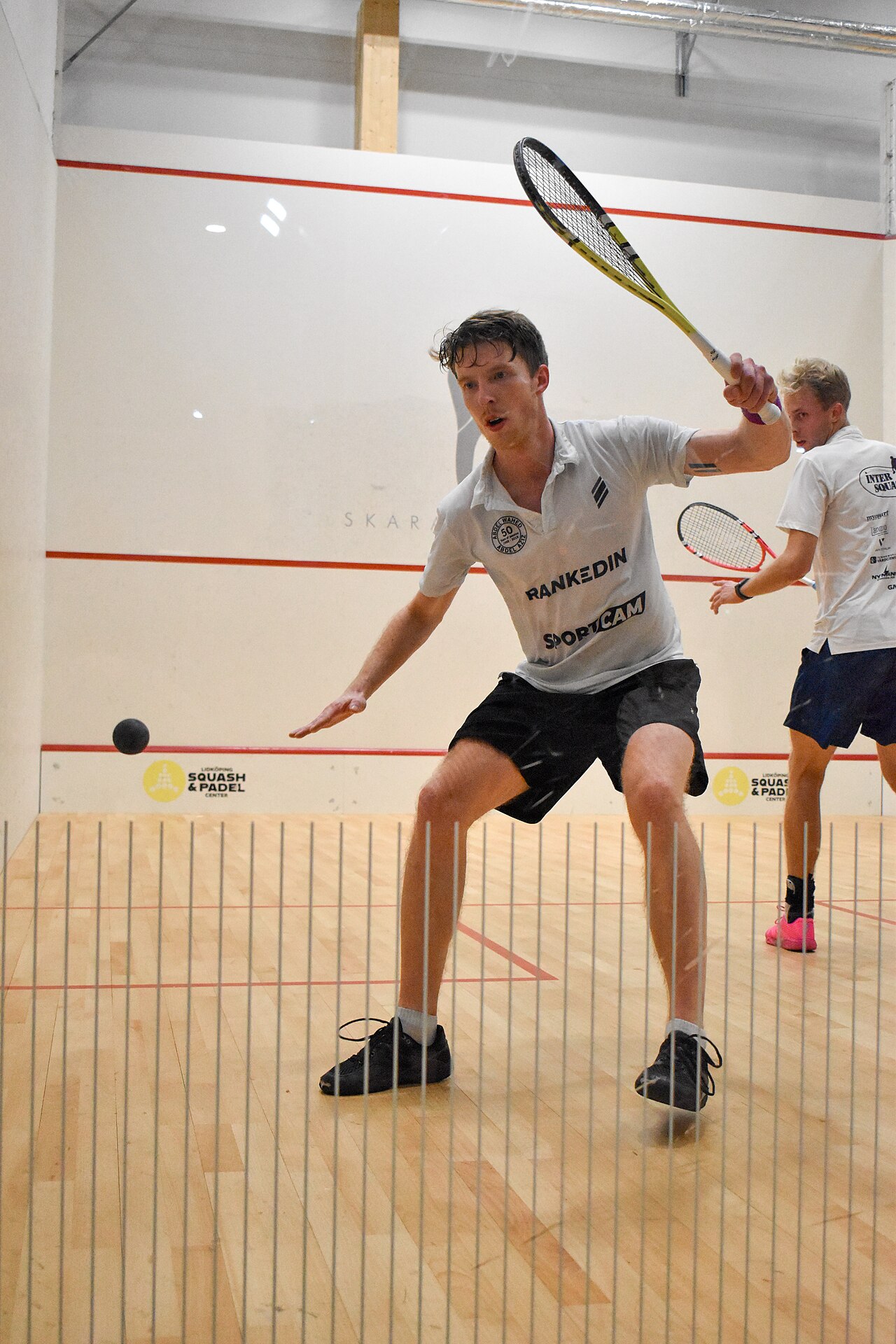
Squash is played inside a sealed box measuring 9.75 by 6.4 meters, and that enclosure is the whole point. Because both players share the same space and hit into the same front wall, there is no net to separate them and no side of the court to defend — only a permanent negotiation over territory, angles and the right to swing. The ball, a hollow rubber sphere about 40 millimeters across, barely bounces when cold and dies in the back corners even when warm. Everything the sport asks of a player follows from those two facts: control the middle, and make the opponent travel further than you do.
No racket sport punishes fitness gaps more brutally. A single elite game can last twelve minutes of near-continuous movement, with lunges, direction changes and recoveries repeating every two or three seconds and no serve clock or between-point walk to hide behind. Forbes ranked squash the healthiest sport in the world in its 2003 survey, weighing cardiorespiratory load, muscular endurance and calorie burn, and the professional game bears that out: five-game matches routinely pass 90 minutes, and the longest recorded competitive match, Jahangir Khan against Gamal Awad in 1983, ran two hours and 46 minutes with a single rally lasting five and a half minutes.
Its geography is genuinely global and rarely where outsiders expect. Invented by schoolboys at Harrow in the 1830s and codified by the English, the sport was seized in the 1950s by a family of court professionals from Peshawar, dominated for four decades by Pakistan, contested throughout by Australia and New Zealand, ruled in the women's game by a Malaysian who spent 112 straight months at world number one, and owned in the modern era by Egypt, whose academies now supply most of the world's top ten. After five failed Olympic bids, squash finally enters the Games at Los Angeles in 2028.
Yes, from 2028. The IOC session in Mumbai voted on October 16, 2023 to add squash to the Los Angeles 2028 programme, alongside cricket, baseball and softball, flag football and lacrosse. The programme is singles events for men and women. It ends a long campaign: squash bid unsuccessfully for the 2012, 2016, 2020 and 2024 Games, losing to golf and rugby sevens for 2016 and to reinstated wrestling for 2020. The consequences go well beyond one fortnight. In most countries, national sports funding is tied to Olympic status, so federations that operated on subscriptions and volunteers now qualify for state high-performance money, which is reshaping coaching and junior programmes worldwide.
How does squash scoring work?
Modern squash uses point-a-rally scoring, or PAR: every rally is worth a point regardless of who served. Games are played to 11, and at 10-10 play continues until someone leads by two. Matches are best of five games, with 90 seconds between games. There is only one serve — no second serve — so a fault loses the rally outright. This system replaced the old English scoring, in which only the server could score and games ran to nine; the men's professional tour switched in 2004 and the World Squash Federation extended PAR to every level from the 2008-09 season. The change shortened matches significantly and pushed players toward attacking earlier, since long defensive rallies now carry a real cost.
What is the difference between a let and a stroke?
Both concern interference, which is unavoidable when two players share one court. A let is a replayed rally with no point awarded: it is given when the opponent got in the way but made a genuine effort to clear, and the interfered player would have made a good return rather than a winning one. A stroke awards the point outright to the interfered player: it applies when the opponent did not make every effort to clear, when the striker's swing was blocked, when the ball would have hit the opponent on a direct path to the front wall, or when the striker would have hit a winner. If the striker could not have reached the ball anyway, or the interference was trivial, the referee calls no let and the appealing player loses the rally.
What do the coloured dots on a squash ball mean?
They indicate how much the ball bounces, which is really a measure of how much work you have to do. Blue and red dots are the liveliest and are made for beginners and cold courts, because the ball keeps bouncing without needing to be warmed up. A single yellow dot is slow, and the double yellow dot, standardized around 2000, is the extra-slow professional ball used in all serious competition. A double-yellow ball is almost dead when cold and must be warmed through several minutes of hard hitting before it plays properly, which is why matches begin with a five-minute knock-up. Beginners using a professional ball will find it simply does not bounce, which is the single most common reason people give up on squash.
Why is Egypt so dominant in squash?
Egypt has held roughly half of both the men's and women's world top tens through the 2020s, an unmatched concentration. The reasons are structural rather than mysterious. Egyptian sporting clubs in Cairo and Alexandria are family institutions with dense court provision, so children start young and play constantly. A coaching lineage runs from the pioneers through Amr Shabana and Ramy Ashour to today's academies, transmitting a distinctive attacking style built on deception, holds and front-court aggression. The domestic junior circuit is more competitive than most international ones. And there is a long history to build on: F.D. Amr Bey won five British Opens in the 1930s, so squash has been a prestige sport in Egypt for almost a century.
Is squash really the healthiest sport?
Forbes ranked squash first in its 2003 survey of the ten healthiest sports, scoring it on cardiorespiratory endurance, muscular endurance, calorie burn, strength, flexibility and injury risk. The logic holds up: squash combines near-continuous movement with repeated high-intensity efforts, rapid direction changes and deep lunges, all inside a heated, enclosed space, so heart rates sit high for long stretches and calorie expenditure per hour is among the highest of any recreational sport. The caveats are real, though. The same lunging load makes knee, hip and Achilles injuries common, and the intensity is not gentle on an unconditioned cardiovascular system. Eye injuries from the ball and racket are the reason protective eyewear is mandatory for juniors in most federations.
What is the difference between squash, racquetball and padel?
All three are walled or caged racket sports, but they play nothing alike. Squash uses a small, low-bouncing rubber ball on a 9.75 by 6.4 metre court, and every shot must reach the front wall above a tin roughly half a metre high — the tin is what makes squash a precision sport. Racquetball, mainly North American, uses a bigger, much livelier ball on a wider court with no tin, and the ceiling is in play, producing higher, faster, more chaotic rallies. Padel is played in doubles on an enclosed court with a net across the middle, solid stringless bats and a slightly depressurized tennis ball; the walls are used for rebounds but the game is fundamentally tennis-shaped. Squash is by some distance the most physically demanding of the three.
How fit do you need to be to play squash?
More than for almost any other racket sport, but the entry level is manageable if you scale the ball and the rallies. A professional five-game match can pass 90 minutes of near-continuous movement, with a lunge and recovery every two to three seconds and no natural rest beyond the 90 seconds between games; elite players cover several kilometres in short, explosive bursts. For a beginner, the practical advice is to start with a red or blue dot ball, which bounces enough to allow rallies without extreme retrieval, and to expect shorter points. The specific physical demands worth preparing for are eccentric leg strength for the lunge, hip and ankle mobility, and the ability to change direction repeatedly rather than run in a straight line.