Milestones in order. This is history, not a weekly activity grid.
- The numbering sequence appears
- Darts ruled a game of skill
- The treble ring is added
- News of the World championship launched
- Darts reaches television
- The British Darts Organisation forms
- The World Darts Federation founded
- The first World Championship
- Eric Bristow's first world title
- Keith Deller's 138
- The first televised nine-darter
- Television walks away
- The breakaway
- A rival world championship
Last reviewed Sources & creditsMedia creditsMethodology
Quick answers
Why are the numbers on a dartboard in that order?
The sequence — 20, 1, 18, 4, 13, 6, 10, 15, 2, 17, 3, 19, 7, 16, 8, 11, 14, 9, 12, 5 clockwise from the top — is designed to punish inaccuracy. Every high number is flanked by two of the lowest, so a dart that drifts a few millimetres off the 20 lands in the 5 or the 1, and a wayward visit can score under 10. That arrangement is what makes darts a skill sport rather than a lottery: precision is rewarded disproportionately and near misses are penalised harder than a deliberately safe shot at a middling number. The design is traditionally credited to Brian Gamlin, a carpenter from Bury, in 1896, though no documentary evidence has ever confirmed it.
What is a nine-dart finish?
A nine-darter is a perfect leg: 501 checked out in the minimum possible nine darts. The classic route is 180, 180, then treble 20, treble 19, double 12 to finish 141. Alternatives include 167, 167, 167, each of treble 20, treble 19 and bullseye. John Lowe threw the first on television on 13 October 1984 and collected £102,000. It remains the sport's signature achievement, though it has become far less rare: professionals now throw several a season across the circuit, and Phil Taylor holds the record of eleven on television, including two in a single match in the 2010 Premier League final against James Wade.
Why do you have to finish on a double?
The double-out rule exists to stop legs ending by accident and to place the hardest shot at the most pressurised moment. Without it a player could simply scrape to zero with any dart, and the finish would carry no risk. Requiring an exact landing in a bed roughly eight millimetres wide means that scoring your way to a finish is only half the job — the best scorers in the world convert only about 35 to 45 per cent of their double attempts in televised matches. It also creates the game's arithmetic: what you leave yourself matters as much as what you score, which is why professionals engineer finishes toward 32 and 40 rather than simply taking the biggest available number.
How far do you stand from a dartboard?
The throwing line, called the oche, is 2.37 metres (7 feet 9.25 inches) from the face of the board, measured horizontally along the floor. The centre of the bullseye sits 1.73 metres (5 feet 8 inches) above the floor, which puts it at roughly eye level for an average adult male — the height was standardised from pub practice rather than designed. Both measurements were fixed internationally by the World Darts Federation in the 1970s, ending decades of local variation in which distances were paced out rather than measured. A player may lean over the oche as far as balance allows but must not step on or beyond it, and the diagonal distance from the throwing point to the bull is 2.93 metres.
What is a three-dart average and what counts as good?
It is total points scored divided by darts thrown, multiplied by three — the sport's headline measure of scoring power. A casual pub player might average in the 40s or 50s, a good league player in the 70s, and a county-standard player in the 80s. A PDC Tour Card holder needs to average in the mid-90s to survive on the circuit. Above 100 in a televised match is a strong performance, above 105 is exceptional, and the all-time televised record is Michael van Gerwen's 123.40 against Michael Smith in 2016. Because the average includes the darts thrown at doubles, missed checkouts drag it down, which is why a player can average higher than an opponent and still lose comfortably.
Why do some players aim at treble 19 instead of treble 20?
Because the punishment for missing is smaller. The treble 20 pays 60 but sits between the 5 and the 1, so a slight drift costs almost everything. The treble 19 pays 57 — only three fewer — and sits between the 3 and the 7, so a miss costs roughly half as much. Over a long match, players who favour the 19s argue the reduced variance outweighs the lower ceiling. The counter-argument is that 180 only exists at the top of the board and a twelve-dart leg usually needs it. Most professionals score on the 20 by default and switch to the 19 when their darts are consistently dropping into the 5, which signals a mechanical fault rather than bad luck.
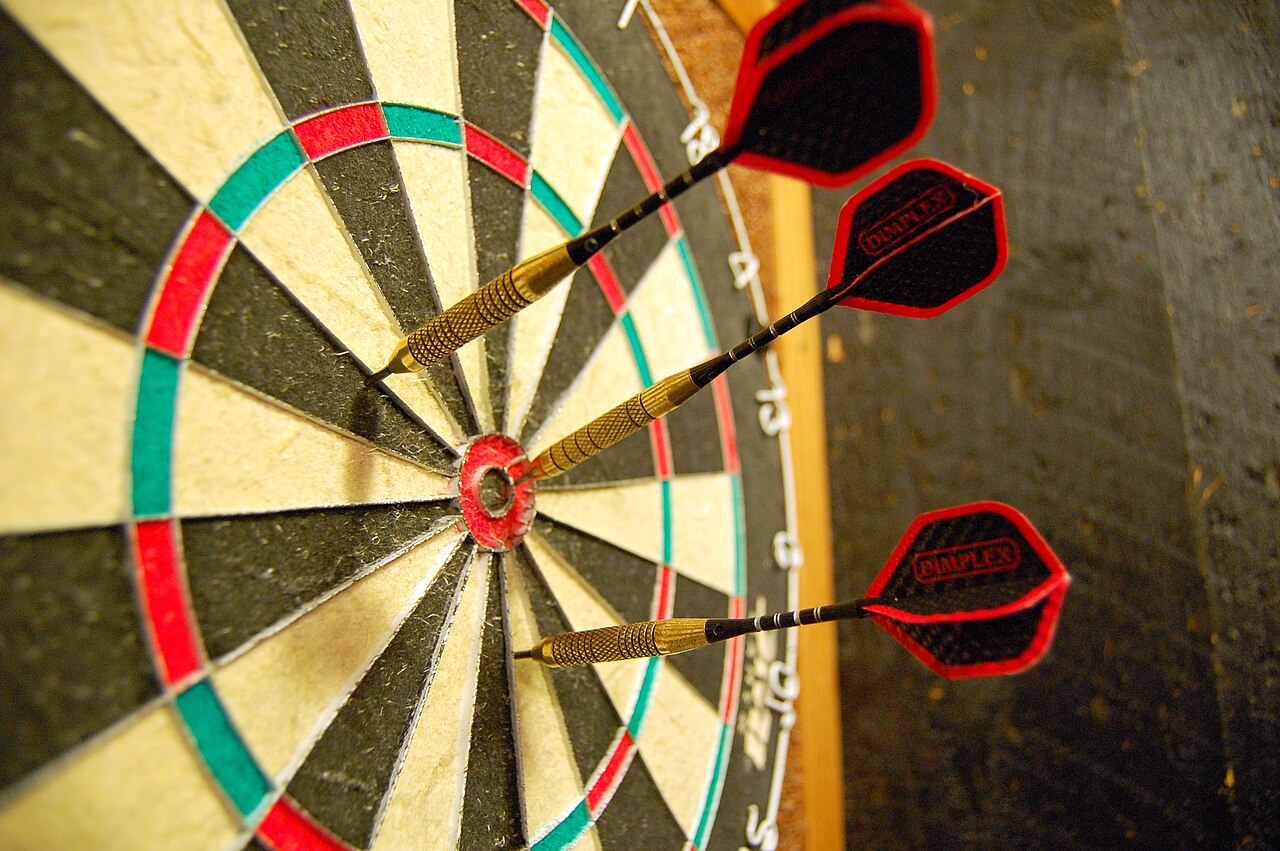
Darts began as an indoor substitute for archery and grew up in the public house. The earliest boards were sections of elm or poplar, the numbering was local and inconsistent, and the game travelled with the brewery trade rather than any governing body. Its transformation into a codified sport happened in fits and starts across the twentieth century: a court ruling that it was a game of skill rather than chance, a numbering system and a treble ring that made scoring interesting, a national newspaper competition that gave it a champion, and finally television, which gave it money.
The modern history divides neatly. The British Darts Organisation, founded in 1973, built the amateur pyramid and put the sport on the BBC and ITV; a boom in the early 1980s made Eric Bristow a household name and then collapsed when broadcasters walked away. In 1992 sixteen leading players broke away to form what became the Professional Darts Corporation, and the resulting decade of legal warfare ended with the PDC controlling the sport's money and its stars. Phil Taylor then won sixteen world titles, and the game that followed him is faster, richer, younger and far more international than the one he entered.
Timeline
The modern order of numbers around the board is traditionally credited to Brian Gamlin, a carpenter from Bury in Lancashire, who is said to have devised it to punish inaccuracy. The attribution has never been documented and remains disputed.
A Leeds publican, William 'Foot' Anakin, was prosecuted for allowing a game of chance on licensed premises. He asked for a board to be brought into court, threw three darts into the 20 and repeated it, and the case was dismissed.
Thomas William Buckle of Dewsbury is credited with producing the board that became the standard London pattern, adding the treble ring to the existing doubles and bull. The change made scoring dramatic and created the treble 20.
The newspaper began a knockout competition for pub players in the London area. It went national after the Second World War and grew into the sport's defining event, with entries eventually numbering in the hundreds of thousands.
Yorkshire Television's Indoor League, presented by the former England cricketer Fred Trueman, put pub games including darts on national television and demonstrated that the sport worked as a broadcast product.
Olly Croft founded the BDO from his home in Muswell Hill, uniting county associations into a national structure that would run the amateur and professional game in Britain for the next four decades.
Fifteen national bodies created the WDF to govern darts internationally, standardising the 2.37-metre throwing distance and the board specification and launching the World Cup for national teams.
The inaugural World Professional Darts Championship was staged at the Heart of the Midlands nightclub in Nottingham. Leighton Rees of Wales beat England's John Lowe 11-7 in the final to become the first world champion.
The 22-year-old Londoner known as the Crafty Cockney won the first of five world championships. Brash, chalk-white shirt and pointed finger, he became the sport's first genuine celebrity and its box-office draw for a decade.
A 23-year-old qualifier ranked outside the top 30, Deller beat Bristow 6-5 in the world final, checking out 138 in three darts after Bristow declined a shot at the bull. It remains the sport's most famous upset.
On 13 October at the MFI World Matchplay in Slough, John Lowe hit 180, 180 and then treble 17, treble 18, double 18 against Keith Deller for the first perfect leg on television, collecting £102,000.
ITV dropped darts entirely and the BBC cut back to the world championship alone, as broadcasters recoiled from the sport's beer-and-cigarettes image. Prize money collapsed and many full-time professionals returned to day jobs.
Sixteen leading players, including Bristow, Lowe, Phil Taylor and Dennis Priestley, left the BDO to form the World Darts Council, seeking commercial control of their own events. The split triggered years of litigation and mutual bans.
The first WDC World Championship was held at the Circus Tavern in Purfleet, Essex, in January. Dennis Priestley beat Phil Taylor 6-1 in the final, having already won the BDO title in 1991 at his first attempt.
The Tomlin Order settled the dispute between the two bodies, granting mutual recognition and allowing players to represent their countries. The WDC was renamed the Professional Darts Corporation, and Sky Sports built its coverage around it.
Raymond van Barneveld beat Phil Taylor 7-6 in the World Championship final at the Circus Tavern, recovering from 3-0 down in sets and winning a sudden-death leg. It is routinely voted the finest match ever played.
The PDC World Championship left the Circus Tavern for Alexandra Palace in north London, expanding capacity to several thousand a session and creating the raucous, costumed festival atmosphere that now defines the event.
In December, Sherrock beat Ted Evetts 3-2 at Alexandra Palace to become the first woman to win a match at the PDC World Championship, then beat world number 11 Mensur Suljovic 3-1 in the next round.
After years of shrinking prize money and the loss of its television deal, the British Darts Organisation entered liquidation in September, ending 47 years. The WDF absorbed its championships and the PDC was left effectively unopposed.
On 3 January, Littler beat Michael van Gerwen 7-3 to become the youngest world champion at 17 years and 347 days, a year after reaching the final at 16 and turning himself into the sport's biggest draw.
The eras
Barrel ends and blind chance
Darts descends from military archery practice and from fairground games in which shortened arrows were thrown at the cross-section of a tree or the bottom of a wine barrel. The wood's natural growth rings and radial cracks suggested the segmented target that survives today, and the very word 'bullseye' predates darts as a marksmanship term. Nineteenth-century boards were local and various: the Yorkshire board had no trebles and no outer bull, the Manchester log-end board was small, black and used only five doubles, the Lincoln, Kent and Grimsby patterns all differed, and East End London pubs favoured the fives board. Boards were made of elm and soaked overnight to close the holes, which is why publicans left buckets of water beside them. Rules were house rules, distances were paced out rather than measured, and the game was played for beer. The one enduring nineteenth-century contribution is the numbering sequence, traditionally attributed to a Lancashire carpenter named Brian Gamlin in 1896 though never proved. Whoever devised it understood the essential idea that makes darts a sport rather than a lottery: place the large numbers next to the small ones, so that accuracy is rewarded and a near miss is punished harder than a deliberate safe shot.
Legality, standardisation and the News of the World
The game's legal status was settled in a Leeds courtroom in 1908, when the publican William 'Foot' Anakin answered a charge of permitting a game of chance by calling for a board, throwing three darts into the 20, and inviting a court official to try. The magistrates ruled darts a game of skill, and it could be played legally in licensed premises across the country. Around 1913 Thomas William Buckle of Dewsbury is credited with the addition that made the modern game: the treble ring, which turned the board into a scoring instrument with a maximum of 180. Standardisation followed. The National Darts Association, founded in London in 1924, fixed rules, board patterns and throwing distances, and in 1927 the News of the World launched an individual championship that would become the sport's summit for sixty years, drawing entries from pub teams across Britain and filling large halls for its finals. Brewers backed leagues, factories fielded teams, and when King George VI and Queen Elizabeth threw darts in Slough in 1937 the game acquired a respectability it had never had. The Second World War then spread it further, as darts boards were issued to service messes and shipped wherever British troops were stationed.
Leagues, the BDO and the arrival of the cameras
Post-war darts was a mass participation game with no professional class. The News of the World championship went fully national in 1947-48 and became an annual ritual, its regional rounds run in thousands of pubs; winning it made a man locally famous and earned him a trophy rather than a living. The structural change came from television. Yorkshire Television's Indoor League, first broadcast in 1972 and presented by Fred Trueman with a pint in hand, proved that the sport's simplicity translated perfectly to the screen: a fixed camera on the board, a close-up of the face, and a score that any viewer can follow. In 1973 Olly Croft founded the British Darts Organisation, welding county associations into a single national body with a ranking system and a calendar; within a few years it had the BBC and ITV competing for its events. The World Darts Federation followed in 1976, formed by fifteen national associations, fixing the throwing distance at 7 feet 9.25 inches and the board specification internationally and creating a World Cup for national teams. By 1977 the Winmau World Masters was a televised championship, and the sport was one year away from crowning its first world champion.
Boom, celebrity and bust
The first World Professional Darts Championship, held in a Nottingham nightclub in 1978 and won by Leighton Rees of Wales, arrived at the perfect cultural moment. British television had three channels and an appetite for working-class spectacle, and darts delivered characters ready-made: Rees, John Lowe's icy precision, Bobby George's sequins and candelabra, Jocky Wilson's toothless Fife charisma and above all Eric Bristow, who won five world titles between 1980 and 1986 and behaved like a heavyweight boxer while doing it. Audiences peaked in the millions; the game show Bullseye, launched in 1981, ran for fifteen years. Keith Deller's 6-5 win over Bristow in the 1983 final, sealed with a 138 checkout, remains the sport's defining upset, and John Lowe's nine-darter in 1984 won a prize larger than most footballers' annual wages. Then it collapsed. The satirical association of darts with beer bellies and chain smoking curdled into contempt, sponsors grew nervous, and in 1988 ITV dropped the sport altogether while the BBC retreated to the world championship. Prize money evaporated, tournaments folded, and by 1990 many of the men who had been household names were back working shifts. Bristow, afflicted by dartitis, was already fading, and a young apprentice he had funded, Phil Taylor, won the 1990 world title by beating him 6-1.
The split and the Taylor era
In January 1992 sixteen leading players — Bristow, Lowe, Taylor, Dennis Priestley, Bob Anderson and others — announced they were leaving the BDO to run their own events as the World Darts Council, arguing that the amateur body was throttling their earning power. The BDO banned them from county and international darts; the WDC sued; years of litigation ended in 1997 with the Tomlin Order, under which the two bodies recognised each other and the WDC renamed itself the Professional Darts Corporation. The PDC had Sky Sports, the promoter Barry Hearn from 2001, and the players. It also had Phil Taylor, whose dominance is without parallel in any professional sport: eight consecutive world titles from 1995 to 2002, fourteen PDC crowns in all, sixteen World Matchplay titles, and a run of televised averages that redefined what was possible. His rivals were serious — Priestley, John Part of Canada who won world titles in both organisations, Raymond van Barneveld who arrived from the BDO with four world titles already and beat Taylor 7-6 in the 2007 final that is still the sport's high-water mark. The move to Alexandra Palace in 2008, Premier League Darts from 2005 and the Grand Slam from 2007 turned the PDC calendar into a year-round television property while the BDO slowly withered.
Globalisation, youth and a sport unrecognisable to 1990
The post-Taylor game belongs first to Michael van Gerwen, who won three world titles and set the highest televised average in history at 123.40, and then to a spread of champions from outside England: Gary Anderson and Peter Wright of Scotland, Gerwyn Price of Wales, with Belgium's Dimitri Van den Bergh and Germany's Gabriel Clemens reaching majors. Prize money climbed steeply under Barry Hearn and his successors, the Development Tour and the Challenge Tour created a genuine ladder, and the PDC pushed abroad with World Series events in Australia, New Zealand, North America, Bahrain and Asia. The BDO, starved of television money and reduced to a fraction of its former prize fund, went into liquidation in 2020; the WDF now runs the amateur world. Two developments define the 2020s. The first is the women's game, given real structure by the PDC Women's Series, guaranteed World Championship places and the emergence of Beau Greaves alongside the trail cut by Fallon Sherrock in 2019. The second is Luke Littler, who reached the world final at 16 in January 2024 and won it at 17 a year later, drawing record audiences and pulling a wave of teenagers into a sport that had spent fifty years being played mostly by men in their forties.
Darts has been rescued twice by the same thing that nearly killed it: its refusal to pretend to be anything other than a pub game. When broadcasters abandoned it in 1988 the sport looked terminal, and when the players walked out in 1992 it looked suicidal. What survived both was the format itself — a target that never changes, an opponent you cannot touch, and a running total that leaves no place to hide. Everything modern about the sport, from the arena lighting to the sports psychologists to the teenage world champion, sits on top of a game that a drinker from a Leeds pub in 1908 would recognise instantly, and would still be able to score.
Keep exploring
More in this category
Golf
A six-century test of nerve where the only opponent is the ground, the wind, and yourself.
🥌Curling
Twenty kilograms of Scottish granite, a sheet of pebbled ice, and a game that is almost always decided by the final stone.
🎱Snooker
Twenty-two balls, six pockets barely wider than they are, and the most pitiless scoreboard in sport.