Milestones in order. This is history, not a weekly activity grid.
- Battledore and shuttlecock
- The Badminton House party
- Poona and the returning officers
- First written rules
- Badminton Association formed
- First All England Championships
- International Badminton Federation
- First Thomas Cup
- First Uber Cup
- First World Championships
- Hartono's world title
- Unification of the sport
- First Sudirman Cup
- Olympic debut
Last reviewed Sources & creditsMedia creditsMethodology
Quick answers
Why did badminton change to 21-point rally scoring?
Until 2006, badminton used a service-only system in which points could be scored only by the serving side — men played games to 15, women to 11 — which made matches unpredictable in length and hard to schedule for television. The BWF adopted rally-point scoring to 21 in 2006, awarding a point on every rally regardless of who served. The change made matches faster and more consistent in duration, rewarded relentless shot-to-shot consistency, and suited broadcasters. A game is now won by the first to 21 with a two-point margin, capped at 30, and a match is the best of three games. The reform is widely credited with modernising the sport's rhythm.
How fast does a badminton shuttle actually travel?
The shuttlecock is the fastest object in racquet sport off the racket. In a controlled Yonex test in 2013, Malaysia's Tan Boon Heong recorded a smash of 493 km/h (306 mph), and in-competition hits have been measured above 400 km/h. However, the shuttle decelerates more violently than any comparable projectile because its feathered skirt creates enormous drag. That is why a smash struck at 400 km/h can still be returned — by the time it crosses the net and reaches the defender it has shed most of its speed. This unique combination of blistering launch speed and rapid deceleration is exactly what makes badminton both explosive and, for defenders, improbably retrievable.
Who is the greatest badminton player of all time?
The most common answer is China's Lin Dan, and it is close to consensus. Nicknamed Super Dan, he won consecutive Olympic golds in 2008 and 2012 — the first man to defend the singles title — took five World Championships and six All England titles, and is the only player to have held all nine of the sport's major titles, the Super Grand Slam. His fiercest rival, Malaysia's Lee Chong Wei, spent a record 349 weeks as world No. 1 but never won Olympic or world gold, losing several finals to Lin. Across eras, figures such as Rudy Hartono, Susi Susanti and Carolina Marin also enter the debate, but Lin Dan survives every version of the argument.
Why is Asia so dominant in badminton?
Elite badminton is overwhelmingly concentrated in Asia — China, Indonesia, Malaysia, Japan and Korea — for reasons of culture and structure. In Indonesia the sport is a national passion with a deep grassroots club system, while China operates a centralised state academy that identifies and develops talent from childhood, producing extraordinary depth across all five disciplines. The intensity of domestic competition in these countries means players face world-class opponents constantly. Denmark is the lone traditional European power, and India, Thailand and Chinese Taipei have risen strongly in recent years. But the combination of mass participation, institutional investment and fierce internal competition keeps East and Southeast Asia as the sport's unshakeable heartland, producing the majority of Olympic and world champions.
What is the difference between the singles and doubles court?
The court is the same length, 13.4 metres, for both, but the width and service boxes differ. Singles uses the inner side lines, making the court 5.18 metres wide, and the full-length back boundary, creating a long, narrow court that rewards deep clears and corner-to-corner movement. Doubles uses the full outer side lines, 6.1 metres wide, but a shorter service court — the serve must land inside the doubles long service line, roughly 0.76 metres short of the back line — to prevent an overwhelming serving advantage in the faster doubles game. In practice this means the side tramlines are in for doubles but out for singles, and the deep service area is out for the doubles serve.
Why did Lee Chong Wei never win Olympic or world gold?
Lee Chong Wei was one of the greatest players in history and spent a record 349 weeks as world No. 1, yet the biggest titles eluded him largely because of Lin Dan. He reached three Olympic finals (2008, 2012, 2016) and four World Championship finals, losing all of them, three of those decisive defeats coming against Lin. The 2011 and 2013 world finals and the 2012 Olympic final, in particular, were agonisingly close contests decided by the finest of margins. He also overcame a 2015 doping ban and a 2018 nasal cancer diagnosis late in his career. His story is the sport's great near-miss: sustained dominance and 69 titles, but never the single gold his career deserved.
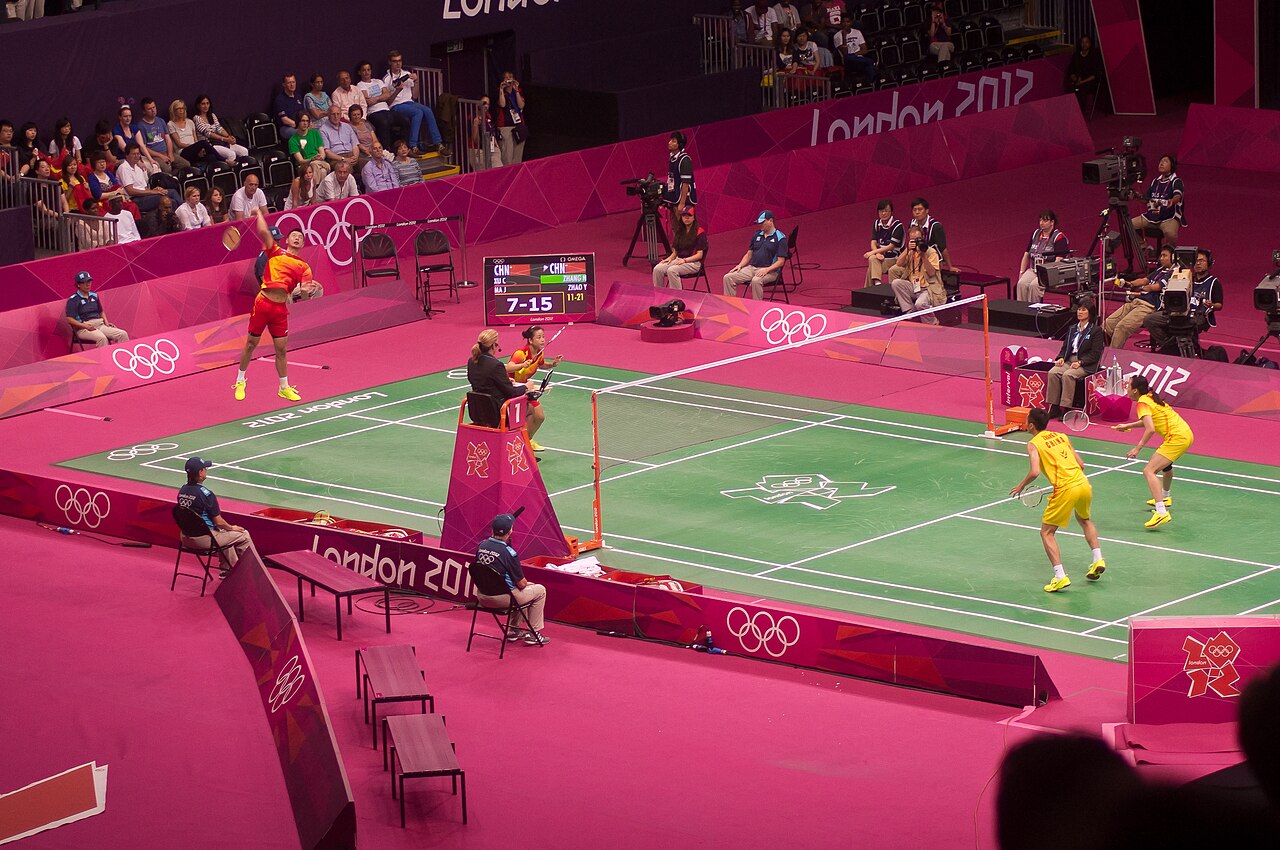
Badminton's ancestry reaches back to ancient battledore-and-shuttlecock games played in China, Greece and India, but the modern sport took shape in the 1860s and 1870s, when British army officers stationed in India added a net to a shuttlecock game and brought it home. It acquired its name from Badminton House, the Duke of Beaufort's Gloucestershire estate, and its first written rules from an English spa town.
From an amateur Victorian pastime it grew into a global, professional, and fiercely Asian-dominated sport. The founding of an international federation in 1934, the great team cups from 1948, the first World Championships in 1977 and the Olympic debut in 1992 turned it from parlour game into elite spectacle — culminating in the modern era of Lin Dan, Lee Chong Wei and 400 km/h smashes.
Timeline
Victorian households play the ancient game of keeping a feathered shuttlecock aloft with small bats, a pastime with roots stretching back over two thousand years across Asia and Europe.
The game, played with an added net, is popularised at the Duke of Beaufort's estate, Badminton House in Gloucestershire, from which the sport takes its enduring name.
British army officers who had played a netted shuttlecock game in Poona (Pune), India bring it back to England, spreading it through garrison towns and country houses.
The Bath Badminton Club draws up the earliest formal code of laws, standardising a game that had been played to countless local variations.
England establishes the world's first national governing body, unifying the rules and laying the groundwork for organised competition.
The inaugural All England Open is contested, initially with doubles events only; singles are added in 1900. It becomes the sport's most prestigious tournament for decades.
The IBF is founded with nine members — Canada, Denmark, England, France, Ireland, Netherlands, New Zealand, Scotland and Wales — creating a global authority for the sport.
The men's international team championship, donated by former All England champion Sir George Thomas, is first contested across 1948-49 and won by Malaya, signalling Asia's rise.
The women's team championship, named after English star Betty Uber, is inaugurated across 1956-57 and won by the United States, before Asian nations came to dominate.
The inaugural IBF World Championships are held in Malmo, Sweden, finally crowning official world individual champions separate from the All England.
Indonesia's Rudy Hartono, already an eight-time All England champion, wins the World Championship at 31, capping the amateur golden age.
The IBF merges with the breakaway World Badminton Federation, ending a schism over China's inclusion and reuniting the global game under one body.
The mixed national team championship, named after Indonesian pioneer Dick Sudirman, is first held in Jakarta and won by the host nation.
Badminton becomes a full Olympic medal sport at Barcelona; Susi Susanti and Alan Budikusuma win Indonesia's first-ever Olympic gold medals on the same day.
Mixed doubles is added to the Olympic programme at Atlanta, completing the five-event format of singles, doubles and mixed that endures today.
The IBF is renamed the Badminton World Federation, and rally-point scoring to 21 replaces the old 15-point service-only system, speeding up and modernising the game.
The BWF Super Series creates a professional global circuit of premier tournaments with ranking points and prize money, professionalising the modern tour.
Lin Dan beats Lee Chong Wei in the London Olympic final to defend his singles title, the defining act of the sport's greatest rivalry across 40 meetings.
The BWF World Tour replaces the Super Series, a fixed 1.15 m service height law is introduced to standardise serving, and instant video review expands across events.
Viktor Axelsen defends Olympic gold in Paris while Korea's An Se-young, the reigning world champion, takes women's singles gold, as India, Thailand and Europe close the gap on the traditional Asian powers.
The eras
Invention and codification
Badminton emerged from Victorian battledore and the netted shuttlecock game played by British officers in India. Named after Badminton House around 1873 and first codified by the Bath Badminton Club in 1877, it spread quickly through England's clubs and country houses. The founding of the Badminton Association in 1893 unified the rules, and the first All England Championships in 1899 gave the game a flagship event that would, for half a century, serve as the unofficial world championship. In 1934 nine national bodies formed the International Badminton Federation, providing global governance. This was an amateur, largely European era — England, Denmark and Ireland produced the leading players — but the framework built in these decades, from standard court dimensions to the feather shuttle's 16-feather construction, remains essentially intact. The seeds of the modern sport, and of the great tournaments still contested today, were all sown before the Second World War, even as the competitive centre of gravity had yet to shift east.
The team cups and the Asian shift
The post-war decades transformed badminton from a European pastime into an Asian passion. The Thomas Cup, first contested in 1948-49 and won by Malaya, and the Uber Cup, launched in 1956-57, gave nations a stage for team rivalry and instantly revealed a new balance of power. Malaya's Wong Peng Soon dominated the All England, and Indonesia surged to the forefront, winning Thomas Cups and producing a conveyor belt of talent. Denmark's Erland Kops kept European hopes alive with seven All England titles, but the momentum was unmistakably eastward. The amateur ethos still governed the sport — there were no world championships, no prize money, and the All England remained the crown jewel — yet the intensity of Thomas Cup ties, contested before vast and fervent crowds in Jakarta and Kuala Lumpur, foreshadowed the fanaticism that would make badminton a defining sport of Southeast Asia. By the late 1960s the stage was set for the game's first true global superstar.
The Hartono era and the amateur golden age
Indonesia's Rudy Hartono defined this period and arguably all of amateur badminton. Between 1968 and 1974 he won the All England seven times in succession, a run without parallel in any singles racquet sport, and added an eighth title in 1976. Elegant, effortless and armed with a whip-like smash, he set a standard of movement that players still study. The era also produced the sport's first official global crown: the inaugural World Championships at Malmo in 1977, which Hartono would win in 1980 at 31. Around him, Indonesia built a dynasty on Thomas Cup triumphs and a deep pool of talent, while stars such as Denmark's Svend Pri and Indonesia's Liem Swie King pushed the game forward. Still amateur in structure but professional in dedication, this was badminton's romantic high point — a time when the All England title carried the weight of a world championship, and when Hartono's grace made the sport, for the first time, genuinely glamorous on the world stage.
Unification, the Olympics and the Chinese-Indonesian duel
The 1981 merger of the IBF with the breakaway World Badminton Federation ended a damaging schism over China's participation and reunited the sport just as China arrived as a superpower. Players such as Yang Yang, Zhao Jianhua and Li Lingwei ushered in an era of Chinese dominance, contested fiercely by an Indonesian generation led by Ardy Wiranata and the incomparable Susi Susanti. The defining moment came at Barcelona 1992, when badminton became a full Olympic medal sport: Susanti and Alan Budikusuma won Indonesia's first Olympic golds of any kind, a national epiphany. Mixed doubles joined the programme at Atlanta in 1996. With the Olympics as a new summit, national investment surged, and the women's game gained unprecedented profile. The rivalry between China's academy system and Indonesia's club culture drove standards ever higher, setting up the professional, television-driven era to come and confirming East Asia and Southeast Asia as the unshakeable heartland of elite badminton.
Lin Dan, Lee Chong Wei and the Super Series
This was the sport's modern golden age, built around the greatest rivalry it has known. China's Lin Dan and Malaysia's Lee Chong Wei met 40 times, contesting Olympic finals in 2008 and 2012 and repeatedly deciding world titles; Lin's defence of Olympic gold in London 2012 is often called the finest match ever played. Lin completed a Super Grand Slam of all nine major titles, while Lee spent a record 349 weeks at world No. 1. Off court, the sport professionalised rapidly: rally-point scoring to 21 arrived in 2006, the IBF became the BWF, and the 2007 Super Series created a lucrative global circuit. Doubles entered a power era led by Cai Yun and Fu Haifeng, and women's singles saw Zhang Ning win two Olympic golds. Television, sponsorship and ranking systems turned badminton into a slicker spectacle, faster and more athletic than ever, and cemented the template of the tour that governs the sport today.
The 2020s have opened the game up. Viktor Axelsen's back-to-back Olympic golds broke Asia's stranglehold on men's singles, Korea's An Se-young and Spain's Carolina Marin have carried the women's game, and India, Thailand and Japan have produced world-beaters in every discipline. Rally-point scoring, video review and a packed World Tour have made badminton faster, fairer and more watchable than at any point in its history — yet its essence, the collision of violent power and delicate touch across a tiny court, is exactly what those Victorian officers would still recognise.
Keep exploring
More in this category
Tennis
The loneliest duel in sport: no clock, no teammates, no place to hide until the last point is won.
🏓Table Tennis
The fastest ball sport on Earth, decided in the width of a fingernail and the spin no eye can fully read.
🎾Squash
Two players, four walls and nowhere to hide — the most physically brutal racket sport ever invented.