🐾Origins & Evolution

Veterinarian · Treats patients from goldfish to horses that cannot describe a symptom, and carries the legal power to end their suffering by euthanasia.

Veterinary medicine can point to the oldest surviving medical text in Egyptian history and still be, as an organized science, barely 260 years old. Between an unnamed priest-healer writing down how to treat a cow's inflamed eye and today's board-certified veterinary oncologist lies a long history of farriers, army horse doctors and livestock plagues that killed enough animals to force governments to act.

This page follows that history through ten turning points, five longer eras, and three vanished trades the profession left behind on its way to becoming a licensed science.

Where it began

c. 1900 BCEKahun, Egypt

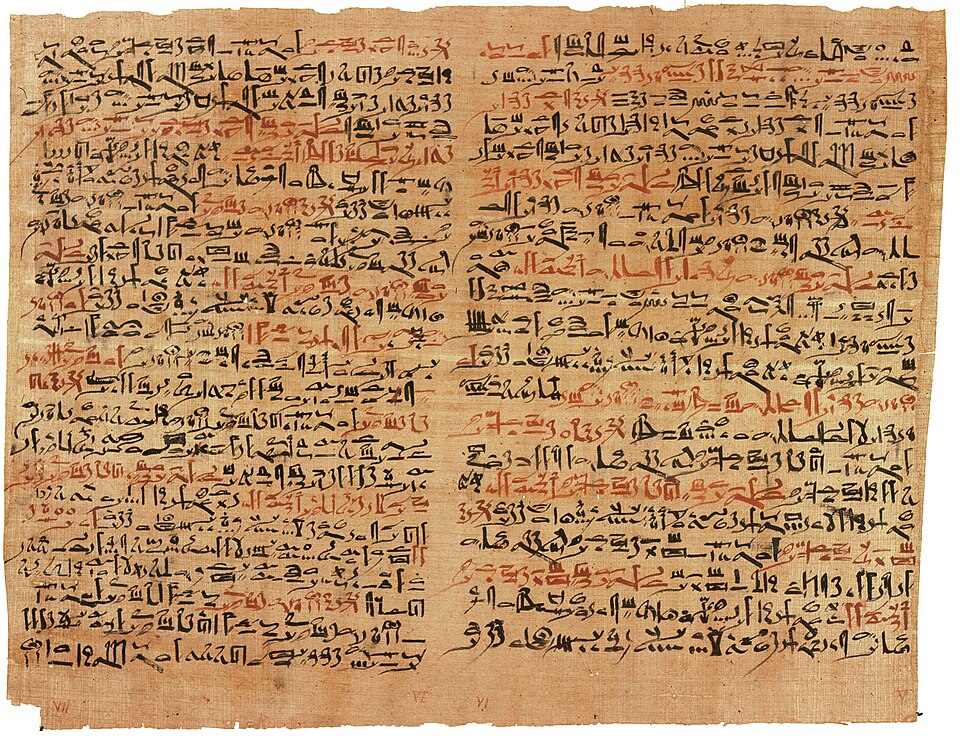
The Kahun Veterinary Papyrus, unearthed in 1889 by archaeologist Flinders Petrie in the Middle Kingdom town of Kahun, is the oldest known veterinary text in the world — older than any comparable human-medicine papyrus. An unnamed priest-healer describes three eye diseases and a case of intestinal worms in cattle, giving each a name, its symptoms, a prognosis and a treatment, the same structure a veterinary case write-up still follows more than 3,800 years later. The surviving fragment even instructs the healer on how to keep the animal comfortable if the treatment fails — the first recorded acknowledgment that a veterinary patient's comfort matters even when a cure does not.

Timeline

c. 1900 BCEThe Kahun Veterinary Papyrus is written

An Egyptian priest-healer records the world's oldest known veterinary text, describing cattle eye disease and intestinal worms with a name, symptoms, prognosis and treatment for each.

c. 322 CEAbsyrtus rides with Constantine's cavalry

The Bithynian veterinarian Absyrtus serves as chief horse doctor on Emperor Constantine's Sarmatian campaign; his case notes on contagious horse disease later anchor the Hippiatrica, Byzantium's standard veterinary reference.

1761Bourgelat opens the world's first veterinary school

Claude Bourgelat founds the Royal Veterinary School at Lyon under order of Louis XV, driven by the need to fight rinderpest scientifically rather than treat livestock disease as farriers' folk knowledge.

1791London opens a veterinary college

The Veterinary College, London — later the Royal Veterinary College — opens, becoming the largest and longest-established veterinary school in the English-speaking world.

1865Rinderpest creates Britain's state veterinary service

After veterinarian J. B. Simonds diagnoses rinderpest in London cattle, Parliament passes the Cattle Diseases Prevention Act and creates a State Veterinary Department, an early template for government animal-health agencies.

1884The USDA creates the Bureau of Animal Industry

Daniel Elmer Salmon, the first American to hold a veterinary degree, becomes founding chief of the US Bureau of Animal Industry, the country's first federal veterinary agency.

1896Theiler develops a rinderpest vaccine in South Africa

As rinderpest devastates Transvaal cattle herds, state veterinarian Arnold Theiler works with scientists from Germany and France's Pasteur Institute to refine a serum-based vaccine, laying the groundwork for the Onderstepoort Institute he founds in 1908.

1922Aleen Cust is finally admitted to the RCVS

Twenty-two years after finishing her training, Aleen Cust becomes the first woman formally recognized as a veterinary surgeon in Britain and Ireland, after the 1919 Sex Disqualification (Removal) Act forces the Royal College's hand.

1947The CDC builds a veterinary public health division

James Harlan Steele establishes the first Veterinary Public Health Division inside the young Communicable Disease Center, formalizing the study of diseases that pass between animals and people decades before the term 'One Health' exists.

2011Rinderpest is declared globally eradicated

The World Organisation for Animal Health confirms rinderpest eradicated worldwide, only the second disease in history — after smallpox — that humans have deliberately wiped out.

The eras

Hieroglyphic medical text inscribed on an ancient Egyptian papyrus
Jeff Dahl · Public domain · Wikimedia Commons
c. 1900 BCE – c. 400 BCE

Priest-healers and sacred remedies

The earliest animal medicine in Egypt and Mesopotamia was bound up with religion: priest-healers treated livestock as part of a broader duty of care that mixed genuine clinical observation with ritual and charm. The Kahun Veterinary Papyrus shows real diagnostic thinking, but there was no separate 'veterinary' profession — the same healers, or none at all, tended people and animals alike.
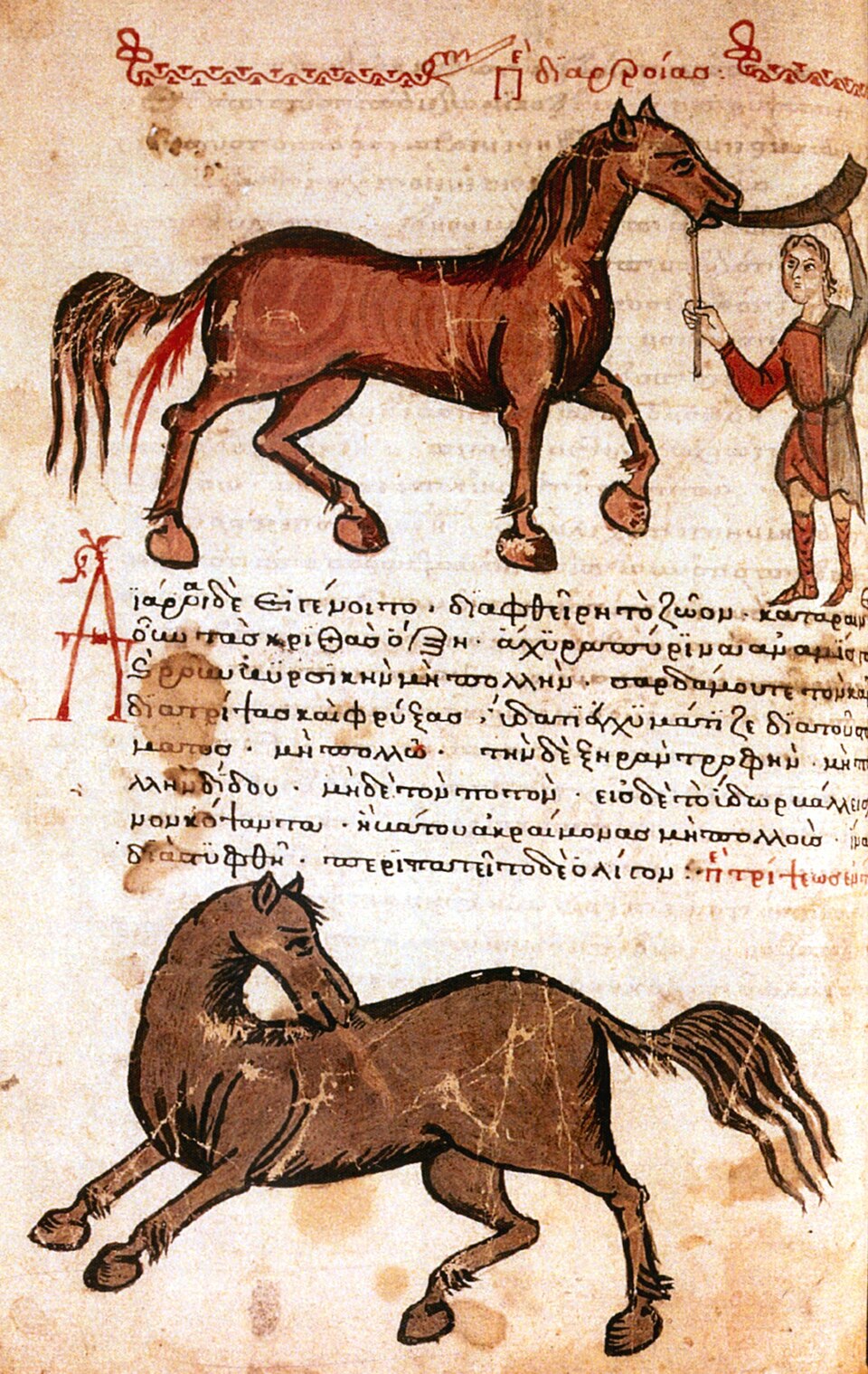
Illuminated manuscript page from a Byzantine horse-medicine compilation
from the Middle Ages, unknown · Public domain · Wikimedia Commons
c. 400 BCE – 500 CE

Army horse doctors of Greece and Rome

Classical armies depended on healthy horses, so Greek and Roman forces employed dedicated hippiatroi — horse doctors — to keep cavalry mounts fit for campaign. Absyrtus, serving under Constantine in the fourth century, is the best-documented of them; his writings on contagious horse disease were copied for centuries into the Hippiatrica, the standard veterinary reference of the Byzantine world.

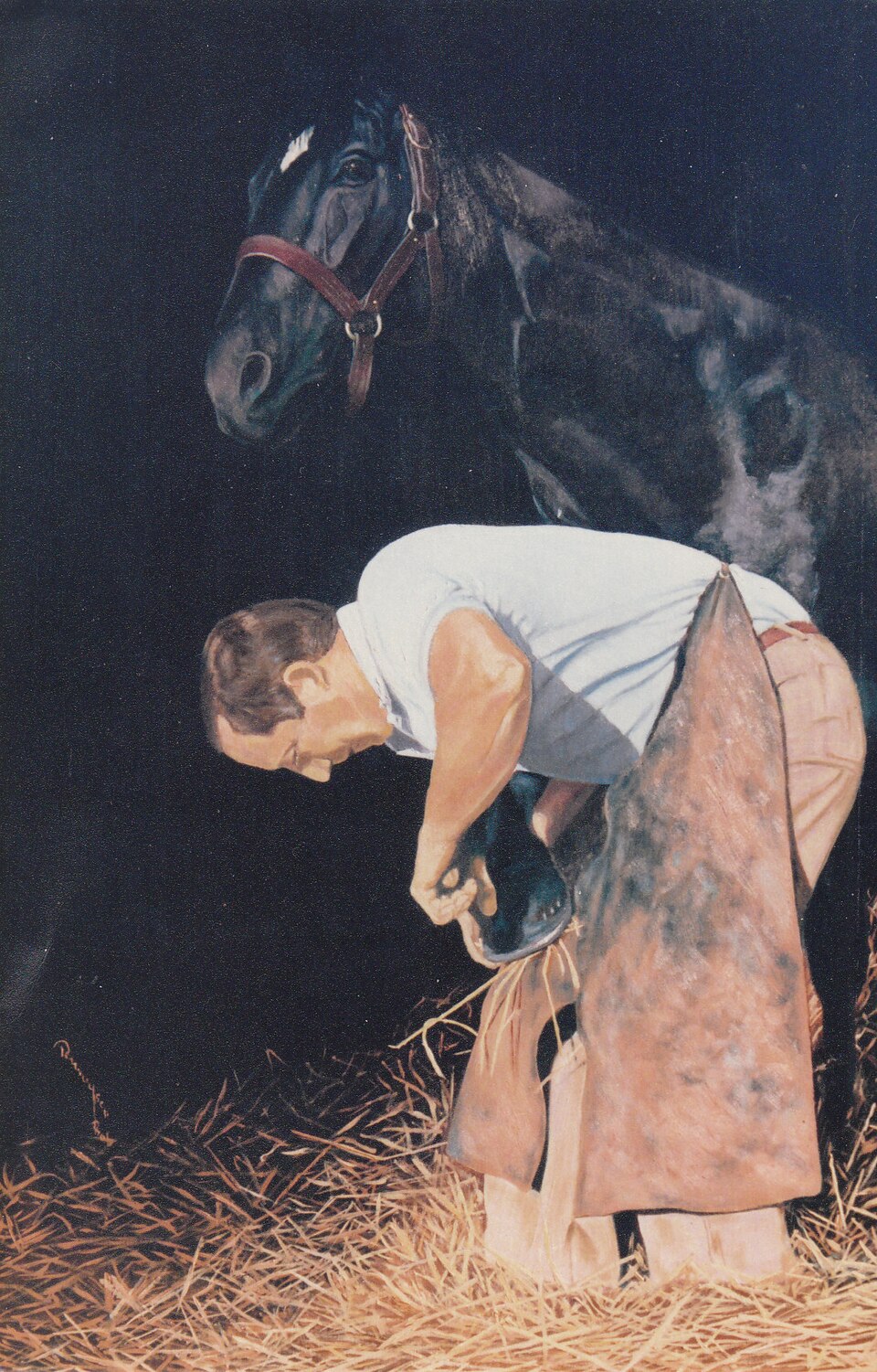
A farrier shoeing a horse's hoof, historically also its doctor
Albert Demuyser · CC BY-SA 3.0 · Wikimedia Commons
c. 500–1761

The farrier's thousand years

For over a millennium, the farrier was both blacksmith and doctor to the horse, treating lameness, colic and wounds through an apprenticeship system rather than formal study, alongside itinerant 'cow-leeches' who dosed cattle and sheep with folk remedies. No scientific institution existed to test whether any of it worked, and treatment quality depended entirely on an individual craftsman's word-of-mouth skill.

1761–1900

Schools, states and the rinderpest wars

Bourgelat's Lyon school (1761) and London's Veterinary College (1791) turned animal medicine into a taught science, and national bodies — the Royal College of Veterinary Surgeons (1844), the United States Veterinary Medical Association (1863) — organized it into a licensed profession. Livestock plagues, above all rinderpest, forced governments to fund veterinary science as a matter of national food security, not animal welfare.

A veterinarian examining a pet dog on an exam table in a modern clinic
Cheryl · CC BY-SA 2.0 · Wikimedia Commons
1900–present

From farm to family: the companion-animal century

Antibiotics, safer anesthesia and vaccines transformed what veterinary medicine could treat, while rising incomes and urbanization shifted the profession's center of gravity from livestock toward pets. Specialty boards, 24-hour emergency hospitals, corporate consolidation and, most recently, the One Health movement linking animal, human and environmental disease have reshaped a job once defined almost entirely by the farm call.

What this job replaced

Neighbouring trades that no longer exist — absorbed, automated or regulated away.

The horse-leech

c. 1493–1948

'Leech' is Old English for healer, and the horse-leech was the untrained, apprenticeship-taught doctor of pre-scientific English horses, treating lameness and colic with bleeding and folk remedies. London's veterinary college (1791) and the Royal College's 1844 charter protected the title 'veterinary surgeon', but lay practice itself stayed legal until the Veterinary Surgeons Act 1948 finally restricted animal treatment to registered vets.

The patent-medicine drencher

c. 1800–1948

Before prescription-only veterinary drug laws, druggists and traveling peddlers sold proprietary 'cattle powders', 'colic drenches' and 'horse balls' directly to farmers, with no diagnosis and no vet involved at all. Twentieth-century licensing acts that reserved treatment and prescribing for registered veterinarians closed off this entire unregulated retail trade.

The knacker's medical judgment

c. 1600s–1900s

Knackers collected sick, dying or worn-out livestock for slaughter and rendering, and in the absence of any veterinary alternative effectively decided which animals were beyond saving. As animal-welfare and veterinary-licensing law tightened through the 19th and 20th centuries, that diagnostic judgment was reserved to licensed veterinarians, leaving the knacker's trade as regulated carcass disposal alone.

Trades that vanished →

The thread running through nearly four thousand years of animal medicine is a slow separation of care from superstition: the Kahun papyrus already shows real clinical observation, but it took Bourgelat's schools, licensing acts and a string of catastrophic livestock plagues to turn that observation into a tested, regulated science practiced by people who had to prove they knew what they were doing.

What has not changed is who the patient answers to. An animal cannot describe its own symptoms, negotiate its own treatment or consent to its own euthanasia — every one of those decisions still runs through a licensed human being, in whatever century, which is exactly why the profession has always needed such a long apprenticeship to earn the public's trust.

Keep exploring

More in Medicine & Life