🍷The Greats

Sommelier · From cupbearers who tasted a king's wine to blind-tasting floor professionals: how the sommelier turned pouring into one of hospitality's most exacting crafts.

A list of great sommeliers is unavoidably a list of the recorded ones. For most of the craft's history its practitioners were servants whose names nobody wrote down: the cupbearers, cellarers and wine waiters who poured for the powerful and vanished from the record with the dishes. The competitive era that began in 1969 finally attached names, dates and titles to excellence — which is why this list tilts modern, and why its oldest entry is a monk whose fame is partly a marketing invention.

The eight below span four centuries and six countries. They include a Benedictine cellar master, the two women who broke the Master Sommelier exam's gender line in America, the only Asian world champion, and the man who held every major credential in the trade at once. What they share is that wine service — how it is taught, examined, performed and imagined — is measurably different because of each of them.

The all-time podium

🥈
Madeline Triffon
United States
2
Dom Pierre Pérignon
Dom Pierre Pérignon
France
1
🥉
Gérard Basset
France / United Kingdom
3

The eight who reached the top

1
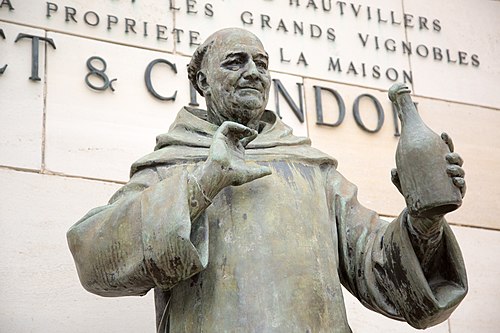
Statue of Dom Pierre Pérignon holding a bottle at Épernay in Champagne. Victor Grigas · CC BY-SA 4.0

Dom Pierre Pérignon

France · 1638–1715

Cellar master of the Benedictine Abbey of Hautvillers for forty-seven years, Pérignon is the patron ancestor of everyone who runs a cellar for a living. He did not invent sparkling champagne — he mostly fought bubbles as a fault — but his rigorous blending of grapes from many villages into one consistent wine founded the doctrine of assemblage that still governs Champagne.

The story

The most famous words ever attributed to a cellar master — "Come quickly, I am drinking the stars!" — were never spoken by him. The line appears nowhere in his lifetime and surfaces in Champagne advertising in the late nineteenth century, more than 150 years after his death. The real Pérignon walked the abbey's vineyards tasting grapes village by village, pressed black grapes gently to run white juice, and blended before fermentation for consistency — unglamorous, systematic craft that made Hautvillers' wines among the most expensive in France.

“Consistency is a craft decision, not an accident — and a good story will outrun the truth for centuries.”

Years as cellar master
47 (1668–1715)
Blending doctrine's reach
Assemblage, still standard
Invented sparkling wine?
No — later legend
2

Madeline Triffon

United States · fl. 1980s–present

In 1987, as a wine director in Detroit, Triffon became the first American woman — and only the second woman in the world — to pass the Master Sommelier examination, in a trade whose upper ranks were then almost entirely male. She spent the next four decades proving that world-class wine service did not require a coastal zip code.

The story

Triffon built her entire career in Michigan, anchored for years at Detroit's storied London Chop House, rather than decamping to New York or San Francisco where the trade's spotlight lived. Then, in the 2010s, she made a move that startled the profession again: she became master sommelier for Plum Market, a Michigan grocery chain — putting one of the world's rarest wine credentials to work advising supermarket shoppers on Tuesday-night bottles, and arguing by example that the craft's point is the drinker, not the dining room.

“Prestige follows the work; it does not have to live in the obvious cities or the obvious rooms.”

Women MS before her, worldwide
1
First American woman MS
1987
Career on Michigan floors
40+ years
3

Gérard Basset

France / United Kingdom · 1957–2019

A Frenchman who built his career in England, Basset became the only person ever to hold the Master Sommelier diploma, the Master of Wine, a wine MBA and the ASI World's Best Sommelier title at once — the trade's grand slam. He co-founded the Hotel du Vin chain in 1994 and was appointed OBE in 2011.

The story

Basset chased the world championship for the better part of two decades, reaching the final rounds repeatedly and losing — defeats he admitted stung more each time. For the 2010 contest in Santiago, Chile, he prepared like an Olympian: a sports psychologist, timed mock finals, structured tasting drills. He won at age 53, the oldest champion ever crowned, and wept on stage. His memoir Tasting Victory, finished as he was dying of cancer and published posthumously in 2020, reads as a manual on losing well for a very long time.

“Sustained, structured preparation can beat younger talent — persistence is itself a trainable skill.”

Major titles held at once
MS + MW + MBA + OBE
Age at world title
53 (Santiago, 2010)
Hotels co-founded
Hotel du Vin, 1994
4

Shinya Tasaki

Japan · b. 1958

Winner of the ASI Best Sommelier of the World contest in Tokyo in 1995 — still the only Asian ever to take the title — Tasaki became a national celebrity and the face of Japan's extraordinary wine-service culture, later rising to the presidency of the international sommelier association itself.

The story

When Tasaki won the world championship on home soil in 1995, Japan responded as if he had won an Olympic gold: television, book deals, a wine school bearing his name. His victory fed directly into Japan's late-1990s wine boom, when imports surged and sommelier-exam applications multiplied, helping make the Japan Sommelier Association one of the largest bodies of certified sommeliers on earth. The state noticed too — he received the Medal with Yellow Ribbon, Japan's honor for professional excellence, an award more usually associated with master artisans than with waiters.

“One practitioner's visible excellence can legitimize an entire profession in a country almost overnight.”

Asian world champions ever
1 — still only him
Japan's wine imports after 1995
Boom years, late 1990s
Imperial honor
Medal, Yellow Ribbon
5

Andreas Larsson

Sweden · b. 1972

Best Sommelier of Europe in 2004 and ASI Best Sommelier of the World in 2007, Larsson emerged not from Paris or London but from PM & Vänner, a restaurant in the small Swedish city of Växjö — proof that the credential era had made the craft's summit reachable from anywhere.

The story

After winning in Rhodes in 2007, Larsson did something unusual for a world champion: he doubled down on blindness. As chief editor of the tasting journal TASTED alongside Markus Del Monego — the 1998 world champion — he built a review platform on a single rule: every wine is scored blind, labels hidden, reputation excluded. It was the competition method turned into publishing ethics, from a man whose entire career had been built on trusting the glass over the label.

“The method that wins competitions — judge the glass, never the label — is also the fairest way to work.”

World title
ASI 2007, Rhodes
Continental title
Europe 2004
Reviews tasted blind
100% (TASTED)
6
Photograph of Master Sommelier Alpana Singh. Lou Stejskal · CC BY 2.0

Alpana Singh

United States · b. 1976

Raised in Monterey, California by Indo-Fijian parents, Singh passed the Master Sommelier examination in 2003 at twenty-six — then the youngest woman ever to do so — while running the wine program at Everest, one of Chicago's most decorated restaurants, and went on to become the rare sommelier who is also a household television name.

The story

The same year she earned the diploma, Singh took over as host of Check, Please!, Chicago public television's restaurant-review show in which ordinary viewers — cab drivers, teachers, retirees — debate their neighborhood spots. For a decade one of the world's rarest wine credentials fronted a show devoted to everyday eating, and the pairing was the point: Singh used the platform, and later her own restaurants, to argue that expertise exists to open doors for civilians, not to guard them.

“The credential is a microphone — what matters is whether you use it to include people or exclude them.”

Age passing the MS exam
26 — youngest woman then
Years hosting Check, Please!
10 (2003–2013)
Chicago restaurants opened
3
7

Pascaline Lepeltier

France / United States · b. 1981

A philosophy graduate from Anjou who traded a doctoral path for the dining room, Lepeltier in 2018 became the first woman ever named Meilleur Ouvrier de France in sommellerie and won Best Sommelier of France — both in the same year — while running acclaimed wine programs in New York City.

The story

The Meilleur Ouvrier de France is French craft's supreme title, its tricolor collar worn by legendary chefs and artisans; in sommellerie, no woman had ever earned it. Lepeltier took it in 2018, then won Best Sommelier of France months later — a double no one had managed in a single year — all while working an ocean away from France on the floor of a Manhattan restaurant, championing the Loire's chenin blanc and natural growers her Paris peers were slower to embrace. Her 2022 book Mille Vignes became a bestselling wine reference in France.

“Master the tradition thoroughly enough and you earn the standing to argue with it.”

Women MOF sommeliers before her
0, ever
National titles in one year
2 (both 2018)
Book published
Mille Vignes (2022)
8

Marc Almert

Germany · b. 1991

A Cologne-born sommelier who came up through German and Swiss luxury hotels, Almert won the ASI Best Sommelier of the World title in Antwerp in 2019 at twenty-seven — one of the youngest champions ever, and only the second German after Markus Del Monego in 1998 — while chef sommelier at Zurich's Baur au Lac.

The story

The Antwerp final that Almert won in March 2019 is the trade's decathlon performed as live theater: blind flights of wines and spirits, food-pairing problems, a sabotaged wine list whose planted errors must be found against the clock, and full table service for a room of judges, all in multiple languages before an arena audience. Sixty-odd national champions entered; Almert, the young hotel sommelier few had picked as favorite, beat them all — then went back to his day job in Zurich, where he kept working the floor.

“Win the biggest prize in the craft and the craft remains the same: the next table still needs serving.”

Age at world title
27 (Antwerp, 2019)
Field of national champions
60+ candidates
German champions before him
1 (Del Monego, 1998)

Bars are scaled to the leader in this list.

Comparison Lab

Toggle names on and off — every bar rescales to the leader of your selection.

5 / 8

The argument

The deepest objection to any such list is that the craft's history is anonymous service: for every recorded champion there were centuries of cupbearers, cellarers and wine waiters — many of them enslaved, most of them unnamed — whose skill left no paper trail. The list necessarily rewards the competition-and-credential era after 1969, which is a history of documentation as much as of excellence.

The credentials themselves are contested ground. The Court of Master Sommeliers voided nearly two dozen new Masters' tasting results in 2018 after an examiner leaked details of the blind flight, and a 2020 New York Times investigation into sexual harassment led to resignations and the expulsion of several prominent Masters, including founding figures of the American chapter. The profession still argues about how much authority those letters should carry.

There is also the quieter greatness the titles miss: career restaurant sommeliers such as David Ridgway, who steered La Tour d'Argent's vast Paris cellar for some four decades without ever entering a televised final. Many in the trade would rank a lifetime of nightly floor excellence above any diploma — and by that measure, the greatest sommeliers may be names their regulars alone remember.

Keep exploring

More in Craft & Trade