💊The Greats

Pharmacist · The medicines expert behind every prescription — from Baghdad's first drug shops and the apothecary's mortar to morphine, artemisinin and the modern dispensary.

Pharmacy's hall of fame has a peculiar shape: several of its greatest figures are claimed by other fields — chemistry, botany, medicine — because for most of history the person who understood drugs best was, by training, an apothecary. The eight below all worked from the pharmacist's side of the divide: the bench, the shop, the materia medica, the extraction flask.

They span nineteen centuries and eight countries, and their common thread is extraction — of order from drug lore, and of pure active substances from crude natural material. Between them they gave medicine its longest-serving textbook, its first alkaloid, its first reliable antimalarial and its current one, and the founding proof that a pharmacist's flask could change what medicine is able to do.

The all-time podium

Ibn al-Baytar
Ibn al-Baytar
Al-Andalus (Spain) / Egypt / Syria
2
Pedanius Dioscorides
Greece / Roman Empire
1
🥉
Carl Wilhelm Scheele
Sweden
3

The eight who reached the top

1
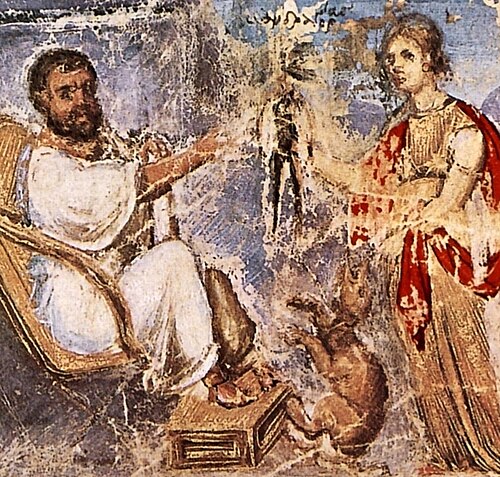
Depiction of Dioscorides, author of De Materia Medica. Unknown author Unknown author · Public domain

Pedanius Dioscorides

Greece / Roman Empire · c. 40–90 CE

A Greek physician from Anazarbus who traveled with Roman armies, Dioscorides compiled De Materia Medica around 60 CE: five books describing some 600 plants and their preparations, organized by drug action rather than alphabet. It remained the standard drug reference across Europe and the Middle East for roughly 1,500 years.

The story

Around 512 CE, more than four centuries after his death, a luxurious illustrated copy of his work — the Vienna Dioscorides — was made for the Byzantine princess Anicia Juliana. A thousand years after that, in the 1560s, the Habsburg ambassador Ogier Ghiselin de Busbecq found the same manuscript still in use in Constantinople, being consulted for drug knowledge, and bought it for the imperial library in Vienna, where it remains — a single book bridging fifteen centuries of continuous pharmaceutical use.

“Organize knowledge by how it is used, not how it is named, and it can outlive empires.”
Plants and substances described
~600 plants, 1,000 drugs
Centuries as the standard text
~15 centuries
Books in De Materia Medica
5 volumes
2
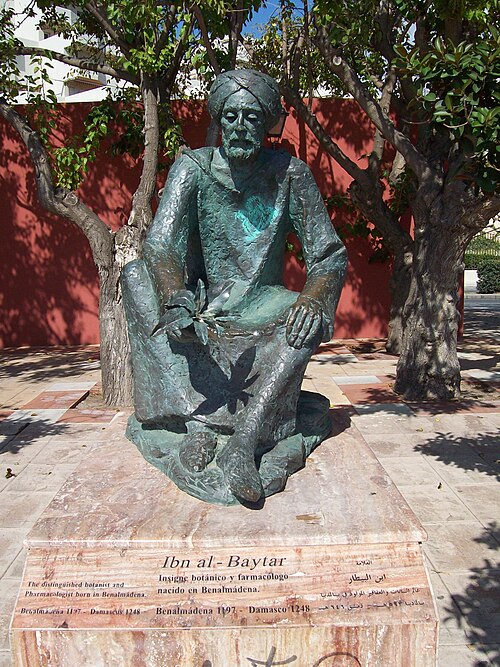
Depiction of the Andalusian pharmacologist and botanist Ibn al-Baytar. Keke999 · CC BY-SA 4.0

Ibn al-Baytar

Al-Andalus (Spain) / Egypt / Syria · 1197–1248

Born in Málaga, Ibn al-Baytar spent two decades botanizing from Iberia and North Africa to Anatolia and Syria, then compiled the greatest drug encyclopedia of the medieval world: a compendium of about 1,400 medicinal substances, several hundred of them recorded by no earlier author, each entry checked against his own field observation.

The story

Appointed chief of herbalists by the Ayyubid sultan al-Kamil in Cairo, Ibn al-Baytar took his student Ibn Abi Usaybi'a — later medicine's great biographer — plant-hunting around Damascus. The student recorded their method: they read Dioscorides and Galen against the living plants in front of them, and his teacher would recite any passage from memory, correcting the thousand-year-old Greek text wherever the specimen in his hand disagreed with it. He died in Damascus in 1248, reportedly poisoned by a plant he was testing.

“Cite your sources, then check every one of them against the specimen in your hand.”

Substances compiled
~1,400 drugs
First recorded by him
~300 novel entries
Earlier authors cited
~150 sources
3

Carl Wilhelm Scheele

Sweden · 1742–1786

A working apothecary his whole life, Scheele discovered oxygen before Priestley published, discovered chlorine, and identified more new substances — tartaric, citric, lactic and prussic acids among them — than almost any chemist of his century, all from the back rooms of pharmacies in Uppsala and the small Swedish town of Köping.

The story

Scheele had isolated and described oxygen — his 'fire air' — by around 1773, but his publisher sat on the manuscript of his book until 1777, three years after Joseph Priestley published his own independent discovery, costing the apothecary priority for the most important substance he ever found. He refused invitations to grander scientific posts, including from Frederick the Great's Berlin, preferring to keep his pharmacy; his lifelong habit of tasting and smelling every new compound — including hydrogen cyanide, whose flavor he described — likely contributed to his death at 43.

“The discovery belongs to whoever publishes; the pharmacy bench can beat the academy, but only if the world hears about it.”

Elements he had a hand in discovering
O₂, Cl₂ and more
Age at death
43, at his bench
Academic chairs accepted
0 — stayed apothecary
4
Portrait of Friedrich Sertürner, who first isolated morphine from opium. Julius Giere · Public domain

Friedrich Sertürner

Germany · 1783–1841

As a twenty-year-old pharmacist's assistant in Paderborn, Sertürner isolated the active principle of opium — the first alkaloid ever purified from a plant — and named it morphine after the god of dreams. The isolation founded alkaloid chemistry and, through it, the entire modern idea that drugs are single, purifiable molecules.

The story

In 1817, to prove morphine's potency, Sertürner and three young friends each swallowed what he later reported as three doses totaling around 100 milligrams within an hour — many times what medicine now considers a safe first dose. All four collapsed into life-threatening stupor, and Sertürner, barely conscious, induced vomiting with vinegar to save them. His published account of the near-disaster convinced the scientific establishment; Gay-Lussac had the work translated into French, and in 1831 the Institut de France awarded Sertürner its Montyon Prize as a benefactor of humanity.

“A pure substance means a knowable dose — the line separating modern pharmacy from everything before it.”

Age when the work began
~20, an apprentice
First alkaloid ever isolated
Morphine, 1804
Commercial production followed
Merck, 1827
5
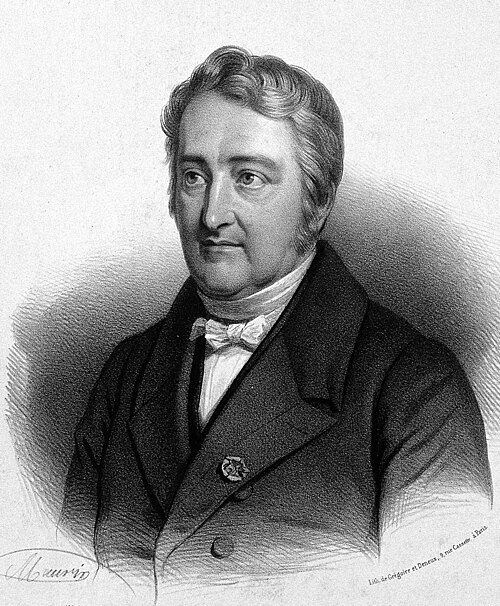
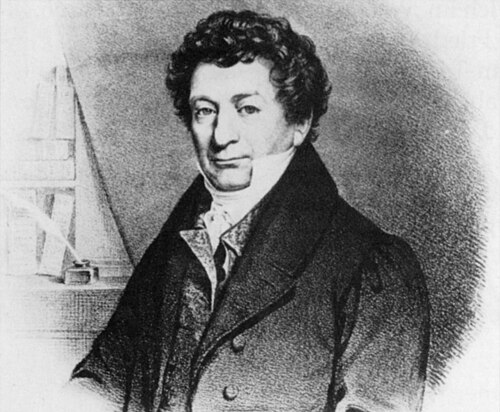
Portrait of the French pharmacist-chemist Pierre-Joseph Pelletier. Lithograph by N. E. Maurin · Public domain

Pierre-Joseph Pelletier

France · 1788–1842

A Paris pharmacy professor, Pelletier and his collaborator Joseph Caventou isolated quinine from cinchona bark in 1820 — the first reliable antimalarial in purified form — after earlier isolating strychnine and helping identify caffeine, making the École de Pharmacie's laboratory the productive center of world drug chemistry.

The story

Having isolated quinine, Pelletier and Caventou published their extraction method in full and deliberately took no patent, stating that the discovery belonged to the public. Quinine factories opened across Europe within a few years, and malaria treatment shifted from unreliable powdered bark to a dosable pure drug. The Institut de France awarded the pair its Montyon Prize of 10,000 francs in 1827; Paris later raised a public monument to them on the Boulevard Saint-Michel in 1900, an honor few pharmacists have ever received.

“Publishing a method without a patent can spread a cure faster than any business model.”

Major alkaloids isolated
Quinine, strychnine…
Patents taken on quinine
0 — method given away
Public monument in Paris
Erected 1900
6
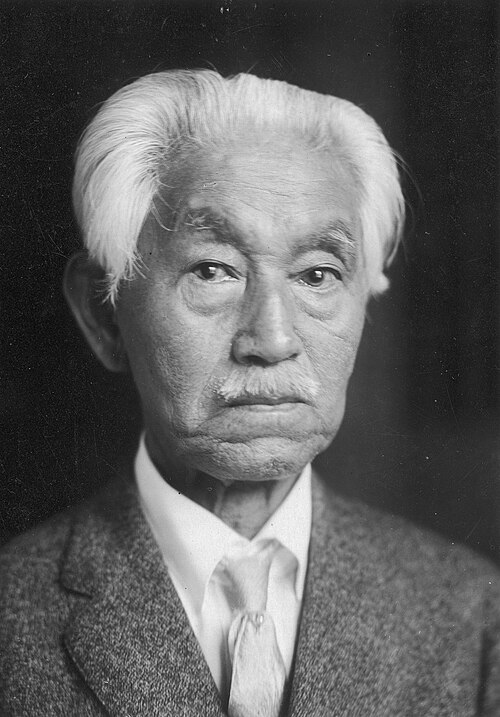
Portrait of the Japanese pharmaceutical chemist Nagai Nagayoshi. Unknown author Unknown author · Public domain

Nagai Nagayoshi

Japan · 1844–1929

Sent to Berlin among Meiji Japan's first government-funded students, Nagai spent thirteen years training under the chemist August Wilhelm von Hofmann, then returned to build Japanese pharmaceutical science almost single-handedly — becoming the first head of the Pharmaceutical Society of Japan and, in 1885, the isolator of ephedrine.

The story

In 1885 Nagai isolated ephedrine from má huáng, the Ephedra herb Chinese medicine had prescribed for coughs and wheezing for two thousand years — a direct chemical vindication of a traditional remedy. The discovery then sat largely unused for four decades until 1920s researchers at Eli Lilly, following work by K. K. Chen on the same herb, established ephedrine as a standard asthma treatment worldwide. Nagai's career made him the bridge over which European laboratory pharmacy entered Japan: he helped draft the country's first pharmacopoeia and trained its first generations of pharmaceutical chemists.

“Traditional remedies are hypotheses; chemistry is how a pharmacist tests them.”

Years training in Berlin
13, under Hofmann
Ephedrine isolated
1885, from má huáng
Pharmaceutical Society of Japan
First president
7

Alice Ball

United States · 1892–1916

Trained in pharmaceutical chemistry and pharmacy at the University of Washington, Ball became the first woman and first African American to earn a master's degree at the College of Hawaii. At 23 she solved a problem that had defeated medicine for decades: making chaulmoogra oil, the only known leprosy treatment, injectable.

The story

Chaulmoogra oil helped leprosy patients but was nearly unusable — too thick to inject, too nauseating to swallow. In 1915–16 Ball isolated the oil's ethyl esters, producing a water-miscible injectable form. She died in December 1916, aged 24, before publishing; the college's president, Arthur Dean, continued the work and published it as the 'Dean Method' without crediting her. A 1922 paper by Harry Hollmann, the physician who had recruited her, restored the name 'Ball Method'. The treatment freed isolated patients to go home, and remained the standard until sulfone antibiotics in the 1940s. Hawaii now marks Alice Ball Day every fourth February 29.

“Credit can be stolen from the record; put the method in writing and the record can be corrected.”

Age when she solved it
23 years old
Standard treatment until
The 1940s sulfones
Years until credit restored
6 (1916–1922)
8

Tu Youyou

China · b. 1930

A pharmacy graduate of Beijing Medical College with no doctorate, no foreign training and no academician's title, Tu led the team that extracted artemisinin from sweet wormwood during China's secret Project 523 — the antimalarial that became the backbone of global malaria treatment and won her the 2015 Nobel Prize.

The story

Screening more than 2,000 traditional remedies for the military's malaria project, Tu's team found qinghao (Artemisia annua) promising but maddeningly inconsistent. The answer came from a fourth-century text: Ge Hong's Emergency Formulas advised soaking the fresh herb in cold water and wringing out the juice — no boiling. Realizing heat was destroying the active compound, Tu switched to low-temperature ether extraction, and in 1971 extract number 191 achieved complete inhibition of malaria parasites in mice. Before patient trials in 1972, she and two colleagues took the extract themselves to prove it safe.

“Read the old texts literally: the detail everyone modernized away may be the whole discovery.”

Remedies screened
2,000+ recipes
Nobel Prize in Medicine
2015
First human subject
Herself, 1972

Bars are scaled to the leader in this list.

Comparison Lab

Toggle names on and off — every bar rescales to the leader of your selection.

5 / 8

The argument

Several names here are contested territory. Dioscorides and Scheele are claimed by medicine and chemistry as readily as by pharmacy, and Tu Youyou's inclusion is argued about in the other direction: Project 523 involved hundreds of researchers, artemisinin's isolation and structure were collective work across teams, and some Chinese colleagues have objected to any single-name credit — one reason Tu, famously, was never elected an academician at home.

Sertürner's priority has its own asterisk: French chemists Derosne and Séguin isolated opium fractions around 1803–04, and French journals initially treated morphine as partly theirs; Sertürner's decisive, dose-establishing work is why history settled on him. More broadly, a list built from published, translated records undercounts the drug experts of oral traditions — the herb-women, Ayurvedic and Chinese pharmacy lineages — whose accumulated knowledge is exactly what figures like Nagai and Tu mined for their celebrated discoveries.

Keep exploring

More in Medicine & Life