🕹️The Greats

Esports Pro · From a Stanford lab's 1972 Spacewar tournament to sold-out stadium finals — the youngest, shortest and most-watched playing career in modern sport.

Ranking players across different games is strictly impossible — there is no ladder where a StarCraft emperor can meet a Quake champion — so this list ranks influence on the profession itself: who proved it could pay, who built its institutions, who widened its doors. It leans toward games with written, broadcast histories, which is a real bias; the mobile-esports stars of Southeast Asia already outdraw several names below at home.

The eight span six countries and five decades of the trade, from a man who won a Ferrari with a rocket launcher to a teenager accused of cheating because she was too precise. Two threads run through all of them: each entered through an open, public competition, and each changed what the following generation believed the job could be.

The all-time podium

Lim "BoxeR" Yo-hwan
Lim "BoxeR" Yo-hwan
South Korea
2
Lee "Faker" Sang-hyeok
South Korea
1
Dennis "Thresh" Fong
United States
3

The eight who reached the top

1
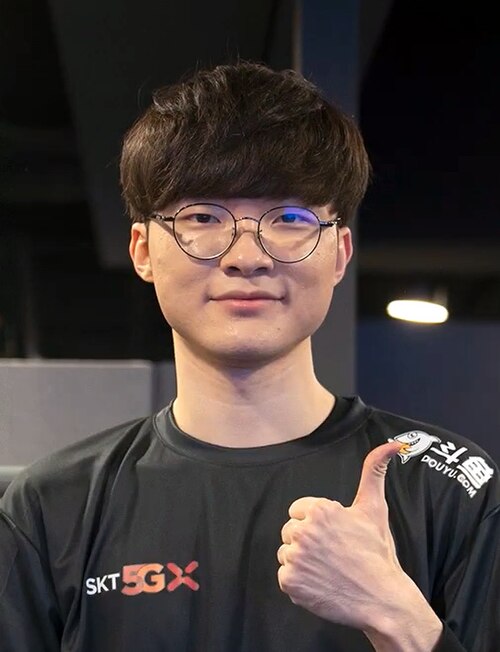
Lee Sang-hyeok, known as Faker, the most decorated League of Legends player in history. Fomos Esports · CC BY 3.0

Lee "Faker" Sang-hyeok

South Korea · b. 1996

Faker debuted for SK Telecom T1 in 2013 at seventeen and never left the club, winning five League of Legends World Championships (2013, 2015, 2016, 2023, 2024), ten domestic LCK titles and a 2023 Asian Games gold medal — the most decorated career in the game's history, at a team he now part-owns.

The story

In the deciding game of the 2013 OGN summer final, played under blind pick, both mid laners locked the assassin Zed. Facing KT Bullets' Ryu Sang-wook, Faker won the mirror duel from a sliver of health with a sequence of swaps and dodges that Korean broadcasters replayed for a decade; the rookie was nineteen games into his television career. The clip remains the most rewatched single play in League of Legends, and Ryu, a fine player, is remembered chiefly as the man standing opposite.

“Mechanics fade; judgment, preparation and staying loyal to one club compound into an era.”

World Championships
5 (2013–2024)
Domestic LCK titles
10 (2013–2022)
Years at one club
12+ (T1, 2013– )
2
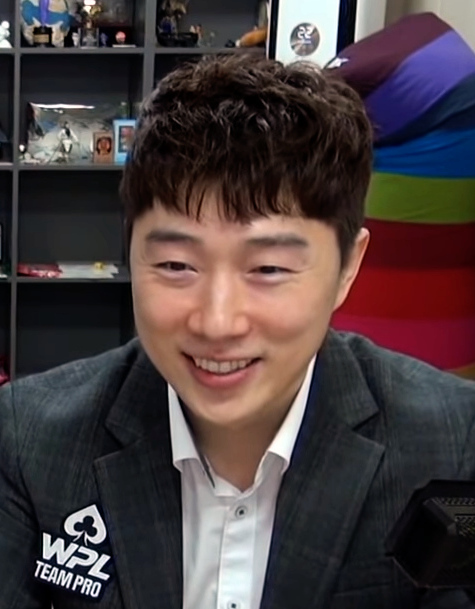
Lim Yo-hwan, the StarCraft: Brood War star known as BoxeR, the first esports superstar. 침착맨 플러스 · CC BY 3.0

Lim "BoxeR" Yo-hwan

South Korea · b. 1980

The "Terran Emperor" of StarCraft: Brood War was the first true esports superstar: back-to-back World Cyber Games golds (2001, 2002), a fan club in the hundreds of thousands, the first corporate team built around a single player, and a theatrical, inventive style that made a strategy game watchable television.

The story

When Lim's mandatory military service came due in 2006, the Republic of Korea Air Force formed Air Force ACE, a professional StarCraft team inside the armed forces, so the country's most famous gamer could keep competing in uniform through his enlistment. A state military fielding a pro gaming roster around one conscript has never happened in any sport before or since; the team competed in Korea's ProLeague for years and disbanded only in 2012, well after his discharge.

“Charisma built this profession: make the audience care about the person before the play.”

World Cyber Games golds
2 (2001, 2002)
Fan club at peak
500,000+ members
Career span
1999–2010
3
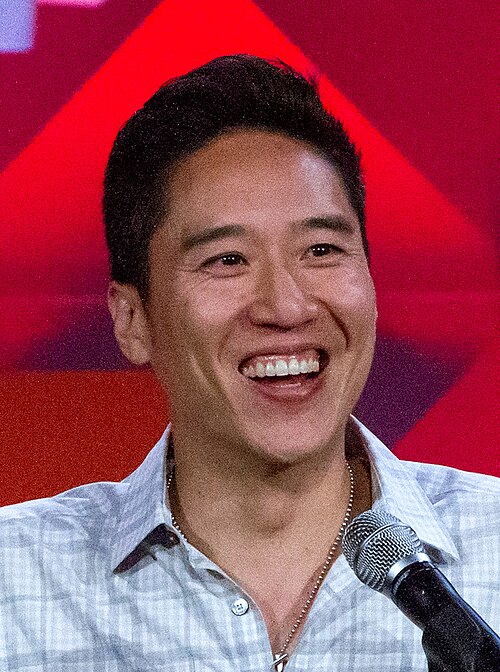
Dennis Fong, known as Thresh, recognized as the first professional gamer. QuakeCon · CC BY 2.0

Dennis "Thresh" Fong

United States · b. 1977

Fong dominated one-on-one Quake so completely in the late 1990s that Guinness World Records credits him as the first professional gamer. His winnings and sponsorships funded a second act as a founder: his gaming chat network Xfire sold to Viacom for $102 million in 2006.

The story

At the Red Annihilation tournament in mid-1997, roughly two thousand players competed online until sixteen finalists met at E3 in Atlanta. Fong beat Tom "Entropy" Kizmey in the final, and id Software's John Carmack handed over the keys to his own Ferrari 328 GTS as first prize. Photographs of a 20-year-old with a sports car won by playing Quake ran worldwide — the first time mainstream media reported, as plain fact, that video games could pay.

“Fong popularized the WASD-and-mouse control scheme; sometimes the technique outlives every trophy.”

Red Annihilation prize
Carmack's Ferrari
Guinness recognition
First pro gamer
Xfire sale to Viacom
$102M (2006)
4
Johnathan Wendel, the FPS champion who turned the Fatal1ty gamertag into a hardware brand. Fatal1ty · CC BY 3.0

Johnathan "Fatal1ty" Wendel

United States · b. 1981

Wendel won twelve world titles across five different first-person shooters — Quake III, Aliens vs. Predator 2, Unreal Tournament 2003, Doom 3 and Painkiller — then did what no player had done before: turned a gamertag into a consumer-hardware brand stamped on motherboards, headsets and mice.

The story

At the Cyberathlete Professional League World Tour final in New York in November 2005, broadcast on MTV, Wendel beat the Dutch favorite Sander "Vo0" Kaasjager at Painkiller for a $150,000 first prize — the richest one-on-one payday esports had seen. He had trained like an athlete for years, famously running several miles before practice sessions, and put the winnings into Fatal1ty, Inc. rather than a car, licensing his name while rivals were still splitting LAN winnings.

“Treat the game as a sport and yourself as a business; both ideas were his first.”

World titles
12, across 5 games
CPL 2005 first prize
$150k (New York)
Brand lifespan
2002–present
5
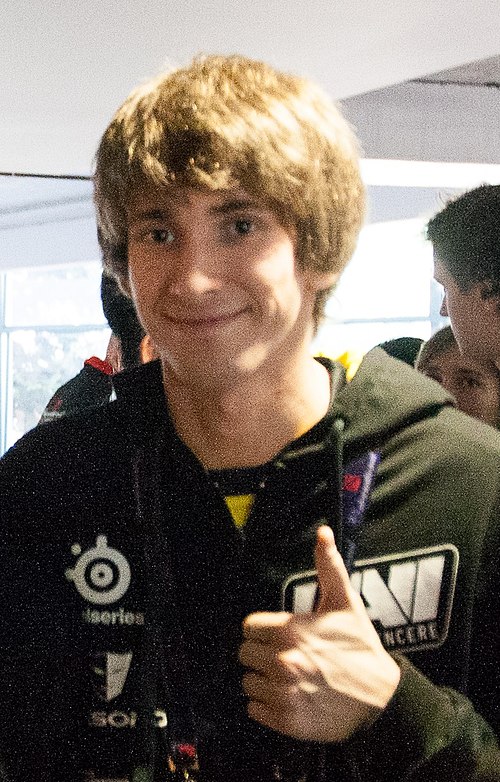
Danil Ishutin, known as Dendi, Dota 2's first global folk hero and champion of the first International. Jakob Wells · CC BY 2.0

Danil "Dendi" Ishutin

Ukraine · b. 1989

Lviv's Dendi won the first Dota 2 International with Natus Vincere in 2011, taking the $1 million first prize that announced esports' new economics, then reached the next two grand finals as well. Playful, crowd-loving and endlessly inventive on his signature hero Pudge, he became the game's first global folk hero.

The story

At The International 2013, against the Chinese favorites TongFu, Na'Vi paired Dendi's Pudge with captain Clement "Puppey" Ivanov's Chen to invent "the fountain hooks": Chen teleported Dendi home the instant his hook connected, dragging enemies into Na'Vi's own fountain to die under its guns. The trick — legal, rehearsed and completely unforeseen — swung the game, produced the loudest crowd reaction in the tournament's history and still opens highlight reels at every International.

“Invent inside the rules: the plays people remember are legal surprises, not perfect executions.”

International titles
1st ever (2011)
TI grand finals
3 straight (2011–13)
TI1 first prize
$1M, Cologne
6
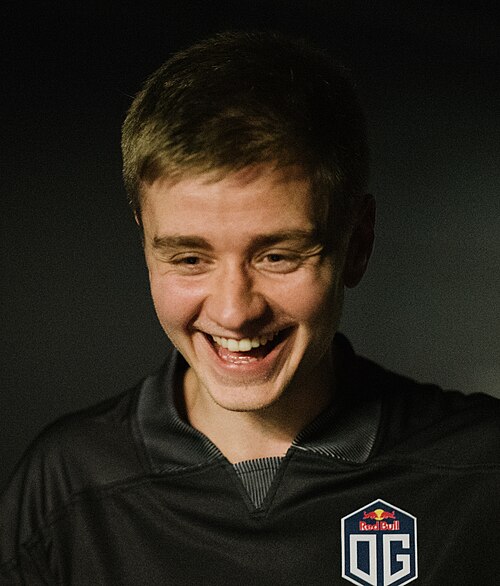
Johan Sundstein, known as N0tail, two-time International champion and esports' top career prize earner. Dota 2 The International · CC BY 2.0

Johan "N0tail" Sundstein

Denmark · b. 1993

Sundstein turned pro in Heroes of Newerth at fifteen, co-founded the Dota 2 organization OG in 2015, and became the only captain to win The International twice — back to back in 2018 and 2019 — retiring with roughly $7.2 million in prize money, the most of any esports player in history.

The story

Weeks before the 2018 qualifiers, OG collapsed: two stars and the coach walked out, one to a direct rival. Sundstein rebuilt around a returning Anathan "ana" Pham, a near-unknown Finnish pub player, Topias "Topson" Taavitsainen, and coach Sébastien "Ceb" Debs moving back to a playing seat. The patched-together roster fought through the regional qualifier, then beat China's PSG.LGD 3–2 in one of the great grand finals to win TI8 — and repeated as champions the following year.

“Morale is a competitive advantage: he rebuilt with friends and beat the superteams twice.”

Career prize money
~$7.2M (record)
International titles
2 (2018, 2019)
Age turned pro
15 (HoN, Fnatic)
7

Sasha "Scarlett" Hostyn

Canada · b. 1993

Hostyn is the most successful woman in esports history: a Canadian StarCraft II Zerg who beat Korea's best at the game Korea invented as a profession, recognized by Guinness World Records as the highest-earning woman in competitive gaming, with a career outlasting most of her male rivals.

The story

In February 2018, days before the Winter Olympics opened, the IOC-endorsed IEM PyeongChang tournament was staged in the Olympic host city as esports' formal audition to the Olympic movement. Hostyn cut through a Korean-dominated bracket and beat Kim "sOs" Yoo-jin — a two-time world champion — in the final, becoming the first woman to win a premier StarCraft II event, on Korean soil, in front of the sporting establishment the profession had courted for a decade.

“Excellence in an open bracket ends arguments that panels and pundits never could.”

IEM PyeongChang
Champion, 2018
Career prize money
$400k+ (2024)
Years at top level
2011–present
8

Kim "Geguri" Se-yeon

South Korea · b. 1999

Kim played Overwatch's Zarya with such precision that, at seventeen, she was publicly accused of cheating on the professional stage — then became the first woman to play in the Overwatch League, joining the Shanghai Dragons in 2018 while still a teenager.

The story

In 2016, two male professionals accused the unknown teenager of using aim-assist software, one vowing to quit the game if she proved clean. Blizzard investigated her accounts and found nothing; Kim then played live at a monitored studio session, hands on camera, replicating the exact flicks that had supposedly proven the hack. The accusers apologized and both soon left professional play. Two years later, the Overwatch League's Shanghai Dragons signed her.

“Let the hands answer: documented, repeatable skill is the only rebuttal that scales.”

First woman in OWL
Shanghai, 2018
Reported Zarya win rate
~80% (2016)
Age when accused
17 years old

Bars are scaled to the leader in this list.

Comparison Lab

Toggle names on and off — every bar rescales to the leader of your selection.

5 / 8

The argument

"First professional gamer" is genuinely contested. Guinness credits Dennis Fong (1997), but Twin Galaxies' arcade champions toured on sponsor money in the early 1980s, and Korea's broadcast leagues created the first salaried class around 2000 — the answer depends entirely on whether a prize, a sponsorship or a wage defines "professional."

A cross-title greatest-of-all-time is unmeasurable: Faker, Brood War's Lee "Flash" Young-ho and Counter-Strike's Oleksandr "s1mple" Kostyliev never shared a ladder, and every ranking quietly weights the games the ranker watched. This list's tilt toward broadcast PC titles also undercounts mobile-esports stars whose domestic audiences in Southeast Asia dwarf several entries here.

The near-absence of women reflects the pipeline, not the ceiling — Hostyn and Kim both won through open competition. Whether women-only circuits like VALORANT's Game Changers (launched 2021) fix the funnel or fence it off remains the profession's most argued structural question.

Keep exploring

More in Media & Performance