🪚Origins & Evolution

Carpenter · The builder in wood — a trade older than Homo sapiens, still measuring twice and cutting once from Nara's ancient temples to Norway's timber towers.

Carpentry's history is unusually physical: unlike most trades, its record survives as standing evidence. The world's oldest wooden buildings still stand at Hōryū-ji in Nara, Japan, thirteen centuries after their carpenters raised them, and a 4,500-year-old Egyptian ship lay in sealed pits at Giza with its joints still tight. Where the documents are silent, the joinery itself testifies.

The trade's turning points are material and mechanical rather than theoretical: iron tools, the sawmill, machine-made nails, the portable power saw. Each one redistributed skill — sometimes toward the carpenter, more often away from the site and into factories — and each time the trade renegotiated what remained: the parts of building in wood that only judgment on the spot can do.

Where it began

c. 2560 BCEGiza, Egypt

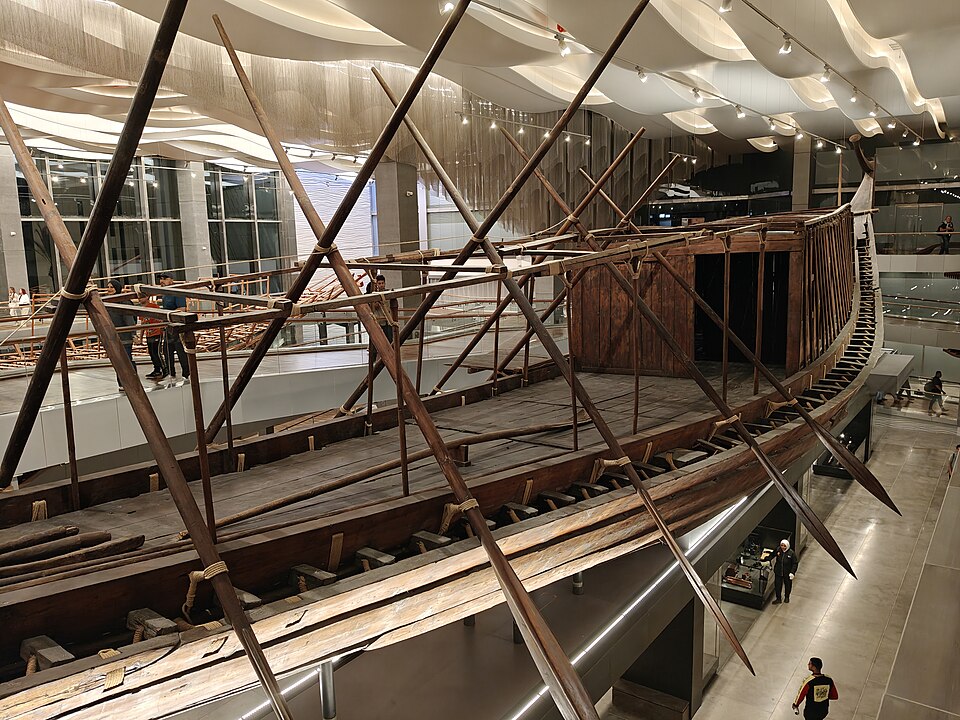
Egyptian carpentry was a fully professional trade by the Old Kingdom, with copper saws and adzes, mortise-and-tenon joints and dovetails. Its masterpiece surfaced in 1954, when archaeologist Kamal el-Mallakh opened a sealed pit at the foot of the Great Pyramid: a 43.6-metre cedar ship built for King Khufu around 2560 BCE, disassembled into 1,224 numbered pieces. Restorer Ahmed Youssef Moustafa spent more than a decade reassembling it — the planks pegged and lashed so precisely they still fit.

Timeline

c. 476,000 BPThe Kalambo Falls joint

At Kalambo Falls, Zambia, a team led by Liverpool archaeologist Larry Barham excavated two interlocking logs joined by a deliberately cut notch, published in Nature in 2023 and dated to roughly 476,000 years ago. Shaped by hominins long before Homo sapiens evolved, it is the oldest known wooden structure — structural carpentry predates our species.

c. 2560 BCEThe Khufu ship is buried at Giza

A full-sized cedar ship, 43.6 metres long, was disassembled into 1,224 pieces and sealed in a pit beside the Great Pyramid. Rediscovered in 1954, it is the world's oldest intact ship — its hull planks sewn and pegged with such precision that restorers could reassemble the vessel like a kit.

607 CEHōryū-ji rises in Nara

Prince Shōtoku founded Hōryū-ji temple; after a fire in 670 it was rebuilt by about 711. Its Golden Hall and five-storey pagoda, framed in hinoki cypress felled some 1,300 years ago, are the oldest wooden buildings on Earth — maintained ever since by hereditary temple carpenters.

1056A 67-metre pagoda without nails

The Sakyamuni Pagoda at Fogong Temple in Ying County, Shanxi, went up in 1056: 67.3 metres of interlocking dougong bracket carpentry, using dozens of distinct bracket types and no structural nails. It has survived roughly a thousand years of earthquakes that leveled masonry around it.

1333London's carpenters write their rules

The Carpenters' Company of London recorded its first book of ordinances in 1333 and received a royal charter in 1477 — one of many European guilds that controlled training, wages and quality through the apprentice–journeyman–master ladder, a structure the trade still loosely follows.

1678The first English trade manual

London printer Joseph Moxon began issuing Mechanick Exercises in monthly parts — the first English-language manual to describe carpentry and joinery technique in print. Until then the trades passed knowledge only by demonstration, guarded inside guild workshops.

1833The balloon frame, Chicago

St. Mary's Church in Chicago went up with light, machine-sawn studs and cheap machine-made nails instead of heavy mortised timbers — a method skeptics said would blow away like a balloon. It let two men do what had needed a raising crew, and it built the American West.

1924The portable circular saw

New Orleans inventor Edmond Michel patented a handheld electric circular saw, commercialized through the company that became Skilsaw. Within a generation, hand-sawing framing lumber on site had essentially ended — the single largest productivity jump in the trade's modern history.

1952The truss plate industrializes the roof

Florida builder A. Carroll Sanford developed the toothed steel connector plate behind the Gang-Nail truss, moving roof framing from skilled site work into factories. Today the overwhelming majority of new American and Australian house roofs arrive as prefabricated trusses on a truck.

2019Timber goes high-rise

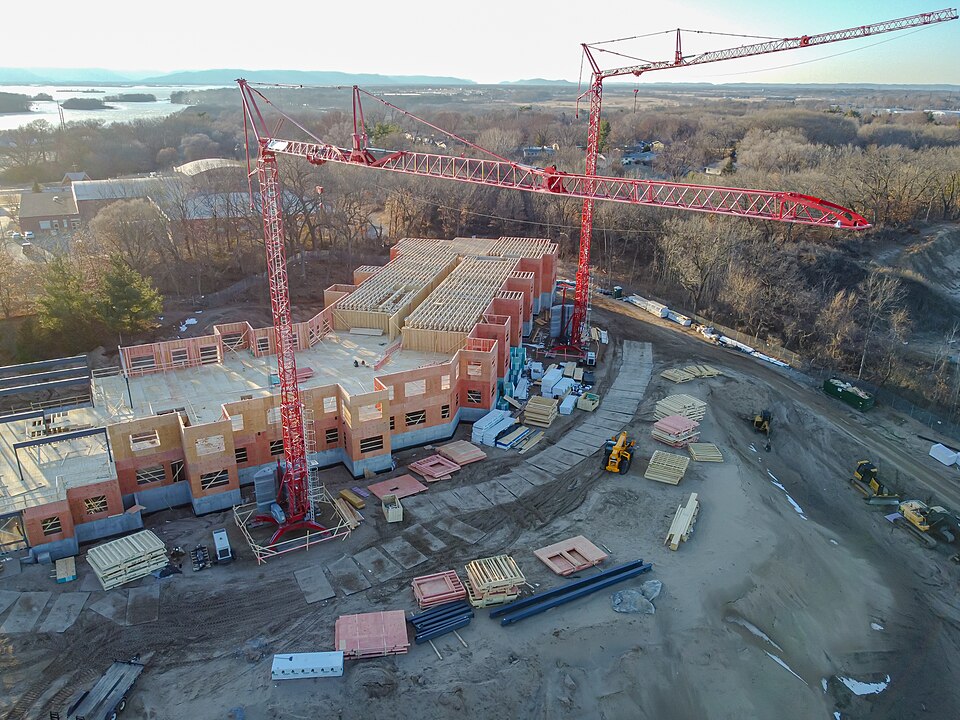
The 85.4-metre Mjøstårnet tower opened in Brumunddal, Norway — then the world's tallest timber building — built of glulam and cross-laminated timber. Mass timber returned wood to commercial high-rise construction a century after steel and concrete had pushed it out, creating a new crane-and-CNC branch of the trade.
The eras

The reconstructed 4,500-year-old cedar ship of King Khufu, found buried beside the Great Pyramid of Giza.
Matthäus Wander · CC0 · Wikimedia Commons
c. 500,000 BCE – 500 CE

The first joiners

From the notched logs of Kalambo Falls to the workshops of Egypt and Rome, woodworking was among the earliest specialized skills. Egyptian carpenters appear in tomb models with saws, adzes and glue pots; Rome organized the trade into collegia and used legion carpenters as military engineers — Caesar's army bridged the Rhine in ten days in 55 BCE, in timber.

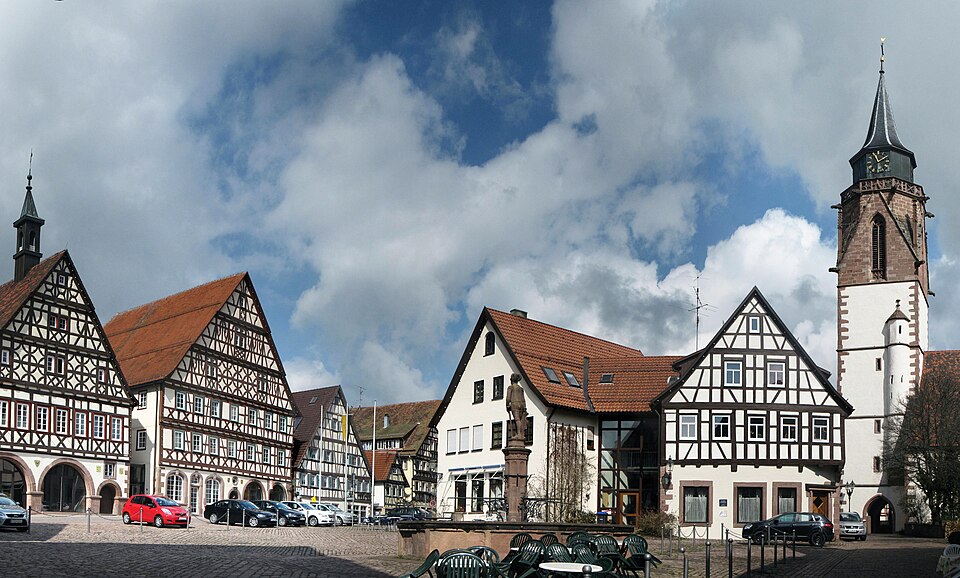
A traditional timber-framed building showing exposed jointed oak framing.
Traveler100 · CC BY-SA 3.0 · Wikimedia Commons
500 – 1500

Guilds, cathedrals and temple carpenters

Medieval Europe framed its cathedrals under 'forests' of oak roof trusses while guilds — London's Carpenters' Company wrote its ordinances in 1333 — controlled who could practice. In East Asia the dougong bracket tradition raised nail-free pagodas, and Japan's hereditary temple-carpenter lineages, including the Kongō family firm founded in 578, carried techniques across centuries intact.

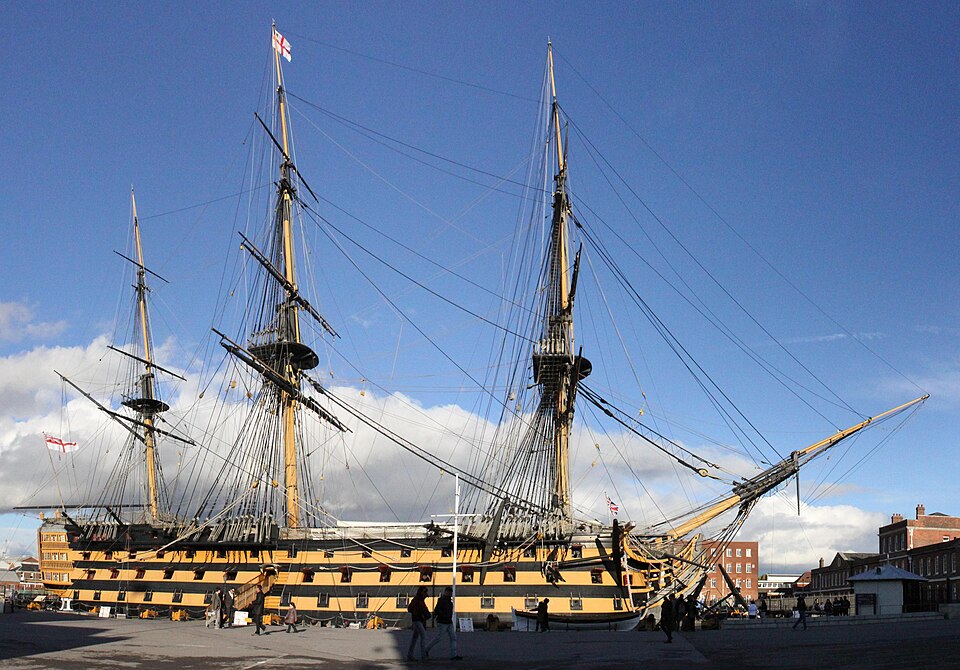
HMS Victory, an 18th-century wooden warship built from around six thousand trees.
User:Cimosteve (modified by MARC912374 ) · CC0 · Wikimedia Commons
1500 – 1830

Print, precision and the great divide

Printed manuals like Moxon's Mechanick Exercises (1678) and pattern books like Chippendale's Director (1754) spread knowledge the guilds once guarded, while the trade split: London's joiners chartered separately in 1571, cabinetmakers courted the wealthy, and shipwrights built the era's most complex machines — HMS Victory consumed roughly six thousand trees.

A light timber balloon frame under construction, with long continuous studs running past the floor levels.
Wikideas1 · CC0 · Wikimedia Commons
1830 – 1945

The balloon frame and the machine

Steam sawmills, dimensional lumber and machine-made nails birthed Chicago's balloon frame in 1833, letting small crews raise houses fast — and letting factories absorb skills the site once owned. Carpenters answered by organizing: Peter J. McGuire founded the United Brotherhood of Carpenters in 1881, and the union became one of the most powerful in American labor history.

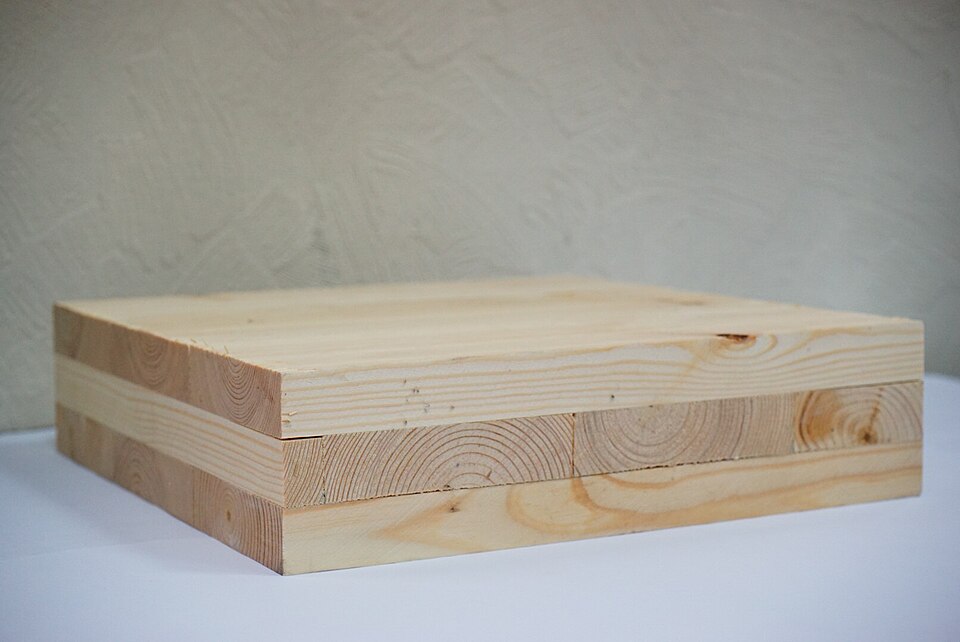
Stacked cross-laminated timber panels, the engineered wood behind modern timber towers.
Райн Александр Дмитриевич · CC BY-SA 4.0 · Wikimedia Commons
1945 – present

Power tools, prefabrication and mass timber

Pneumatic nailers, factory trusses from 1952, and finally the battery-tool revolution transformed the site, while platform framing standardized house construction. Since the 1990s, Austrian-developed cross-laminated timber has carried wood into high-rise construction, and CNC beam processors now cut entire frames from digital models — redistributing the trade between factory and site once again.

What this job replaced

Neighbouring trades that no longer exist — absorbed, automated or regulated away.

Pit sawyer

c. 1300–1880

Before mechanized mills, every plank began with two men and a two-metre saw: the top-man balancing on the log, the pit-man below in a rain of sawdust, ripping timber lengthwise for hours at a stretch. Sawyers worked in paired teams as a distinct trade allied to carpentry until steam sawmills spread through the nineteenth century and erased the pit within two generations.

Wheelwright

Antiquity–1930s

The maker of wooden wheels — hub, spokes and felloes fitted with shrunk-on iron tyres — was once every village's most exacting woodworker, combining carpentry, turning and smithing. George Sturt's 1923 memoir The Wheelwright's Shop documented the trade's last working generation in Farnham, England, just as the motor car and the pressed-steel wheel ended four thousand years of demand.

Chair bodger

c. 1700–1950s

In the beech woods of England's Chiltern Hills, bodgers lived and worked among the trees, turning chair legs on foot-powered pole lathes and selling them by the gross to the High Wycombe chair factories. Factory turning killed the trade in the twentieth century; Samuel Rockall, commonly counted the last traditional bodger, kept working his woodland shop until his death in 1962.

Trades that vanished →

The pattern across half a million years is consistent: the cutting keeps moving to wherever it can be done fastest — from the site to the sawpit, the sawpit to the mill, the mill to the CNC line — while the fitting, the judgment and the repair stay stubbornly on site, in human hands.

A trade that has already outlived the sawpit, the guild monopoly and the hand-nailed roof is unlikely to be finished off by the factory wall panel. Every era has moved the boundary between what is made and what is built; none has yet removed the person who reconciles the two.

Keep exploring

More in Craft & Trade