🎭The Greats

Actor · From Thespis stepping out of the Athenian chorus to the self-tape era: the professional pretender whose work is to make invented people feel true, take after take.

Ranking actors across twenty-five centuries is unfair by construction: everyone before 1895 survives only in witnesses' words, and everyone outside the industries that got filmed, translated and archived is invisible to lists like this one. The eight below are chosen for documented influence — each one changed what acting is, how it is taught, or who is allowed to do it, in ways still visible on stages and screens today.

They span four centuries and six countries: an eighteenth-century Londoner who made the trade respectable, a Frenchwoman who invented global celebrity, a Russian who turned craft into a system, and screen actors from the United States, Japan and India who defined what the camera could believe. Four are women — in acting, unusually among the professions on this site, the history allows it easily.

The all-time podium

David Garrick
David Garrick
United Kingdom
2
Konstantin Stanislavski
Russia
1
Sarah Bernhardt
Sarah Bernhardt
France
3

The eight who reached the top

1
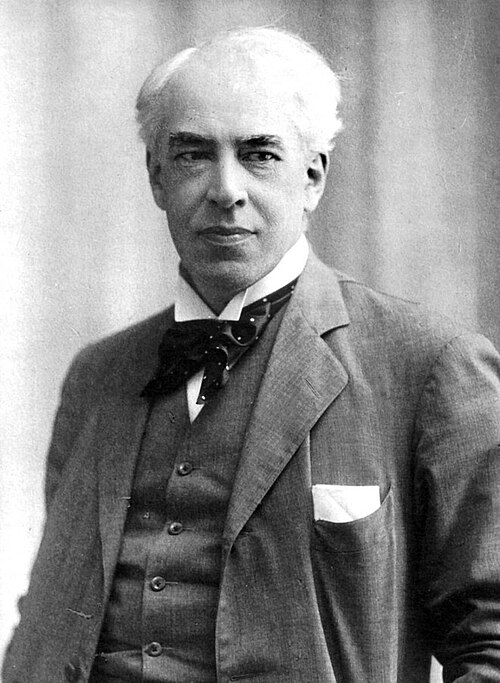
Portrait of Konstantin Stanislavski, co-founder of the Moscow Art Theatre. Unknown author Unknown author · Public domain

Konstantin Stanislavski

Russia · 1863–1938

Actor, director and co-founder of the Moscow Art Theatre, Stanislavski turned acting from an inherited bag of tricks into a teachable discipline. His "system" — objectives, given circumstances, the magic if — is the root of the Method, Meisner and Adler techniques, and of virtually every formal actor-training program in the world.

The story

On 22 June 1897, Stanislavski met the playwright-teacher Vladimir Nemirovich-Danchenko for lunch at Moscow's Slavyansky Bazaar restaurant to discuss founding a theatre. The conversation ran roughly eighteen hours, continuing at Stanislavski's family estate until the next morning, and settled everything: ensemble over stars, rehearsal discipline, contempt for cheap theatricality. The Moscow Art Theatre that resulted opened in 1898 and rescued Chekhov's The Seagull from its disastrous premiere, staging the second production that made both the theatre and the playwright.

“Craft that is written down and systematized outlives any performance; teaching multiplies a career into thousands.”
Founding meeting length
~18 hours, 1897
Years leading the MAT
40 (1898–1938)
Techniques descended
Method, Meisner, Adler
2
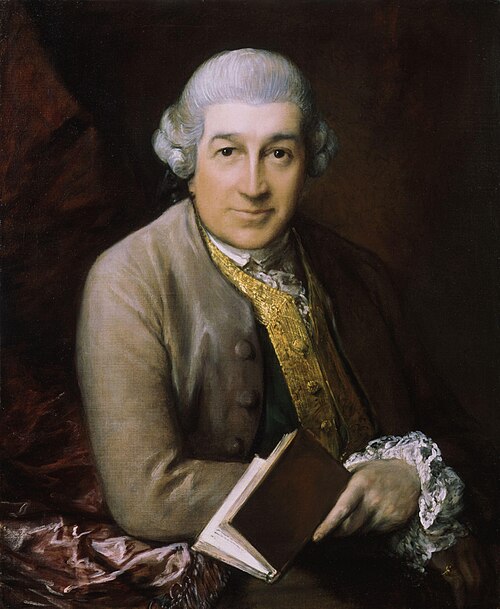
Portrait of the eighteenth-century English actor David Garrick. Thomas Gainsborough · Public domain

David Garrick

United Kingdom · 1717–1779

Garrick replaced the stately declamation of the eighteenth-century stage with quick, observed, natural behavior, managed Drury Lane for twenty-nine years, and — through fame, wealth and impeccable respectability — did more than anyone to turn the English actor from a legal vagabond into a gentleman.

The story

In October 1741, Garrick debuted as Richard III at the unlicensed Goodman's Fields theatre, billed anonymously as "a gentleman who never appeared on any stage" to dodge both the licensing laws and the shame the profession still carried. His natural style was so startling that fashionable London jammed the streets to the East End with carriages; Alexander Pope came three times and pronounced that the young man never had his equal. Within months Garrick was the most famous performer in Britain — and in 1779 he became the first actor buried in Westminster Abbey.

“Play the truth of the moment and the fashion of the age will reorganize itself around you.”

Years managing Drury Lane
29 (1747–76)
Anonymous debut to fame
One season, 1741
First actor in the Abbey
Westminster, 1779
3
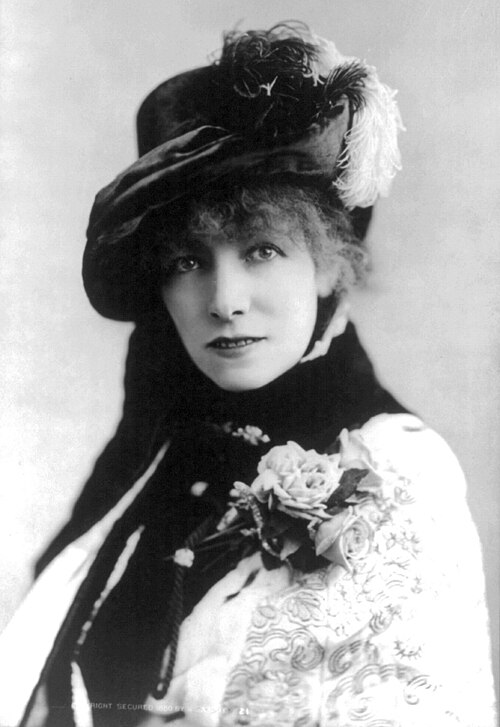
Photograph of the French stage actress Sarah Bernhardt. Napoleon Sarony · Public domain

Sarah Bernhardt

France · 1844–1923

"The Divine Sarah" was the first performer to be world-famous in person, touring Europe, the Americas and Australia with her own company and playing Hamlet as well as the great female roles. She managed her own theatres, controlled her own image, and invented the template of global stage celebrity that film stars later inherited.

The story

In February 1915, aged seventy, Bernhardt had her right leg amputated above the knee after years of pain from an old stage injury. She refused a prosthetic, resumed performing within months, and in 1916 toured the Western Front in a sedan chair, performing for French soldiers close enough to the lines to hear the guns. She continued acting until the end — dying in 1923 during a break in shooting a film being made in her own Paris home.

“Celebrity is a product you can own and manage yourself; the audience follows the person, not the vehicle.”

Farewell tours of America
9 tours
Age at front-line tour
71, WWI (1916)
Years on stage
60 (1862–1922)
4
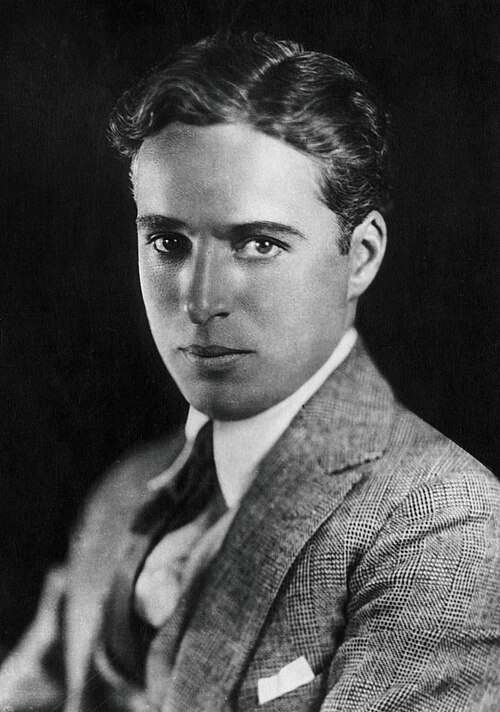
Charlie Chaplin in costume as the Tramp, with bowler hat and cane. Strauss-Peyton Studio · Public domain

Charlie Chaplin

United Kingdom / United States · 1889–1977

A London music-hall child performer who became, as the Tramp, the most recognized human being of the early twentieth century. Chaplin wrote, directed, scored and starred in his own films, and in 1919 co-founded United Artists with Mary Pickford, Douglas Fairbanks and D. W. Griffith — actors seizing the means of production.

The story

For City Lights (1931), Chaplin shot the short scene in which the blind flower girl mistakes the Tramp for a rich man 342 times across many months — footage preserved in his archives shows him unable to articulate what he wanted, only that each take lacked it — and he fired and rehired his leading lady Virginia Cherrill along the way. The finished scene runs about three minutes, and the film's ending built on it is routinely called the most moving in silent cinema.

“Perfectionism is expensive and unreasonable, and on the screen, forever, only the take that worked survives.”

Takes for one scene
342 (City Lights)
United Artists founded
1919, 4 partners
Honorary Oscar ovation
12 minutes, 1972
5
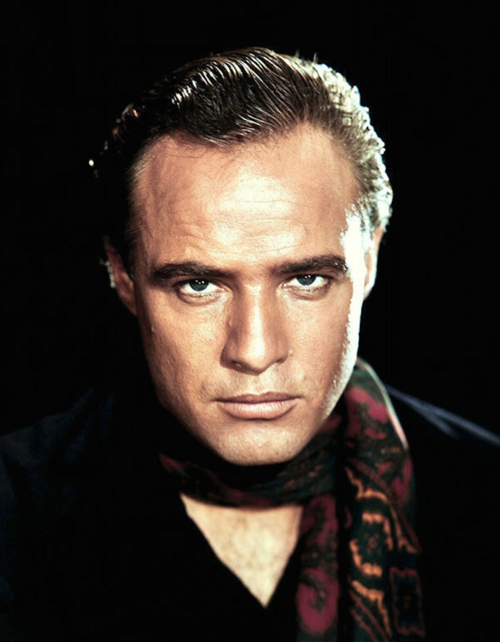
Photograph of the American actor Marlon Brando. None visible/Paramount Pictures · Public domain

Marlon Brando

United States · 1924–2004

Brando's Stanley Kowalski in A Streetcar Named Desire — on Broadway from 1947, on film in 1951 — made every prior screen style look staged, and made Stanislavski-derived acting the American norm. Mumbling, dangerous and unpredictable, he redefined screen masculinity twice: as the young rebel, then as Don Corleone in 1972.

The story

Named Best Actor for The Godfather at the 1973 Academy Awards, Brando refused the Oscar and sent the Apache activist Sacheen Littlefeather to decline it on live television, in protest at Hollywood's treatment of Native Americans and the standoff then underway at Wounded Knee. The audience booed and cheered; the moment remains the most famous refusal in the history of entertainment awards — an actor spending accumulated fame on something other than himself.

“Fame is a currency; what you buy with it, not its amount, is what history remembers.”

Oscars won
2 (1955, 1973)
Streetcar Broadway run
2 yrs (1947–49)
AFI screen-legend rank
#4, male legends
6
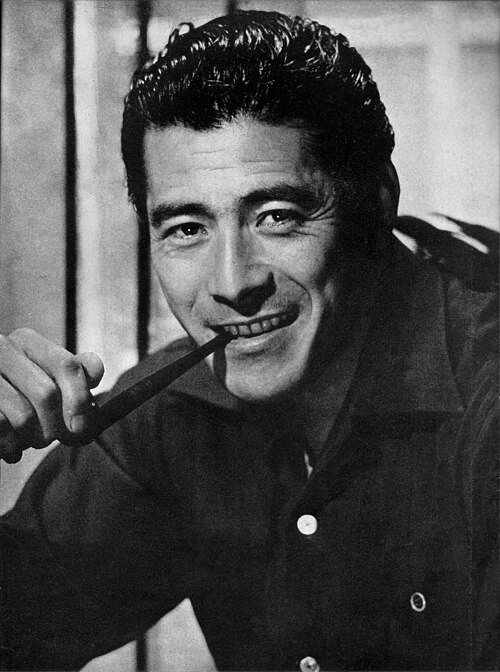
Photograph of the Japanese actor Toshiro Mifune. 映画世界社 (Eiga Sekai Publications, Inc.) · Public domain

Toshiro Mifune

Japan · 1920–1997

Mifune made sixteen films with Akira Kurosawa — Rashomon, Seven Samurai, Yojimbo — performances of such physical ferocity and precision that they carried Japanese cinema to the world and stamped every action and Western hero since. He won the Venice Festival's best-actor prize twice, in 1961 and 1965.

The story

In 1946, demobilized and broke, Mifune applied for a job as an assistant cameraman at Toho Studios; his application ended up in the studio's "New Faces" acting audition instead. Asked to mime anger, he raged so convincingly that most of the jury found him unusable — until Kurosawa, drawn in from next door, later wrote that he was transfixed by "a young man reeling around the room in a violent frenzy." Kurosawa insisted the studio take him. Neither man's career made sense without the other again.

“Enter through whatever door opens; the audition that matters may not be the one you applied for.”

Films with Kurosawa
16 (1948–65)
Venice Best Actor wins
2 (1961, 1965)
Career film roles
150+
7

Meryl Streep

United States · b. 1949

With twenty-one Academy Award acting nominations — the most of any performer in history — and three wins across five decades, Streep made technical transformation the modern standard: accents learned to fluency, characters built from Polish, Danish, Italian and British voices, and a career sustained past sixty in an industry that discards actresses at forty.

The story

Auditioning for the 1976 King Kong remake, the young Streep listened as producer Dino De Laurentiis, assuming she could not understand, complained to his son in Italian about being brought something so ugly — "che brutta." Streep, who understood, answered him in Italian: she was sorry she was not beautiful enough to be in King Kong. She lost the part, told the story publicly decades later, and within three years of that room had won her first Academy Award.

“The room that rejects you is not the career; outlast the verdict and it becomes an anecdote you tell.”

Oscar nominations
21, all-time record
Oscar wins
3 (1980, '83, '12)
Years since screen debut
45+ (since 1977)
8

Sridevi

India · 1963–2018

On screen from age four and a lead across Tamil, Telugu, Malayalam, Kannada and Hindi cinema — roughly 300 films — Sridevi became Hindi film's first female superstar, opening films on her own name in an industry organized entirely around male leads. India awarded her the Padma Shri in 2013.

The story

Sridevi's range was built on a childhood spent entirely inside the industry: she debuted at four in the 1967 Tamil film Thunaivan, and at thirteen played a grown woman in Moondru Mudichu — a character who marries the widowed father of the hero played by Rajinikanth, making her his stepmother on screen while barely a teenager. After a fifteen-year hiatus at the height of her fame, her 2012 comeback English Vinglish — as a housewife mocked for her English — premiered to a standing ovation in Toronto.

“Range is built, not granted; an industry's constraints can become the resume that outgrows them.”

Films acted in
~300
Languages performed in
5
Age at screen debut
4 (1967)

Bars are scaled to the leader in this list.

Comparison Lab

Toggle names on and off — every bar rescales to the leader of your selection.

5 / 8

The argument

Every actor before 1895 is ranked on hearsay: Sarah Siddons, Edmund Kean and Eleonora Duse — whom Chekhov and Shaw judged Bernhardt's superior — left no usable recordings, so film-era names dominate lists like this by default of evidence, not of talent.

The technique wars remain genuinely unsettled: partisans of Laurence Olivier's exterior craft and Brando's interior Method still argue over which produces truth, an argument crystallized in the (probably embellished) Marathon Man story of Olivier telling a haggard Dustin Hoffman, who had stayed up for days to play exhaustion, to try acting instead.

The omissions are their own argument: Ira Aldridge, the African-American Shakespearean who conquered Europe's stages when America's were closed to him; Katharine Hepburn and her record four acting Oscars; Amitabh Bachchan, a national institution for half a century. Every national cinema keeps its own list, and almost none of them overlap.

Keep exploring

More in Media & Performance