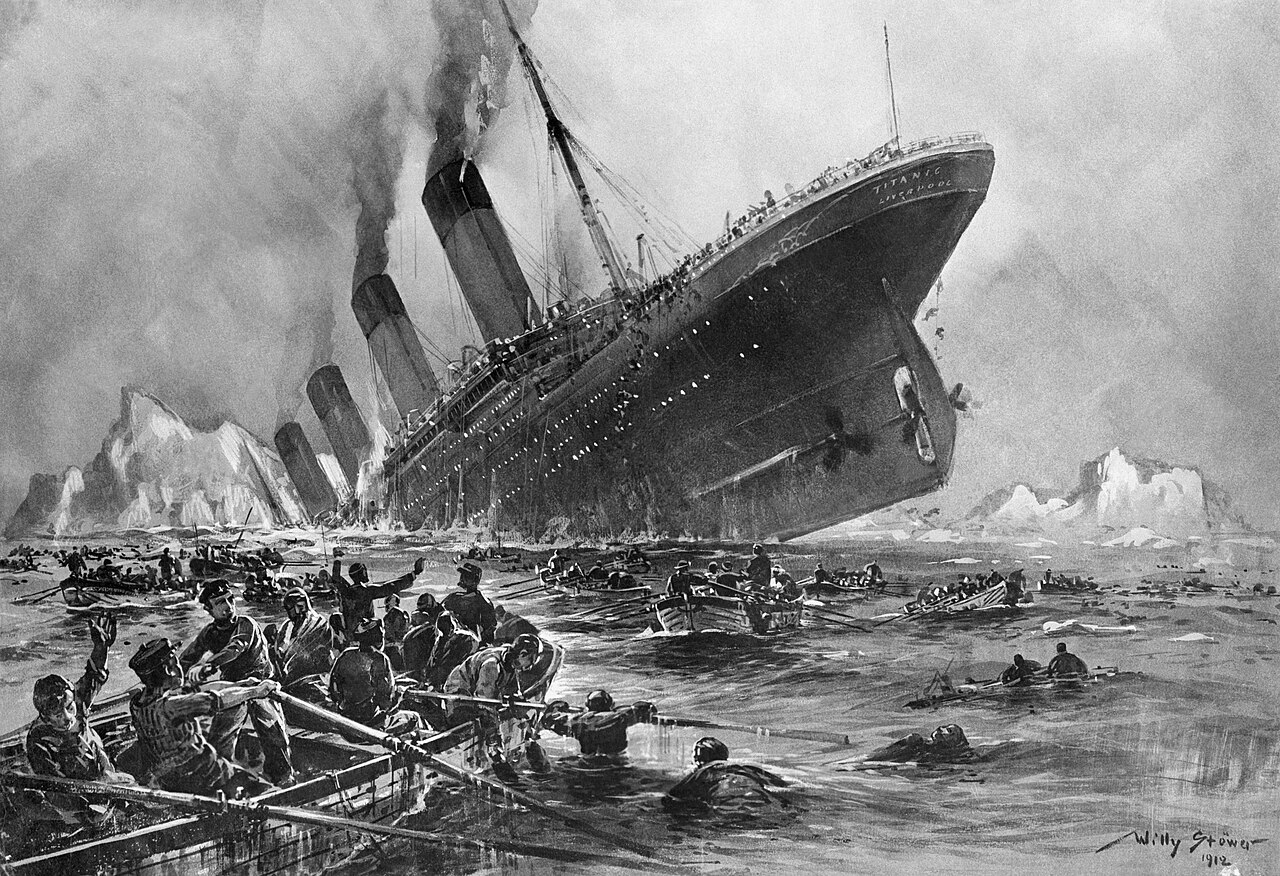
On 14–15 April 1912 the White Star liner RMS Titanic struck an iceberg in the North Atlantic and sank, killing about 1,500 people and forcing the first SOLAS convention.
Also called: RMS Titanic · 1912 iceberg collision
At a glance
Score intensity
Darker cells mean a higher score for this topic on that metric.
Notoriety98
Mystery30
Scale90
Evidence82
Legal impact85
Culture98
LessMore
Score profile
Each bar is a 0-100 atlas score for this topic, not a timeline.
Notoriety98
Mystery30
Scale90
Evidence82
Legal impact85
Culture98
Evidence
Evidence
82%
Score profile
Mystery
30%
Timeline
Milestones in order. This is history, not a weekly activity grid.
RMS Titanic, an Olympic-class liner of the White Star Line, left Southampton on 10 April 1912 for New York via Cherbourg and Queenstown. Shortly before midnight on 14 April the ship struck an iceberg in the North Atlantic. It sank at about 02:20 on 15 April. The British Wreck Commissioner’s report of 30 July 1912 recorded the loss of 1,490 lives at 41°46′N, 50°14′W.
Two public inquiries sat within weeks. A United States Senate subcommittee chaired by Senator William Alden Smith heard witnesses from 19 April. In London, Lord Mersey’s court sat from 2 May to 30 July 1912, examined 97 witnesses and answered 26 Board of Trade questions. Both found that high speed in an ice field, thin lookout practice and too few lifeboats turned a collision into a mass-casualty wreck.
The disaster is closed as a cause-of-loss case. The wreck was located on 1 September 1985 by a Franco-American team led by Robert Ballard and Jean-Louis Michel. What remains open is heritage law: who may visit, film or lift objects from a gravesite that now sits under UNESCO and United States protective statutes.
Date14–15 Apr 1912
Deaths1,490 (UK 1912)
ShipRMS Titanic
OperatorWhite Star Line
InquiriesUS + UK, 1912
WreckFound 1 Sep 1985
Dossier scores
Notoriety 98
Mystery 30
Scale 90
Evidence 82
Legal impact 85
Culture 98
Notoriety
98
Mystery
30
Scale
90
Evidence
82
Legal impact
85
Culture
98
Why a maiden voyage rewrote the sea
Titanic was not the first liner lost to ice. It was the first whose passenger lists, wireless traffic and two governments’ transcripts made the failure of Edwardian safety rules impossible to bury.
A ship built to a legal minimum
Harland & Wolff launched Titanic at Belfast on 31 May 1911. The liner carried twenty lifeboats with a combined capacity of about 1,178 people, a figure that met the British Board of Trade’s 1894 scale based on tonnage rather than headcount. About 2,200 passengers and crew were aboard on the maiden crossing.
Watertight bulkheads rose only as high as E Deck. Naval architect Edward Wilding later told the British inquiry that a long side-grazing tear along plate seams could flood several compartments. The design assumed a head-on or limited-compartment breach, not a running wound along the starboard side.
Ice, speed and a single wireless watch
On 14 April the ship received multiple ice warnings, including from SS Californian and SS Mesaba. Captain Edward J. Smith kept a near-full speed of about 21–22 knots on a clear, moonless night. Lookouts in the crow’s nest had no binoculars. The iceberg was seen at about 23:40; the helm order came too late to clear it.
Californian, stopped in ice a few miles away, had shut down its wireless for the night after a single operator’s watch. Rockets from Titanic were seen and misread. Carpathia, under Captain Arthur Rostron, turned at full speed and took about 710 survivors from the boats after dawn on 15 April.
Class, boats and the public record
Survival rates tracked class and location more than myth. First-class women and children left in higher proportions than steerage families whose corridors and language barriers delayed access to the boat deck. The phrase “women and children first” describes a contested practice on the night, not a statute.
Passenger and crew lists, Marconi traffic and the two inquiry transcripts remain the core public record. Later wreck photography confirmed a break between the third and fourth funnels as the hull sank, a fact the 1912 courts could only infer from testimony.
From outrage to SOLAS
The United States Radio Act of 1912 required ships to keep a continuous wireless watch. The International Ice Patrol began in 1914 under the United States Coast Guard, funded by Atlantic liner states. The first International Convention for the Safety of Life at Sea opened for signature in London in 1914.
SOLAS 1914 was delayed by the First World War; later conventions in 1929, 1948 and 1974 kept the Titanic lesson as the treaty’s founding story: enough boats for all, boat drills, ice routing and a radio that does not sleep.
Beat weight marks
Mark each timeline beat already on this dossier as supported, contested or unknown, using the public-record claims already filed here. Not a verdict.
Editorial marks on this device only. Public-record encyclopedia — not legal advice, not a how-to, not a private file.
Timeline beat
Supported / Contested / Unknown
31 May 1911 — Launch at Belfast
Claim already on file: The ship was certified unsinkable.
10 Apr 1912 — Southampton departure
Claim already on file: A fire in a coal bunker sank the ship.
14 Apr 1912 — Iceberg at 23:40
Claim already on file: Third class was locked below as policy.
15 Apr 1912 — Sinking and Carpathia
Claim already on file: The wreck is one intact ship on the bottom.
19 Apr 1912 — US Senate inquiry opens
Claim already on file: The wreck is one intact ship on the bottom.
2 May 1912 — British wreck court sits
Claim already on file: The wreck is one intact ship on the bottom.
30 Jul 1912 — Mersey report
Claim already on file: The wreck is one intact ship on the bottom.
1914 — SOLAS and Ice Patrol
Claim already on file: The wreck is one intact ship on the bottom.
1 Sep 1985 — Wreck located
Claim already on file: The wreck is one intact ship on the bottom.
2012 — Centenary and heritage law
Claim already on file: The wreck is one intact ship on the bottom.
The ship struck an iceberg at about 23:40 on 14 April 1912 and sank at about 02:20 on 15 April in the North Atlantic. The British Wreck Commissioner’s report placed the loss at 41°46′N, 50°14′W.
How many people died?
Lord Mersey’s court recorded 1,490 lives lost. Other 1912 tallies ran higher; modern compilers often cite about 1,500 of roughly 2,200 aboard. About 710 people reached Carpathia. Figures still differ because crew and steerage lists were incomplete.
What did the official inquiries conclude?
Both the United States Senate inquiry and the British Wreck Commissioner found that the ship was driven too fast in an ice region, that lookout and wireless practice were inadequate, and that lifeboat capacity and loading failed the people on board. The British report dated 30 July 1912 blamed the collision on excessive speed.
Why were there too few lifeboats?
Board of Trade rules then scaled boatage to gross tonnage, not to the number of souls. Titanic’s twenty boats were legal. After 1912 the rule of boats for all became the political and then the treaty standard under SOLAS.
Was the ship officially called unsinkable?
No classification society certified Titanic as unsinkable. Trade-press and White Star publicity stressed watertight subdivision. The word stuck in English headlines after the wreck and became a lesson about marketing, not a hidden design stamp.
When was the wreck found?
On 1 September 1985 a joint expedition of the Woods Hole Oceanographic Institution and IFREMER located the wreck in two main pieces at about 3,800 metres. The United States later passed the RMS Titanic Memorial Act 1986 to treat the site as a memorial.
What law changed because of Titanic?
Immediate changes included the United States Radio Act of 1912, the International Ice Patrol (1914) and the first SOLAS convention (1914). Later SOLAS revisions still treat sufficient lifeboats, drills and continuous radio as baseline merchant-ship duties.
Is the cause of the sinking still disputed?
The iceberg collision and progressive flooding are not in serious dispute. Historians still argue about rivet quality, the exact length of the side damage, and how the hull broke. Those are engineering footnotes on a closed navigational case.