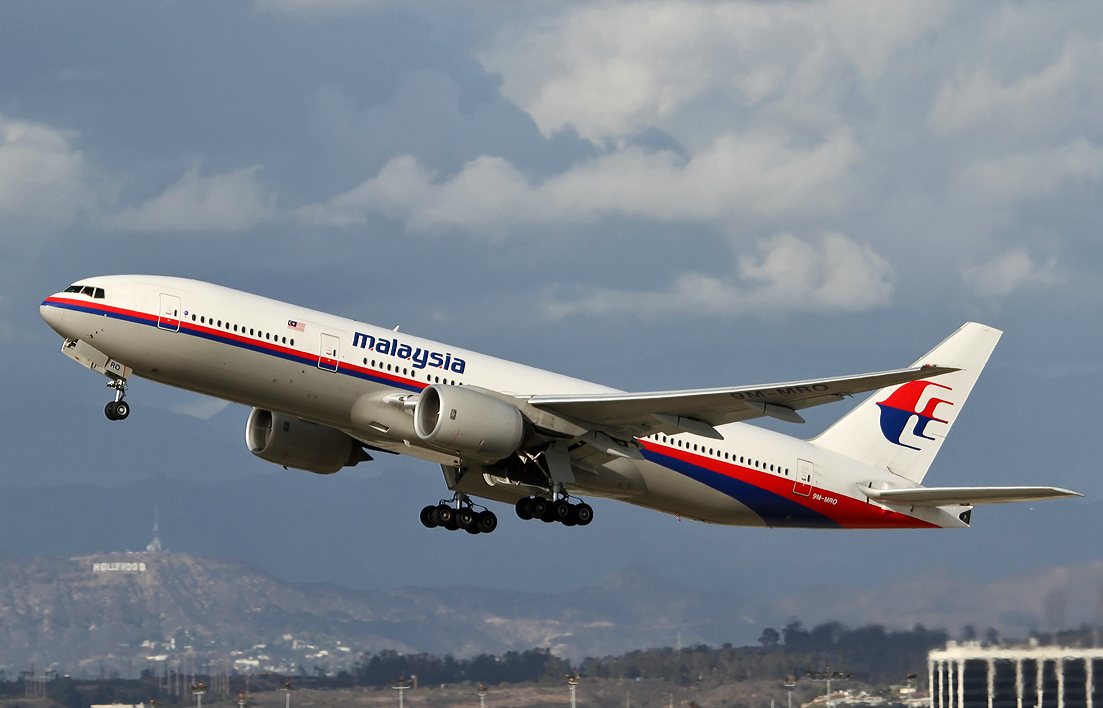
On 8 March 2014 Malaysia Airlines Flight 370 left Kuala Lumpur for Beijing and vanished; satellite handshakes and later Indian Ocean debris never produced a located wreck or a cause.
Also called: MH370 · MAS 370
At a glance
Score intensity
Darker cells mean a higher score for this topic on that metric.
Notoriety96
Mystery90
Scale78
Evidence48
Legal impact55
Culture88
LessMore
Score profile
Each bar is a 0-100 atlas score for this topic, not a timeline.
Notoriety96
Mystery90
Scale78
Evidence48
Legal impact55
Culture88
Evidence
Evidence
48%
Score profile
Mystery
90%
Timeline
Milestones in order. This is history, not a weekly activity grid.
Malaysia Airlines Flight 370, a Boeing 777-200ER registered 9M-MRO, left Kuala Lumpur International Airport at 00:41 MYT on 8 March 2014 for Beijing Capital. On board were 227 passengers and 12 crew. The last air-traffic-control radio from the cockpit, after a routine handoff toward Ho Chi Minh, was “Good night Malaysian three seven zero.” Secondary radar returns ceased over the South China Sea near the waypoint IGARI. Primary military radar later showed the aircraft turning west across the Malay Peninsula, then northwest, then south — a track that civil controllers did not see in real time.
Inmarsat, the satellite operator that still received hourly handshake signals from the aircraft’s data unit, later reconstructed a southern Indian Ocean corridor. On 24 March 2014 Malaysia’s prime minister, Najib Razak, announced that the flight had ended in that ocean with no survivors. The statement was a political and technical judgment from satellite analysis, not a photographed wreck. Australia’s Joint Agency Coordination Centre and the Australian Transport Safety Bureau then led a seabed search west of Australia that ended on 17 January 2017 without the airframe.
A right flaperon found on Réunion in July 2015 was identified as from 9M-MRO. Other fragments later appeared on western Indian Ocean shores. Malaysia’s Annex 13 safety investigation, published on 30 July 2018, could not determine who was at the controls after the turn or why the aircraft left the route. Ocean Infinity’s 2018 private search also failed to locate the wreck. The case remains unsolved.
Date8 March 2014
AircraftBoeing 777-200ER
RouteKUL to Beijing
On board239 people
DebrisRéunion flaperon
StatusUnsolved
Dossier scores
Notoriety 96
Mystery 90
Scale 78
Evidence 48
Legal impact 55
Culture 88
Notoriety
96
Mystery
90
Scale
78
Evidence
48
Legal impact
55
Culture
88
A corridor without a wreck
MH370 is a missing airliner with a reconstructed track, a handful of authenticated fragments and no cockpit voice, no flight-data recorder and no agreed cause.
What the radar and satellite paper show
Civil secondary radar and radio place 9M-MRO on the planned route until shortly after 01:19 MYT. Malaysian military primary radar, released in reconstructed form, then shows a westward crossing of the peninsula and a later southbound leg. Those plots are the main reason official English speaks of a South China Sea corridor that became an Indian Ocean problem.
Inmarsat’s ground station kept receiving automated handshakes from the aircraft’s satellite data unit for hours after the last voice call. Burst-frequency-offset analysis, later reviewed by the ATSB and by an international working group, produced the southern-arc end-of-flight estimate that moved the search from the South China Sea to the southern Indian Ocean. The method is technical and public; it is not a photograph of the seabed.
Search, debris and the 2018 report
Surface and underwater searches ran first in the South China Sea and the Strait of Malacca, then, after the 24 March announcement, in a vast box west of Australia. The ATSB-led seabed survey covered about 120,000 square kilometres. It found no 777. A 2018 Malaysian safety report recorded the known facts, the debris identifications and the absence of a cause. It did not name a perpetrator and did not close the wreck-file.
The Réunion flaperon, confirmed by French judicial authorities in September 2015, and later pieces examined in Australia and elsewhere, proved that at least part of 9M-MRO reached the western Indian Ocean. Drift studies then tried to back-calculate a crash latitude. Those studies narrowed arguments; they did not replace a locator beacon or a wreck photograph.
What the file does not decide
The official investigation found that the aircraft’s turn off route was consistent with manual inputs and that some communications systems stopped sending. It did not establish who acted, whether hypoxia or another onboard event occurred, or where the aircraft struck the water. Passenger and crew names are on the manifest; suspicion aimed at the flight deck in public debate is not a finding in the 2018 report.
Family groups in China, Malaysia, Australia and Europe have treated the missing wreck as an unfinished state duty. Later private sonar campaigns, including Ocean Infinity’s 2018 sweep, were attempts to finish that duty without a new intergovernmental fleet. Unsolved remains the correct status: people and recorders are still missing.
Why the case stayed global
MH370 vanished on a busy scheduled route with 239 people, including a large number of Chinese nationals, in an era of continuous news and satellite phones. The combination of a missing wide-body jet and a week of contradictory official briefings made the flight a worldwide English-language story before any debris existed.
Legal change after 2014 was real but partial: longer-life underwater locators, better tracking standards at ICAO, and arguments about how fast a state must share military radar. Cultural change was larger. The flight number became shorthand for a modern aircraft that can still disappear.
Beat weight marks
Mark each timeline beat already on this dossier as supported, contested or unknown, using the public-record claims already filed here. Not a verdict.
Editorial marks on this device only. Public-record encyclopedia — not legal advice, not a how-to, not a private file.
Timeline beat
Supported / Contested / Unknown
8 Mar 2014 — Flight 370 departs
Claim already on file: The aircraft landed and was hidden.
8 Mar 2014 — Last ATC call
Claim already on file: The 2018 report named the captain as the cause.
8–15 Mar 2014 — First search boxes
Claim already on file: The wreck has been found.
24 Mar 2014 — Southern-ocean announcement
Claim already on file: Nothing of the aircraft was ever recovered.
2014–17 — ATSB seabed search
Claim already on file: Nothing of the aircraft was ever recovered.
29 Jul 2015 — Réunion flaperon
Claim already on file: Nothing of the aircraft was ever recovered.
17 Jan 2017 — Official search ends
Claim already on file: Nothing of the aircraft was ever recovered.
Jan–May 2018 — Ocean Infinity sweep
Claim already on file: Nothing of the aircraft was ever recovered.
30 Jul 2018 — Malaysian safety report
Claim already on file: Nothing of the aircraft was ever recovered.
2018– — Open wreck-file
Claim already on file: Nothing of the aircraft was ever recovered.
A scheduled Boeing 777-200ER service, 9M-MRO, from Kuala Lumpur to Beijing on 8 March 2014. It carried 227 passengers and 12 crew. It never arrived. The wreck has not been found.
When did contact end?
The last ATC voice call was shortly after 01:19 MYT near waypoint IGARI. Secondary radar then ceased. Military primary radar later showed a westward and then southward track. Inmarsat handshakes continued for hours.
Why do officials say the southern Indian Ocean?
Inmarsat handshake timing and frequency-offset analysis, announced by Malaysia on 24 March 2014 and later used by the ATSB, placed the end of flight on a southern arc. Debris later found on western Indian Ocean shores is consistent with that ocean, not with a landing in China.
Has any of the aircraft been found?
Yes, fragments. A right flaperon on Réunion in July 2015 was identified as from 9M-MRO. Other pieces were later accepted or treated as almost certain. The main wreckage and the recorders have not been located.
What did the 2018 Malaysian report conclude?
The Annex 13 safety investigation could not determine the cause. It recorded the reconstructed track, the debris and the limits of the evidence. It did not name a person as responsible.
Who led the ocean search?
After the southern-arc announcement, Australia’s JACC coordinated and the ATSB led the official seabed search west of Australia, with Malaysia and China as partners. That search ended in January 2017. Ocean Infinity searched again in 2018.
Is the case closed?
No. The safety report is published; the wreck-file is not. Status is unsolved. Families continue to press for a located airframe.
Did anyone survive?
The 24 March 2014 Malaysian statement said the flight ended in the southern Indian Ocean with no survivors. That judgment rests on satellite analysis and later debris, not on recovered remains from a known site.