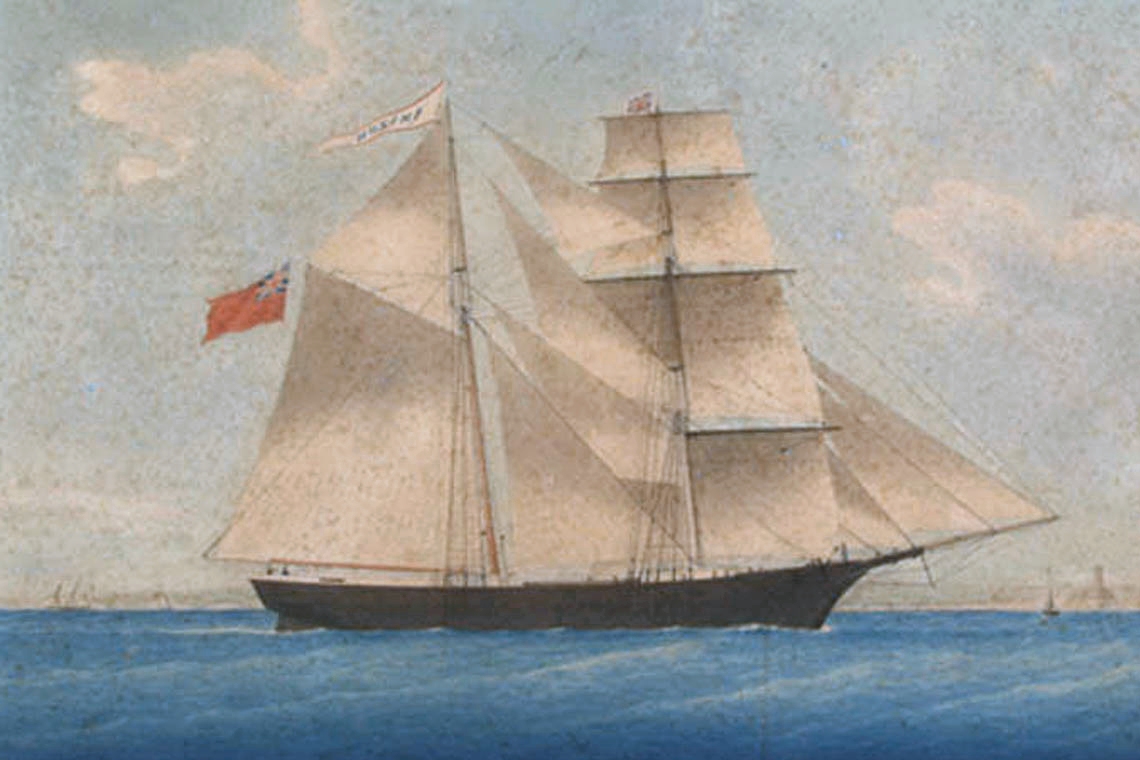
Unconfirmed, possibly Honore Pellegrin (1800–c.1870). This speculative attribution is suggested in Paul Begg: Mary Celeste: The Greatest Mystery of the Sea . Longmans Education Ltd, Harlow (UK) 2007. Plate 2 · Public domain · Wikimedia Commons
Mary Celeste, a Canadian-built brigantine then under American ownership, left New York on 7 November 1872 for Genoa with a cargo of 1,701 barrels of denatured alcohol. Her master was Captain Benjamin Spooner Briggs. With him sailed his wife, Sarah Elizabeth Briggs, their two-year-old daughter Sophia Matilda, and a crew of seven. The last entry in the ship’s log slate was dated 25 November, when the vessel was near the island of Santa Maria in the Azores.
On 4 December 1872 — 5 December by some deck clocks — the British brigantine Dei Gratia, Captain David Morehouse, sighted a ship under partial sail several hundred miles east of the Azores. First mate Oliver Deveau boarded and found Mary Celeste abandoned: no one on deck or below, the yawl or small boat missing, personal effects and most cargo still there, and a hull that was still seaworthy enough to be sailed to Gibraltar. Dei Gratia’s men brought her in as salvage.
A Vice-Admiralty salvage hearing opened at Gibraltar under Attorney-General Frederick Solly-Flood. The court paid a salvage award but never found a cause for the abandonment. Theories — alcohol vapour, a seiche or waterspout, a feared explosion, a missing boat in a rising sea — remain unproved. Arthur Conan Doyle’s 1884 fiction “J. Habakuk Jephson’s Statement” renamed the ship Marie Celeste and taught English readers a ghost story the salvage file does not support.
Found4–5 Dec 1872
ShipBrigantine
MasterBenjamin S. Briggs
FinderDei Gratia
HearingGibraltar, 1873
StatusUnsolved
Dossier scores
Notoriety 82
Mystery 94
Scale 28
Evidence 45
Legal impact 22
Culture 80
Notoriety
82
Mystery
94
Scale
28
Evidence
45
Legal impact
22
Culture
80
An empty ship, a full docket
Mary Celeste is the type derelict: a boarded brigantine, a missing boat, a suspicious law officer and a century of stories that added pirates Conan Doyle never found in the Gibraltar paper.
What Dei Gratia actually found
Deveau’s boarding notes, later read in court, described a ship that could still be pumped and sailed. Sails were set in a disordered way. The main peak halyard was parted. There was water in the hold, not enough in the salvage testimony to explain a panic by itself. The chronometer, sextant and some papers were missing; the logbook remained. Nine of the alcohol barrels were later reported empty or leaking.
The people were gone. Food and belongings suggested they had not packed for a long departure. The missing boat is the central physical fact. Whatever they feared, they left a vessel that reached Gibraltar under a prize crew. That mismatch — a livable ship and an empty deck — is the mystery the court could not close.
Gibraltar and Solly-Flood
Frederick Solly-Flood, Attorney-General at Gibraltar, treated the derelict as possible crime: mutiny, murder, or a staged wreck for insurance. He had the hull examined, including cuts on the bow that surveyors later judged to be old or ordinary. He suspected Dei Gratia’s men. The court, sitting in early 1873, did not adopt a murder theory. It awarded salvage — a reduced sum that still recognised Morehouse’s risk — and left the disappearance unexplained.
Captain Briggs had a reputation as a careful, temperate master. The crew list named experienced Germans among the seamen. Nothing in the surviving paper shows a documented quarrel. Solly-Flood’s suspicion is part of the file; it is not a finding. English readers often meet his doubts as if they were proof. They were not.
The fiction that renamed the ship
Conan Doyle, then a young doctor, published “J. Habakuk Jephson’s Statement” in the Cornhill Magazine in 1884. He called the brigantine Marie Celeste, added a vanished boatload of racial melodrama and a conspiratorial passenger, and set a template later magazines copied. The real salvage hearing had no such passenger and no such plot.
Later popular English — from boys’ annuals to twentieth-century radio — kept Marie and the idea of a meal still warm on the table. Boarding testimony does not describe a staged dinner. The warm-meal detail is folklore. Historians who go back to the Gibraltar depositions, notably Charles Edey Fay’s 1942 study, have to unteach the short story before they can teach the log slate.
End of the ship, not of the argument
Mary Celeste herself was wrecked in 1885 on Rochelais Reef off Haiti, under Captain Gilman C. Parker, in a loss that insurers treated as suspicious. That later wreck is a separate commercial episode. It does not explain 1872.
Serious later writing has favoured an accidental abandonment: a fear of explosion from alcohol vapour, a sounding that seemed to show catastrophic leaking, a boat made fast that then parted. Each version fits some facts and strains others. Unsolved remains the correct status. No court named a killer or a surviving boat’s landfall.
Beat weight marks
Mark each timeline beat already on this dossier as supported, contested or unknown, using the public-record claims already filed here. Not a verdict.
Editorial marks on this device only. Public-record encyclopedia — not legal advice, not a how-to, not a private file.
Timeline beat
Supported / Contested / Unknown
1861 — Launched as Amazon
Claim already on file: The crew’s meal was still warm on the table.
7 Nov 1872 — Sails from New York
Claim already on file: The ship’s name was Marie Celeste.
25 Nov 1872 — Last log-slate entry
Claim already on file: Dei Gratia’s men were found guilty of murder.
4–5 Dec 1872 — Dei Gratia boards
Claim already on file: The 1885 Haiti wreck explains 1872.
Dec 1872 — Arrival at Gibraltar
Claim already on file: The 1885 Haiti wreck explains 1872.
1873 — Salvage award
Claim already on file: The 1885 Haiti wreck explains 1872.
1873–83 — Ship returns to trade
Claim already on file: The 1885 Haiti wreck explains 1872.
1884 — Conan Doyle’s story
Claim already on file: The 1885 Haiti wreck explains 1872.
1885 — Rochelais Reef wreck
Claim already on file: The 1885 Haiti wreck explains 1872.
1942 — Fay’s documentary study
Claim already on file: The 1885 Haiti wreck explains 1872.
Where was the Mary Celeste sailing when she was found in 1872?
She was found derelict under sail near the Azores in December 1872 on a New York–Genoa cargo voyage. Gibraltar’s salvage inquiry never proved why the people left.
What was the Mary Celeste?
A brigantine built in 1861 at Spencer’s Island, Nova Scotia, originally named Amazon, later American-owned. In 1872 she carried denatured alcohol from New York toward Genoa under Captain Benjamin Spooner Briggs.
When and where was she found abandoned?
Dei Gratia sighted her on 4–5 December 1872 in the Atlantic east of the Azores. The last log-slate entry was 25 November near Santa Maria. No one was aboard. The small boat was missing.
Who should have been on board?
Ten people: Briggs, his wife Sarah, their daughter Sophia, and seven crew. None was found. No verified landing of the boat was ever recorded.
Did the cargo and ship look plundered?
Most of the 1,701 alcohol barrels were still there; a few were empty or leaking. Personal effects remained. The hull was sailed to Gibraltar. That is not the picture of a stripped prize.
What did the Gibraltar court decide?
The Vice-Admiralty court in 1873 granted salvage to Dei Gratia at a reduced figure and did not find murder, mutiny or a proven cause of abandonment. Attorney-General Solly-Flood’s suspicions were not adopted as a verdict.
Why is the ship sometimes called Marie Celeste?
Arthur Conan Doyle’s 1884 story used Marie Celeste. The registered name was Mary Celeste. English popular memory often keeps Doyle’s spelling.
Is there an accepted explanation?
No. Alcohol-vapour fear, a false impression of sinking, weather and a lost boat are the explanations most often offered by later historians. None is proved. Status is unsolved.