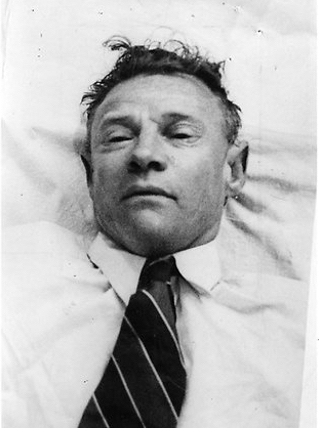
On 1 December 1948 an unidentified man was found dead on Somerton Park beach; a Rubaiyat scrap reading Tamám Shud defined the case, and a 2022 DNA claim named Carl Webb without settling how he died.
Also called: Tamám Shud case · unidentified Adelaide man
At a glance
Score intensity
Darker cells mean a higher score for this topic on that metric.
Notoriety70
Mystery93
Scale18
Evidence50
Legal impact20
Culture62
LessMore
Score profile
Each bar is a 0-100 atlas score for this topic, not a timeline.
Notoriety70
Mystery93
Scale18
Evidence50
Legal impact20
Culture62
Evidence
Evidence
50%
Score profile
Mystery
93%
Timeline
Milestones in order. This is history, not a weekly activity grid.
Australian police. File originally uploaded on English Wikipedia in November 30, 2008 by Bletchley · Public domain · Wikimedia Commons
On the morning of 1 December 1948, two men found a well-dressed stranger dead against the seawall on Somerton Park beach, south of Adelaide. He carried no ordinary identification. South Australia Police photographed him, took fingerprints that matched no Australian or circulated overseas file, and opened a coronial investigation. The press called him the Somerton Man. The inquest, under coroner Thomas Erskine Cleland, heard that a cause of death could not be stated with certainty. A poison was suspected and not identified in a form the court would treat as proved.
In January 1949 a tiny scrap of paper was found in a hidden fob pocket. It bore the Persian words Tamám Shud — “it is ended” — torn from a New Zealand edition of Edward FitzGerald’s Rubaiyat of Omar Khayyam. Police later recovered a matching copy, said to have been left in a Glenelg car, with the torn phrase gone, faint pencil markings that looked like a code, and a telephone number. The number led to a nurse later widely known as Jessica Thomson, then living nearby and using the name Jestyn. She said she did not know the dead man. Detectives recorded that she seemed distressed when shown a plaster bust.
For seventy-four years the man had no accepted name. In July 2022 University of Adelaide physicist Derek Abbott and American genealogist Colleen Fitzpatrick announced that DNA from hair embedded in the 1949 plaster bust identified him as Carl “Charles” Webb, born 1905 in Footscray, Melbourne. South Australia Police said they were examining the claim. The identification is now the leading public account; it is not a completed inquest finding on how he died. Status is mixed: a named candidate, an unsolved death.
Found1 Dec 1948
PlaceSomerton Park beach
PhraseTamám Shud
BookRubaiyat (Khayyam)
ID claimCarl Webb, 2022
StatusMixed
Dossier scores
Notoriety 70
Mystery 93
Scale 18
Evidence 50
Legal impact 20
Culture 62
Notoriety
70
Mystery
93
Scale
18
Evidence
50
Legal impact
20
Culture
62
A beach, a phrase, a late name
The Somerton Man is Australia’s type unidentified-person file: a 1948 coronial mystery, a book fragment that named a genre, and a 2022 DNA claim that changed the name without closing the cause.
What the 1948–49 file actually held
Detective Sergeant Lionel Leane’s investigation recorded a man on the sand, a suitcase later recovered from Adelaide Railway Station with clothing and tools, and a death that pathologist John Burton Cleland could not reduce to a simple natural cause. Clothing labels had been removed — a fact the inquest noted, not a lesson this page will expand. No inquest paper identified a weapon or a struggle on the beach.
The Tamám Shud scrap, found weeks after the body, turned a local unexplained death into an English-language riddle. The Glenelg Rubaiyat, the pencil lines and Jestyn’s number are the exhibits that later books treat as a spy plot. They are also ordinary objects that a coroner could not convert into a named second person or a proved poison.
Jestyn, the bust and the code
Jessica Thomson, the nurse behind the Jestyn inscription, is the living figure English readers most often meet. She denied knowing the man. Later interviews, including remarks after her death by her family, have been read both as concealment and as the stress of a police visit. Neither reading is a 1949 finding. Prosper Thomson, her then husband, is in the same neighbourhood file and was not charged with any offence arising from the death.
The five lines of letters in the Rubaiyat were sent to code-minded officials and, later, to hobbyists. No agency published a decrypted text that a court accepted. The 1949 plaster bust, made to help identification, became the physical bridge to the 2020s: hairs in the plaster were the samples Abbott’s team used for forensic genealogy.
Carl Webb and a mixed status
Carl Webb was an electrical instrument maker from Melbourne, married to Dorothy Robertson, and last placed by family paper in the late 1940s. Abbott and Fitzpatrick’s 2022 announcement matched DNA to Webb relatives. South Australia Police did not immediately issue their own identification. Later reporting treated Webb as the name that fits; a formal coronial amendment is a separate legal act from a university press conference.
Naming Webb does not explain Tamám Shud, the Glenelg book, Jestyn’s number or the medical cause. Mixed is the correct status token: identity is no longer the empty file of 1948, and the death remains without a proved mechanism or a charged second person.
Why a local death became a world story
Adelaide in 1948 was a small capital with a sharp press. The Advertiser and later interstate papers made an unidentified beach death into a national curiosity. Cold-war English then supplied a spy template the inquest never adopted. That template travelled to British and American true-crime hours far more easily than Cleland’s cautious medical evidence.
The cultural reach is real and still smaller than Cooper or Earhart. The case matters in English as Australia’s unsolved-identity legend and, after 2022, as a demonstration of forensic genealogy applied to a plaster bust. Legal impact is slight. The open human question is how Carl Webb, if the name holds, came to die on that beach.
Beat weight marks
Mark each timeline beat already on this dossier as supported, contested or unknown, using the public-record claims already filed here. Not a verdict.
Editorial marks on this device only. Public-record encyclopedia — not legal advice, not a how-to, not a private file.
Timeline beat
Supported / Contested / Unknown
1 Dec 1948 — Body found
Claim already on file: The inquest proved a Cold War assassination.
14 Jan 1949 — Railway suitcase
Claim already on file: The Rubaiyat code has been officially read.
Jan 1949 — Tamám Shud scrap
Claim already on file: Jessica Thomson was convicted of a crime in the case.
1949 — Glenelg Rubaiyat
Claim already on file: The 2022 DNA result closed the whole case.
17–21 Jun 1949 — Inquest sits
Claim already on file: The 2022 DNA result closed the whole case.
1949 — Plaster bust
Claim already on file: The 2022 DNA result closed the whole case.
1958 — Inquest closed without name
Claim already on file: The 2022 DNA result closed the whole case.
2000s–2010s — Abbott’s public campaign
Claim already on file: The 2022 DNA result closed the whole case.
2019–21 — Exhumation and tests
Claim already on file: The 2022 DNA result closed the whole case.
Jul 2022 — Carl Webb announced
Claim already on file: The 2022 DNA result closed the whole case.
An unidentified man found dead on Somerton Park beach, Adelaide, on 1 December 1948. In July 2022 researchers named him as Carl “Charles” Webb of Melbourne. South Australia Police said they were examining that DNA claim. Cause of death remains unproved.
What does Tamám Shud mean?
Persian for “it is ended,” printed at the close of FitzGerald’s Rubaiyat of Omar Khayyam. A scrap with those words was found in a fob pocket in January 1949 and became the case’s English nickname.
Was a spy plot proved?
No. Cold-war timing and an unread pencil “code” fed that story. The inquest did not find a foreign service, a charged accomplice or a decrypted text.
Who was Jestyn?
The inscription name linked to Jessica Thomson, a nurse whose telephone number was in the Glenelg Rubaiyat. She told police she did not know the dead man. She was not charged.
What did the coroner decide?
Thomas Erskine Cleland’s inquest could not state a certain cause of death. A poison was suspected and not identified to the court’s satisfaction. Identity was then unknown.
How was Carl Webb named?
Derek Abbott and Colleen Fitzpatrick used DNA from hair in the 1949 identification bust and genealogical records. They announced Webb’s name in July 2022. Police treated it as a claim under review, not as a 1949 verdict.
Has the cause of death been settled?
No. Naming Webb, if accepted, answers who. It does not answer how. Status is mixed for that reason.
Was anyone convicted?
No. The file is a coronial mystery and a later identification claim, not a criminal conviction. No second person was tried for the death.