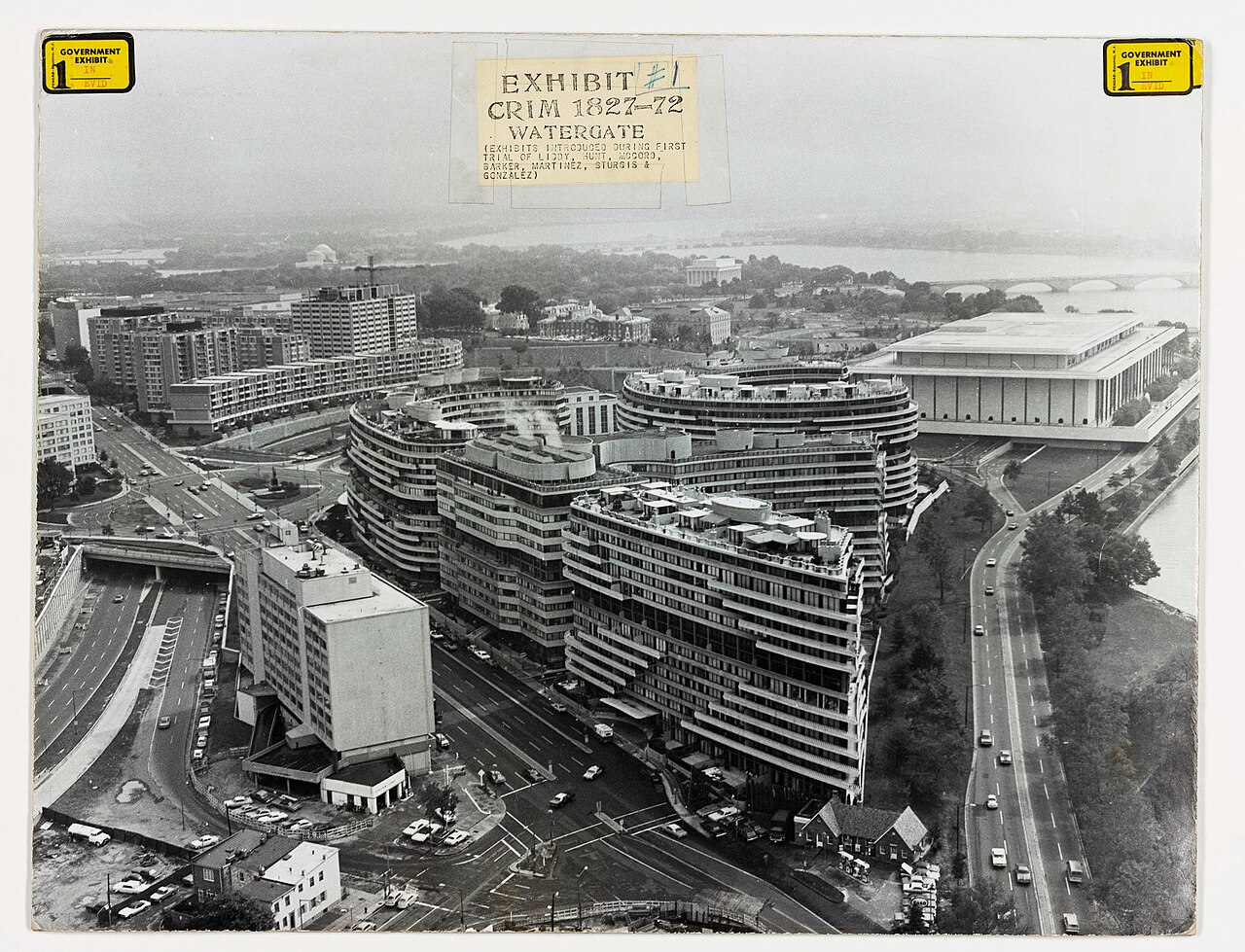
A 17 June 1972 break-in at the DNC in Washington's Watergate complex became a cover-up that ended in Richard Nixon's resignation on 9 August 1974 and a wave of United States ethics law.
Also called: Nixon resignation · CRP break-in
At a glance
Score intensity
Darker cells mean a higher score for this topic on that metric.
Notoriety97
Mystery20
Scale75
Evidence88
Legal impact96
Culture94
LessMore
Score profile
Each bar is a 0-100 atlas score for this topic, not a timeline.
Notoriety97
Mystery20
Scale75
Evidence88
Legal impact96
Culture94
Evidence
Evidence
88%
Score profile
Mystery
20%
Timeline
Milestones in order. This is history, not a weekly activity grid.
In the early hours of 17 June 1972, five men were arrested inside the Democratic National Committee offices in the Watergate office building in Washington, D.C. They carried surveillance equipment and were tied, through address books and cash, to the Committee to Re-elect the President (CRP, often mocked as CREEP) and to the Nixon White House. The burglary itself was a botched political intelligence job. The scandal was the cover-up that followed.
The Washington Post's Bob Woodward and Carl Bernstein, federal prosecutors, Judge John Sirica, the Senate Select Committee on Presidential Campaign Activities (the Ervin Committee) and a special prosecutor's office pulled the thread through 1973. White House counsel John Dean testified. The existence of a taping system was revealed. The Saturday Night Massacre of 20 October 1973 — Nixon's firing of special prosecutor Archibald Cox and the resignations of Attorney General Elliot Richardson and Deputy William Ruckelshaus — turned a burglary story into a constitutional crisis.
On 24 July 1974 the Supreme Court ruled in United States v. Nixon that the president had to surrender tapes. The House Judiciary Committee approved articles of impeachment. Nixon resigned on 9 August 1974. President Gerald Ford pardoned him on 8 September. Many aides and burglars were convicted. The status is mixed because the president left office without a criminal trial, while the surrounding dock was full. The legal afterlife includes the Ethics in Government Act, campaign-finance rules and a permanent '-gate' suffix in English.
Break-in17 Jun 1972
PlaceDNC, Watergate
Resignation9 Aug 1974
PardonFord, 8 Sep 1974
Key paperWashington Post
StatusMixed
Dossier scores
Notoriety 97
Mystery 20
Scale 75
Evidence 88
Legal impact 96
Culture 94
Notoriety
97
Mystery
20
Scale
75
Evidence
88
Legal impact
96
Culture
94
A burglary that became a constitutional file
Watergate is the English-language type case of a political scandal: a dated break-in, a paper trail, televised hearings, a Supreme Court order, a resignation and a statute wave.
From a hotel-office complex to CRP
The Watergate is a Washington hotel, office and apartment complex. The DNC rented offices there in 1972. The five men arrested on 17 June — including James McCord, a CRP security coordinator, and Cuban exiles with prior CIA-adjacent histories — were not random burglars. Address-book entries led to E. Howard Hunt and G. Gordon Liddy, White House and CRP operatives.
This page does not reconstruct surveillance technique. The public record is who paid, who knew and who lied afterward. The White House and CRP denied a link; the money and the later tapes said otherwise. Woodward and Bernstein's early stories, with an FBI source later revealed as Mark Felt ('Deep Throat'), kept the file alive through the 1972 election, which Nixon won in a landslide.
Hearings, tapes and a massacre on Saturday
Judge Sirica pressed the burglars. McCord's March 1973 letter said pressure to stay silent had come from the White House. Dean's Senate testimony in June 1973 described a cancer on the presidency. Alexander Butterfield revealed the taping system. Those three beats turned rumour into a documentary case.
When Cox insisted on tapes, Nixon ordered him fired. Richardson and Ruckelshaus resigned rather than do it; Robert Bork carried out the order. The Saturday Night Massacre produced a firestorm, a new special prosecutor (Leon Jaworski) and, eventually, United States v. Nixon. The 18½-minute gap on one tape became a symbol of missing evidence, not a mystery about whether a cover-up existed.
Resignation, pardon, convictions
The 'smoking gun' tape of 23 June 1972, released after the Supreme Court ruling, showed Nixon and H. R. Haldeman discussing using the CIA to impede the FBI. Republican senatorial support collapsed. Nixon resigned rather than face a near-certain Senate removal. Ford's pardon a month later was meant to end a 'national nightmare' and instead prolonged the argument about accountability.
John Mitchell, Haldeman, John Ehrlichman, Hunt, Liddy, the burglars and others were convicted or pleaded guilty on charges including conspiracy, perjury and obstruction. Nixon was not tried. Mixed is therefore the honest status: a full dock around an untried, pardoned former president.
Law that still says '-gate'
The Ethics in Government Act (1978) created a statutory independent-counsel mechanism later used and then allowed to expire. Campaign-finance disclosure, War Powers debates and a more adversarial press all claim 1974 as a parent. Whether those tools worked as intended is a later political fight.
English globally borrowed Watergate as a template: a suffix, a hero-reporter myth and a lesson that cover-up can outrun the original act. All the President's Men (book 1974, film 1976) fixed that myth. The Senate hearings remain the civic primary source.
Beat weight marks
Mark each timeline beat already on this dossier as supported, contested or unknown, using the public-record claims already filed here. Not a verdict.
Editorial marks on this device only. Public-record encyclopedia — not legal advice, not a how-to, not a private file.
Timeline beat
Supported / Contested / Unknown
17 Jun 1972 — DNC break-in
Claim already on file: Two reporters alone brought down a president.
1972–73 — Post and prosecutors
Claim already on file: It was only a third-rate burglary.
Mar 1973 — McCord's letter
Claim already on file: Nixon was convicted in criminal court.
Jun 1973 — Dean and Butterfield
Claim already on file: Deep Throat was a composite or a fiction.
20 Oct 1973 — Saturday Night Massacre
Claim already on file: Deep Throat was a composite or a fiction.
24 Jul 1974 — United States v. Nixon
Claim already on file: Deep Throat was a composite or a fiction.
27–30 Jul 1974 — Impeachment articles
Claim already on file: Deep Throat was a composite or a fiction.
9 Aug 1974 — Nixon resigns
Claim already on file: Deep Throat was a composite or a fiction.
8 Sep 1974 — Ford pardon
Claim already on file: Deep Throat was a composite or a fiction.
1975–78 — Convictions and ethics law
Claim already on file: Deep Throat was a composite or a fiction.
A political scandal that began with a 17 June 1972 break-in at the Democratic National Committee offices in Washington's Watergate complex and became a White House cover-up. It ended with President Richard Nixon's resignation on 9 August 1974 and convictions of many aides and burglars.
Who was arrested on 17 June 1972?
Five men inside the DNC offices, including James McCord of CRP. They were tied to E. Howard Hunt and G. Gordon Liddy. The burglary was a political intelligence operation, not a random theft. The scandal was the lying that followed.
What did the Washington Post do?
Reporters Bob Woodward and Carl Bernstein, with editor Ben Bradlee, kept publishing links between the burglars, CRP cash and the White House through 1972–73. An FBI source, later named as Mark Felt, helped. The paper did not act alone: courts and Congress built the public record.
What was the Saturday Night Massacre?
On 20 October 1973 Nixon ordered special prosecutor Archibald Cox fired for insisting on the White House tapes. Attorney General Elliot Richardson and Deputy William Ruckelshaus resigned rather than comply. Solicitor General Robert Bork carried out the firing. The crisis forced a new prosecutor and deepened impeachment talk.
Why did Nixon resign?
After the Supreme Court ordered the tapes released in United States v. Nixon (24 July 1974), the 23 June 1972 'smoking gun' conversation showed him joining an effort to halt the FBI. The House Judiciary Committee had approved impeachment articles. Senate conviction looked certain. He resigned on 9 August 1974.
Did Nixon go to prison?
No. President Gerald Ford pardoned him on 8 September 1974 for federal crimes he 'committed or may have committed'. Many subordinates were convicted. That split is why this atlas marks the status mixed.
What laws changed after Watergate?
The Ethics in Government Act (1978) created a statutory independent-counsel process. Campaign-finance disclosure was tightened. Inspectors general and ethics offices expanded. Later Congresses argued over those tools; the 1970s wave is the legal impact.
Who was Deep Throat?
The Washington Post's secret source, named in 2005 as W. Mark Felt, then the FBI's associate director. Felt's identity was a long side mystery. It does not change the tape-and-testimony core of the case.