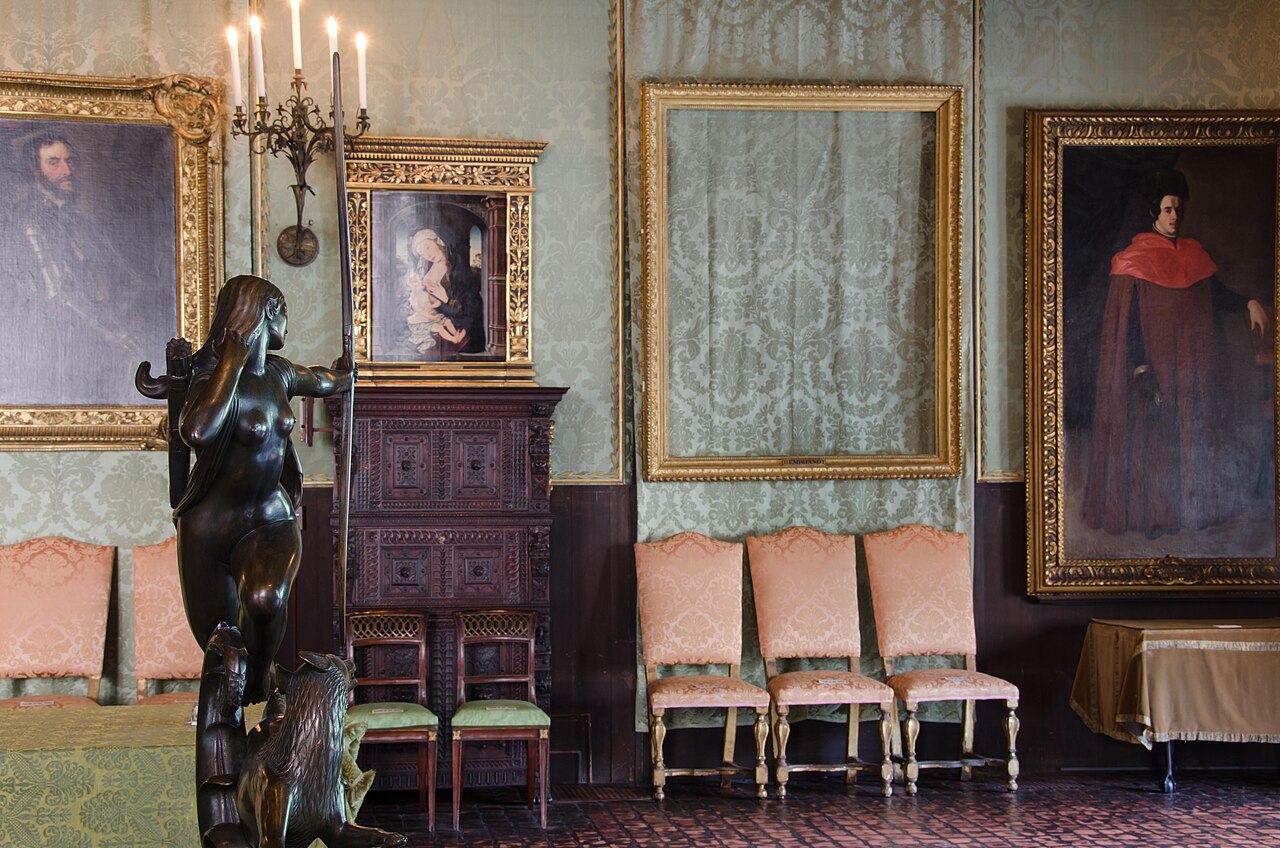
On 18 March 1990 thirteen works vanished from Boston's Isabella Stewart Gardner Museum. Empty frames still hang; the FBI reward stands and the case remains unsolved.
Also called: Gardner heist · 13 stolen works
At a glance
Score intensity
Darker cells mean a higher score for this topic on that metric.
Notoriety86
Mystery88
Scale72
Evidence55
Legal impact40
Culture78
LessMore
Score profile
Each bar is a 0-100 atlas score for this topic, not a timeline.
Notoriety86
Mystery88
Scale72
Evidence55
Legal impact40
Culture78
Evidence
Evidence
55%
Score profile
Mystery
88%
Timeline
Milestones in order. This is history, not a weekly activity grid.
In the early hours of 18 March 1990, the day after St Patrick's Day, thirteen works left the Isabella Stewart Gardner Museum in Boston's Fenway. The haul included Johannes Vermeer's The Concert, Rembrandt van Rijn's only known seascape The Storm on the Sea of Galilee, a second Rembrandt oil, a Rembrandt etching, Édouard Manet's Chez Tortoni, five Edgar Degas works on paper, a Govaert Flinck landscape, a Chinese bronze gu and a bronze eagle finial from a Napoleonic flag.
The museum opened in 1903 as Isabella Stewart Gardner's Venetian-style palace. Her 1924 will required that the collection stay as she arranged it. After the theft the empty frames were left on the walls of the Dutch Room and nearby galleries — a curatorial decision that became the public face of the unsolved file. The Federal Bureau of Investigation opened a case that is still open more than three decades later.
In 2013 the FBI said it believed it had identified the thieves as members of a New England organised-crime group and that the works had moved through organised-crime circles. No painting has been recovered. The museum's reward, raised to $10 million in 2017 for information leading to the return of all thirteen works in good condition, still stands. Possessing the stolen objects remains a federal crime even though the original theft's statute of limitations has run.
Date18 Mar 1990
Works taken13 pieces
MuseumGardner Museum
StatusUnsolved
Reward$10M (museum)
Signature lossVermeer's The Concert
Dossier scores
Notoriety 86
Mystery 88
Scale 72
Evidence 55
Legal impact 40
Culture 78
Notoriety
86
Mystery
88
Scale
72
Evidence
55
Legal impact
40
Culture
78
Thirteen absences in a frozen palace
The Gardner theft is the largest unsolved art theft on the United States public record: a named list of works, empty frames, an FBI file and no courtroom ending.
What left the building
The Concert is one of only about three dozen paintings securely given to Vermeer. The Storm on the Sea of Galilee is Rembrandt's only seascape. Together with A Lady and Gentleman in Black and a small Rembrandt self-portrait etching, they made the Dutch Room the centre of the loss. Manet's Chez Tortoni was taken from the Blue Room.
The Degas group was works on paper, not the museum's most famous oils. The Shang-dynasty or later Chinese gu and the flag finial show that the take was not a single-school shopping list. Insurance did not replace the objects: Gardner's will and the museum's practice treat the collection as a fixed installation, not a liquid inventory.
A night the city already knew
Boston papers dated the event to a holiday weekend when the Fenway was still loud from St Patrick's celebrations. Two men gained entry after presenting themselves as police officers answering a disturbance. This page does not reconstruct how they moved through the galleries. The public record is what was missing at dawn and what the night watch later told investigators.
The museum closed for a short period, then reopened with the frames still in place. Ulrich Boser, Stephen Kurkjian and later FBI briefings became the English-language spine of the story. The Boston Globe treated the theft as a local wound; national magazines treated it as the American art crime.
An investigation without a return
The FBI's Boston office has held the federal case. Over the years agents have examined New England organised-crime figures, including names later aired in court filings around Robert Gentile of Connecticut and older Winter Hill and Patriarca-orbit rumours. Whitey Bulger was asked; he denied a role. None of those threads produced a painting.
In March 2013 the FBI announced that it believed the thieves were deceased members of a criminal organisation and that the art had been offered in the years after 1990. The announcement named no living defendant in open court and returned nothing. A 2015 video appeal and later reward increases kept the file in the news without changing the recovery column.
Law that outlasts a limitation period
The five-year federal statute of limitations on the 1990 theft itself expired in 1995. Transporting or possessing stolen goods that crossed state lines, and conspiracy counts tied to later handling, remain live theories. The museum has said it wants the objects back more than a prison sentence.
Gardner's will still governs hang and sale. That is why the empty frames are not a gimmick: replacing the walls with other pictures would break the legal and curatorial identity of the palace. The case's legal impact is therefore smaller than its cultural one — a standing reward and a frozen room, not a new statute.
Beat weight marks
Mark each timeline beat already on this dossier as supported, contested or unknown, using the public-record claims already filed here. Not a verdict.
Editorial marks on this device only. Public-record encyclopedia — not legal advice, not a how-to, not a private file.
Timeline beat
Supported / Contested / Unknown
1903 — Fenway Court opens
Claim already on file: The FBI solved the case in 2013.
1924 — Gardner's will
Claim already on file: A single mastermind outwitted the art world for sport.
18 Mar 1990 — Thirteen works taken
Claim already on file: The pictures were insured and the museum was made whole.
1990 — FBI case opens
Claim already on file: The empty frames are a tourist gimmick.
1995 — Theft limit runs
Claim already on file: The empty frames are a tourist gimmick.
1997 — Empty frames as fixture
Claim already on file: The empty frames are a tourist gimmick.
Mar 2013 — FBI identification claim
Claim already on file: The empty frames are a tourist gimmick.
2015 — Public video appeal
Claim already on file: The empty frames are a tourist gimmick.
2017 — Reward to $10 million
Claim already on file: The empty frames are a tourist gimmick.
2020s — Still open
Claim already on file: The empty frames are a tourist gimmick.
In the early hours of 18 March 1990, after St Patrick's Day in Boston. The Isabella Stewart Gardner Museum reported thirteen works missing when staff returned. The FBI opened a federal investigation that remains open.
What was taken?
Thirteen objects: Vermeer's The Concert; Rembrandt's The Storm on the Sea of Galilee and A Lady and Gentleman in Black; a Rembrandt etching; Manet's Chez Tortoni; five Degas works on paper; a Flinck landscape; a Chinese bronze gu; and a Napoleonic flag finial. The empty frames still hang.
Has anything been recovered?
No. As of the museum's public statements in the 2020s, none of the thirteen works has been returned. The FBI said in 2013 that it believed it knew who had taken them, but that announcement did not produce a recovery or a public trial of living thieves.
Is there still a reward?
Yes. The museum raised its offer to $10 million in 2017 for information leading to the return of all thirteen works in good condition. Separate, smaller sums have been discussed for individual pictures. The FBI continues to ask the public for leads.
Why are the frames still on the walls?
Isabella Stewart Gardner's will requires the collection to remain as she installed it. The museum left the frames as markers of the missing works and as a refusal to pretend the rooms are complete. Visitors still walk past them in the Dutch Room and nearby galleries.
Did the statute of limitations end the case?
The original 1990 theft can no longer be prosecuted as a standalone federal theft after the five-year limit ran in 1995. Possessing or moving the stolen works can still be a crime. The museum's stated priority is recovery, not a historic conviction.
Who does the FBI think was involved?
In 2013 the Bureau said it believed deceased New England organised-crime figures carried out the theft and that the art later moved in criminal circles. Later court papers aired names around Connecticut and Massachusetts. No recovered painting has confirmed those theories in public.
Was the museum insured for the pictures?
The collection was not treated as a conventional insured stock that could be cashed and replaced. Gardner's legal structure and the museum's mission are about keeping her arrangement. Money cannot buy another Concert or another Rembrandt seascape on the open market.