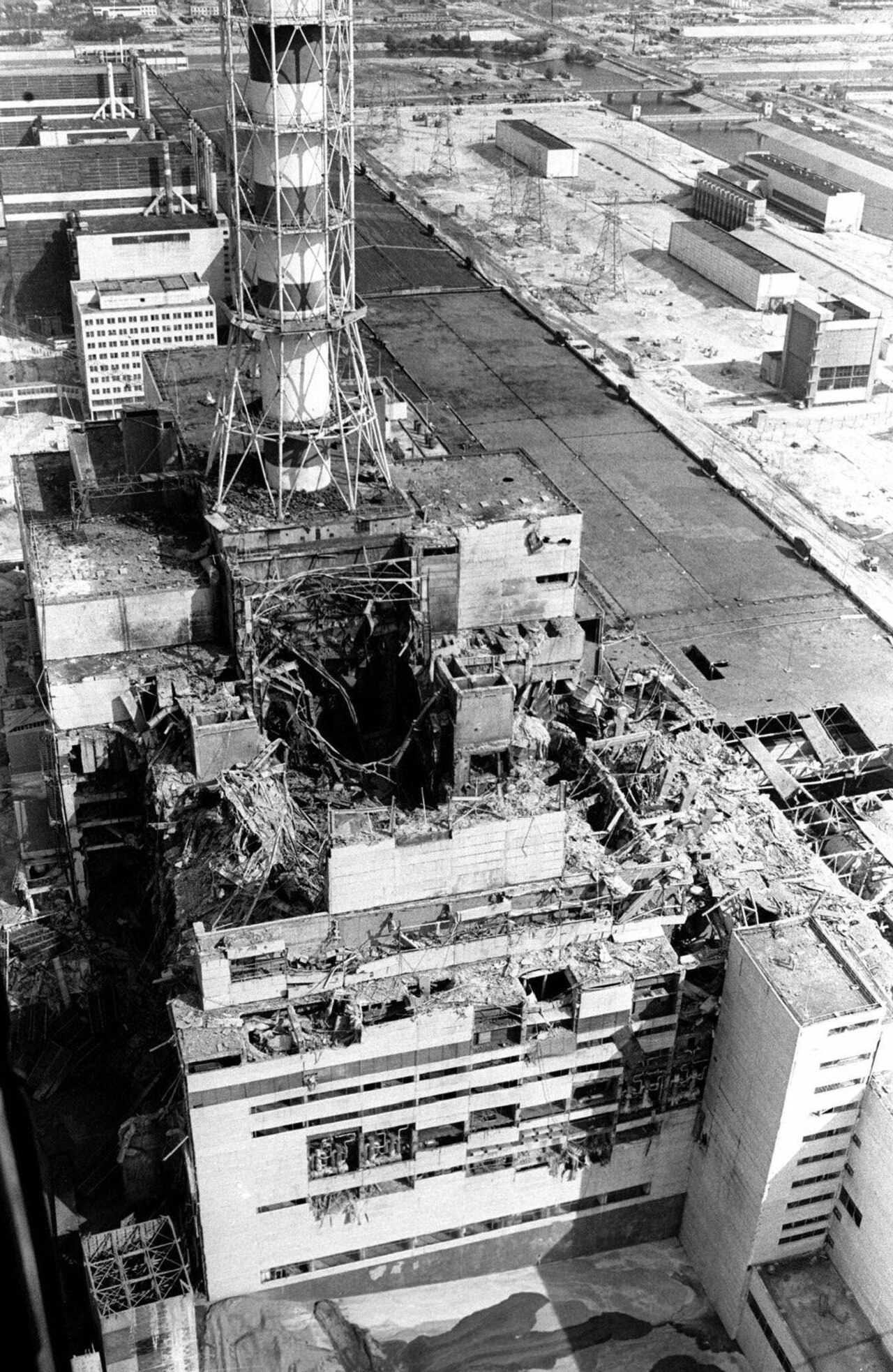
On 26 April 1986 an explosion at reactor 4 of the Chernobyl plant in the Ukrainian SSR became the worst nuclear accident on the public record and rewrote international nuclear law.
Also called: Chornobyl · reactor 4 explosion
At a glance
Score intensity
Darker cells mean a higher score for this topic on that metric.
Notoriety96
Mystery25
Scale97
Evidence80
Legal impact90
Culture95
LessMore
Score profile
Each bar is a 0-100 atlas score for this topic, not a timeline.
Notoriety96
Mystery25
Scale97
Evidence80
Legal impact90
Culture95
Evidence
Evidence
80%
Score profile
Mystery
25%
Timeline
Milestones in order. This is history, not a weekly activity grid.
At 01:23 on 26 April 1986, unit 4 of the Chernobyl Nuclear Power Plant exploded during a planned turbine-rundown test. The reactor was an RBMK-1000, graphite-moderated and light-water-cooled, a Soviet design with a positive void coefficient and a slow emergency-protection system. Two workers died in the immediate blast; UNSCEAR later recorded 28 further deaths from acute radiation syndrome among plant and emergency staff within four months.
Pripyat, the purpose-built atomgrad next to the plant, was evacuated on 27 April. The Soviet state confirmed an accident only after Swedish monitors detected the plume on 28 April. IAEA’s INSAG-1 (1986) first stressed operator error; INSAG-7 (1992) shifted the main cause to design and a weak safety culture. The 1987 Chernobyl trial convicted plant managers. The New Safe Confinement was slid over the 1986 sarcophagus on 29 November 2016.
The engineering case is closed: a test plus RBMK design features produced a prompt power excursion. What remains contested is how to count later cancers and how to value the exclusion zone. English-language memory now runs through the 2005 Chernobyl Forum, UNSCEAR annexes and, after 2019, a television miniseries that is not a primary source.
Date26 Apr 1986
UnitReactor 4, RBMK
PlacePripyat, Ukrainian SSR
Early deaths30 official (1986)
ReportsINSAG / UNSCEAR
ShelterNSC Nov 2016
Dossier scores
Notoriety 96
Mystery 25
Scale 97
Evidence 80
Legal impact 90
Culture 95
Notoriety
96
Mystery
25
Scale
97
Evidence
80
Legal impact
90
Culture
95
A test, a design and a late admission
Chernobyl is the public-record type case for a Level 7 nuclear accident: dated official deaths, revised international reports, and a treaty wave that still governs notification and safety culture.
What the test was for
Operators intended to see whether a spinning turbine could power emergency pumps during a station blackout until diesel generators started. The test had been postponed and was run on a night shift with the reactor in an unstable low-power state. Control-rod and coolant conditions violated the plant’s own operating limits.
When the emergency-protection (AZ-5) command was given, the RBMK’s graphite-tipped rods briefly added reactivity at the core bottom. Power rose in a fraction of a second. Steam explosions and a graphite fire followed. This page does not reconstruct a procedure that could be copied; the public record is the sequence as later reconstructed by INSAG and Soviet investigators.
From Pripyat to Vienna
Firefighters and plant staff entered the ruined block in the first hours. UNSCEAR’s 2008 annex describes 134 confirmed acute radiation syndrome cases among them, 28 fatal within four months, plus the two blast deaths. There were no ARS cases in the general public. Pripyat’s roughly 49,000 residents were told to take a three-day leave on 27 April.
About 116,000 people were relocated from the most contaminated areas in 1986; later programmes brought the figure of people moved over the years to the order of 350,000 (UNSCEAR). Several hundred thousand recovery workers, often called liquidators, received recorded occupational doses. Sweden’s Forsmark plant alarmed on 28 April and forced Moscow’s first public statement.
How the official story changed
INSAG-1, written in 1986 from incomplete Soviet data, blamed operators. INSAG-7 in 1992, after RBMK design details were shared, named the positive void coefficient, the control-rod design and a missing containment as decisive, with safety culture as the organisational cause. The 1987 trial of Viktor Bryukhanov, Nikolai Fomin and Anatoly Dyatlov still treated the night shift as criminally negligent.
Health attribution is the remaining scientific argument. UNSCEAR links a large rise in thyroid cancers among those who were children or adolescents in 1986 to iodine-131 in milk, with few deaths in that cohort by 2005 because treatment works. The 2005 Chernobyl Forum’s “up to 4,000” eventual deaths among the most exposed is a model, not a body count, and remains disputed by higher independent estimates.
Law after a Level 7 accident
The Convention on Early Notification of a Nuclear Accident and the Convention on Assistance were adopted in 1986. The Convention on Nuclear Safety followed in 1994. Remaining RBMKs were modified: faster rods, extra absorbers, higher enrichment and a fast-acting protection system, as INSAG-7 recorded.
Ukraine, with G7 and EBRD money, built the New Safe Confinement as a movable arch over the 1986 object shelter. The arch was in place in November 2016 and later commissioned so that debris removal could be planned toward a 2065 cleanup horizon. The exclusion zone remains a legal and ecological special regime, not a closed book.
Beat weight marks
Mark each timeline beat already on this dossier as supported, contested or unknown, using the public-record claims already filed here. Not a verdict.
Editorial marks on this device only. Public-record encyclopedia — not legal advice, not a how-to, not a private file.
Timeline beat
Supported / Contested / Unknown
1970 — Construction begins
Claim already on file: The official death toll is in the hundreds of thousands.
1983 — Unit 4 online
Claim already on file: The accident was a Western-style containment meltdown.
26 Apr 1986 — Explosion at 01:23
Claim already on file: Pripyat was left in place for weeks.
27 Apr 1986 — Pripyat evacuated
Claim already on file: INSAG never changed its mind.
28 Apr 1986 — Sweden detects the plume
Claim already on file: INSAG never changed its mind.
Aug 1986 — INSAG-1 in Vienna
Claim already on file: INSAG never changed its mind.
Jul 1987 — Plant managers tried
Claim already on file: INSAG never changed its mind.
1992 — INSAG-7 revises cause
Claim already on file: INSAG never changed its mind.
2005 — Chernobyl Forum
Claim already on file: INSAG never changed its mind.
29 Nov 2016 — New Safe Confinement
Claim already on file: INSAG never changed its mind.
During a delayed safety test, reactor 4 of the RBMK-1000 plant underwent a rapid power excursion. Explosions destroyed the core and started a graphite fire. The event is classed as INES Level 7, the same top rank later assigned to Fukushima Daiichi in 2011 for a different accident sequence.
How many people died?
UNSCEAR records two immediate deaths and 28 ARS deaths among staff and emergency workers within four months — the 30 official early deaths often cited, sometimes listed as 31 with a later cardiac case. Later cancer totals are modelled. Thyroid cancer rose among those exposed as children; UNSCEAR does not treat a six-figure death toll as an observed count.
Was it only operator error?
INSAG-1 (1986) emphasised operators. INSAG-7 (1992) concluded that design features and a weak safety culture were the main causes, with the night’s rule-breaking as the trigger. Both reports remain part of the public file.
When was Pripyat evacuated?
On 27 April 1986, about 36 hours after the explosions. Residents were told the leave would be short. The city was not reoccupied. Slavutych was later built for plant staff.
What is the New Safe Confinement?
A steel arch, the largest movable land structure of its kind, built beside unit 4 and slid over the 1986 sarcophagus on 29 November 2016, with later commissioning. It is meant to last about a century and to allow dismantling work.
What international law followed?
The 1986 Early Notification and Assistance conventions, then the 1994 Convention on Nuclear Safety, plus IAEA safety-culture doctrine. Domestic Soviet criminal law produced the 1987 plant-management trial.
Is the disaster still unsolved?
No. Status is closed for cause. Open questions are long-term health models, site dismantling and how English popular culture treats the 2019 series as if it were an inquiry.
Why do English sources say Chornobyl?
Chornobyl is the Ukrainian romanisation; Chernobyl is the older Russian-based English form. Both refer to the same plant and town. This file keeps the English Wikipedia title Chernobyl disaster.