Milestones in order. This is history, not a weekly activity grid.
- Organised racing begins in London
- Matthew Webb swims the Channel
- Swimming at the first modern Olympics
- The Australian crawl spreads
- FINA founded
- Women enter the Olympic pool
- Weissmuller breaks the minute
- First European Championships
- Butterfly emerges
- Butterfly debuts at the Olympics
- Schollander's four golds
- Spitz wins seven in Munich
- First World Championships
- East German women dominate Montreal
Last reviewed Sources & creditsMedia creditsMethodology
Quick answers
What are the four competitive swimming strokes?
Competitive swimming is contested in four strokes, each with its own rules. Freestyle (front crawl) is the fastest and allows any technique, so swimmers universally use the crawl. Backstroke is swum on the back with an alternating arm pull and is the only stroke started in the water. Breaststroke uses a simultaneous, symmetrical frog-kick and arm pull and is the slowest and most technical. Butterfly features a simultaneous over-water double-arm recovery above a dolphin kick and is the second-fastest but most exhausting. The individual medley combines all four in the order butterfly, backstroke, breaststroke, freestyle. Ranked by 100m world-record pace, the strokes go freestyle, butterfly, backstroke, breaststroke.
Who is the greatest swimmer of all time?
By any objective measure it is Michael Phelps. The American won 28 Olympic medals, 23 of them gold, across five Games from 2000 to 2016, including a record eight golds at Beijing 2008, and set 39 world records and 26 world-championship titles. No other swimmer is close on career hardware, and his versatility across butterfly, freestyle and individual medley is unmatched. The debate for second place is livelier: Katie Ledecky has a case as the most dominant swimmer ever in a single discipline, distance freestyle, and Mark Spitz's seven world-record golds at Munich 1972 remain historic. But first place is settled beyond serious dispute.
Why is freestyle the fastest stroke?
Freestyle (front crawl) is fastest because it minimises drag and keeps at least one arm generating propulsion almost continuously. The alternating over-water arm recovery lets the swimmer maintain near-constant forward force while the body rotates along its long axis, staying flat and streamlined. The flutter kick is compact and produces little braking. By contrast, breaststroke and butterfly have propulsion-free glide and recovery phases and greater vertical movement that create drag, and backstroke, while efficient, sacrifices the ideal head and body position. Technically, freestyle events allow any stroke, but everyone swims the crawl because it is measurably the quickest way through the water. The men's 50m freestyle world record is 20.91 seconds.
What is the 15-metre underwater rule?
After the start and every turn, a swimmer may travel underwater, usually in a streamlined dolphin kick, but the head must break the surface no later than the 15-metre mark in freestyle, backstroke and butterfly. Staying under past 15 metres is an immediate disqualification. The rule exists because the underwater dolphin kick can be faster than surface swimming; in 1988 some backstrokers raced almost an entire length submerged, prompting the sport to cap the phase. Today the underwater breakout is one of the most important skills in swimming, and the athletes who kick fastest to 15 metres and surface most efficiently frequently win. Breaststroke is governed by its own single-pull-down rule instead.
Why were the 2009 super-suits banned?
In 2008 and 2009 manufacturers introduced full-body suits made of polyurethane and other non-textile materials that trapped air, added buoyancy and slashed drag, effectively making swimmers faster without any change in fitness. The effect was so extreme that 43 world records fell at the 2009 World Championships in Rome alone, and races became partly a technology contest. FINA banned non-textile and full-body suits from 2010, restricting swimmers to textile suits covering limited areas. Many 2009 records survived for a decade because human swimmers could not match the artificial advantage, leaving those marks as a statistical scar on the record book that modern athletes are only now erasing.
What is the difference between long course and short course?
Long course refers to a 50-metre pool, short course to a 25-metre pool. The Olympics and the main World Championships are long course, considered the sport's premier standard; separate Short Course World Championships and many World Cup meets use 25m pools. Short-course times are generally faster because the doubled number of turns lets swimmers spend more of the race in the fast underwater dolphin-kick phase and gain speed off each wall. World records are tracked separately for the two pool lengths. American college swimming adds a third format, 25 yards, used only domestically, which is why US collegiate times are not directly comparable to international marks.
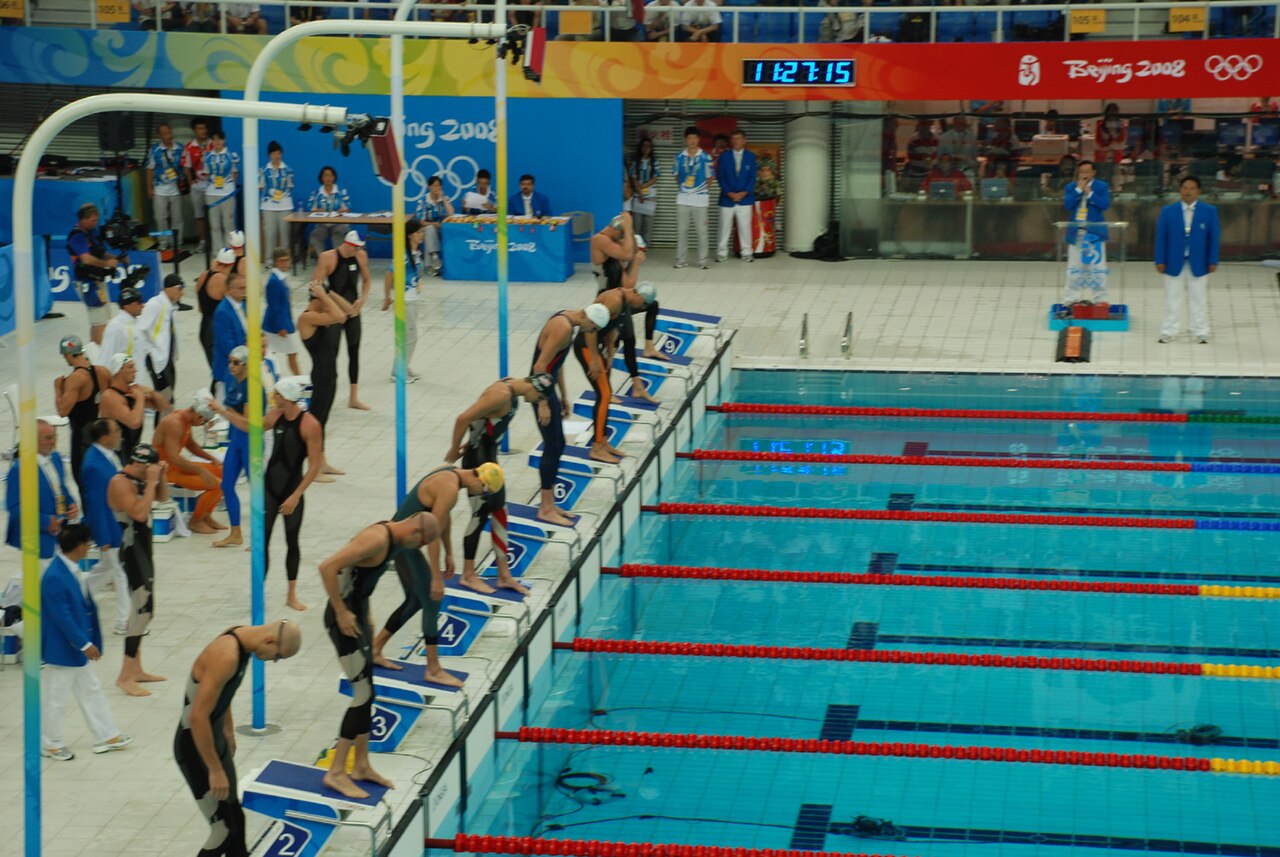
Humans have swum for survival and recreation for millennia, as Egyptian reliefs and Roman baths attest, but competitive swimming is a modern invention. Organised racing emerged in early-19th-century Britain, where the National Swimming Society staged competitions in London from 1837 using a rudimentary breaststroke and sidestroke. The sport's transformation came with the crawl, imported from the Pacific and the Americas, which made swimmers dramatically faster and reshaped every event around speed through the water.
From its Olympic debut in the open sea at Athens 1896, swimming grew into one of the Games' marquee sports, its history punctuated by technical revolutions (the crawl, butterfly, the flip turn, goggles, the underwater kick), by dominant champions from Weissmuller to Phelps, and by controversies over state doping and technological suits. Each leap in technique or equipment forced the rule-makers to respond, and the modern sport is the product of that long negotiation between human performance and the water.
Timeline
The National Swimming Society stages competitions in London's man-made pools, using breaststroke and an English sidestroke, marking the birth of competitive swimming as a codified sport.
Captain Matthew Webb becomes the first person to swim the English Channel unaided, 21 hours and 45 minutes from Dover to Calais, turning distance swimming into a public spectacle.
Swimming appears at the inaugural modern Games in Athens, contested in the cold, choppy Bay of Zea. Hungary's Alfred Hajos wins the 100m and 1,200m freestyle.
Richmond Cavill popularises the front crawl, or 'Australian crawl', in Sydney, a stroke far faster than breaststroke that soon dominates all freestyle racing.
The Federation Internationale de Natation is founded in London during the Olympic Games, standardising rules, distances and world-record ratification for the sport.
Women's swimming debuts at the Stockholm Olympics, where Australia's Fanny Durack wins the 100m freestyle, the first women's Olympic swimming champion.
American Johnny Weissmuller swims the 100m freestyle in 58.6 seconds, the first man under a minute, before an undefeated career and Hollywood fame as Tarzan.
The inaugural European Aquatics Championships are held in Budapest, establishing the continent's premier meet and one of the oldest championships in the sport.
Swimmers begin using an over-water double-arm recovery within breaststroke rules, a faster but exhausting technique that would become the fourth competitive stroke.
Formally separated from breaststroke, butterfly is contested as its own event for the first time at the Melbourne Olympics, completing the sport's four strokes.
American Don Schollander wins four gold medals at the Tokyo Olympics, a sign of US collegiate swimming's growing dominance in the amateur era.
Mark Spitz wins seven gold medals in seven events at the Munich Olympics, every one in world-record time, a haul unmatched until Michael Phelps in 2008.
FINA launches the World Aquatics Championships in Belgrade, giving swimmers a global title between Olympic Games for the first time.
GDR women win 11 of 13 events at the Montreal Olympics; the results were later confirmed as the product of a systematic state doping programme.
David Berkoff races much of the backstroke underwater, prompting the future 15-metre rule, while Kristin Otto wins six golds at the Seoul Games.
Australia's Ian Thorpe, 17, wins the 400m freestyle in world-record time and anchors a stunning relay win over the United States on home soil.
Michael Phelps takes eight gold medals at a single Olympics, surpassing Spitz, aided by the arrival of full-body polyurethane racing suits.
Non-textile suits produce 43 world records at the Rome World Championships alone; FINA bans them from 2010, freezing many marks for a decade.
Katie Ledecky wins four golds at the Rio Olympics and lowers her own 400m and 800m freestyle world records, redefining the limits of women's distance racing.
China's Pan Zhanle sets a 46.40 world record in the 100m freestyle and France's Leon Marchand wins four individual golds at the Paris Olympics.
The eras
From bathing to sport
Competitive swimming crystallised in Victorian Britain. The National Swimming Society organised races in London pools from 1837, and by 1869 the forerunner of the Amateur Swimming Association began codifying rules. Early racing was dominated by breaststroke and an English sidestroke, both slow and upright. The era's popular imagination was captured by Captain Matthew Webb, who in August 1875 became the first person to swim the English Channel unaided, 21 hours and 45 minutes from Dover to Calais, making distance swimming a public spectacle. When Pierre de Coubertin revived the Olympics at Athens in 1896, swimming was on the programme, but contested in the cold, choppy Bay of Zea, where Hungary's Alfred Hajos won the 100m and 1,200m freestyle and had to fight the waves to survive. There were no pools, no lane ropes and no standard strokes; the sport was closer to open-water survival than to the sterile 50-metre arenas of today. Yet its competitive framework, the idea of racing set distances for time and title, was firmly established.
The crawl and the first stars
The defining technical revolution was the front crawl. Popularised by Sydney's Cavill family, with Richmond Cavill using the 'Australian crawl' around 1902, and refined by Hawaiian Duke Kahanamoku, who added a powerful flutter kick and won 100m freestyle gold in 1912 and 1920, the crawl rendered breaststroke obsolete for freestyle racing. In 1908 the world governing body FINA was founded in London during the Games, standardising rules, distances and record-keeping. Women entered the Olympic programme at Stockholm 1912, where Australia's Fanny Durack won the 100m freestyle. The interwar years produced the sport's first global celebrity, American Johnny Weissmuller, who broke the one-minute barrier for 100m freestyle in 1922 (58.6 seconds), won five Olympic golds, never lost an individual race, and then became Hollywood's Tarzan. By the 1930s swimmers were experimenting with an over-water breaststroke recovery, the seed of butterfly, and the sport had moved decisively indoors into standardised pools with lane markings and pace clocks.
New strokes and the amateur golden age
Butterfly, long swum as a faster but exhausting variant of breaststroke, was formally separated into its own event in the mid-1950s and debuted at the 1956 Melbourne Olympics, giving the sport its fourth stroke. Technique advanced rapidly: the tumble (flip) turn cut freestyle times, and lane ropes, standardised 50-metre pools and, from the late 1960s, swimming goggles reshaped training and racing. American programmes, powered by college swimming, dominated. Don Schollander won four golds at Tokyo 1964 and Debbie Meyer three at Mexico City 1968. The era climaxed at Munich 1972, where Mark Spitz won seven gold medals in seven events, every one in world-record time, a haul unmatched until Phelps. In 1973 FINA launched the World Championships in Belgrade, giving swimmers a global title between Olympics. This was still an amateur sport in name, but its training volumes, science and depth were professionalising fast, setting up the state-backed programmes that would soon dominate, and taint, the results.
State machines and the doping shadow
The Cold War turned swimming into a proxy battleground, and the East German women's programme, fuelled by a systematic state doping regime, rewrote the record books. At Montreal 1976 GDR women won 11 of 13 events; their times and physiques drew immediate suspicion later confirmed by Stasi archives detailing the Oral-Turinabol programme administered, often to minors, without consent. Kristin Otto's six golds at Seoul 1988 remain officially recorded but forever contested. The men's side saw American depth reassert itself, Matt Biondi winning seven medals (five gold) at Seoul 1988, echoing Spitz. The period exposed how far organised programmes would go, prompting the first serious out-of-competition testing. It also globalised the talent base beyond the USA, Australia and Europe, and hardened the sport's uneasy relationship with performance enhancement, a theme that would recur with tech suits and later doping scandals. The GDR case remains the starkest example of institutional cheating in Olympic history.
Globalization, Phelps and the suit arms race
The professional era arrived. Russia's Alexander Popov reigned over sprint freestyle, Australia's Ian Thorpe smashed 400m barriers in Sydney 2000, and Japan's Kosuke Kitajima owned breaststroke. Above them all rose Michael Phelps, who won six golds at Athens 2004 and a record eight at Beijing 2008, surpassing Spitz. Prize money, professional contracts and year-round World Cup racing replaced the old amateur ideal. Then technology nearly broke the sport: full-body polyurethane super-suits, led by Speedo's LZR Racer in 2008 and non-textile suits in 2009, trapped air and reduced drag so dramatically that a staggering 43 world records fell at the 2009 Rome World Championships alone, including Paul Biedermann's defeat of Phelps. FINA banned non-textile suits from 2010, freezing many of those marks as near-untouchable relics. The controversy underlined how sensitive swimming is to equipment, and reset the sport around textile suits and human improvement, leaving the 2009 records as a statistical scar.
The textile reset, data and new powers
After the 2009 suit ban, the sport rebuilt around textile suits, and it took years for human swimmers to erase the polyurethane marks. New icons emerged: Katie Ledecky redefined women's distance swimming, winning the 800m freestyle at four straight Olympics from 2012 to 2024 and lowering her own world records; Britain's Adam Peaty became the only man under 57 seconds in the 100m breaststroke; and America's Caeleb Dressel inherited the sprint-butterfly crown with five golds at Tokyo 2020. Training science, stroke-rate telemetry, underwater video, lactate-guided periodization and altitude work, sharpened marginal gains. The talent map broadened dramatically: France's Leon Marchand won four individual golds at Paris 2024, and China's Pan Zhanle stunned the sport with a 46.40 100m freestyle world record. The period has also been dogged by doping controversy, including the 2024 revelations over Chinese swimmers, keeping the tension between performance, technology and integrity at the centre of the modern sport.
Nearly two centuries after the first races in London's pools, swimming remains a sport of elemental simplicity and relentless refinement, a body, a stroke, a wall and a clock. Its future champions will still be judged, as Webb and Weissmuller and Phelps were, by the oldest question in the water: who reached the other end first.
Keep exploring
More in this category
Track & Field
Faster, higher, stronger — the oldest contest in sport, settled in seconds and centimetres.
🚴Road Cycling
An individual sport won by teams, where drafting, mountains and split-second timing decide everything.
🤸Gymnastics
Ten seconds of controlled flight, judged to a tenth of a point, after ten years of daily repetition.