Milestones in order. This is history, not a weekly activity grid.
- Harrow schoolboys invent the game
- The first purpose-built courts
- A squash court on the Titanic
- First British Professional Championship
- The women's championship begins
- The Squash Rackets Association is founded
- The first men's British Open
- Hashim Khan changes everything
- Heather McKay starts a 16-year run
- A world governing body at last
- The first World Opens
- Jahangir Khan, world champion at 17
- The longest match ever played
- Ross Norman ends the streak
Last reviewed Sources & creditsMedia creditsMethodology
Quick answers
Is squash in the Olympics?
Yes, from 2028. The IOC session in Mumbai voted on October 16, 2023 to add squash to the Los Angeles 2028 programme, alongside cricket, baseball and softball, flag football and lacrosse. The programme is singles events for men and women. It ends a long campaign: squash bid unsuccessfully for the 2012, 2016, 2020 and 2024 Games, losing to golf and rugby sevens for 2016 and to reinstated wrestling for 2020. The consequences go well beyond one fortnight. In most countries, national sports funding is tied to Olympic status, so federations that operated on subscriptions and volunteers now qualify for state high-performance money, which is reshaping coaching and junior programmes worldwide.
How does squash scoring work?
Modern squash uses point-a-rally scoring, or PAR: every rally is worth a point regardless of who served. Games are played to 11, and at 10-10 play continues until someone leads by two. Matches are best of five games, with 90 seconds between games. There is only one serve — no second serve — so a fault loses the rally outright. This system replaced the old English scoring, in which only the server could score and games ran to nine; the men's professional tour switched in 2004 and the World Squash Federation extended PAR to every level from the 2008-09 season. The change shortened matches significantly and pushed players toward attacking earlier, since long defensive rallies now carry a real cost.
What is the difference between a let and a stroke?
Both concern interference, which is unavoidable when two players share one court. A let is a replayed rally with no point awarded: it is given when the opponent got in the way but made a genuine effort to clear, and the interfered player would have made a good return rather than a winning one. A stroke awards the point outright to the interfered player: it applies when the opponent did not make every effort to clear, when the striker's swing was blocked, when the ball would have hit the opponent on a direct path to the front wall, or when the striker would have hit a winner. If the striker could not have reached the ball anyway, or the interference was trivial, the referee calls no let and the appealing player loses the rally.
What do the coloured dots on a squash ball mean?
They indicate how much the ball bounces, which is really a measure of how much work you have to do. Blue and red dots are the liveliest and are made for beginners and cold courts, because the ball keeps bouncing without needing to be warmed up. A single yellow dot is slow, and the double yellow dot, standardized around 2000, is the extra-slow professional ball used in all serious competition. A double-yellow ball is almost dead when cold and must be warmed through several minutes of hard hitting before it plays properly, which is why matches begin with a five-minute knock-up. Beginners using a professional ball will find it simply does not bounce, which is the single most common reason people give up on squash.
Why is Egypt so dominant in squash?
Egypt has held roughly half of both the men's and women's world top tens through the 2020s, an unmatched concentration. The reasons are structural rather than mysterious. Egyptian sporting clubs in Cairo and Alexandria are family institutions with dense court provision, so children start young and play constantly. A coaching lineage runs from the pioneers through Amr Shabana and Ramy Ashour to today's academies, transmitting a distinctive attacking style built on deception, holds and front-court aggression. The domestic junior circuit is more competitive than most international ones. And there is a long history to build on: F.D. Amr Bey won five British Opens in the 1930s, so squash has been a prestige sport in Egypt for almost a century.
Is squash really the healthiest sport?
Forbes ranked squash first in its 2003 survey of the ten healthiest sports, scoring it on cardiorespiratory endurance, muscular endurance, calorie burn, strength, flexibility and injury risk. The logic holds up: squash combines near-continuous movement with repeated high-intensity efforts, rapid direction changes and deep lunges, all inside a heated, enclosed space, so heart rates sit high for long stretches and calorie expenditure per hour is among the highest of any recreational sport. The caveats are real, though. The same lunging load makes knee, hip and Achilles injuries common, and the intensity is not gentle on an unconditioned cardiovascular system. Eye injuries from the ball and racket are the reason protective eyewear is mandatory for juniors in most federations.
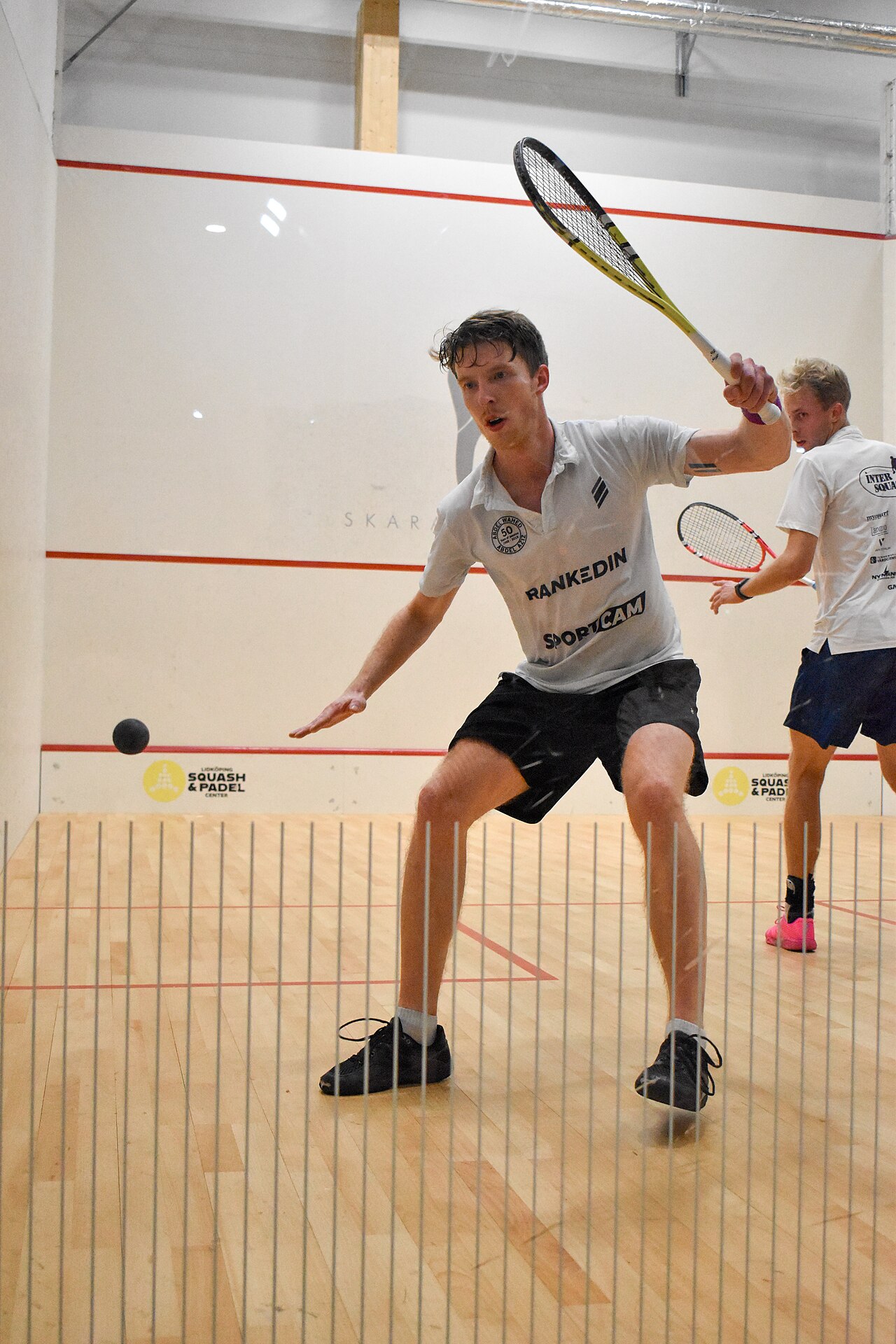
Squash began as a nuisance. Boys at Harrow School in the 1830s, waiting for a turn on the rackets courts, knocked a punctured ball about in the yards and alleys around them; because the softer ball squashed on impact and travelled less far, it rewarded angles and touch rather than raw pace, and a separate game slowly formed around it. Harrow built the first purpose-built courts in 1864, but for decades squash had no standard court size, no standard ball and no governing body — English and North American versions diverged so far that they became effectively different sports.
The century since codification splits into clear phases: British and colonial amateurism up to 1950; the Pakistani takeover launched by Hashim Khan in 1951; the fitness revolution of Jonah Barrington and Geoff Hunt in the 1970s; the absolute dominance of Jahangir and Jansher Khan from 1981 to 1997; a globalized, professional but Olympics-less era; and the Egyptian age that runs to the present. Rule changes — PAR scoring, the lowered tin, the rewritten interference law — punctuate the story as sharply as any champion.
Timeline
Pupils waiting for the rackets courts at Harrow School play with a punctured ball that squashes on impact. The softer ball travels less and rewards angles, and a distinct game takes shape in the yards.
Harrow constructs four dedicated squash courts, the moment usually taken as the sport's official birth. Court sizes and ball specifications still vary wildly from club to club and country to country.
RMS Titanic carries a squash court on G Deck with a resident professional, Fred Wright, evidence of how quickly the game had become a fixture of Edwardian leisure. Wright died in the sinking.
Charles Read wins the inaugural professional title in England, formalizing the club professional as the game's leading practitioner at a time when amateurs still controlled its administration.
Joyce Cave wins the first women's squash championship in England, later known as the Women's British Open — a competition that predates the men's equivalent by eight years.
Britain's SRA takes over from the Tennis and Rackets Association's squash sub-committee, finally standardizing court dimensions, ball specification and the rules of the English game.
Contested on a challenge basis, with Don Butcher taking the title from Charles Read. For the next half-century the British Open is treated as the unofficial world championship.
A court professional from Peshawar, aged around 35, wins the British Open at his first attempt and takes seven titles by 1958, launching a Pakistani dynasty that would run for four decades.
The Australian wins the first of sixteen consecutive British Opens and loses the only two competitive matches of her entire career in the same year. She would not be beaten again.
The International Squash Rackets Federation is founded to unify a sport that still had incompatible codes on either side of the Atlantic. It is renamed the World Squash Federation in 1992.
Geoff Hunt wins the inaugural men's World Open and Heather McKay the women's, giving squash a genuine world championship for the first time and beginning the slow eclipse of the British Open.
Two years after winning the world amateur title at 15, Jahangir becomes the youngest men's world champion. In November he loses the British Open final to Geoff Hunt — and then stops losing.
Jahangir Khan beats Gamal Awad in the Chivas Regal Patrick International final at Chichester in 2 hours 46 minutes, with one rally lasting five and a half minutes. It remains the benchmark for attrition.
The New Zealander beats Jahangir in the World Open final in Toulouse, ending an unbeaten run of 555 matches stretching over five years and eight months — the longest winning streak in any professional sport.
Jansher Khan completes a run of eight World Open titles between 1987 and 1996, still the men's record, alongside six consecutive British Opens from 1992. Pakistan's era closes with him.
The sport debuts at Kuala Lumpur, with Scotland's Peter Nicol taking men's singles gold. The Commonwealth Games becomes squash's most valuable multi-sport shop window in the absence of the Olympics.
The men's professional tour abandons the old English hand-in hand-out system, in which only the server could score, for PAR to 11. The WSF extends it to every level of the game from the 2008-09 season.
The Malaysian takes the women's world number one ranking in August and holds it without interruption until September 2015, the longest continuous reign at the top in squash history.
The PSA and the Women's Squash Association merge into a single professional body, unifying calendars, rankings and marketing. Raneem El Welily becomes the first Egyptian woman to reach world number one.
On October 16 the IOC session in Mumbai votes squash onto the Los Angeles 2028 programme, after failed bids for the 2012, 2016, 2020 and 2024 Games. Singles events for men and women are confirmed.
The eras
The yard game becomes a sport
For its first eighty years squash had no rules worth the name. It grew out of rackets, the hard-ball game played in the debtors' prisons of eighteenth-century London and adopted by the English public schools, and it existed at Harrow purely as a warm-up for boys queuing for the real courts. The punctured, softer ball made the game possible in cramped, irregular spaces, which is exactly why it spread: any walled yard would do. Harrow's four purpose-built courts in 1864 gave it a home, and from there the British Empire distributed it exactly as it distributed cricket — through schools, garrisons, clubs and ships. Courts appeared in Egypt, India, South Africa, Australia and New Zealand well before anyone agreed how big a court should be. That absence of standardization had lasting consequences. In North America, where cold clubhouses demanded a livelier ball, players adopted a harder ball and a narrower court, 18.5 feet wide against the eventual British 21, and the two codes diverged into genuinely different sports for the better part of a century. The first real institutional step came in 1907, when England's Tennis and Rackets Association formed a squash sub-committee; the first standardized English court followed in the 1920s. By then the game had already been played mid-Atlantic, on the Titanic, where the professional Fred Wright coached first-class passengers until the ship went down.
British amateurs and the first professionals
Between the wars squash acquired the architecture of a competitive sport. The first British Professional Championship in 1920 went to Charles Read; the women's championship, launched in 1922 and won by Joyce Cave, arrived eight years before the men's British Open and gave the women's game an unusually deep pedigree that it has never lost. The Squash Rackets Association, founded in 1928, finally fixed the court at 32 by 21 feet and standardized the ball. The men's British Open began in 1930 on a challenge basis, with Don Butcher taking the title from Read, and for the next fifty years it functioned as the sport's de facto world championship. The social structure was rigidly two-tier: amateurs from the clubs and services held the committee positions and the amateur championship, while professionals were employees who coached members by day and competed among themselves. Egypt produced the era's outstanding talent in F.D. Amr Bey, an Egyptian diplomat in London who won five British Opens in the 1930s and was widely regarded as untouchable — the first hint that the game's centre of gravity would not stay British. The Second World War froze competition, but the club infrastructure survived, and in 1950 squash remained an overwhelmingly British and Commonwealth pursuit.
The Khans and the fitness revolution
In 1951 a court professional from Nawakille, near Peshawar, flew to England and won the British Open at his first attempt. Hashim Khan was around 35, self-taught on the army courts where he had worked as a ball boy, and he collected seven British Opens by 1958. He then imported his family: his brother Azam Khan won four British Opens from 1959, his cousin Roshan Khan took the 1957 title, and his nephew Mohibullah followed. Pakistani squash did not merely produce champions, it produced a method — flat, low, relentlessly accurate hitting learned on hot outdoor courts where the ball flew and only precision survived. The counter-revolution came from an unlikely source. Jonah Barrington, an Irish-born dropout who took up the game seriously in his twenties, decided that if he could not match Pakistani touch he would out-train everyone alive, and built a training regime of running, weights and court sprints that was without precedent in any racket sport. He won six British Opens between 1967 and 1973 and turned squash into a television proposition in Britain. Australia answered with Geoff Hunt, whose eight British Opens between 1969 and 1981 and four World Opens from 1976 combined Barrington's conditioning with a far better technical base. When the first World Open was staged in 1976, squash finally had a world championship to fight over.
Jahangir, Jansher and total dominance
No sport has produced a stretch of individual supremacy like squash's. Jahangir Khan, son of Roshan and nephew of Hashim, won the world amateur title at 15 and the World Open at 17 in 1981. After losing the 1981 British Open final to Geoff Hunt in November, he did not lose again for five years and eight months — 555 consecutive matches, a streak unmatched in professional sport, ended only by New Zealand's Ross Norman in the 1986 World Open final in Toulouse. Jahangir won ten straight British Opens from 1982 to 1991 and six World Opens. His squash was built on inexhaustible length and a refusal to make errors; opponents described matches as a physical interrogation rather than a contest. Then came Jansher Khan, no relation, who lost his first six meetings with Jahangir and then beat him repeatedly, finishing their 37-match rivalry almost level. Jansher won eight World Opens between 1987 and 1996, still the men's record, plus six consecutive British Opens from 1992, and accumulated the highest career total of professional tour titles in the men's game. Between them the two Khans held the world number one ranking for the better part of sixteen years. The cost was a competitive monoculture: for a generation, the story of professional squash was who might finish second.
Globalization, glass courts and the Olympic rejections
The post-Khan era scattered the honours and professionalized the business. Scotland's Peter Nicol became the first British world number one in 1998 and won the World Open the same year; Australia's Michelle Martin and Sarah Fitz-Gerald, and later Nicol David of Malaysia, dominated a women's game that had merged into a properly organized tour. North America finally abandoned hardball for the international softball code, which unified the sport globally for the first time in its history. The most visible change was architectural: portable all-glass show courts let promoters stage events in Grand Central Terminal, in front of the Pyramids of Giza, in Hong Kong harbour and on Egyptian beaches, transforming a sport that had been unwatchable from outside a white box into a broadcast product. Squash also changed how it scored, adopting PAR to 11 for the men's professional game in 2004 and universally from 2008-09, and lowering the tin for men's professional matches to 17 inches to reward attacking play. Yet the defining story of the period was failure: squash bid for the 2012, 2016 and 2020 Olympics and was rejected each time, losing out to golf and rugby sevens for 2016 and to reinstated wrestling for 2020. Each rejection cost the sport funding and visibility in dozens of countries.
The Egyptian age and the road to Los Angeles
Egypt's takeover was decades in the making — Amr Bey won British Opens in the 1930s, Ahmed Barada reached a World Open final in 1999 — but it became total in the 2010s. Amr Shabana, a left-hander with the softest hands in the sport, won four World Opens between 2003 and 2009; Ramy Ashour, perhaps the most naturally gifted player the game has produced, won three between 2008 and 2014 despite chronic hamstring injuries; Karim Abdel Gawad and Mohamed ElShorbagy followed. In the women's game Raneem El Welily became the first Egyptian world number one in 2015 and Nour El Sherbini, the youngest women's world champion at 20, has since assembled a haul of world titles second only to Nicol David's. By the mid-2020s Egyptians routinely occupied half or more of both top tens, fed by a club and academy system in Cairo and Alexandria with no equivalent anywhere else. The rest of the world pushed back through England's Nick Matthew, France's Grégory Gaultier, New Zealand's Paul Coll and Peru's Diego Elias, the first South American man to top the world rankings. Then, on October 16, 2023, the IOC voted squash onto the Los Angeles 2028 programme at the sixth time of asking, reorganizing the ambitions of every federation in the sport.
Squash's history is a repeated argument between touch and attrition. Pakistani precision beat British amateurism; Barrington's conditioning beat pure touch; Jahangir's length beat everyone; Egyptian deception and the lowered tin have swung the pendulum back toward the shot-maker. The sport keeps rewriting its own scoring, its tin height and its interference law to keep that balance interesting, and it has spent a century arriving at the Olympic stage. What has not changed since 1864 is the essential proposition: a box, a dead ball, and an opponent standing exactly where you want to be.
Keep exploring
More in this category
Tennis
The loneliest duel in sport: no clock, no teammates, no place to hide until the last point is won.
🏓Table Tennis
The fastest ball sport on Earth, decided in the width of a fingernail and the spin no eye can fully read.
🏸Badminton
The world's fastest racquet sport, where 400 km/h smashes and feather-soft net shots collide inside a single rally.