Milestones in order. This is history, not a weekly activity grid.
- Pankration enters the ancient Olympics
- Bartitsu blends East and West
- Maeda seeds jiu-jitsu in Brazil
- LeBell chokes out a boxer
- Ali versus Inoki
- UFC 1 in Denver
- 'Human cockfighting' backlash
- PRIDE launches in Japan
- The Unified Rules are born
- Zuffa buys the UFC
- The Ultimate Fighter saves the UFC
- The million-buy milestone
- UFC absorbs PRIDE
- Network TV and the youngest champ
Last reviewed Sources & creditsMedia creditsMethodology
Quick answers
What does MMA stand for?
MMA stands for mixed martial arts, a full-contact combat sport that combines techniques from multiple disciplines — boxing, Muay Thai, kickboxing, wrestling, Brazilian jiu-jitsu, judo and more — into a single ruleset. Rather than restricting fighters to one style, MMA lets them strike standing, clinch, take the fight to the ground and use submissions, all within one contest. The sport grew out of style-versus-style challenge matches designed to test which martial art was most effective in a real fight. The modern answer is that no single art dominates; the best competitors blend striking, wrestling and grappling into a seamless, complete skill set.
Is MMA the same as the UFC?
No. MMA is the sport; the UFC (Ultimate Fighting Championship) is a promotion — a private company that organizes events and crowns its own champions within that sport. The relationship is like the one between basketball and the NBA. Because the UFC is by far the largest and most prestigious promotion, signing most of the world's best fighters, the two terms are often used interchangeably in casual conversation, but they are not the same. Other MMA promotions include ONE Championship in Asia, the PFL, Bellator and Japan's RIZIN, and historically PRIDE and Strikeforce. A fighter can compete in MMA without ever fighting in the UFC.
What martial arts are used in MMA?
MMA draws on a wide range of disciplines, generally grouped by range. For striking, fighters use boxing (punches and head movement), Muay Thai (kicks, knees, elbows and clinch work), kickboxing and karate (kicking and footwork). For taking the fight to the ground, freestyle and Greco-Roman wrestling supply takedowns and takedown defense, and judo adds throws. On the ground, Brazilian jiu-jitsu governs positional control and submissions like chokes and joint locks. Elite fighters do not practice these as separate arts but blend them into one continuous system, transitioning fluidly from a punch to a takedown to a submission depending on where the fight goes.
How do you win an MMA fight?
There are four main ways to win. A knockout (KO) ends the fight when a legal strike renders an opponent unconscious. A technical knockout (TKO) comes when the referee, a doctor or the opponent's corner stops the bout because a fighter can no longer intelligently defend himself. A submission ends things when a fighter taps out to a choke or joint lock, verbally quits, or is choked unconscious. If no finish occurs, the fight goes to the judges' scorecards and is decided by decision — unanimous, split or majority — under the 10-Point Must System. Fights can also end in a draw, a disqualification for fouls, or a no-contest.
Is MMA more dangerous than boxing?
Research suggests MMA produces more visible injuries — cuts, bruises and minor damage — but potentially fewer catastrophic brain injuries than boxing. The key reason is the finish: MMA fighters can win by submission or ground-and-pound, and referees tend to stop fights quickly, so a competitor takes fewer repeated head blows than a boxer who is knocked down, given a standing eight-count and allowed to continue over 12 rounds. MMA's lighter gloves cause more surface cuts but transfer less repeated concussive force than boxing's heavily padded gloves, which let fighters absorb more head trauma over time. Both are inherently risky combat sports, and long-term brain-health concerns apply to each; no combat sport is truly safe.
What are the weight classes in MMA?
The UFC uses eight men's divisions: flyweight (125 lb), bantamweight (135 lb), featherweight (145 lb), lightweight (155 lb), welterweight (170 lb), middleweight (185 lb), light heavyweight (205 lb) and heavyweight (up to 265 lb). There are four women's divisions: strawweight (115 lb), flyweight (125 lb), bantamweight (135 lb) and featherweight (145 lb). Fighters must make their division's limit at an official weigh-in, usually the day before the fight, and title bouts allow no extra weight while non-title fights permit a one-pound allowance. Bouts contested at a weight between divisions, or where a fighter misses weight, are called catchweight fights.
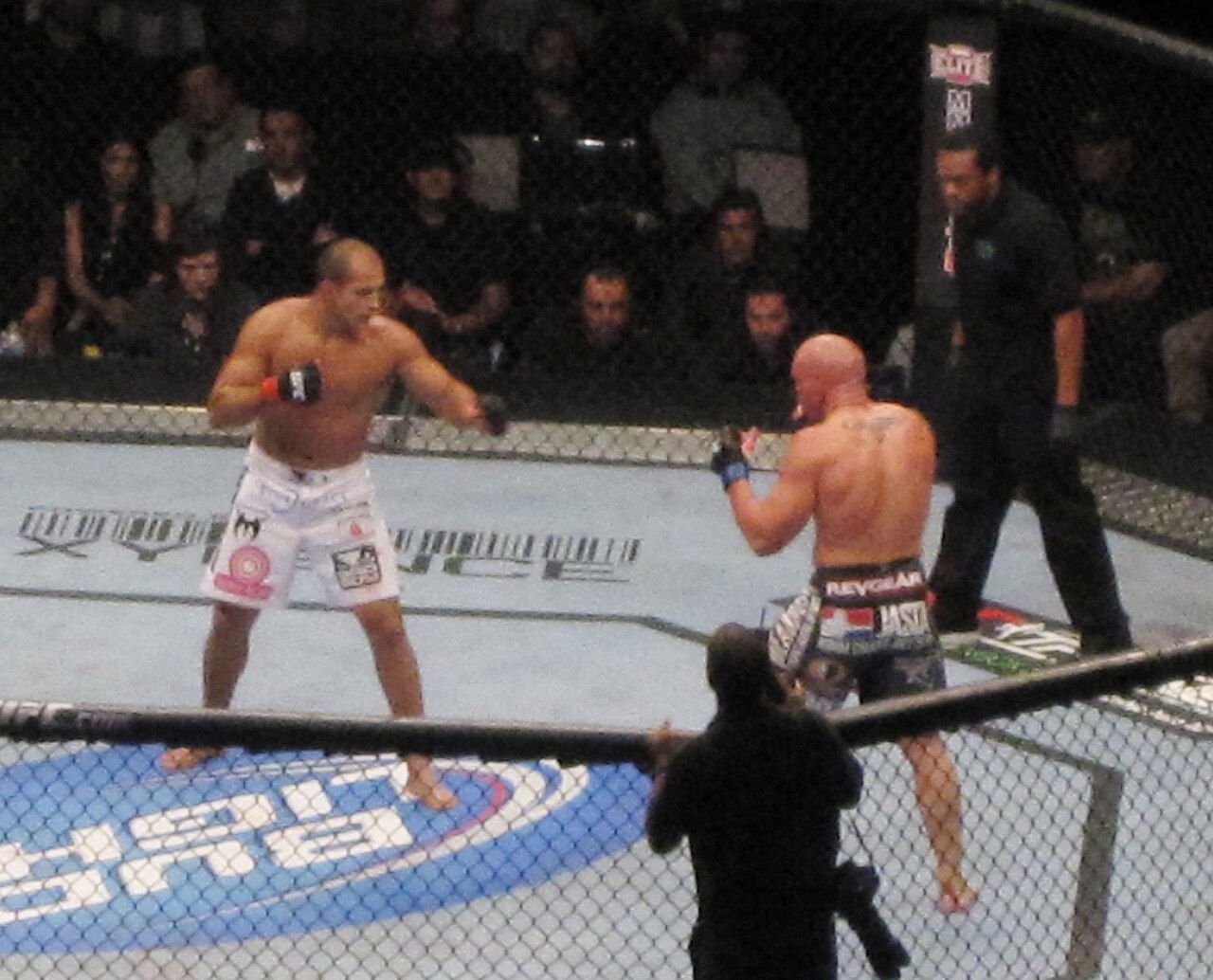
Mixed martial arts is at once ancient and brand new. The idea of pitting one fighting style against another goes back to Greek pankration in 648 BC and lived on through Brazilian vale tudo and a century of style-versus-style spectacles. But the sport as we know it dates precisely to a single night in Denver in November 1993, when eight men of different disciplines met in a cage to see whose art would prevail.
From that near-lawless beginning MMA was almost legislated out of existence, saved by the codification of the Unified Rules, the arrival of reality television, and a change of ownership that turned a fringe curiosity into a global entertainment business. In three decades it went from banned in most of the United States to a multibillion-dollar sport whose champions are worldwide celebrities.
Timeline
Greece introduces pankration, a near-no-rules blend of boxing and wrestling, at the 33rd Olympiad — the earliest recorded organized mixed-combat sport.
Edward Barton-Wright fuses jujitsu, boxing, savate and cane-fighting into Bartitsu in London, an early formal attempt to combine striking and grappling systems.
Judoka Mitsuyo Maeda arrives in Brazil and begins teaching Carlos Gracie, planting the roots of Gracie (Brazilian) jiu-jitsu and the vale tudo challenge culture.
Judoka Gene LeBell submits boxer Milo Savage in Salt Lake City in a nationally noticed 'martial arts vs boxing' match, foreshadowing style-versus-style contests.
Muhammad Ali fights Japanese wrestler Antonio Inoki in a widely watched Tokyo exhibition; the awkward draw nonetheless helped inspire Japan's future MMA scene.
Eight fighters of different styles meet in a cage on November 12; 175-pound jiu-jitsu artist Royce Gracie wins the tournament, proving grappling could beat bigger strikers.
Senator John McCain condemns the sport as 'human cockfighting' and lobbies to ban it; the UFC is dropped by cable providers and driven to small venues.
PRIDE Fighting Championships debuts at the Tokyo Dome, growing into a spectacle that would rival and, for a time, surpass the UFC in star power.
New Jersey's athletic commission adopts the Unified Rules of MMA — weight classes, rounds, gloves and fouls — the framework that made regulation and legalization possible.
Casino executives Frank and Lorenzo Fertitta, with Dana White, purchase the near-bankrupt UFC for about $2 million and begin the push for mainstream legitimacy.
The reality series debuts on Spike TV; its live finale, Forrest Griffin versus Stephan Bonnar, is hailed as the fight that rescued the promotion.
UFC 66, headlined by Chuck Liddell versus Tito Ortiz, tops one million pay-per-view buys, signaling MMA's arrival as major-league entertainment.
Zuffa acquires PRIDE FC, ending the Japanese giant and consolidating the sport's biggest stars — Wanderlei Silva, Mirko Cro Cop, Shogun Rua — under one banner.
The UFC signs a landmark deal with Fox; at UFC 128 a 23-year-old Jon Jones becomes the youngest champion in UFC history by stopping Shogun Rua.
Ronda Rousey headlines UFC 157 against Liz Carmouche as the first female UFC champion, launching women's MMA into the mainstream.
WME-IMG purchases the UFC for about $4 billion; months later Conor McGregor stops Eddie Alvarez at UFC 205 to become the first simultaneous two-division champion.
Khabib Nurmagomedov submits Conor McGregor before a chaotic post-fight brawl; the event sets the promotion's pay-per-view record at roughly 2.4 million buys.
The UFC runs cards on Abu Dhabi's 'Fight Island' through the pandemic; Khabib retires 29-0 after a triangle-choke win over Justin Gaethje at UFC 254.
The UFC and WWE combine into TKO Group Holdings under Endeavor; Jon Jones returns to submit Ciryl Gane at UFC 285 for the vacant heavyweight title.
Jim Miller and Charles Oliveira extend all-time UFC marks while rule-makers move to remove the '12-to-6 elbow' foul, reshaping the sport's technical boundaries.
The eras
Vale Tudo and style-versus-style roots
Long before the cage, cultures staged contests to find the superior fighting art. Greek pankration in 648 BC allowed nearly everything but biting and eye-gouging, and its champions were Olympic heroes. The modern lineage runs through the Gracie family of Brazil, where Mitsuyo Maeda's judo lessons in the 1910s evolved into Brazilian jiu-jitsu and the no-holds-barred 'vale tudo' — anything goes — challenge matches that filled Rio arenas from the 1920s onward. Parallel experiments dotted the twentieth century: Bartitsu in Victorian London, Gene LeBell choking out a boxer in 1963, and the surreal 1976 spectacle of Muhammad Ali against wrestler Antonio Inoki. These were curiosities rather than a sport, with no unified rules, weight classes or governing body. But they framed the essential question — which style truly works? — that the cage would soon answer, and they built the grappling tradition that would dominate the sport's first decade.
No-holds-barred beginnings
The Ultimate Fighting Championship debuted at Denver's McNichols Arena on November 12, 1993, marketed as a brutal tournament to determine the world's best fighting style. There were almost no rules — no weight classes, no rounds, no judges, minimal fouls — and the sport's central lesson landed immediately: Royce Gracie, a slender jiu-jitsu practitioner, submitted far larger strikers to win the first event and several that followed. Grappling, it turned out, beat brawling. The spectacle was raw and enormously controversial. Politicians recoiled; Senator John McCain branded it 'human cockfighting' and lobbied to have it outlawed. Cable and satellite carriers dropped the pay-per-views, and the UFC was pushed to obscure venues in states without athletic commissions. Yet the competition itself was already teaching fighters that they had to cross-train. The one-dimensional stylist was becoming extinct, and the first true mixed martial artists — men who could both strike and grapple — began to emerge from the chaos of these early tournaments.
Survival, PRIDE and the Unified Rules
Nearly legislated into oblivion in America, the sport found refuge and grandeur in Japan. PRIDE Fighting Championships launched in 1997 and grew into a stadium spectacle at the Tokyo Dome and Saitama Super Arena, showcasing legends like Fedor Emelianenko, Wanderlei Silva and Mirko Cro Cop before crowds of tens of thousands. Back in the United States, salvation came through regulation: New Jersey adopted the Unified Rules of MMA in 2000, establishing weight classes, rounds, gloves, judging and fouls — the legal skeleton that let states sanction the sport. In 2001 the Fertitta brothers and Dana White bought the near-bankrupt UFC for roughly two million dollars through their company Zuffa and began a patient campaign for legitimacy. The two-tone period saw Japan's PRIDE at its artistic peak and the American UFC clawing back respectability. Fighters like Randy Couture, Chuck Liddell and Matt Hughes became the first American MMA stars, and the sport slowly shed its outlaw image ahead of the boom to come.
The boom and mainstream breakthrough
One television experiment changed everything. The Ultimate Fighter, a reality series in which prospects lived and trained together, debuted on Spike TV in 2005 and climaxed with a live finale so thrilling — Forrest Griffin outlasting Stephan Bonnar — that it is credited with saving the UFC. Casual fans finally understood the athletes and the craft. Momentum snowballed: UFC 66 topped a million pay-per-view buys in 2006, and in 2007 Zuffa bought and folded PRIDE, absorbing its stars and ending the sport's split personality. Chuck Liddell, Georges St-Pierre, Anderson Silva and Brock Lesnar became household names, and the technical game matured rapidly as wrestlers learned to strike and strikers learned takedown defense. By 2011 the UFC had signed a network deal with Fox and staged UFC 129 before 55,000 fans in Toronto. The sport that had been banned in most of America a decade earlier was now filling stadiums and airing in prime time.
Global superstardom
MMA became genuinely mainstream and minted crossover celebrities. The Fox deal put fights on free television, and a new generation of stars supplied narrative firepower. Ronda Rousey headlined UFC 157 in 2013 as the first female champion and became one of the most famous athletes in America, proving women could sell out arenas. Conor McGregor arrived as a once-in-a-generation showman, knocking out José Aldo in thirteen seconds at UFC 194 and, at UFC 205 in 2016, becoming the first fighter to hold two belts simultaneously. That same year Endeavor's WME-IMG bought the UFC for about four billion dollars, a staggering valuation for a company purchased for two million fifteen years earlier. The rivalry between McGregor and undefeated Dagestani wrestler Khabib Nurmagomedov peaked at UFC 229 in 2018, which set the promotion's pay-per-view record near 2.4 million buys. Champions like Jon Jones, Anderson Silva, Demetrious Johnson and Amanda Nunes defined an era of extraordinary technical depth and global reach.
The TKO era and new dynasties
The sport weathered the pandemic by building 'Fight Island' in Abu Dhabi and running cards in empty arenas, keeping momentum while other leagues went dark. Business consolidation followed: in 2023 the UFC merged with WWE to form TKO Group Holdings under Endeavor, valuing the combined company in the tens of billions. On the mat, a Dagestani dynasty took hold — Khabib retired 29-0 in 2020, and his protégé Islam Makhachev inherited the lightweight throne, extending a wrestling-first pipeline that reshaped the sport's meta. Jon Jones moved up to conquer heavyweight, submitting Ciryl Gane for the vacant title in 2023 and stopping Stipe Miocic in 2024. Africa emerged as a powerhouse through Kamaru Usman, Israel Adesanya and Francis Ngannou, while women's divisions matured behind Amanda Nunes and Zhang Weili. Streaming, analytics and reformed weight-cutting protocols now define a sport that, three decades on, keeps raising its technical ceiling.
In roughly thirty years MMA traveled from a banned curiosity in a Denver cage to a multibillion-dollar global sport with champions on every continent and a talent pipeline that spans Dagestan, Brazil, Nigeria, Ireland and beyond. Its history is a compressed evolutionary story: the one-dimensional stylist gave way to the complete mixed martial artist, regulation replaced chaos, and reality television and shrewd ownership converted outlaw spectacle into mainstream entertainment. What has never changed is the founding question the first UFC asked — which approach truly works — and the answer, refined every year, remains the same: everything, combined better than anyone else can.
Keep exploring
More sports
Soccer
The simplest game on Earth, played by hundreds of millions and argued over by half the planet.
🏀Basketball
Five players, 24 seconds, and geometry at full sprint — the city game that conquered the world.
⚾Baseball
The clockless chess match where a round bat meets a round ball and the best hitters on earth still fail seven times out of ten.
🎾Tennis
The loneliest duel in sport: no clock, no teammates, no place to hide until the last point is won.
🏎️F1
Twenty drivers, a thousand horsepower, and the most expensive engineering arms race in sport.
⛳Golf
A six-century test of nerve where the only opponent is the ground, the wind, and yourself.
🏈Football
Four downs, ten yards, one end zone: the ultimate game of territory, collision, and coaching.
🏏Cricket
The bat-and-ball contest where a single match can last five days and still turn on one ball.