Milestones in order. This is history, not a weekly activity grid.
- Holger Nielsen writes the rules
- Torball codified in Berlin
- Karl Schelenz enlarges the game
- First world federation founded
- Olympic debut in Berlin
- The first world championships
- The IHF founded in Copenhagen
- First IHF indoor world title
- Women's world championship begins
- The last field handball world title
- Indoor handball becomes Olympic
- Women's handball joins the Games
- The EHF is founded
- The European Championship begins
Last reviewed Sources & creditsMedia creditsMethodology
Quick answers
What is handball and how is it played?
Team handball is an indoor sport played seven against seven on a court 40 metres long and 20 metres wide, in two halves of thirty minutes. Players throw, catch and bounce a ball small enough to hold in one hand, aiming to throw it into a goal 3 metres wide and 2 metres high defended by a goalkeeper. The defining rule is the goal area: a six-metre arc in front of each goal that only the goalkeeper may stand in, so every shot is taken from outside it or from the air above it. A player may take three steps and hold the ball for three seconds before passing, dribbling or shooting. Scores are high, typically around thirty goals per team.
How many players are on a handball team?
Seven players from each team are on court at any moment: six outfield players and a goalkeeper. The outfield positions are left wing, left back, centre back, right back, right wing and pivot, also called the line player. Teams may name up to sixteen players on the match sheet, and substitutions are unlimited and need no permission from the referees, provided players enter and leave through their own substitution zone near the halfway line. Because of that freedom, most elite teams swap several players between attack and defence on every change of possession, so almost the entire squad gets meaningful court time in a single match and defensive and attacking specialists can coexist.
How long is a handball match?
A match is two halves of thirty minutes with a ten-minute interval, so sixty minutes of playing time. The clock stops for timeouts, injuries and disciplinary sanctions, which means a typical elite match takes seventy to eighty minutes in real time. Each team has three one-minute timeouts per match, with no more than two in a single half. If a knockout match is level at full time, two periods of five minutes are played; if it is still level, a second five-plus-five period follows, and if the scores remain tied the match is decided by 7-metre throws, five per side and then sudden death. In league play a draw simply stands.
What are the basic rules about steps and dribbling?
A player holding the ball may take a maximum of three steps before passing, shooting or starting to dribble, and may hold the ball stationary for a maximum of three seconds. Dribbling with one hand is unlimited, but once the ball is gathered in both hands the count restarts and dribbling again is a double-dribble violation, which concedes a free throw. In practice players move in a rhythm of three steps, one bounce, three more steps, then release. The ball may be played with any part of the body above the knee; touching it with the foot or lower leg is a violation for everyone except the goalkeeper, who may use any part of the body inside the goal area.
Which country is the best at handball?
In the men's game the two strongest nations of the modern era are France and Denmark. France hold the record with six World Championships and three Olympic golds, won mainly between 2008 and 2020, and added the 2024 European title. Denmark have been dominant since 2019, winning four consecutive World Championships in 2019, 2021, 2023 and 2025 plus Olympic gold in 2016 and 2024. Sweden, Germany, Spain, Croatia and Norway are the other consistent contenders. In the women's game Norway are the benchmark, with ten European Championships, four world titles and Olympic golds in 2008, 2012 and 2024, closely followed by Denmark, France and Hungary.
Why do handball teams take their goalkeeper off?
Since a 2016 rule change, a team may substitute its goalkeeper for an extra field player without any special jersey requirement, which lets it attack seven against six with its own goal empty. The extra attacker guarantees that one player is unmarked somewhere along the six-metre line, forcing the defence out of its normal sliding coverage and raising the chance of scoring. The risk is total: any turnover gives the opposition an uncontested throw at an open net from up to forty metres away. Coaches therefore use it selectively - when trailing late, when a teammate is serving a two-minute suspension, or against a defence that has been shutting down conventional attacks.
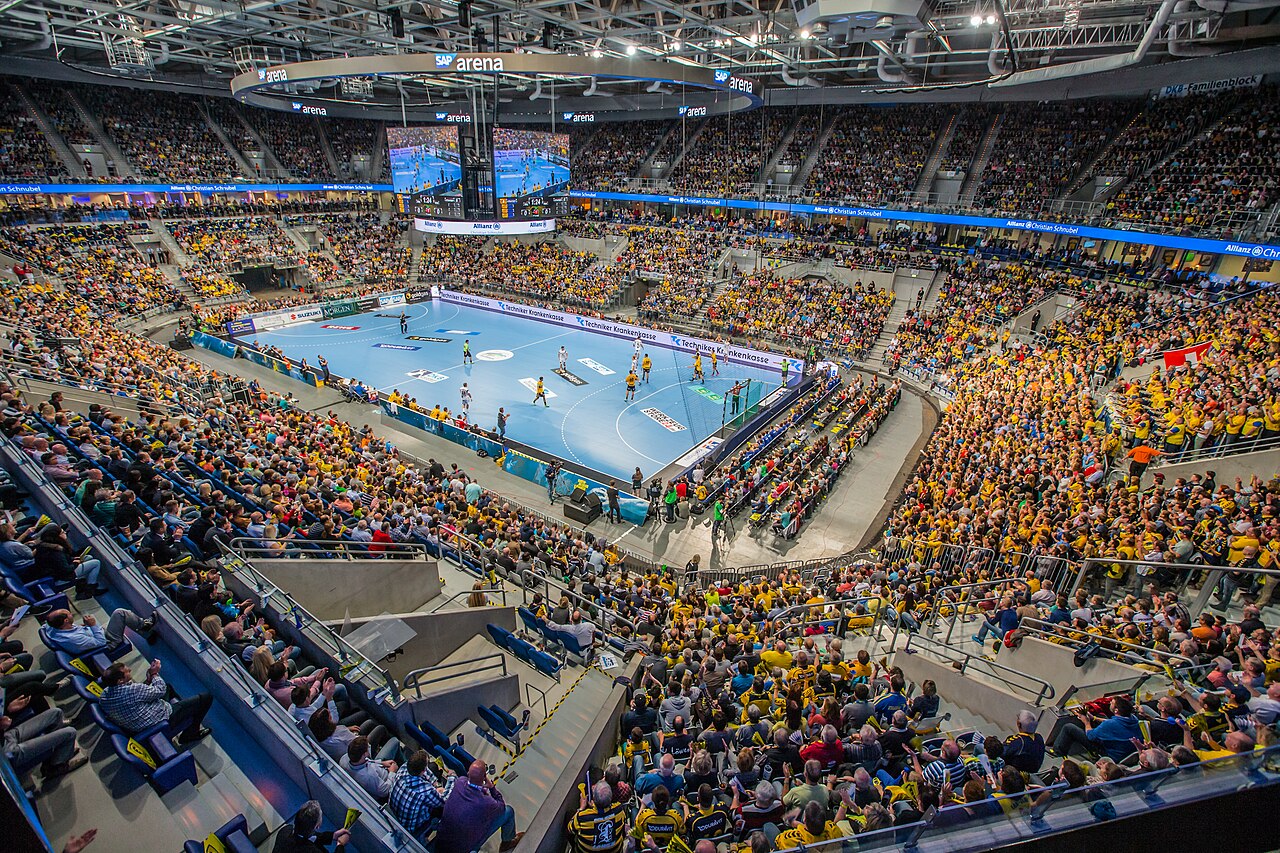
Handball has two founding stories and they happened in different countries for different reasons. In 1898 a Danish schoolteacher named Holger Nielsen wrote a set of rules for haandbold at Ordrup Gymnasium near Copenhagen, a small-sided indoor game for winter physical education, publishing them in 1906. Two decades later in Berlin, Max Heiser codified Torball as a non-contact game for women in 1917, and Karl Schelenz enlarged it around 1919 into an eleven-a-side outdoor sport played on a football pitch with tackling permitted. For fifty years the two versions coexisted, and the German outdoor game was the dominant one.
The sport's modern identity was settled between 1946 and 1972. The IHF's founding in Copenhagen restored international competition after the war, the first indoor world championships established a rival tradition, and the arrival of indoor handball at the 1972 Munich Olympics killed the outdoor game inside a decade. What followed divides cleanly: Eastern European supremacy through the 1970s and 1980s, a professional club revolution in Germany and Spain after the EHF was created in 1991, Scandinavian and Balkan national dynasties, and a French run of trophies from 2008 that has no parallel in the sport.
Timeline
A teacher at Ordrup Gymnasium near Copenhagen sets down rules for haandbold, a small-sided indoor throwing game for school gymnastics. He publishes them in 1906, and the Danish version becomes the ancestor of the modern seven-a-side sport.
Max Heiser writes rules for Torball, a non-contact throwing game designed for women workers in Berlin. It spreads through German gymnastics clubs and forms the German half of handball's parentage.
The Berlin physical educator adapts Torball for men, moving it onto a full football pitch with eleven players a side, a larger ball and permitted body contact. Field handball is born and quickly becomes a mass sport in Germany.
The International Amateur Handball Federation is created in Amsterdam during the Olympic Games by eleven nations, with the American administrator Avery Brundage as its first president.
Field handball is played at the Berlin Olympics, where Germany beat Austria 10-6 in the final at the Olympic Stadium before a crowd reported above 100,000. It is the only Olympic appearance the outdoor game ever makes.
Germany stages both the first outdoor eleven-a-side World Championship and the first indoor seven-a-side World Championship, winning them both. The indoor event is a four-team affair and, at the time, an afterthought.
Eight nations - Denmark, Finland, France, the Netherlands, Norway, Poland, Sweden and Switzerland - create the International Handball Federation, restoring an international structure after the war and moving the sport's centre of gravity to Scandinavia.
Sweden host and win the first men's indoor World Championship organised by the new federation, the beginning of a Scandinavian tradition in the small-court game that has never really been broken.
Yugoslavia hosts the first indoor Women's World Championship, won by Czechoslovakia. The women's competition would be dominated in turn by Eastern Europe, Scandinavia and, briefly, South America.
West Germany win the final outdoor eleven-a-side World Championship in Austria. Within a decade the outdoor game has effectively disappeared from elite competition, surviving only in German amateur leagues.
The seven-a-side game enters the Olympic programme in Munich, where Yugoslavia beat Czechoslovakia to win the gold medal. Olympic status transforms funding and federation priorities across Europe.
Montreal adds a women's tournament, won by the Soviet Union, who also take the men's gold. Eastern bloc state programmes dominate both competitions for the next fifteen years.
The European Handball Federation is established in Berlin as the continental body for a sport whose elite is almost entirely European. It rapidly becomes the commercial engine of the game.
The EHF launches its own continental title. Sweden win the first men's tournament in Portugal and Denmark the first women's in Germany, opening two of the sport's great national eras.
France beat Iceland 28-23 in the Beijing Olympic final for their first Olympic gold, the beginning of a decade in which Les Experts win every trophy in the sport, some of them repeatedly.
North Macedonia's Kiril Lazarov scores 92 goals at the World Championship in Croatia, the most any player has managed at a single world championship, in a tournament his team did not win.
The IHF permits a seventh field player to replace the goalkeeper without a special bib, allows the throw-off to be taken immediately, caps passive play at six passes and introduces the blue card. Scoring rates jump.
Denmark beat Norway 31-22 in Herning to claim their first men's world title, and begin the most dominant national-team run the men's game has seen since the Soviet era.
53,586 people watch Germany play Switzerland in Duesseldorf at the European Championship, a world attendance record for handball. In August, Denmark beat Germany 39-26 in the Olympic final in Paris.
Denmark beat Croatia in the final in Oslo to win the World Championship for a fourth consecutive time, a sequence no men's team had previously achieved.
The eras
Two inventions, one name
Handball was invented twice, in two countries, for two different purposes, and the modern sport is the survivor of a fifty-year argument between them. Holger Nielsen's Danish haandbold of 1898 was a school gymnastics exercise: small court, few players, no room for tackling, and a premium on passing accuracy. It spread through Danish and later Swedish and Norwegian schools as a winter activity, which is why Scandinavia has produced small-court specialists ever since. The German line was entirely different. Max Heiser's Torball of 1917 was a non-contact throwing game for women in Berlin; Karl Schelenz's revision around 1919 put eleven players on a football pitch, permitted body contact, and reframed the sport as an outdoor mass-participation game with football's dimensions and none of its foot skills. That version exploded in Germany, which had hundreds of thousands of registered players by the late 1920s, and it was the German model the new International Amateur Handball Federation adopted when it was founded in Amsterdam in 1928. The 1936 Berlin Olympics, staged for propaganda as much as sport, gave field handball its only Olympic tournament, and Germany duly won it. The Danish indoor game was, at that point, a curiosity.
The indoor game wins the argument
The war ended the first federation, and the IHF that replaced it in Copenhagen in 1946 was founded by eight nations of whom four were Nordic. That shifted the balance of power decisively toward the small court. Both codes ran world championships in parallel for two decades - the outdoor version from 1938 to 1966, the indoor version from 1938 and then regularly from 1954 - but the arithmetic favoured the gymnasium. Indoor handball needed no pitch, no weather and no daylight, which mattered enormously in northern Europe, and it played far better on television, where twenty-two players scattered across a football field looked like nothing at all. Sweden won the first IHF indoor world title at home in 1954, Romania emerged as the outstanding force of the 1960s and early 1970s with four world championships between 1961 and 1974, and the women's competition, launched in 1957, established itself in Eastern Europe. The decisive blow came in 1972, when the IOC added the indoor game to the Munich programme and Yugoslavia won gold. Olympic status meant state funding, and state funding meant that within a decade almost no national federation was seriously investing in the outdoor code. Field handball, once the German national sport, survives today only in amateur leagues.
State programmes and Eastern supremacy
Olympic status arrived precisely when Eastern European sports systems were at their most effective, and the result was two decades of near-total dominance by countries with centrally planned athlete development. Yugoslavia won the men's gold in Munich in 1972 and again in Los Angeles in 1984; the Soviet Union won in Montreal in 1976 and Seoul in 1988, and their women won the first two Olympic tournaments in 1976 and 1980. Romania, East Germany, Hungary, Poland and Czechoslovakia all produced world-class sides, and the sport's technical vocabulary was largely written in this period: the flat 6-0 defence as an organised wall, the aggressive 3-2-1 as its counterpart, structured crossing patterns between the backcourt players, and the pivot as a specialist rather than an extra shooter. West Germany's 1978 world title and Sweden's slow rebuild were the significant Western exceptions. It was also the era in which the sport's physical template hardened. Backcourt players grew: the two-metre left back who shoots over a block from nine metres became the position around which teams were designed, and the modern separation between attacking and defending specialists, made possible by unlimited substitution, began to standardise. When the Berlin Wall fell, the talent that state systems had concentrated dispersed westward into the professional leagues of Germany and Spain almost overnight.
The EHF era and the club revolution
The European Handball Federation, founded in Berlin in 1991, changed the sport's economics as thoroughly as the Champions League changed football's. The old European Cup was rebranded and expanded into the EHF Champions League from the 1993-94 season, the European Championship was launched in 1994, and the German Bundesliga and Spain's Liga ASOBAL became genuinely professional destinations that could pay Eastern European and Balkan players proper wages. FC Barcelona assembled the strongest club side the sport had seen, winning five consecutive European titles from 1996 to 2000; THW Kiel built a rival dynasty in Germany. Internationally the period belonged to two very different national projects. Sweden's Bengan Boys, coached by Bengt Johansson and built around the pivot Magnus Wislander, won world titles in 1990 and 1999 and four consecutive European Championships in 1994, 1998, 2000 and 2002, yet lost three Olympic finals in a row and never won gold. The Balkans supplied the flair: Croatia won Olympic gold in Atlanta in 1996 and again in Athens in 2004, with the world title at home in 2003 in between, built around Ivano Balic, the most inventive playmaker the sport has produced. Russia, Spain and Germany all took world titles, and by 2007, when Germany won at home in front of enormous television audiences, the sport had a genuine European mass market.
France, and the answer from Scandinavia
No national team in handball history has assembled a record like France's between 2008 and 2017. Beginning with Olympic gold in Beijing, where they beat Iceland 28-23, Les Experts won three Olympic titles (2008, 2012 and 2020), four world championships (2009, 2011, 2015 and 2017) and three European Championships (2006, 2010 and 2014), a run built on Thierry Omeyer in goal, Nikola Karabatic and Daniel Narcisse in the backcourt and Bertrand and Guillaume Gille in defence. The team's identity was defensive and transitional rather than flamboyant: a 6-0 that conceded almost nothing, a goalkeeper with save rates near forty percent, and a fast break that punished every miss. The counter-argument came from Scandinavia. Denmark won the European title in 2008 and 2012, then Olympic gold in Rio in 2016 with Mikkel Hansen as the outstanding backcourt shooter in the world. Norway's men reached two consecutive world finals in 2017 and 2019 with Sander Sagosen, while Norway's women constructed the most consistent dynasty in the entire sport, winning Olympic golds in 2008 and 2012 and a run of European titles that has reached ten in total. Spain won back-to-back Europeans in 2018 and 2020, and Qatar's run to the 2015 world final as hosts, with a heavily naturalised squad, forced the IHF into an uncomfortable debate about eligibility.
The speed era
The 2016 rule package was the biggest single change to how handball looks since the introduction of passive play. Allowing a seventh field player to replace the goalkeeper without a special jersey turned the empty-net attack from an occasional gimmick into standard practice; permitting the throw-off to be taken immediately after a concession created the fast centre, a set play in which a team scores within four seconds of conceding; and capping passive play at six passes forced attacks to commit. Scores rose accordingly, and matches that would have finished 26-24 in 2010 now finish 34-31. Denmark have been the era's beneficiaries: world champions in 2019, 2021, 2023 and 2025, the first men's team to win four in a row, plus Olympic gold in Rio in 2016 and again in Paris in 2024, where they beat Germany 39-26 in a final that produced 65 goals. France remain the closest challenger, winning the 2024 European title in Cologne. The women's game has grown fastest of all, with Norway winning Olympic gold in Paris and European crowds and broadcast deals expanding across the continent. The unresolved problems are structural rather than sporting: a calendar with a major international tournament every single year, club schedules that push elite players past sixty matches a season, and a commercial base still concentrated in eight or nine countries.
The through-line of handball's history is compression. A game invented on a football pitch moved indoors and shrank; a sport that once tolerated teams holding the ball for three minutes now caps an attack at six passes; a match that averaged forty goals in the 1970s now averages more than sixty. Every rule change of the last thirty years has pushed in the same direction, toward more possessions, faster restarts and less space to hide, and every tactical innovation from the fast centre to the seventh-player attack has been an attempt to exploit that. What has not changed is the shape of the argument on court: six defenders forming a wall in front of a six-metre arc, and six attackers trying to break it with speed, deception and one player willing to jump into the contact.
Keep exploring
More in this category
Soccer
The simplest game on Earth, played by hundreds of millions and argued over by half the planet.
🏀Basketball
Five players, 24 seconds, and geometry at full sprint — the city game that conquered the world.
⚾Baseball
The clockless chess match where a round bat meets a round ball and the best hitters on earth still fail seven times out of ten.
🏈Football
Four downs, ten yards, one end zone: the ultimate game of territory, collision, and coaching.
🏏Cricket
The bat-and-ball contest where a single match can last five days and still turn on one ball.
🏉Rugby Union
Fifteen players, eighty minutes of collision and continuity, and a code that prizes the contest for the ball above all else.
🏒Hockey
The fastest team sport on Earth: six skaters, one frozen puck, and no time to breathe.
🏐Volleyball
Three touches, no second chances: the fast, vertical duel fought across a net no one may cross.