Milestones in order. This is history, not a weekly activity grid.
- Jahn opens the first Turnplatz
- The FIG is founded in Liège
- Gymnastics at the first modern Olympics
- First World Championships, Antwerp
- Women debut at the Olympics
- First women's World Championships
- The Soviet Union arrives in Helsinki
- Keleti and Latynina in Melbourne
- Japan's men begin their reign on home soil
- Olga Korbut in Munich
- Nadia Comaneci scores the first perfect 10
- Los Angeles reshuffles the order
- Vitaly Scherbo wins six golds in Barcelona
- The minimum age rises to 16
Last reviewed Sources & creditsMedia creditsMethodology
Quick answers
How is artistic gymnastics scored, and what happened to the perfect 10?
Since 2006 every routine receives two scores that are added together. The difficulty score, or D-score, has no upper limit and is calculated from the values of the counting elements plus credit for required element groups and for connections performed without a pause. The execution score, or E-score, starts at 10.00 and only falls, with judges deducting 0.1 for a small fault, 0.3 for a medium one, 0.5 for a large one and 1.00 for a fall. The perfect 10 was abolished after the 2004 Athens Games, where a start-value error decided the men's all-around and a crowd protest over Alexei Nemov's high bar score halted competition. The old system could no longer separate gymnasts whose difficulty had outgrown its ceiling.
Why do men and women compete on different apparatus?
The two programs developed separately and were standardised at different times. The men's six apparatus — floor, pommel horse, rings, vault, parallel bars and high bar — descend directly from the nineteenth-century German Turnen movement and were essentially fixed by the 1930s, with a strong emphasis on upper-body strength. The women's program entered the Olympics in 1928 and was built around vault, uneven bars, balance beam and floor, emphasising acrobatic tumbling, flexibility and, on beam and floor, an explicit artistry component judged within the execution score. The result is that men contest eight Olympic medal events and women six, an imbalance FIG has been repeatedly asked to address. The apparatus themselves have not changed in principle for roughly a century.
Who is the greatest gymnast of all time?
Simone Biles has the strongest case by almost every measure. Through Paris 2024 she holds 41 Olympic and World Championship medals with 30 golds, including a record 23 world titles and six world all-around crowns, plus Olympic all-around golds in 2016 and 2024. Five elements in the Code of Points carry her name, and FIG has deliberately valued her hardest skills below what she argued they were worth in order to discourage imitation. The historical alternatives are serious: Larisa Latynina's 18 Olympic medals remain the gymnastics record, Kohei Uchimura went unbeaten in all-around competition from 2009 to 2016 on six apparatus, and Vitaly Scherbo won six golds at a single Games. The answer usually depends on whether you value accumulation, dominance or difficulty of the task.
How old do you have to be to compete at the Olympics?
Women must turn 16 during the calendar year of the competition and men must turn 18. The women's minimum was raised from 15 to 16 in 1997, after decades in which teenagers as young as 14 won Olympic titles — Nadia Comaneci was 14 when she won the 1976 all-around, a record now permanently unbreakable. The rule was introduced partly on health grounds, since very young gymnasts training elite volumes face growth-plate injuries and disordered eating risks, and partly because minors cannot meaningfully advocate for themselves inside coaching systems. Age falsification has been alleged repeatedly, most publicly against members of the Chinese team at Beijing 2008, and FIG now requires documentary verification through national federations.
What does it mean when a skill is named after a gymnast?
The Code of Points catalogues every recognised element, and a gymnast who invents a genuinely new one can have it entered under their own name permanently. The requirements are strict: the element must be submitted to the FIG technical committee in advance, and it must be performed successfully in qualification at a World Championships or Olympic Games, without a fall or a major error. Natalia Yurchenko's round-off vault entry, Yelena Produnova's front handspring double front, Aliya Mustafina's bar transition and Epke Zonderland's release combinations all carry their inventors' names. Simone Biles has five named elements across vault, beam and floor, the most of any woman, including the Yurchenko double pike named Biles II in 2023.
What are the twisties?
The twisties are a sudden loss of air awareness in which a gymnast cannot sense where their body is during rotation. Twisting skills are performed almost entirely on proprioceptive memory built through thousands of repetitions, and when that mapping breaks down the athlete may over-rotate, under-rotate or freeze mid-air. This is not stage fright: landing a double somersault without knowing which way is down is a realistic route to a spinal or head injury, which is why gymnasts stop competing rather than push through. Simone Biles withdrew from the Tokyo Olympic team final in July 2021 for exactly this reason. The episode changed how the sport treats the condition, which is now managed as an injury requiring graded rehabilitation rather than as a lapse of nerve.
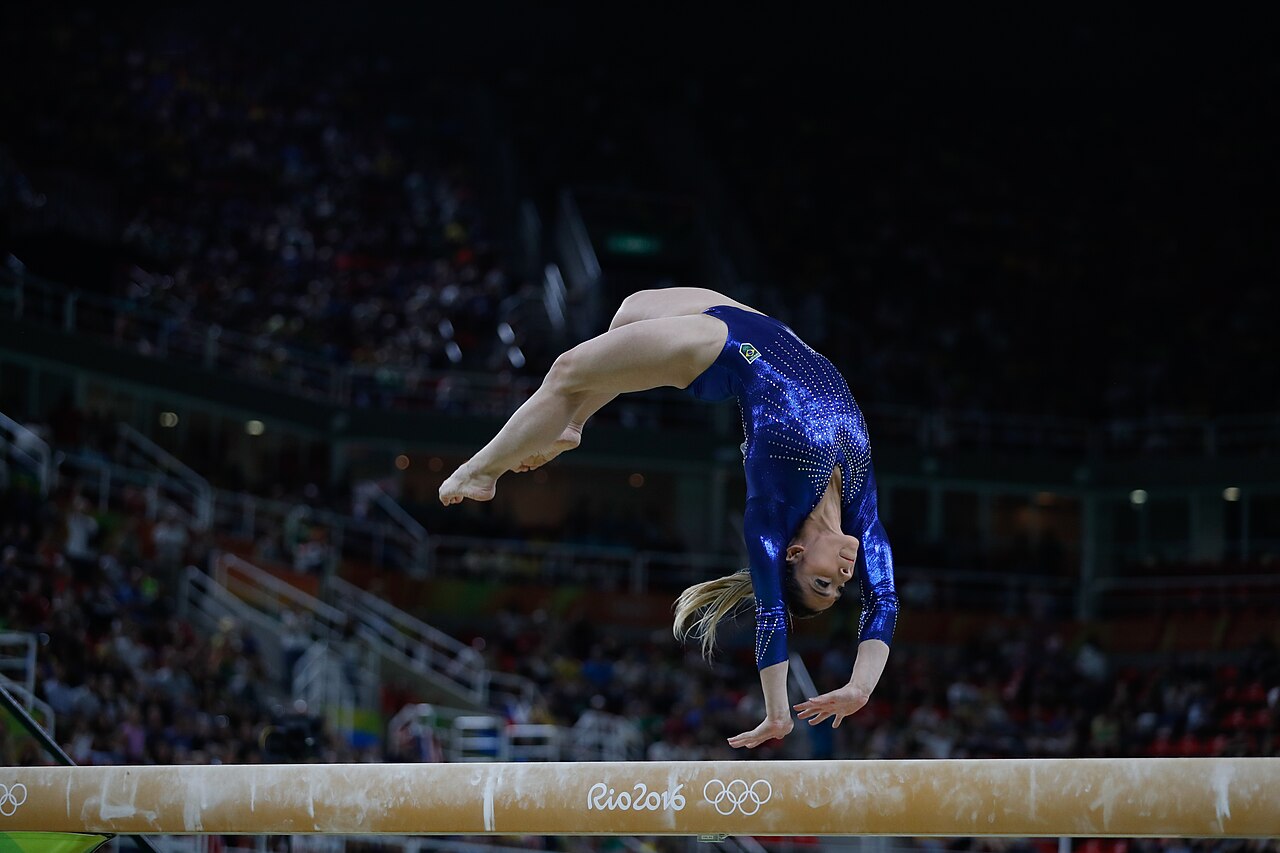
Artistic gymnastics has two ancestors that met in the nineteenth century. One is the German Turnen movement, founded by Friedrich Ludwig Jahn, who opened an outdoor gymnasium in Berlin in 1811 and invented the parallel bars, the horizontal bar and the vaulting horse as instruments of nationalist physical education. The other is the Czech Sokol movement, established in Prague in 1862, which added mass display and artistry. Both were political projects before they were sports, and both bequeathed apparatus that are still in use, essentially unchanged in principle, two centuries later.
The competitive sport was built on top of that equipment between 1881 and 1952: a federation, a world championship, an Olympic program, and finally a stable set of six men's and four women's apparatus. Everything since has been an argument about how to measure what happens on them — an argument that produced the perfect 10, destroyed it in 2004, and replaced it with an open-ended code that has driven difficulty to levels the sport's founders could not have imagined.
Timeline
Friedrich Ludwig Jahn establishes an open-air gymnasium in Berlin's Hasenheide and devises the parallel bars, horizontal bar and vaulting horse. The apparatus he built for military-nationalist training became the sport's core equipment.
Belgium, France and the Netherlands create the body that becomes the Fédération Internationale de Gymnastique — the oldest international sports federation in existence, predating the modern Olympics by fifteen years.
Athens stages horizontal bar, parallel bars, pommel horse, rings, vault and rope climbing. German gymnasts dominate, and the sport becomes one of the very few contested at every subsequent Summer Games.
The inaugural men's world championship is held in Belgium with a program still closer to athletics than to modern gymnastics, including rope climbing and standing jumps alongside apparatus work.
A women's team event is added at the Amsterdam Games and won by the host nation, the Netherlands. Individual women's events would not appear on the Olympic program for another 24 years.
Budapest hosts the first world championship for women, establishing the parallel competitive structure that FIG has maintained ever since alongside the men's program.
In its Olympic debut the USSR wins both team titles and Maria Gorokhovskaya takes seven medals, still the most won by a woman at a single Games. The full women's individual program is contested for the first time.
Hungary's Agnes Keleti wins four golds at the age of 35, while Larisa Latynina of the USSR begins a three-Games run that will yield 18 Olympic medals — a record for any athlete until 2012.
Tokyo delivers the second of five consecutive Japanese Olympic team titles. Broadcast to a global television audience for the first time, gymnastics starts to become a mainstream spectator sport.
The Soviet teenager performs the backward-standing Korbut Flip on the uneven bars, wins three golds and turns gymnastics into prime-time television across Europe and North America almost overnight.
On 18 July in Montreal the 14-year-old Romanian scores 10.00 on uneven bars; the scoreboard, built for three digits, displays 1.00. She records seven perfect scores and wins three golds at those Games.
With the Soviet bloc absent, Mary Lou Retton becomes the first American woman to win the Olympic all-around and China's Li Ning takes six medals, three of them gold, announcing a new gymnastics power.
Competing for the Unified Team, the Belarusian wins the team title, the all-around and four apparatus finals — the most gold medals ever won by a gymnast at a single Olympic Games.
FIG lifts the senior eligibility age for women from 15 to 16 in the competition year, ending an era in which 14-year-olds routinely won Olympic titles and shifting the sport toward more physically mature athletes.
A start-value error costs South Korea's Yang Tae-young in an all-around decided by 0.012 in Paul Hamm's favour, and a crowd revolt in Athens over Alexei Nemov's high bar mark halts competition for minutes. The 10.0 system loses its legitimacy.
FIG replaces the 10.0 with a difficulty score of unlimited value added to an execution score starting at 10.00. Difficulty becomes an explicit currency, and the sport's technical ceiling rises immediately.
The host nation wins both team titles and Yang Wei takes the men's all-around, while Li Ning lights the Olympic cauldron by running through the air around the stadium roof — a full-circle moment for Chinese gymnastics.
Larry Nassar, the former USA Gymnastics team doctor, is sentenced in January after more than 150 survivors testify. The scandal collapses the federation's leadership and triggers safeguarding inquiries in Britain, the Netherlands, Australia and Japan.
Biles withdraws from the Olympic team final on 27 July citing a loss of air awareness, returns for beam bronze, and makes athlete mental health the central conversation in world sport.
Biles wins three more golds and Rebeca Andrade takes floor to become Brazil's most decorated Olympian, while Algeria's Kaylia Nemour wins uneven bars, Ireland's Rhys McClenaghan pommel horse and the Philippines' Carlos Yulo two titles.
The eras
Turnen, Sokol and the invention of the apparatus
The equipment came first. Friedrich Ludwig Jahn's Berlin Turnplatz of 1811 was a nationalist training ground for a Prussia humiliated by Napoleon, and the parallel bars, horizontal bar and vaulting horse he devised there were conceived as instruments of mass physical preparation rather than of competition. Per Henrik Ling's Swedish system, developed in parallel, emphasised therapeutic and postural exercise and would shape physical education in schools worldwide. In 1862 Miroslav Tyrs founded Sokol in Prague, adding to the German apparatus a Czech tradition of synchronised mass display, artistry and civic ceremony; Sokol festivals drew tens of thousands and exported the movement across the Slavic world and into emigrant communities in the United States. What none of these movements had was a common rulebook. That arrived in 1881, when Belgium, France and the Netherlands founded the body that would become the FIG in Liège — the first international sports federation of any kind, fifteen years ahead of the revived Olympic Games. When gymnastics appeared in Athens in 1896 it was still a hybrid discipline, mixing apparatus work with rope climbing, and German competitors swept it. But the six apparatus that would define the men's sport for the next century were already standing in the arena.
Codification and the Olympic program
The first half of the twentieth century was spent deciding what the sport actually was. Early World Championships from 1903 and Olympic programs through the 1920s were a jumble of apparatus events, athletics-style tests, rope climbing and club swinging; Italy's Alberto Braglia won Olympic all-around titles in 1908 and 1912 in a format that would be unrecognisable today. Standardisation came slowly, driven by FIG's technical committees and the demands of comparing gymnasts across countries. Women entered the Olympic program at Amsterdam in 1928 with a team competition won by the Netherlands, and got their own World Championships in Budapest in 1934, but the women's program stayed limited to team work for another two decades. By the 1936 Berlin Games the men's six-apparatus format was essentially fixed at floor, pommel horse, rings, vault, parallel bars and high bar, and judging had begun to converge on the ten-point scale that would define the sport's public understanding for seventy years. The Second World War then removed two Olympic cycles and much of Central European gymnastics infrastructure. When competition resumed, the balance of power was about to shift decisively eastward.
The Soviet system and the Japanese school
The Soviet Union entered the Olympics in Helsinki in 1952 and won both team titles at the first attempt, beginning a run of ten consecutive women's Olympic team golds that lasted until the Unified Team of 1992. Larisa Latynina collected 18 Olympic medals across 1956, 1960 and 1964, a total no athlete in any sport would exceed until Michael Phelps in 2012, while Boris Shakhlin gathered 13 on the men's side. Vera Caslavska of Czechoslovakia interrupted the pattern with all-around titles in 1964 and 1968, winning four golds in Mexico City weeks after the Soviet invasion of her country and turning her head away during the Soviet anthem at the medal ceremony — the sport's most famous act of political defiance. On the men's side Japan built the most durable dynasty in gymnastics history, winning five straight Olympic team titles from 1960 to 1976 through Yukio Endo, Sawao Kato and a national coaching system built on relentless technical precision. Then television arrived. Olga Korbut's Munich routines in 1972 and Nadia Comaneci's seven perfect tens in Montreal in 1976 transformed a specialist discipline into one of the Olympics' two or three biggest attractions, and the sport's centre of gravity moved permanently toward the women's competition.
The small gymnast, the boycotts and the last perfect tens
Comaneci's Montreal victory at 14 defined a generation. Bela and Marta Karolyi's Romanian program, and the Soviet system it competed against, favoured very young, very light athletes whose strength-to-weight ratio made the new acrobatic elements possible, and the average age of an Olympic women's champion dropped into the mid-teens. The results were spectacular and the human cost, documented much later, severe. Politics disrupted the era twice: the Western boycott of Moscow 1980, where Comaneci won beam and floor amid a disputed all-around, and the Eastern boycott of Los Angeles 1984, which opened the door for Mary Lou Retton's American all-around title and for Li Ning's six-medal haul. The 1990s brought both a climax and a reckoning. Vitaly Scherbo won six golds in Barcelona in 1992, still the record for one Games, before the Soviet machine dissolved into a dozen national federations. The Karolyis, by then in the United States, guided the Magnificent Seven to America's first women's team gold in Atlanta in 1996. And in 1997 FIG raised the women's minimum age to 16, closing the era of the child champion and forcing the sport to build athletes who could last.
China's rise and the death of the 10.0
China had signalled its intent with Li Ning in 1984 and converted it into systematic dominance over the following two decades, producing Li Xiaopeng on parallel bars and vault, Yang Wei in the all-around and Chen Yibing on rings, and sweeping both team titles at its home Games in Beijing in 2008. The period's decisive event, though, was a judging crisis. At Athens 2004 the men's all-around was settled by 0.012 in Paul Hamm's favour after officials set Yang Tae-young's parallel bars start value 0.1 too low, and days later a Greek crowd stopped the competition for several minutes in protest at Alexei Nemov's high bar mark, forcing an on-the-spot upward revision. The perfect 10 had become a ceiling that could no longer separate the best from the merely excellent, and the arbitrariness of start values was now visible on television. FIG's answer, effective from 2006, was the open-ended code: unlimited difficulty added to an execution score that still began at 10.00. Difficulty immediately inflated, routines got harder and often uglier, and a fresh argument began about whether the sport had traded beauty for arithmetic. Meanwhile Kohei Uchimura began an all-around run that would go unbeaten from 2009 to 2016.
Biles, reckoning and globalisation
Simone Biles won her first world all-around title in 2013 and did not lose one she entered for the next decade, finishing the Paris cycle with 41 Olympic and World Championship medals, 30 of them gold, and five elements named after her in the Code of Points. Her tumbling forced the code itself to respond, with FIG repeatedly setting her hardest skills below the values gymnasts argued they deserved in order to discourage imitation. The same decade forced the sport to confront what its systems had hidden. Larry Nassar's sentencing in 2018, after more than 150 survivors testified, destroyed USA Gymnastics' leadership and led to a 380 million dollar settlement in 2021, while independent inquiries in Britain, the Netherlands, Australia and Japan documented abusive coaching cultures. Biles's withdrawal from the Tokyo team final in 2021 with the twisties — a loss of air awareness that makes twisting skills genuinely dangerous — reframed athlete welfare as a performance issue rather than a weakness. Competitively, the field broadened: Russia and Belarus were excluded from FIG events after February 2022, Japan's men won team gold again in Paris, and Algeria, the Philippines, Ireland, Armenia and Brazil all took Olympic gymnastics titles in 2024.
The through-line of gymnastics history is the tension between the apparatus, which has barely changed since Jahn, and the rulebook, which changes every four years. Every code revision is an attempt to answer the same question the 1896 judges faced: how do you compare a gymnast who does something difficult imperfectly with one who does something easier beautifully? The perfect 10 answered it for seventy years and then collapsed under its own compression. The open-ended code answers it differently, and will itself be replaced. What survives untouched is the demand — leave the ground, rotate, land still.
Keep exploring
More in this category
Track & Field
Faster, higher, stronger — the oldest contest in sport, settled in seconds and centimetres.
🏊Swimming
Four strokes, one clock, and the oldest question in the water: who reached the wall first.
🚴Road Cycling
An individual sport won by teams, where drafting, mountains and split-second timing decide everything.