🧵The Greats

Tailor · The craftsman who cuts cloth to one particular human body — a trade the sewing machine industrialized, ready-to-wear shrank, and no machine has finished replacing.

Tailoring's fame is structurally unfair: the trade has flourished on every continent, but the names that survive are overwhelmingly the ones whose ledgers, patterns and press cuttings were kept — which means London, Paris, Rome and New York are over-represented, and centuries of masters in Ningbo, Lagos, Istanbul and Bombay are not. The eight below are chosen because their influence is documented and still visible in how clothes are cut.

They span three centuries and six countries of origin, and reached the top by opposite routes: inherited firms and bought freedom, royal patronage and open shop windows, rules enforced without exception and rules cheerfully broken. What they share is that some concrete piece of the modern craft — a garment, a silhouette, a standard, a door — exists because of each of them.

The all-time podium

Charles Frederick Worth
United Kingdom / France
2
Henry Poole
Henry Poole
United Kingdom
1
Elizabeth Keckley
Elizabeth Keckley
United States
3

The eight who reached the top

1
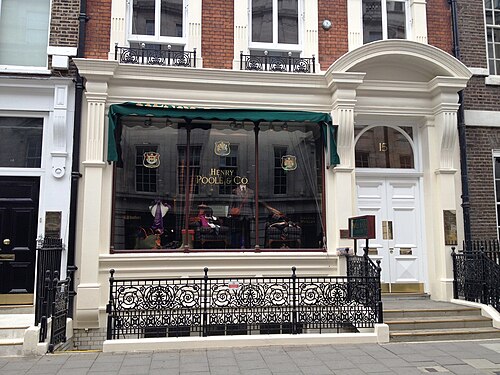
The Savile Row premises of Henry Poole & Co, founders of Savile Row tailoring. Gryffindor · CC BY-SA 4.0

Henry Poole

United Kingdom · 1814–1876

Poole inherited his father James's military tailoring firm in 1846, opened its showroom entrance onto Savile Row, and made the street's name a synonym for the trade itself. Court tailor to Napoleon III and holder of royal warrants across Europe's courts, his house also originated the dinner jacket.

The story

In 1865 Edward, Prince of Wales, asked Poole for a short, comfortable evening jacket to replace the formal tailcoat at informal Sandringham dinners. In 1886 the prince referred an American guest, James Brown Potter, to Poole for the same garment; Potter took his home to the Tuxedo Park club outside New York, where members copied it — and Americans have called the dinner jacket a tuxedo, after the club, ever since.

“One well-judged commission for one client can name a garment for a century and a half.”

Royal warrants accumulated
40 courts & crowns
Pattern ledgers preserved
Back to the 1800s
Firm still trading since
1806
2
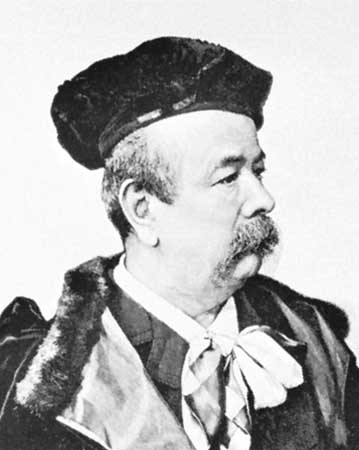
Portrait of Charles Frederick Worth, the tailor-draper who founded haute couture. Nadar · Public domain

Charles Frederick Worth

United Kingdom / France · 1825–1895

A Lincolnshire draper's apprentice who arrived in Paris at twenty with little French, Worth turned garment-making from an anonymous service into a signed art: he sewed his name into his clothes, showed designs on live models, and dictated to clients instead of taking dictation. Haute couture is his invention.

The story

In 1860 Princess Pauline von Metternich, the Austrian ambassador's wife, wore a Worth gown she had bought for 300 francs to a ball at the Tuileries. Empress Eugénie demanded the next morning to know who had made it, and summoned him; imperial patronage followed, and with it every court in Europe. Metternich later joked that from that day on, no one ever got a Worth dress for 300 francs again.

“Sign the work, choose the clients, and a trade becomes an authorship.”

House opened
1858, rue de la Paix
Staff employed at peak
~1,200 (1870s)
Label sewn into garments
A first
3
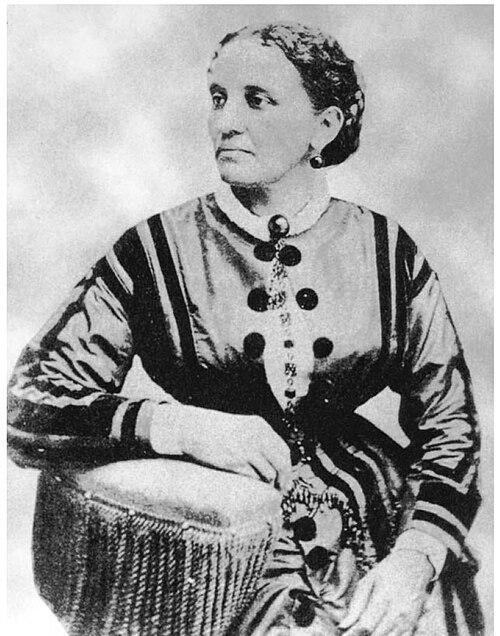
Photograph of Elizabeth Keckley, dressmaker to Mary Todd Lincoln. Unknown author Unknown author · Public domain

Elizabeth Keckley

United States · 1818–1907

Born enslaved in Virginia, Keckley became so sought-after a dressmaker in St. Louis that her clients lent her $1,200 to buy her own and her son's freedom in 1855. By 1861 she was dressing Mary Todd Lincoln in the White House and running a Washington workshop with a staff of seamstresses.

The story

In 1868 Keckley published Behind the Scenes, an intimate memoir of the Lincoln White House written partly to defend Mary Lincoln from public ridicule over her debts. Washington society read it as a servant's betrayal; Robert Lincoln pressured to have it suppressed, her clientele evaporated, and she died poor. The book outlived the scandal: historians now treat it as an indispensable primary source on the Lincoln marriage, and the Smithsonian holds gowns attributed to her needle.

“Skill can buy what the law refuses to grant — and writing your own record can cost everything.”

Price of her freedom
$1,200 (1855)
Debt repaid to her lenders
In full, by 1860
Gowns attributed in the Smithsonian
Mrs. Lincoln's
4

Frederick Scholte

Netherlands / United Kingdom · c. 1885–1948

A Dutch-born tailor working in London, Scholte created the drape cut — fullness over the chest and shoulder blades above a defined waist, adapted from the Brigade of Guards officer's greatcoat. Through his own clients and the cutters he trained, it became the dominant suit silhouette of the mid-twentieth century.

The story

Scholte dressed the Duke of Windsor for some three decades and never once bent his rules for him: the Duke recorded Scholte's 'rigid standards' in his memoir, and because Scholte refused to cut trousers in the loose style the Duke wanted, the most photographed dresser of the age wore Scholte coats with trousers made by other tailors — eventually in New York, an arrangement menswear historians retell with the Duke's own joke about 'pants across the sea.'

“A house style enforced without exception outlives any client, however royal.”

Years dressing the Duke of Windsor
~30 yrs
Signature contribution
The drape cut
Cutting lineage
Anderson & Sheppard
5
Brioni, the Roman tailoring house co-founded by master tailor Nazareno Fonticoli. Brioni · Public domain

Nazareno Fonticoli

Italy · 1906–1981

A master tailor from Penne, in Abruzzo, Fonticoli founded Brioni in Rome in 1945 with the salesman Gaetano Savini, setting a lighter, more sculpted Roman silhouette against London's — and turning Italian tailoring from a domestic craft into a global export industry with a factory full of tailors.

The story

In 1952, at Giovanni Battista Giorgini's fashion shows in the Sala Bianca of Florence's Palazzo Pitti, Brioni sent men down a catwalk — the first men's runway show in fashion history, an idea considered faintly scandalous at the time. American buyers ordered on the spot, US tours followed, and Hollywood arrived. Brioni later founded a tailoring school in Penne named after Fonticoli, and decades on dressed Pierce Brosnan's James Bond from GoldenEye onward.

“Craft plus showmanship travels the world; craft alone stays home.”

First men's catwalk show
1952, Sala Bianca
Hand-stitches per Brioni suit
~7,000
School named for him, Penne
Founded 1985
6

Tommy Nutter

United Kingdom · 1943–1992

Nutter opened Nutters of Savile Row on Valentine's Day 1969, aged twenty-five, backed by the singer Cilla Black and Apple Corps executive Peter Brown, with Edward Sexton at the cutting board. His flamboyant wide-lapelled designs, built on rigorous Row craft, made bespoke suddenly young.

The story

Nutters had been open barely six months when, on 8 August 1969, the Beatles walked across a zebra crossing for the cover of Abbey Road — John Lennon, Paul McCartney and Ringo Starr all in Nutter suits, George Harrison alone in denim. The most reproduced album cover in history became a bespoke advertisement no house could have bought, and the Stones, Elton John and Bianca Jagger followed through Nutter's scandalously open shop windows.

“A craft stays alive by letting each generation redraw its shop window.”

Age when he opened on the Row
25 (1969)
Beatles in his suits on Abbey Road
3 of 4
Row convention broken
Open shop windows
7

Andrew Ramroop

Trinidad and Tobago / United Kingdom · b. 1952

Ramroop left Trinidad at seventeen for London, joined Maurice Sedwell at No. 19 Savile Row in 1974 and bought the house outright in 1988 — the first tailor of colour to own a Savile Row business. Appointed OBE for services to bespoke tailoring, he founded the Savile Row Academy in 2008.

The story

Ramroop has described arriving in London in 1970 with a few pounds and finding that skill alone did not open the fitting room: early employers kept him sewing out of sight because customers, he was told, were not ready to be measured by a Black tailor. He answered by buying the house. As owner of Maurice Sedwell he cut for prime ministers and celebrities, and made clothes privately for Diana, Princess of Wales, in the mid-1990s.

“If the front of house is closed to you, own the house.”

Arrived in London
1970, aged 17
Bought Maurice Sedwell
1988
Founded Savile Row Academy
2008
8

Kathryn Sargent

United Kingdom · b. 1974

Sargent joined Gieves & Hawkes at No. 1 Savile Row in 1996 and rose through its cutting rooms to become, in 2009, the first woman head cutter in the Row's recorded history. In 2016 she opened her own house — the first founded by a woman in the street's two centuries as tailoring's capital.

The story

When Sargent opened Kathryn Sargent Bespoke at No. 37 Savile Row in April 2016, the milestone was reported worldwide: in a trade whose guilds had excluded women for most of its nine hundred years, and on a street that had employed women for generations as seamstresses and finishers but never before as the name over the door, a woman now owned the pattern, the cut and the business. She cuts for both men and women, and trains apprentices of both.

“Two centuries of precedent is an argument, not a law.”

First woman head cutter on the Row
2009, Gieves & Hawkes
Own house opened
2016, No. 37
Years at the board before it
~20 yrs

Bars are scaled to the leader in this list.

Comparison Lab

Toggle names on and off — every bar rescales to the leader of your selection.

5 / 8

The argument

Where tailoring ends and dressmaking or couture begins is genuinely contested. Worth and Keckley called themselves dressmakers; the division between the trades was created by law — Louis XIV's 1675 charter splitting seamstresses from tailors — not by technique, and a list that admits Worth but excluded, say, Madeleine Vionnet is drawing a line history never drew cleanly.

The list's geography is an artifact of documentation. Ningbo's 'red gang' tailors cut China's first Western suits and dressed its republican elite; Hong Kong's Shanghainese-lineage masters built the world's fastest bespoke trade; generations of West African, Indian and Ottoman master tailors clothed empires — but their names survive in family memory and local records, not in the English-language archive this genre of ranking depends on.

And the near-absence of women before the twentieth century is not evidence about talent: guild rules barred women from the trade for most of its existence, then employed them anonymously as seamstresses and finishers in its back rooms. Keckley and Sargent are on this list partly because they are among the few whose work the record allows us to check.

Keep exploring

More in Craft & Trade