💻The Greats

Software Engineer · Writes, tests and maintains the code that runs modern life — and is one of the first professions watching AI automate its own daily work.

Software engineering's canon is shorter and younger than medicine's or law's, and a surprising amount of it was written by women working in rooms full of men who did not yet think programming mattered. The eight people here span a countess writing for a machine that was never built and a Japanese language designer still maintaining his own creation in his sixties.

What connects them is not a shared background — they range across four countries and more than 180 years — but a shared insistence that how software is built matters as much as whether it works at all.

The all-time podium

Grace Hopper
Grace Hopper
United States
2
Dennis Ritchie
Dennis Ritchie
United States
1
Margaret Hamilton
Margaret Hamilton
United States
3

The eight who reached the top

1
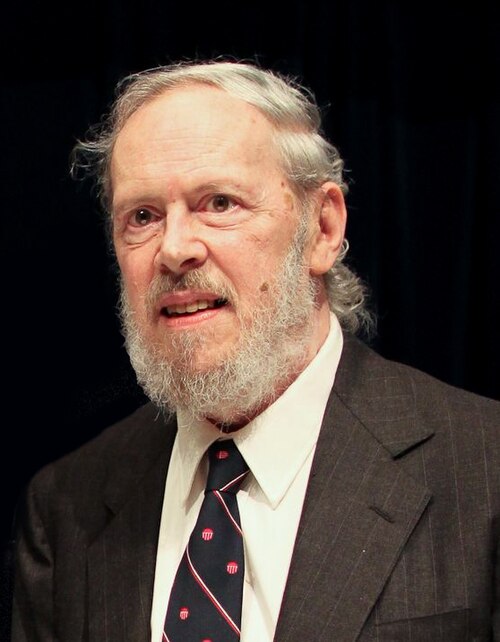
Photograph of Dennis Ritchie Denise Panyik-Dale · CC BY 2.0

Dennis Ritchie

United States · 1941–2011

Co-created Unix and designed the C programming language at Bell Labs, giving the industry a portable operating system and the language whose syntax most later languages borrowed. He shared the 1983 Turing Award with Ken Thompson; most operating systems running today descend from, or were built with tools descended from, his work.

The story

With Thompson, Ritchie rewrote Unix in C in 1973 so it could move to new hardware instead of being tied to one machine — the decision that let Unix, and everything descended from it, outlive any single computer. He died at home in Berkeley Heights, New Jersey, on October 12, 2011, a death largely overshadowed in the press by Steve Jobs's, a week earlier, even though software built on Ritchie's work ran inside Jobs's own products.

“Build so the work outlives the machine it was built for — portability let Unix's ideas survive fifty years of hardware.”

Turing Award
1983 (with Thompson)
Languages descended from C
C++, Java, C#, JavaScript…
Career at Bell Labs
~40 years
2
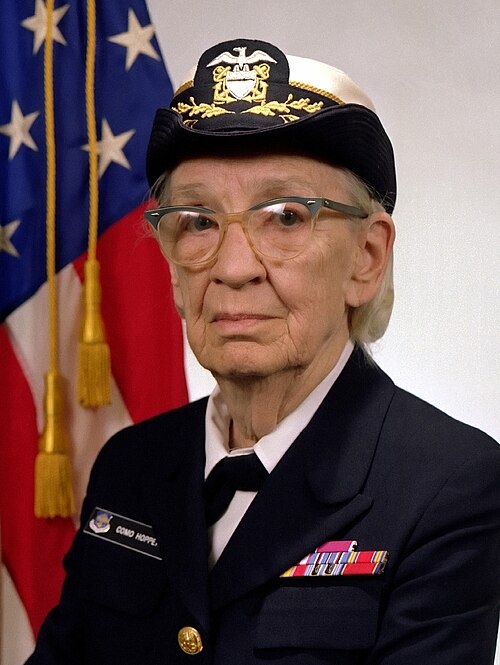
Photograph of Grace Hopper in Navy uniform James S. Davis · Public domain

Grace Hopper

United States · 1906–1992

Mathematician and naval officer who built the first working compiler in 1952, arguing that people should program in something closer to English rather than raw machine instructions. That argument led directly to COBOL, a language still running inside banks, airlines and governments seven decades later.

The story

Rejected by the Navy for active duty for being underweight, Hopper joined the Naval Reserve in 1943 and was later assigned to program the Harvard Mark I. In September 1947, her Mark II team taped a moth that had jammed a relay into their logbook, noting the "first actual case of bug being found" — Hopper did not coin the word 'bug', but she told the story for decades until it became the field's founding legend.

“Make the machine speak the programmer's language, not only the other way around.”

Naval career
43 years, Rear Admiral
Age at retirement
79, oldest active officer
Presidential Medal of Freedom
2016 (posthumous)
3
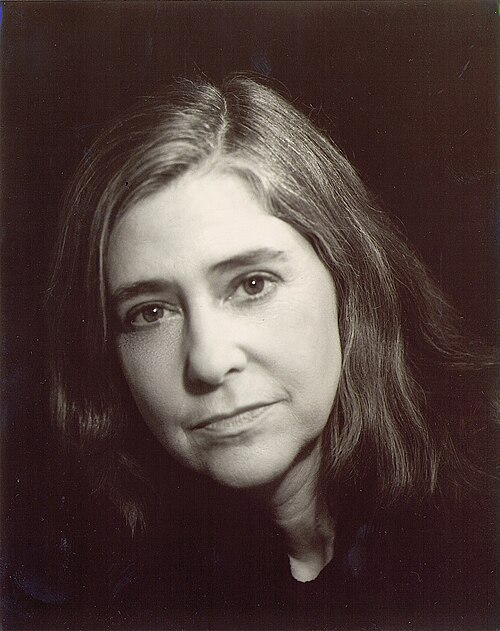
Photograph of Margaret Hamilton standing next to a stack of Apollo software listings Daphne Weld Nichols · CC BY-SA 3.0

Margaret Hamilton

United States · b. 1936

Led the team at MIT's Instrumentation Laboratory that wrote the Apollo program's onboard flight software, and is widely credited with popularizing the term 'software engineering' to argue that code deserved the same rigor and respect as hardware engineering.

The story

During Apollo 11's lunar descent in July 1969, the guidance computer began throwing 1202 and 1201 alarms as a misconfigured radar switch flooded it with extra work. Hamilton's team had built the software to shed low-priority tasks under overload rather than crash, so it kept the landing guidance running; Mission Control, primed by a NASA engineer's handwritten alarm cheat sheet, called "go" instead of aborting.

“Design software to fail gracefully under overload, not only to work when everything goes to plan.”

Presidential Medal of Freedom
2016
Historic mission
Apollo 11 landing, 1969
MIT role
Director, Software Eng. Div.
4
Photograph of Linus Torvalds Krd (photo) Von Sprat (crop/extraction) · CC BY-SA 4.0

Linus Torvalds

Finland / United States · b. 1969

Started the Linux kernel as a Helsinki student's hobby project in 1991 and, fourteen years later, wrote the core of Git in about ten days. Both projects now sit underneath most of the public internet, most of the world's phones, and most professional software teams' daily workflow.

The story

On August 25, 1991, Torvalds posted to the Usenet group comp.os.minix that he was writing "a (free) operating system (just a hobby, won't be big and professional like gnu)". Volunteers around the world began contributing within months. In 2005, after a licensing dispute cut the kernel team off from its existing source-control tool, he wrote Git's core himself in about ten days rather than wait for someone else to build one.

“Working code, shared freely and argued about in the open, beats a closed committee's perfect design.”

Linux kernel started
1991, age 21
Git written in
~10 days, 2005
Devices running Linux-based OS
Billions, incl. all Android
5
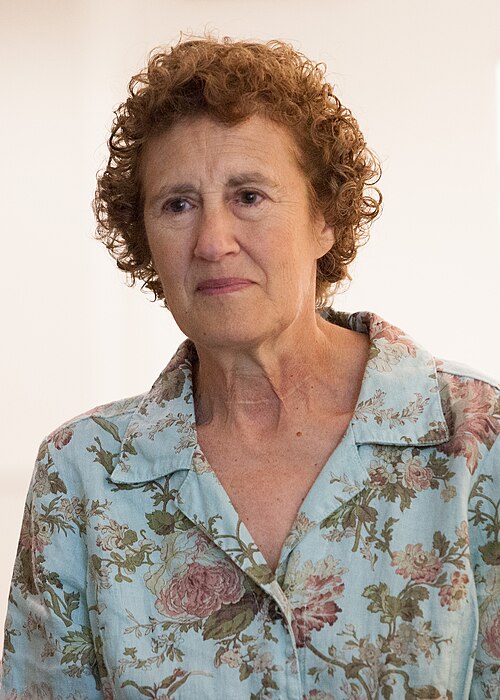
Photograph of Barbara Liskov Kenneth C. Zirkel · CC BY-SA 3.0

Barbara Liskov

United States · b. 1939

Built CLU at MIT in the mid-1970s, one of the first languages with real data abstraction, and later formalised the substitution principle that still governs how engineers design class hierarchies. In 2008 she became only the second woman to win the Turing Award.

The story

Liskov earned her PhD in computer science from Stanford in 1968, one of the first women in the United States to do so. At MIT she led the team that built CLU between 1974 and 1975, introducing abstract data types years before 'object-oriented programming' was a common phrase. In a 1987 conference keynote she stated what became known as the Liskov Substitution Principle, now the 'L' in the SOLID design principles taught to nearly every engineer.

“A subtype must honor every promise its supertype made, or abstraction stops protecting you.”

Turing Award
2008 (2nd woman)
PhD in computer science
1968, Stanford
CLU language built
1974–75, MIT
6
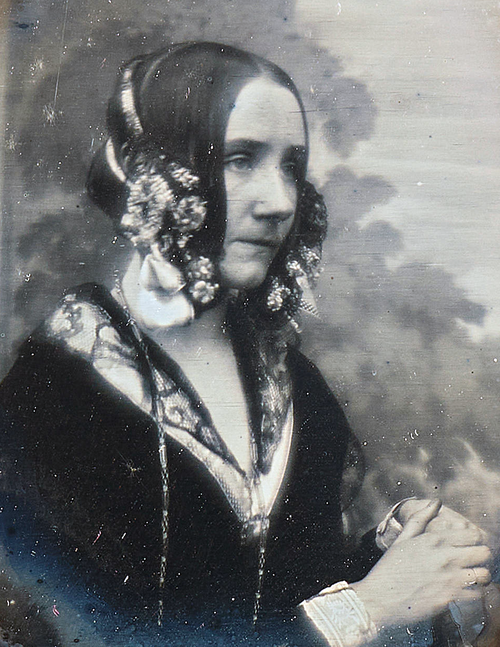
Portrait of Ada Lovelace Antoine Claudet · Public domain

Ada Lovelace

United Kingdom · 1815–1852

In 1843, Lovelace translated and annotated an Italian paper on Charles Babbage's unbuilt Analytical Engine, and in her longest note wrote out, step by step, how the machine could compute a sequence of numbers — a working program written for a computer that did not yet exist.

The story

Lovelace's Note G, the longest of seven notes accompanying her translation of Luigi Menabrea's paper, laid out the Analytical Engine's operation cards to compute Bernoulli numbers, and she caught and corrected an error in the calculation before publication. She died of cancer in 1852 at 36, decades before anyone built a machine that could run what she had written; the programming language Ada, adopted by the US Department of Defense in 1980, was named for her.

“A program can be designed and debugged before the machine to run it even exists.”

Notes published
1843
Age at death
36
Language named for her
Ada, 1980, US DoD
7

Frances Allen

United States · 1932–2020

Spent nearly her whole career at IBM Research turning the literal, inefficient code a compiler first produces into the fast programs engineers actually ship, laying the mathematical groundwork for modern optimizing and parallelizing compilers. In 2006 she became the first woman to win the Turing Award.

The story

Allen grew up on a dairy farm in Peru, New York, without electricity or plumbing, and joined IBM in 1957 mainly to pay off her college debt from teaching. Her 1966 paper 'Program Optimization' introduced graph-based techniques for analysing code that are still taught in compiler courses. She later led PTRAN, a project that taught compilers to find hidden parallelism in old Fortran programs automatically, and became IBM's first female Fellow in 1989.

“The program a person writes and the program the machine should run are different problems; solve both.”

Turing Award
2006 (1st woman)
IBM Fellow
1989 (1st woman)
Career at IBM Research
~45 years
8

Yukihiro Matsumoto

Japan · b. 1965

Designed the Ruby programming language starting in 1993 around one explicit goal — programmer happiness rather than machine efficiency — and watched it become the engine behind early Twitter, GitHub and Shopify, and the wider Rails-era wave of startups it helped launch.

The story

Matsumoto began sketching Ruby on paper in February 1993, blending pieces of Perl, Smalltalk, Eiffel, Lisp and Ada, and released it publicly in 1995. He has said his goal was to make programmers happy rather than to optimise for the computer, a philosophy the Ruby community turned into its own motto, "Matz is nice, and so we are nice" — a rule about how contributors should treat each other, not just how the language should behave.

“Design tools for how people feel using them, not only for what they let a machine compute.”

Ruby's first public release
1995
Years designing Ruby
Since 1993
Role
Chief Designer, Ruby

Bars are scaled to the leader in this list.

Comparison Lab

Toggle names on and off — every bar rescales to the leader of your selection.

5 / 8

The argument

Whether the 1968 NATO conference 'coined' the term software engineering is disputed: Margaret Hamilton and others say versions of the phrase were already circulating informally in engineering circles before Garmisch, and that the conference popularized rather than invented it.

The naming and credit around Linux draws its own long-running argument: Richard Stallman and the Free Software Foundation argue the operating system should be called 'GNU/Linux', since so much of the surrounding toolchain came from the GNU project that predated Torvalds's kernel.

Keep exploring

More in Engineering & Technology