🔌Origins & Evolution

Semiconductor Engineer · Designs and fabricates the transistors inside every computer, phone and weapon, using machines precise enough that only a few factories on Earth can run them.

Semiconductor engineering runs through a Bell Labs demonstration nobody outside a small lab noticed at the time, a patent fight over who really invented the integrated circuit, a magazine article that an entire industry decided to treat as an instruction rather than an observation, and a Taiwanese executive who restructured the whole business around a single idea: a factory that never competes with its own customers.

It is also a history that keeps getting rewritten by geography. The same technology has repeatedly concentrated in a small number of places — Bell Labs, Silicon Valley, Hsinchu, Veldhoven — and each concentration has become a strategic fact that governments, not just companies, now plan around.

Where it began

December 16, 1947Murray Hill, New Jersey, US

At Bell Telephone Laboratories, physicists John Bardeen and Walter Brattain demonstrate a working point-contact transistor, amplifying an electrical signal using a sliver of germanium and two gold contacts instead of a bulky, power-hungry vacuum tube. Their colleague William Shockley, unhappy at being left out of the initial demonstration, develops a more practical junction-transistor design within weeks; the three share the 1956 Nobel Prize in Physics. Bell Labs delays public announcement until June 1948, and it takes years before anyone fully grasps that this small lab bench had just replaced the vacuum tube as the basis of modern electronics.

Timeline

1947The first transistor is demonstrated at Bell Labs

John Bardeen and Walter Brattain demonstrate a working point-contact transistor on December 16; William Shockley's junction-transistor design follows within weeks, and all three later share the 1956 Nobel Prize in Physics.

1954The first commercial silicon transistor ships

Texas Instruments chemist Gordon Teal grows the first practical silicon transistor, replacing the germanium used until then; silicon's ability to handle far higher temperatures makes it the material the entire industry standardizes on.

1958–1959Kilby and Noyce independently invent the integrated circuit

Jack Kilby at Texas Instruments demonstrates a working circuit on a single sliver of germanium in September 1958; Robert Noyce at Fairchild Semiconductor files a rival patent in 1959 for a manufacturable silicon version, triggering a decade-long legal fight over credit.

1965Gordon Moore publishes what becomes Moore's Law

In a magazine article for Electronics, Moore extrapolates from just five data points that the number of components on a chip is doubling roughly every year — a forecast the industry turns into a self-fulfilling roadmap.

1968Noyce and Moore found Intel

Leaving Fairchild Semiconductor, Robert Noyce and Gordon Moore found Intel, soon joined by Andy Grove as employee number three; the company becomes the dominant maker of memory chips and later microprocessors.

1971Intel ships the 4004, the first single-chip microprocessor

Federico Faggin leads the design and layout, applying the silicon-gate process he developed at Fairchild, while Ted Hoff, Stanley Mazor and Masatoshi Shima shape the architecture; an entire computer's logic now fits on one chip.

1980Mead and Conway publish 'Introduction to VLSI Systems'

Carver Mead and Lynn Conway's textbook turns chip design into a structured, teachable methodology; the MOSIS shuttle service, launched the following year, lets universities fabricate students' own chip designs for the first time.

1987Morris Chang founds TSMC and the foundry model

After 25 years at Texas Instruments, Chang founds Taiwan Semiconductor Manufacturing Company in Hsinchu, funded partly by Taiwan's government and a technology-licensing deal with the Dutch firm Philips — a fab that manufactures chips for others but designs none of its own.

2019EUV lithography enters high-volume chip production

TSMC and Samsung begin using extreme ultraviolet lithography scanners built exclusively by the Dutch company ASML in high-volume manufacturing, the first fundamentally new patterning wavelength the industry has adopted in over two decades.

2022The US CHIPS Act and export controls reshape the industry

The United States signs the CHIPS and Science Act, allocating $52.7 billion for domestic chip manufacturing and research, then in October restricts exports of advanced chips and chipmaking equipment to China — opening an explicitly geopolitical era for the profession.

The eras

1947–1959

From vacuum tubes to point contacts to planar silicon

The decade after Bardeen and Brattain's demonstration was spent making transistors reliable and manufacturable rather than merely possible. Early point-contact devices were fragile and inconsistent; Shockley's junction transistor and then Gordon Teal's silicon version at Texas Instruments made the technology rugged enough for real products, starting with hearing aids and pocket radios. By the decade's end, Jack Kilby and Robert Noyce had each shown that an entire circuit, not just one transistor, could exist on a single piece of semiconductor — the idea that made everything after this era possible.
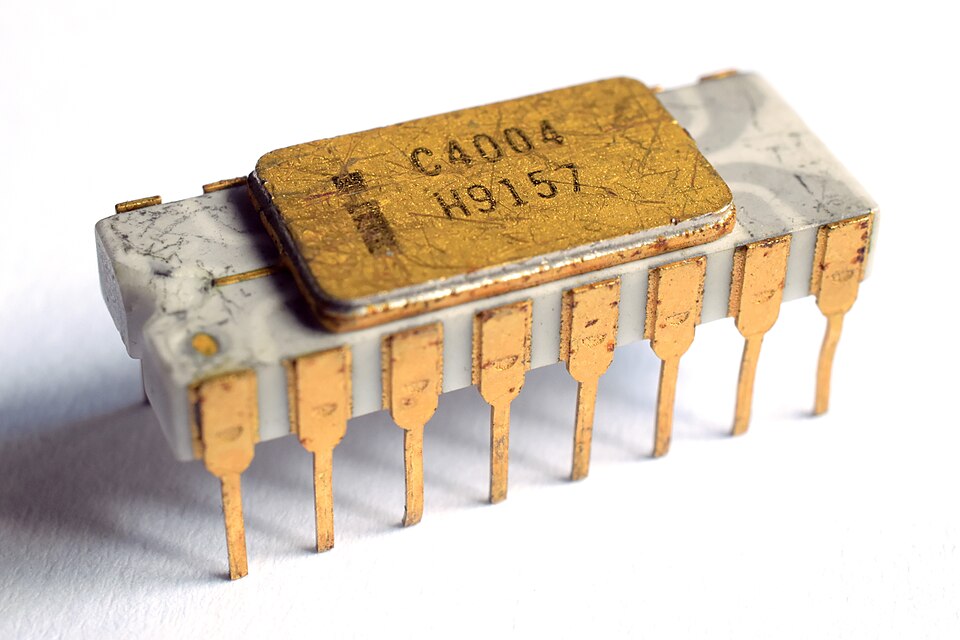

Die of the Intel 4004, the first commercial single-chip microprocessor
Thomas Nguyen · CC BY-SA 4.0 · Wikimedia Commons
1965–1975

Moore's Law and the birth of the microprocessor

Gordon Moore's 1965 forecast turned a decade of dramatic improvement into an explicit industry target, and companies began planning years of factory investment around hitting it. Intel, founded in 1968, built its early business on memory chips before Federico Faggin's team folded an entire computer's logic onto the single Intel 4004 chip in 1971. The idea that a whole processor could sit on one piece of silicon, rather than a circuit board full of separate chips, reset what a computer could be and how small it could get.

TSMC's Fab 12 advanced wafer fabrication complex in Hsinchu, Taiwan
曾 成訓 · CC BY 2.0 · Wikimedia Commons
1978–1990

The design revolution and the foundry split

As chips grew too complex for any one engineer to lay out by hand, Carver Mead and Lynn Conway's 1980 textbook turned chip design into a structured discipline that could be taught and automated, and the MOSIS shuttle let university students fabricate real silicon for the first time. That same complexity made owning a fab prohibitively expensive for smaller design teams. Morris Chang answered the split in 1987 by founding TSMC purely as a manufacturer, never competing with the design companies that became its customers — a structural idea that eventually reorganized the entire industry.

Photolithography equipment used to pattern circuits onto a silicon wafer
Rob Bulmahn · CC BY 2.0 · Wikimedia Commons
1991–2010

Global scaling and the lithography race

Through the 1990s and 2000s, chipmakers pushed transistor sizes down through generation after generation, adopting copper interconnects, immersion lithography and ever more exotic materials to keep pace with Moore's Law. Japan's memory-chip dominance of the 1980s gave way to South Korea's Samsung and, later, to a broader Asian manufacturing base. Deep-ultraviolet lithography scanners, built almost exclusively by the Dutch company ASML and Japan's Nikon and Canon, became the industry's most consequential bottleneck: only a handful of companies on Earth could build a tool precise enough to keep the scaling going.

An ASML extreme ultraviolet lithography machine used to manufacture advanced chips
A ansems · Public domain · Wikimedia Commons
2011–present

EUV, the AI chip boom and chip geopolitics

ASML's extreme ultraviolet lithography machines, decades and tens of billions of dollars in development, finally entered high-volume production in 2019, letting TSMC and Samsung keep shrinking transistors past the limits of older light sources. Nvidia's graphics chips, repurposed for training artificial-intelligence models, turned chip demand into a strategic national priority almost overnight. Export controls, the US CHIPS Act and similar subsidy programs in the European Union, Japan and South Korea have since turned where a chip is designed, made and sold into an explicitly political question.

What this job replaced

Neighbouring trades that no longer exist — absorbed, automated or regulated away.

Vacuum-tube engineer

1900s–1950s

Before the transistor, radios, early computers and telephone amplifiers all depended on engineers skilled at designing around fragile, power-hungry, heat-generating vacuum tubes. Within about a decade of Bell Labs' 1947 demonstration, the transistor made most of that specialized knowledge obsolete, and vacuum-tube design largely survived only in guitar amplifiers and a few legacy military systems.

Rubylith mask cutter

1960s–1980s

Before computer-aided design tools existed, chip layouts were hand-drawn at huge scale and cut from sheets of red-and-clear Rubylith film on precision cutting tables, then photographically reduced onto the masks used to pattern a wafer. The Mead–Conway design methodology and digital layout software of the 1980s eliminated the physical cutting step almost entirely.

Germanium transistor specialist

1948–1960s

The earliest transistors, and the engineers who understood how to manufacture them reliably, were built around germanium rather than silicon. Once Gordon Teal's silicon transistor proved far more heat-tolerant at Texas Instruments in 1954, germanium expertise stopped being a viable specialty within about a decade, as the whole industry re-tooled around silicon.

Trades that vanished →

Every turn in this history follows the same shape: a lab result becomes a manufacturable product, the product becomes a target the whole industry organizes itself around hitting, and the place that can hit that target best becomes strategically irreplaceable for a while — until the target changes again.

The current turn, built around extreme ultraviolet lithography and artificial-intelligence chips, is the first one where governments are shaping the outcome as deliberately as the engineers are.

Keep exploring

More in Engineering & Technology