🦾Origins & Evolution

Robotics Engineer · Designs the machines that sense, decide and act in the physical world, where the hard problem was never intelligence but the world itself.

Robotics engineering is a young profession, built almost entirely within living memory. Its founding idea is a 1920s stage play about manufactured workers who revolt against their makers; its founding product is a 1961 factory arm that lifted hot metal die-castings so a human worker wouldn't have to. Within a single working lifetime, the field went from a name borrowed from Czech fiction to machines walking through disaster zones and assisting brain surgery.

Two threads run through the history below: American invention followed by Japanese industrialization, and a recurring argument over how much intelligence a robot actually needs internally versus how much it can simply react to what its sensors tell it, moment to moment. Both threads are still live in the robots being designed today.

Where it began

1961Ewing Township, New Jersey, United States

George Devol's Unimate #001, built by his and Joseph Engelberger's company Unimation, is installed at a General Motors die-casting plant to lift red-hot metal parts fresh from the mold and stack them — a job too hot and repetitive for a line worker to do safely for a full shift. It is the first robot to work an industrial job anywhere, run by a program stored on a magnetic drum rather than dedicated wiring: the moment 'robotics engineer' became a job description rather than a science-fiction premise.

Timeline

1921Čapek's R.U.R. coins 'robot'

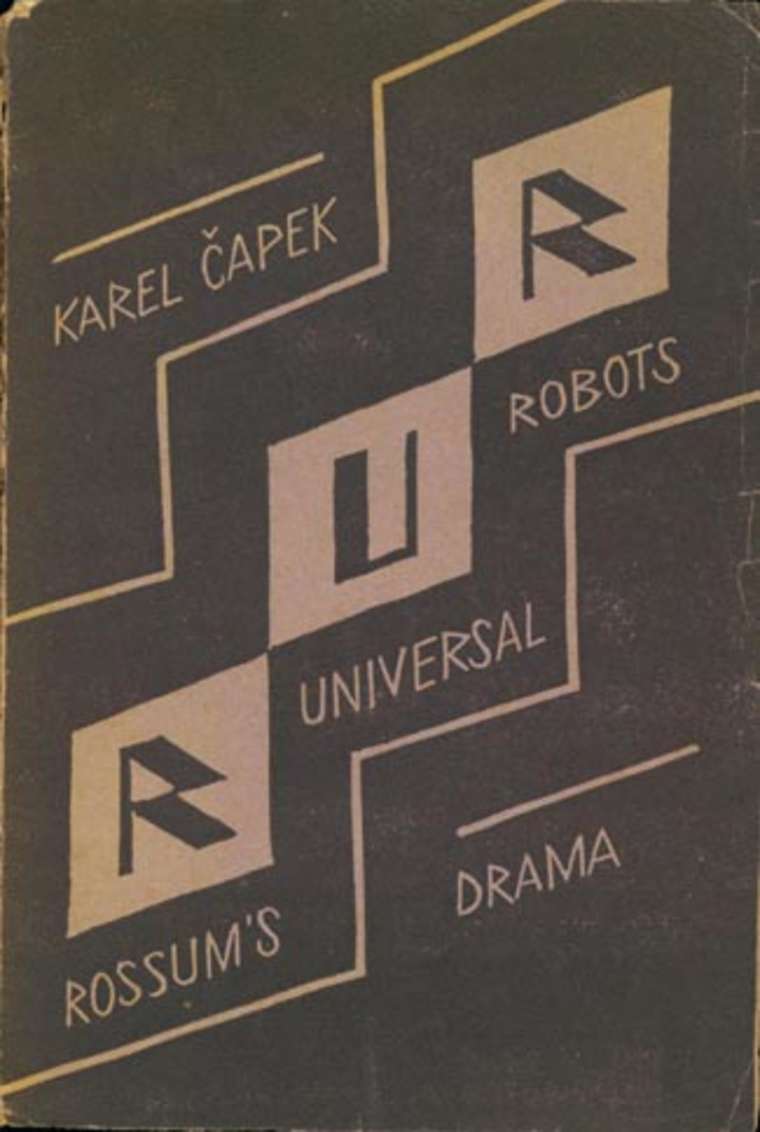
Karel Čapek's play Rossum's Universal Robots premieres in Prague on January 25, 1921, introducing the word 'robot' — coined by his brother, painter Josef Čapek — from the Czech 'robota,' meaning forced labor.

1954Devol patents the programmable manipulator

George Devol files a patent for 'Programmed Article Transfer,' describing a reprogrammable robotic arm controlled by stored instructions — the concept behind Unimate, granted in 1961.

1961Unimate goes to work at General Motors

The first Unimate, built by Devol and Joseph Engelberger's company Unimation, is installed at a GM die-casting plant in New Jersey, lifting and stacking hot metal parts — the first industrial robot on a production line.

1969The Stanford Arm is built for computer control

Victor Scheinman designs the Stanford Arm at Stanford University's AI Lab, the first robot arm built specifically for computer control rather than adapted from industrial machinery.

1973WABOT-1, the first full-scale humanoid

Ichiro Kato's laboratory at Waseda University in Tokyo completes WABOT-1, the first full-scale humanoid robot, able to walk, grip objects with tactile sensors and hold a simple conversation in Japanese.

1978The PUMA arm sets the industry template

Unimation launches the PUMA arm, developed with General Motors and drawing on Scheinman's design, becoming a standard research and light-assembly platform used worldwide for two decades.

1985The first robot-assisted surgery

Surgeons in Long Beach, California, use a modified PUMA 200 industrial arm to precisely orient a needle for a CT-guided brain biopsy — the first recorded use of a robot in an operating room.

1986Brooks publishes subsumption architecture

Rodney Brooks publishes his subsumption-architecture paper at MIT, arguing that robots need no internal world model to act — layered, reactive behaviors wired directly to sensors are enough — challenging symbolic AI planning.

2000The da Vinci surgical robot is cleared

The FDA clears Intuitive Surgical's da Vinci Surgical System for general laparoscopic procedures, launching the first widely adopted surgical robotics platform.

2012Amazon buys Kiva Systems for $775 million

Amazon acquires warehouse-robotics maker Kiva Systems and rolls its mobile shelf-carrying robots out across its fulfillment centers, later renamed Amazon Robotics — the moment warehouse robotics went mainstream.

The eras

A scene from a stage production of R.U.R., the 1921 play that introduced the word robot
Unknown author Unknown author · Public domain · Wikimedia Commons
1920–1960

Robots on paper, in fiction and in patents

For four decades, 'robot' existed mostly as an idea. Karel Čapek's 1921 play imagined manufactured workers rebelling against their makers; Isaac Asimov's Three Laws of Robotics, introduced in his 1942 story 'Runaround,' gave the fictional idea an ethical framework decades before any machine needed one. The real engineering groundwork was quieter: numerically controlled machine tools in the early 1950s proved a machine could follow a stored program instead of a human operator's hand, and George Devol's 1954 patent for a reprogrammable mechanical arm turned that idea toward general-purpose manipulation for the first time.
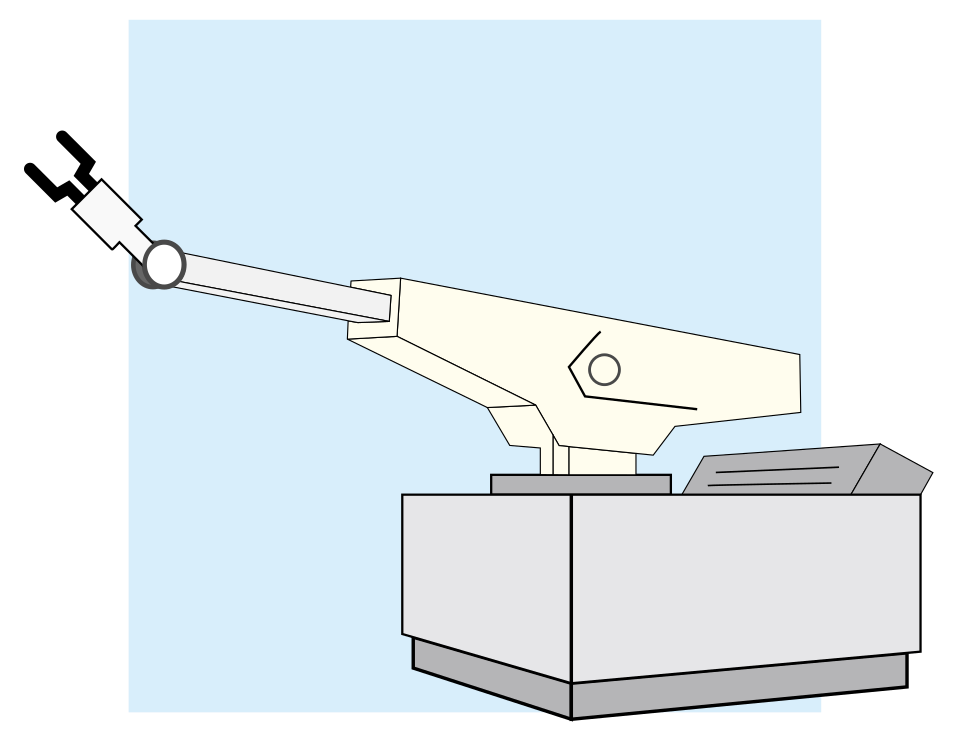
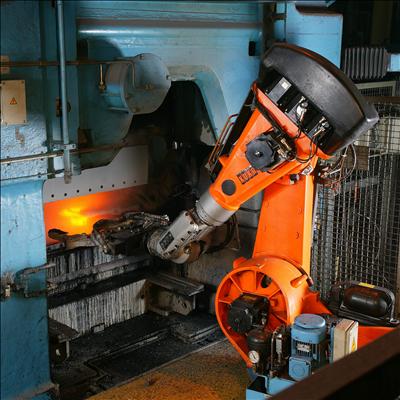
A Unimate industrial robot arm on an early factory production line
EBatlleP · CC BY-SA 4.0 · Wikimedia Commons
1961–1980

The industrial arm reaches the factory floor

Unimation's Unimate went to work at General Motors in 1961, and by the late 1960s the idea had crossed the Pacific: Kawasaki licensed Unimate's design in 1968 and began building robots in Japan, which went on to industrialize the technology faster and more thoroughly than the country that invented it. Victor Scheinman's Stanford Arm (1969) and the PUMA arm that grew out of it (1978) shifted robot-arm design from adapted industrial hardware toward machines purpose-built for computer control, setting the template research labs and factories used for the next two decades.

Industrial robot arms welding car bodies on an automotive assembly line
KUKA Roboter GmbH, Bachmann · Public domain · Wikimedia Commons
1980–1995

Japan's robot economy and a rebellion in the labs

Through the 1980s, Japan built and installed more industrial robots than the rest of the world combined, with Fanuc, Yaskawa and Kawasaki turning automotive and electronics manufacturing into the field's largest employer. At the same time, an academic reaction was brewing against ambitious, internally modeled 'thinking' robots that mostly failed to leave the lab: Rodney Brooks's 1986 subsumption-architecture papers argued that simple, reactive behavior wired straight to sensors could navigate the real world better than a robot reasoning over a symbolic map of it, a debate that reshaped mobile-robot design through the following decade.

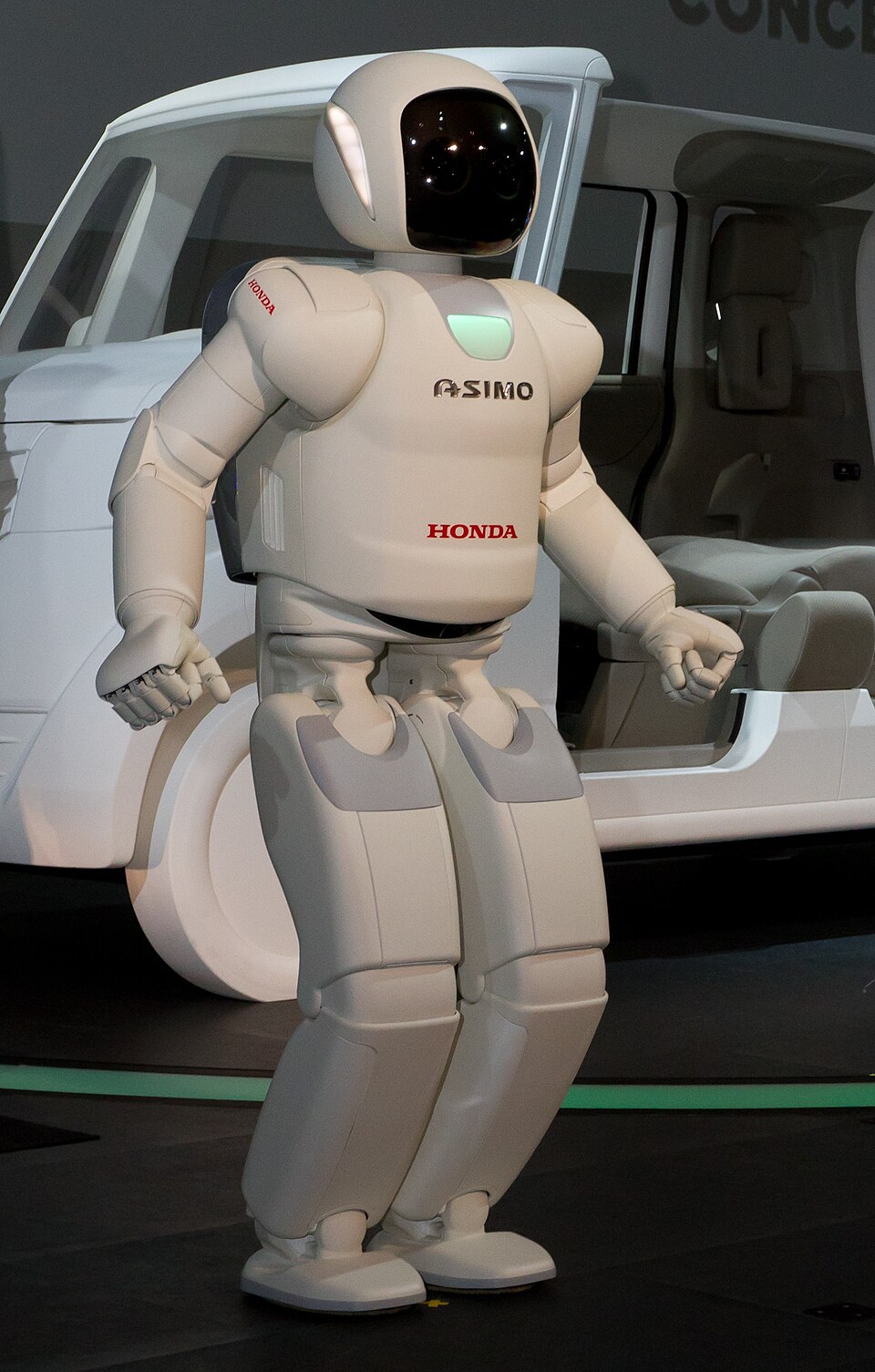
Honda's ASIMO humanoid robot on display
Morio · CC BY-SA 3.0 · Wikimedia Commons
1995–2010

Robots leave the factory floor

Robots spent this era escaping the fenced-off factory cell. Honda's ASIMO humanoid, unveiled in 2000, could walk and climb stairs; iRobot's Roomba, launched in 2002, put an autonomous robot in millions of ordinary homes; and the same company's rugged PackBot, built for bomb disposal, was deployed to Iraq and Afghanistan from 2002 and later sent into Fukushima's damaged reactor buildings in 2011 to measure radiation too dangerous for people. In medicine, the FDA cleared Intuitive Surgical's da Vinci system for general laparoscopic surgery in 2000, opening a new specialty inside the profession entirely.

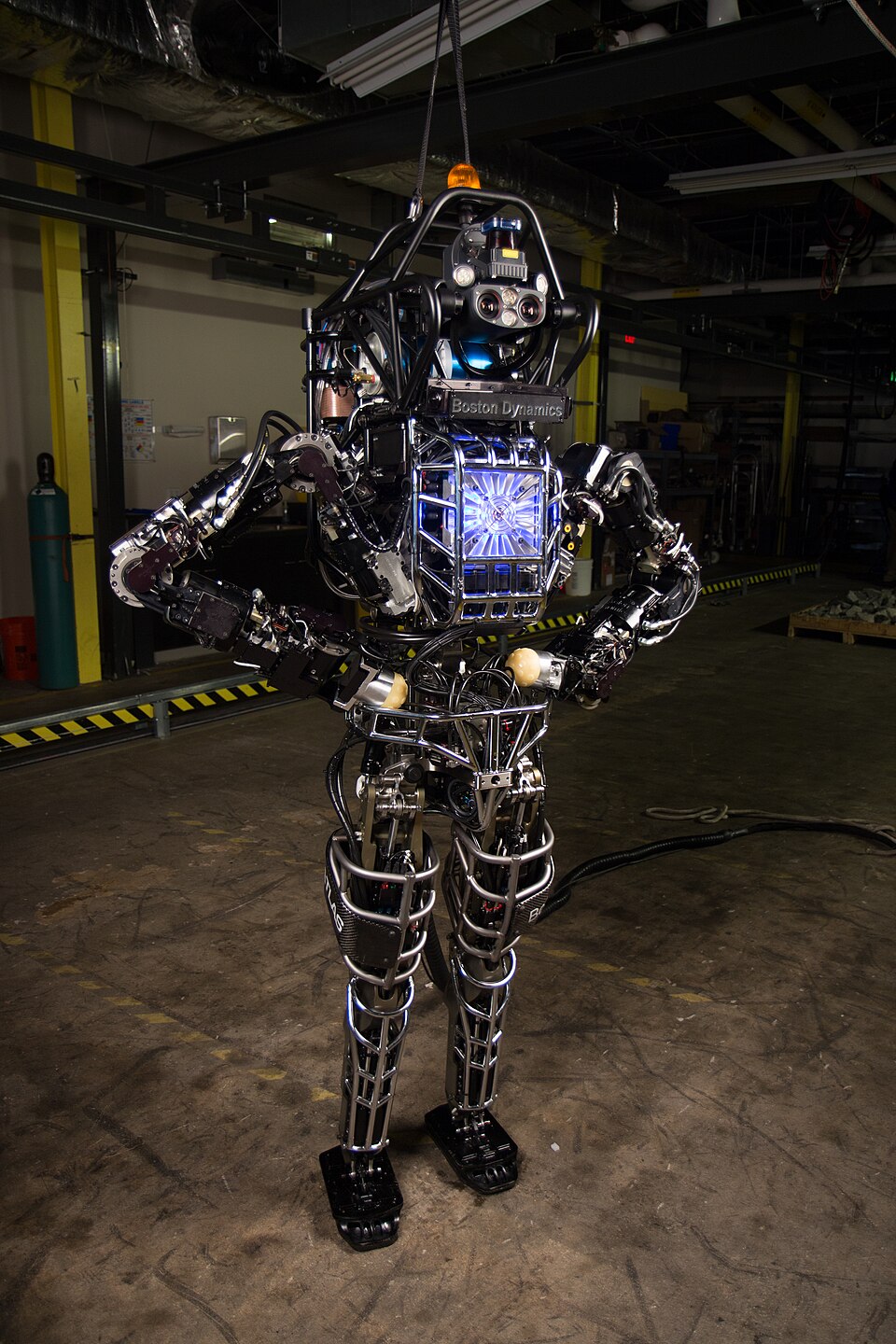
Boston Dynamics' Atlas robot performing a dynamic maneuver
DARPA · Public domain · Wikimedia Commons
2010–present

Legs, warehouses and learning machines

Boston Dynamics' dynamically balancing BigDog (2005) and Atlas (2013 onward) turned legged locomotion from a lab curiosity into viral video material, while Amazon's 2012 acquisition of Kiva Systems, later renamed Amazon Robotics, made mobile warehouse robots a standard part of logistics rather than a novelty. Machine learning reshaped perception and, increasingly, control itself, letting robots learn to grasp unfamiliar objects from training data instead of hand-coded rules. By the early 2020s, a wave of well-funded humanoid-robot startups — Figure, Agility Robotics and Tesla's Optimus program among them — bet that a general-purpose walking, gripping robot, not another single-task arm, was the field's next major product.

What this job replaced

Neighbouring trades that no longer exist — absorbed, automated or regulated away.

Teach-pendant lead-through programmer

1960s–1990s

Early industrial robots like Unimate were programmed by a specialist who physically grabbed the arm and walked it through the exact motions a job required, recording the path onto a magnetic drum for playback. CAD-linked offline programming and simulation software, standard by the 1990s, moved that work from the factory floor onto a screen.

NC tape programmer

1950s–1980s

Early numerically controlled machine tools, direct ancestors of robotic motion control, were programmed by punching instructions onto rolls of paper tape, a slow process specialists trained in for years. Computer-aided manufacturing software from the 1970s and 1980s let engineers generate machine code straight from a CAD model, and the tape punch disappeared from machine shops.

Jig-and-fixture maker

1900s–1980s

Factories once employed toolmakers who hand-built custom metal jigs and fixtures to hold every part in exact position for assembly, since neither a human nor an early machine could reliably locate a part on its own. Vision-guided robotic grippers, widespread by the 1980s, let robots find and grasp parts directly, and the bespoke fixture-building trade shrank into a specialty rather than a factory-wide necessity.

Trades that vanished →

Nearly every leap in this history follows the same two-step pattern: an idea proven in a lab or a patent office, then scaled by whichever country built the industrial capacity to manufacture it cheaply and reliably — the United States invented the industrial robot, and Japan made it ordinary.

The 2020s humanoid-robot boom is the latest attempt to repeat that pattern with a genuinely general-purpose machine rather than another single-task arm, and it remains an open bet: robotics has been described as a decade away from a general-purpose robot for several decades running.

Keep exploring

More in Engineering & Technology