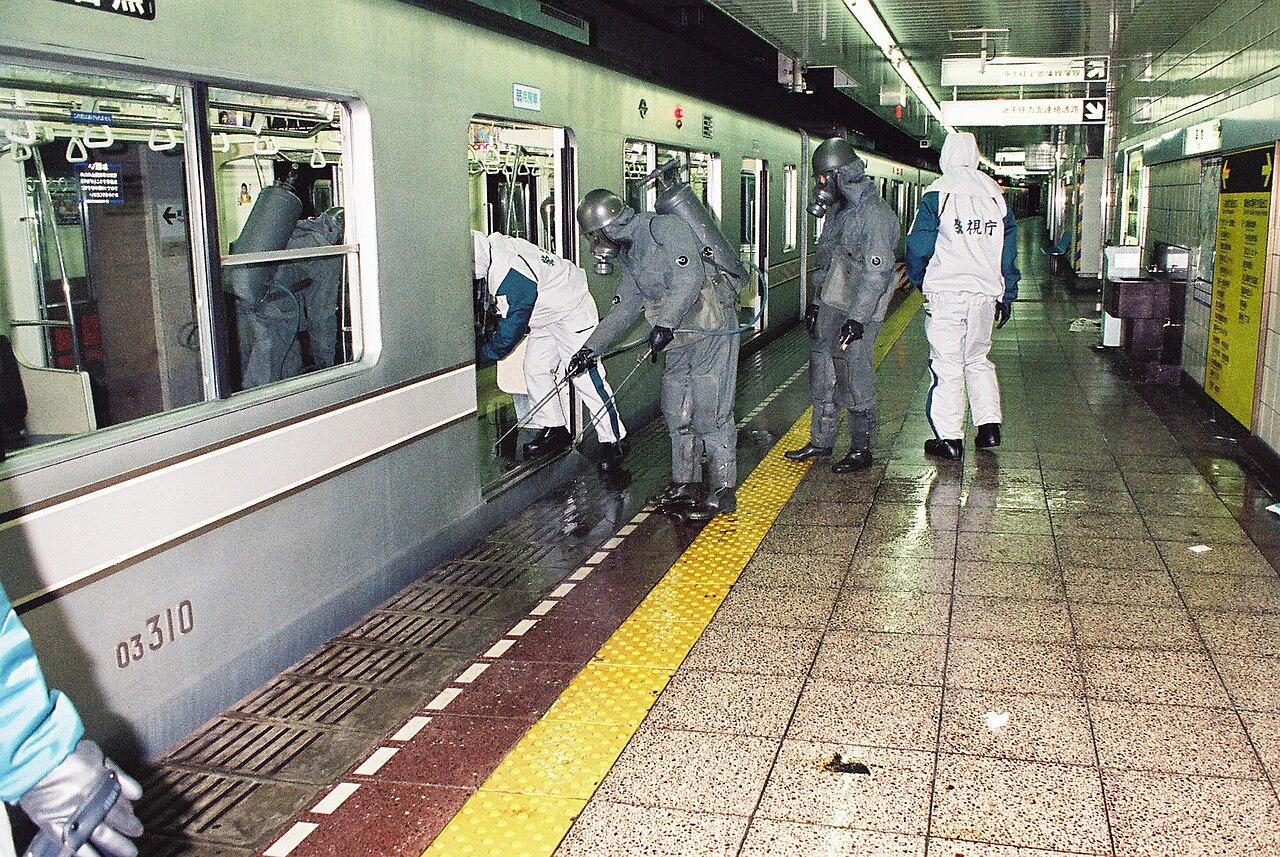
On 20 March 1995 members of Aum Shinrikyo released sarin on Tokyo subway trains, killing 13 people; the investigation and trials remade Japanese security law.
Also called: Aum Shinrikyo 1995 · 20 March 1995
At a glance
Score intensity
Darker cells mean a higher score for this topic on that metric.
Notoriety90
Mystery18
Scale85
Evidence88
Legal impact86
Culture80
LessMore
Score profile
Each bar is a 0-100 atlas score for this topic, not a timeline.
Notoriety90
Mystery18
Scale85
Evidence88
Legal impact86
Culture80
Evidence
Evidence
88%
Score profile
Mystery
18%
Timeline
Milestones in order. This is history, not a weekly activity grid.
On the morning of 20 March 1995, members of the new religious movement Aum Shinrikyo released the nerve agent sarin on five Tokyo subway trains converging on the Kasumigaseki government district. Tokyo Metropolitan Police later treated 13 deaths as official after a 2008 compensation survey added one fatality to the first count of 12; a 14th death was recorded in 2020. Several thousand people sought treatment — figures of about 5,500 to 6,300 appear in police and later surveys. This page does not describe injuries or how the agent was made or released.
The attack was a criminal and terrorism investigation, not a war. Police had already been moving toward Aum after the June 1994 Matsumoto sarin case (eight dead) and earlier crimes, including the 1989 murder of lawyer Tsutsumi Sakamoto and his family. Asahara Shoko, born Matsumoto Chizuo, was arrested on 16 May 1995. He was sentenced to death in 2004; the sentence became final in 2006. He and other Aum convicts were executed beginning on 6 July 2018.
Legal aftermath included revocation of Aum’s religious-corporation status, a 1995 revision of the Religious Corporations Act, and the 1999 Act on the Control of Organizations Which Have Committed Acts of Indiscriminate Mass Murder. Successor groups remain under public-security watch. English-language memory framed Aum as a “doomsday cult” that ended Japan’s reputation for public safety.
Date20 Mar 1995
Deaths13 official (2008)
GroupAum Shinrikyo
SystemTokyo Metro
LeaderAsahara exec. 2018
StatusConvicted
Dossier scores
Notoriety 90
Mystery 18
Scale 85
Evidence 88
Legal impact 86
Culture 80
Notoriety
90
Mystery
18
Scale
85
Evidence
88
Legal impact
86
Culture
80
A subway crime and a long trial
Tokyo 20 March 1995 is the type investigation in which arrests, chemistry identifications and a decade of trials left almost no mystery — and still remade how Japan watches religious corporations.
What the public record says happened
Five coordinated releases occurred on Teito Rapid Transit Authority (now Tokyo Metro) lines during the Monday rush, aimed at trains passing Kasumigaseki, the ministry quarter. Station staff and passengers were among the dead. Hospitals treated thousands for exposure. The page stops at that public sequence.
Sarin had already been used in Matsumoto on 27 June 1994. That prior case, once it was linked, showed Aum as a group willing to use a banned chemical agent against a domestic population. The subway attack is therefore the second dated sarin crime in the file, not an isolated experiment.
From raid to arrest
Police raided Aum facilities from 22 March 1995, including the Kamikuishiki complex in Yamanashi. They arrested more than 200 members over the following months. Asahara was found at Kamikuishiki on 16 May. Seized materials and later confessions built a trial record that English reporters summarised as a “cult laboratory” without needing a recipe.
Investigators also reopened the Sakamoto family murders of November 1989 and other Aum crimes. The subway case became the centre of a wider criminal enterprise file: prior killings, the Matsumoto attack, and the 20 March operation ordered as police pressure closed in.
Trials that lasted a generation
Japanese courts sentenced Asahara to death in February 2004 on thirteen counts including the subway attack. The Supreme Court rejected his final appeal in 2006. Other senior members received death or life terms. About 190 Aum members were convicted in related cases; thirteen death sentences were eventually carried out in July 2018 after the last related appeal ended.
Aum’s religious-corporation status was stripped in 1995. The group later rebranded as Aleph; splinters appeared. The 1999 organisations-control law created a surveillance regime short of a blanket ban. Public Security Intelligence Agency reporting on successor bodies is part of the living file.
Law after a peacetime chemical attack
The Religious Corporations Act was amended in December 1995 to strengthen official scrutiny of religious juridical persons. Separate chemical-weapons and anti-terrorism adjustments followed in Japanese statute through the late 1990s. The 1999 control act is the specific organisational tool aimed at Aum’s remaining structures.
Victim compensation and medical follow-up produced the 2008 survey that raised the official dead from 12 to 13. English memory rarely mentions that survey; it still prints “12 dead” from 1995 wires. Dated official figures matter here as much as in a disaster file.
Beat weight marks
Mark each timeline beat already on this dossier as supported, contested or unknown, using the public-record claims already filed here. Not a verdict.
Editorial marks on this device only. Public-record encyclopedia — not legal advice, not a how-to, not a private file.
Timeline beat
Supported / Contested / Unknown
1984–89 — Aum founded and expands
Claim already on file: The perpetrators were never identified.
Nov 1989 — Sakamoto family murders
Claim already on file: The attack was an act of war by a foreign state.
27 Jun 1994 — Matsumoto sarin
Claim already on file: Exactly twelve people died, full stop.
20 Mar 1995 — Tokyo subway attack
Claim already on file: Aum appeared from nowhere on 20 March.
22 Mar 1995 — Nationwide raids
Claim already on file: Aum appeared from nowhere on 20 March.
16 May 1995 — Asahara arrested
Claim already on file: Aum appeared from nowhere on 20 March.
Dec 1995 — Religious Corporations Act revised
Claim already on file: Aum appeared from nowhere on 20 March.
1999 — Organisations-control law
Claim already on file: Aum appeared from nowhere on 20 March.
2004–06 — Asahara sentenced, appeals end
Claim already on file: Aum appeared from nowhere on 20 March.
6 Jul 2018 — Executions begin
Claim already on file: Aum appeared from nowhere on 20 March.
Aum Shinrikyo members released sarin on five Tokyo subway trains during the morning rush toward Kasumigaseki. Thirteen people were later counted as official dead (twelve at first; one added after a 2008 survey). Thousands sought medical care. This page does not describe the release method.
Who was convicted?
Asahara Shoko (Matsumoto Chizuo) and a group of senior members were convicted. Asahara’s death sentence became final in 2006; he was executed on 6 July 2018 with other Aum convicts. About 190 members were found guilty in related cases. Status is convicted, not unsolved.
Was this a war?
No. It was a domestic criminal and terrorism case against a civilian transport system. It belongs in an investigations family, not in a wars file.
What was Aum Shinrikyo?
A Japanese new religious movement founded in the 1980s by Matsumoto Chizuo, who took the name Asahara. It mixed Buddhist and Hindu language with apocalyptic teaching and, in its criminal core, organised murders and two sarin attacks. After 2000 the main successor body used the name Aleph.
What was the Matsumoto case?
On 27 June 1994, sarin was used in Matsumoto, Nagano Prefecture, killing eight people. Once linked to Aum, it became the prior chemical crime in the same investigation family as 20 March 1995.
What laws changed?
Aum’s religious-corporation status was revoked. The Religious Corporations Act was revised in 1995. The 1999 Act on the Control of Organizations Which Have Committed Acts of Indiscriminate Mass Murder created ongoing surveillance of successor groups.
When were the executions?
Asahara and six others were executed on 6 July 2018 after Justice Minister Yoko Kamikawa signed the orders. Further Aum executions followed later that month. Thirteen death sentences in the Aum file were carried out.
Is there a mystery left?
Very little about authorship. Open questions are medical aftercare, how successor groups are watched, and how English still says “12 dead” from first-week wires.