Milestones in order. This is history, not a weekly activity grid.
- Mintonette is invented
- The game is renamed volleyball
- A dedicated ball
- The set and spike arrive
- Sets shortened to 15 points
- Three hits and back-row rules
- The USVBA is founded
- FIVB is founded
- First men’s World Championship
- First women’s World Championship
- Olympic debut in Tokyo
- The World Cup begins
- USA men break through
- World League professionalises the men’s game
Last reviewed Sources & creditsMedia creditsMethodology
Quick answers
What are the six positions in volleyball?
There are five specialist roles distributed across six on-court players. The setter (S) runs the offence, delivering the second ball to attackers. Outside hitters (OH), also called left-side hitters, attack from the left and lead serve-receive. The middle blocker (MB) hits quick sets and anchors the block at the net. The opposite (OPP), or right-side hitter, attacks from the right and blocks the opponent's outsides. The libero (L) is a back-row defensive specialist in a contrasting jersey who cannot serve, block or attack above net height. Teams may also use a defensive specialist (DS) who substitutes for weaker back-row passers. A standard 5-1 lineup fields one setter, two outsides, two middles, one opposite, and a libero rotating through the back row.
How does volleyball scoring work?
Modern volleyball uses rally-point scoring: a point is awarded on every rally regardless of which team served. Matches are best-of-five sets. The first four sets are played to 25 points and the deciding fifth set to 15, but a team must always win by a two-point margin, so sets can extend beyond the target - 26-24, 30-28 - until someone leads by two. The first team to win three sets takes the match; there are no draws and no clock. Rally scoring, adopted by FIVB around 1999, replaced the older side-out system in which only the serving team could score, making matches faster and easier to schedule for television.
What is the difference between the 5-1 and 6-2 systems?
Both describe how a team organises its setters. In a 5-1, a single setter runs the offence through all six rotations, giving consistency and one dedicated right-side attacker, the opposite. The drawback is that in three rotations the setter is in the front row, leaving only two front-row hitters. In a 6-2, two setters play opposite each other in the rotation, so whichever is in the back row sets while the front-row setter becomes an attacker - meaning the team always has three front-row hitters and a bigger attack. The cost is losing the rhythm of a single playmaker, and each setter must also attack and serve well. Most elite teams favour the 5-1.
Why can't the libero attack or serve?
The libero is a specialised back-row defender, introduced in 1998 to raise the standard of reception and floor defence, and the rules deliberately confine the role to defence. A libero cannot complete an attack on a ball that is entirely above the height of the net, cannot block or attempt to block, and generally cannot serve, though some competitions permit it in one rotation. If the libero uses an overhand finger-set to feed a hitter while standing on or in front of the attack line, that hitter may not attack the ball above net height. In exchange for these limits, the libero enjoys unlimited substitutions for back-row players and wears a contrasting jersey so officials can track the role easily.
How high is a volleyball net?
For indoor competition the net is set at 2.43 metres for men and 2.24 metres for women, measured at the centre of the court; the two ends may sit fractionally higher but within a small tolerance. The men's height dates to the sport's early standardisation and has remained fixed for generations. Youth, seated and some recreational categories use lower nets. In beach volleyball the same 2.43-metre men's and 2.24-metre women's heights apply. The court itself measures 18 by 9 metres, split into two nine-metre squares by the net, with an attack line three metres from the centre dividing each half into front and back zones.
Who is the greatest volleyball player of all time?
Most experts name Karch Kiraly of the United States, the only player to win Olympic gold both indoors, in 1984 and 1988, and on the sand, in 1996, and the figure FIVB honoured as the best male player of the 20th century. In the women's game the equivalent is Cuba's Regla Torres, a three-time Olympic champion whom FIVB named the best female player of the century. Beyond those two the debate is open, with the likes of Giba, Lorenzo Bernardi, Sergey Tetyukhin, Zhu Ting and Paola Egonu all in the conversation. Because volleyball is a team sport without a single career statistic, any ranking blends titles, longevity and individual dominance.
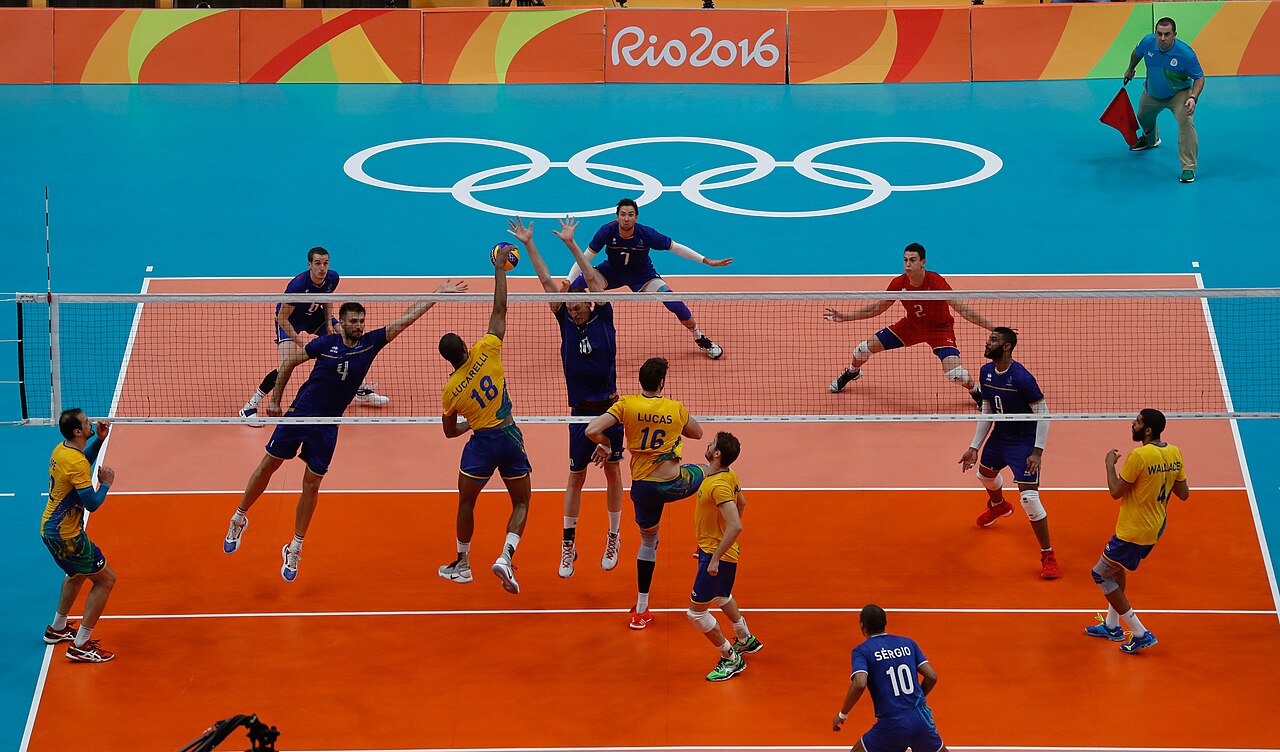
Volleyball was invented deliberately, on a specific afternoon, by a named person - a rarity among major sports. In 1895 William G. Morgan, a YMCA physical director in Holyoke, Massachusetts, wanted a gentler indoor game than the new sport of basketball for older businessmen. He strung a tennis net at 1.98 metres and had them bat an inflated bladder back and forth. Within a year the game had a new name, and within two decades it had crossed the Pacific and gained the set-and-spike that made it an attacking sport.
From those parlour beginnings the game professionalised in waves: Cold War superpowers turned it into a discipline of drilled precision, Americans added the power swing, Italians and Brazilians made it a paying profession, and a 1998 rule revolution rewrote its tempo. Today it is played, by the sport's own count, by hundreds of millions worldwide, with a global calendar of Olympic tournaments, World Championships and a season-long Nations League.
Timeline
William G. Morgan creates the game at the Holyoke, Massachusetts YMCA as a low-impact alternative to basketball, using a tennis net raised to about 1.98 metres.
Professor Alfred Halstead, watching the ball volleyed back and forth in an exhibition at Springfield College, suggests the name 'volley ball'; it sticks.
Spalding designs the first ball made specifically for the sport, replacing the improvised basketball bladders used in the earliest games.
In the Philippines players develop the 'bomba' - setting the ball high for a teammate to attack - turning a genteel rally game into an offensive one.
The scoring target is lowered from 21 to 15 points and the net raised toward its modern height, standardising competitive play.
The three-contacts-per-side rule and restrictions on back-row attacking are codified, establishing the tactical framework still used today.
The United States Volleyball Association forms to govern the American game and runs its first national championships, helping spread standard rules.
Fourteen national federations meet in Paris to create the Federation Internationale de Volleyball, giving the sport a single world governing body.
The inaugural men’s Worlds are held in Prague; the Soviet Union wins, beginning decades of Eastern-bloc dominance.
Moscow hosts the first women’s Worlds, again won by the USSR, as the international women’s game takes formal shape.
Volleyball enters the Olympic programme; Japan's women, the 'Oriental Witches', win gold with their rolling receive, and the USSR men take the title.
FIVB launches the World Cup, later staged in Japan and used for years as a direct Olympic qualifier.
Coach Doug Beal's United States, led by Karch Kiraly, win Olympic gold in Los Angeles, pioneering the swing offence and a power-based American style.
FIVB introduces the World League, a lucrative annual circuit that accelerates professionalism, as Italy's golden generation begins a decade of dominance.
The two-player sand game debuts at the Atlanta Games; Karch Kiraly adds beach gold to his indoor titles.
FIVB adds the defensive libero in a contrasting jersey, transforming back-court defence and serve-receive across the sport.
The side-out system is replaced by rally scoring to 25 points, so every rally yields a point; matches become faster and more television-friendly.
The VNL replaces the men's World League and women's World Grand Prix, creating a unified annual competition for the top national teams.
FIVB launches Volleyball World with investor CVC Capital Partners to grow the sport commercially, and France win their first Olympic title in Tokyo.
Italy win their first Olympic women's volleyball gold in Paris, with Paola Egonu among the tournament's decisive scorers.
The eras
Invention and codification
Volleyball spent its first half-century becoming a real sport. Morgan's 1895 Mintonette was almost a novelty - a soft rally game for men too old or too dignified for basketball - with no limit on hits and a ball batted gently over a low net. The essential ideas arrived piecemeal and internationally. American YMCA missionaries carried the game to Asia within a few years, and it was in the Philippines around 1916 that players invented the set-and-spike, the single innovation that made volleyball an athletic, attacking contest rather than a pastime. Rule-makers gradually imposed structure: fifteen-point sets in 1917, the three-contacts-per-side limit and back-row restrictions by the early 1920s, and standardised net heights. National bodies such as the United States' USVBA, founded in 1928, organised championships and unified the rulebook. By the 1930s the game had strongholds in Eastern Europe, the Soviet Union and East Asia, each developing distinct styles. What was still missing was a global authority to reconcile competing rulebooks and stage true world events - a gap that would define the sport's next phase.
The federation and Eastern-bloc mastery
The founding of FIVB in Paris in 1947 turned a patchwork of national games into a world sport almost overnight. World Championships followed for men in 1949 and women in 1952, and in 1964 volleyball joined the Olympic programme in Tokyo. This era belonged to disciplined, systematised teams. The Soviet Union dominated through sheer depth and drilling, winning multiple world and Olympic titles across both genders. Japan re-imagined training itself: coach Hirofumi Daimatsu drove his women's team - the 'Oriental Witches' - through punishing sessions that produced the rolling receive and rapid, deceptive attacks, culminating in home gold in 1964. The period established volleyball's core tactical vocabulary: quick sets to the middle, structured serve-receive and the beginnings of specialised roles. It was an amateur, state-supported world, largely hidden from Western television, in which national programmes rather than clubs drove the sport forward. The technical foundations laid here - tempo, blocking systems and defensive footwork - would underpin everything that followed, even as the balance of power began to shift westward in the 1980s.
The American power revolution
The 1980s broke the Eastern monopoly and redefined how the men's game was played. Coach Doug Beal's United States team, built around the peerless all-rounder Karch Kiraly alongside Steve Timmons and Dusty Dvorak, won Olympic gold in Los Angeles in 1984 and again in Seoul in 1988, with a 1986 World Championship in between. Their innovation was the swing offence: a relentlessly athletic, power-based approach that treated the spike as the primary weapon and demanded that every player pass, move and jump. On the women's side the decade was defined by China's rise under the 'Iron Hammer', Lang Ping, whose team won the 1984 Olympic title, and by the emergence of Cuban and later Brazilian power. Television began to notice, and the athletic spectacle of the American game - bigger jumps, harder swings, dramatic digs - helped globalise volleyball's appeal beyond its traditional heartlands. The decade also seeded professional ambitions: the best players increasingly sought paid careers abroad, especially in Italy, setting up the fully professional era that the 1990s would deliver.
Professionalism, Italy and Cuba
The 1990s made volleyball a paying profession and produced two of its greatest dynasties. The launch of the FIVB World League in 1990 poured prize money into the men's game, and Italy's Serie A became the richest league on earth, drawing the world's stars. Italy's national team, coached by Julio Velasco and led by Lorenzo Bernardi, Andrea Zorzi and Andrea Gardini, won three consecutive World Championships in 1990, 1994 and 1998 and a string of World League titles - the most dominant men's side of the decade, even though Olympic gold famously eluded them. Among the women, Cuba's 'Morenas del Caribe', spearheaded by the teenage middle blocker Regla Torres, completed a three-peat of Olympic golds in 1992, 1996 and 2000 while adding World titles. The professional structure also accelerated the globalisation of coaching and tactics, as Italian and Brazilian methods spread worldwide. By decade's end the sport was fast, rich and international - and poised for a rule overhaul that would change its very rhythm.
Rule revolution and Brazilian gold
Two rule changes at the turn of the millennium reinvented volleyball. The libero, introduced in 1998, created a defensive specialist who lifted the standard of back-court play, while rally-point scoring - every rally a point, sets to 25 - swept away the old side-out system and made matches faster, tenser and better suited to television. On court, Brazil became the dominant men's force under coach Bernardinho, with captain Giba orchestrating gold in Athens 2004 and World Championships in 2002, 2006 and 2010. The women's game grew more global, with Brazil, the United States, China and Russia all contending. The era's signature moment came in the 2012 London final, where Russia, inspired by the towering Dmitriy Muserskiy, recovered from two sets down to stun Brazil - a fitting emblem of a period defined by power, height and the new scoring system's capacity for sudden swings. Serve speed and player size climbed sharply, and video-challenge technology began creeping into the biggest events, foreshadowing the data-driven age to come.
Analytics and the commercial game
The modern era is defined by data and business. Every elite team now employs statisticians coding every serve, pass and swing in real time, using scouting software to target opponents' weakest passers and exploit rotational match-ups; the video challenge system, formalised across FIVB events, has made millimetre net-touches and line calls reviewable. Commercially, FIVB restructured its calendar around the annual Volleyball Nations League from 2018 and created Volleyball World, a joint venture with CVC Capital Partners, to monetise the sport. On court a new generation of stars - China's Zhu Ting, Italy's Paola Egonu, Poland's adopted Wilfredo Leon and France's Earvin N'Gapeth - has pushed power and athleticism further still. France won Olympic gold in Tokyo 2021, and Italy's women captured a first Olympic title in Paris 2024. Poland and Italy now stage matches before sell-out arena crowds, and FIVB has moved its World Championships to a shorter cycle to keep the sport constantly visible. Volleyball has become at once more scientific and more commercial than at any point in its history.
From a low net strung in a Massachusetts gym to sold-out arenas and a season-long global tour, volleyball's arc is one of steady reinvention - each generation adding a new weapon, a new rule or a new market while keeping the elegant three-touch core intact. The names change, from the Oriental Witches to Zhu Ting, but the essential drama endures: three chances to turn defence into attack, across a net that no one may cross.
Keep exploring
More in this category
Soccer
The simplest game on Earth, played by hundreds of millions and argued over by half the planet.
🏀Basketball
Five players, 24 seconds, and geometry at full sprint — the city game that conquered the world.
⚾Baseball
The clockless chess match where a round bat meets a round ball and the best hitters on earth still fail seven times out of ten.
🏈Football
Four downs, ten yards, one end zone: the ultimate game of territory, collision, and coaching.
🏏Cricket
The bat-and-ball contest where a single match can last five days and still turn on one ball.
🏉Rugby Union
Fifteen players, eighty minutes of collision and continuity, and a code that prizes the contest for the ball above all else.
🏒Hockey
The fastest team sport on Earth: six skaters, one frozen puck, and no time to breathe.
🤾Handball
The fastest scoring team sport on the planet: seven a side, thirty minutes a half, and a goal roughly every ninety seconds.