Milestones in order. This is history, not a weekly activity grid.
- Parlour origins in England
- The celluloid ball and 'ping-pong'
- ITTF founded, first World Championships
- The Hungarian dynasty begins
- The Prague marathon rally
- Japan and the sponge revolution
- China's first world champion
- Zhuang Zedong era in Beijing
- Ping-Pong Diplomacy
- Olympic debut in Seoul
- Waldner's Olympic gold
- The 40mm ball
- The 11-point game
- Last non-Asian men's world champion
Last reviewed Sources & creditsMedia creditsMethodology
Quick answers
Why do China dominate table tennis so completely?
China's dominance stems from a systematic, state-backed development pyramid that identifies and trains talent from a very young age across thousands of schools and provincial academies, feeding a fiercely competitive national team. The sport carries deep cultural and historical significance since Rong Guotuan won China's first world title in 1959, and success is heavily resourced. The talent pool is so deep that the domestic selection trials are often harder to win than the Olympics themselves, and elite training partners simulate every world rival. The result is that China has won 37 of the 42 Olympic golds contested since 1988, an unmatched level of sustained supremacy in any global sport.
What is a career Grand Slam in table tennis?
The career Grand Slam is the sport's ultimate individual honour: winning the singles titles at all three of the game's major competitions, the World Championships, the World Cup and the Olympic Games, over the course of a career. It is exceptionally rare. Liu Guoliang became the first man to achieve it, completing the set in 1999. Zhang Jike holds the record for the fastest, sweeping all three in just 445 days. Ma Long is the only player to complete a double career Grand Slam, winning each of the three titles at least twice. Among women, Deng Yaping, Wang Nan, Zhang Yining and others have also achieved it.
Why was the ball changed from 38mm to 40mm and then to plastic?
The ball was enlarged from 38mm to 40mm after the 2000 Sydney Olympics to slow rallies slightly and make the ball more visible for television, since the previous game had become extremely fast in the speed-glue era. In 2014 the material changed from flammable celluloid to a seamless 40+ plastic (poly) ball, driven by manufacturing and safety concerns as celluloid production declined. The plastic ball is marginally larger and harder, generating slightly less spin and speed. Together these changes reduced extreme spin and pace, rewarding placement and early timing over pure spin, and are a major reason the modern game is played so close to the table.
What is the difference between shakehand and penhold grips?
The two grips define how a player holds the racket. The shakehand grip resembles a handshake, wrapping the hand around the handle, and offers balanced power on both forehand and backhand; it dominates the modern game. The penhold grip pinches the handle between thumb and forefinger like holding a pen, historically favouring a devastating forehand and quick wrist but a weaker backhand. The development of the reverse-penhold backhand gave penholders a genuine two-wing attack, and champions like Ma Lin and Ryu Seung-min won Olympic gold with it. However, shakehand's easier backhand has made it the default choice for most players worldwide today.
How does scoring work in modern table tennis?
Since 2001, games are played to 11 points rather than the old 21, and a player must win by at least two points, so a tight game can extend into deuce past 11. Service alternates every two points, switching to every point once the score reaches 10-10. A match is the best of an odd number of games, most commonly best of five (first to three games) or best of seven (first to four) at major events. Players change ends after each game, and in a deciding game they swap again when one side reaches five points. There is no time limit under normal play.
What is the banana flick and why did it change the game?
The banana flick, also called the chiquita, is an aggressive backhand receiving stroke in which the player reaches over the table and brushes the ball with a curling motion, imparting sidespin and topspin to attack even short, low serves. Before it became widespread in the 2010s, receivers typically pushed short serves back passively, letting the server dictate the point. The flick transferred the initiative to the receiver, forcing servers to keep serves shorter and lower and shifting the whole game toward fast, backhand-led exchanges at the table. It is one of the main reasons modern points are so often decided within the first three or four balls.
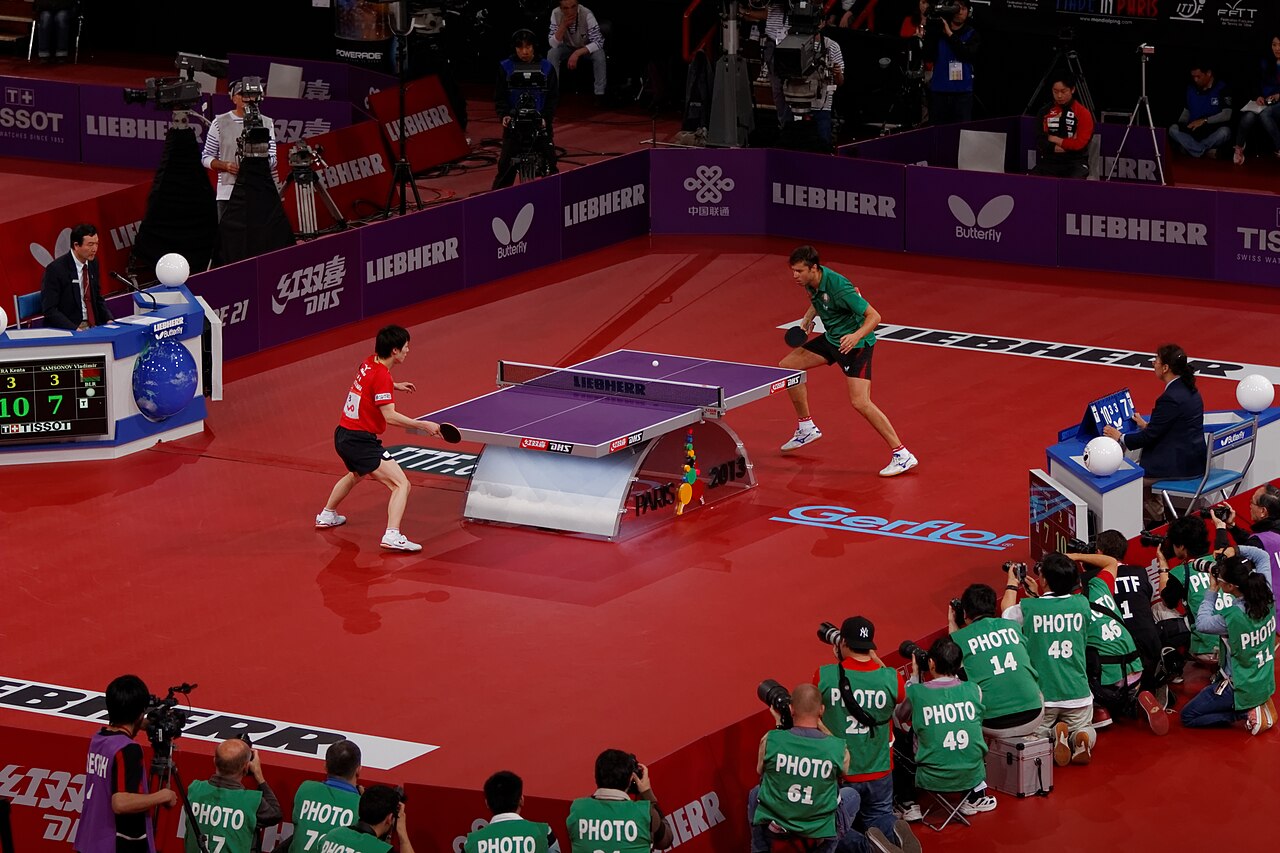
Table tennis began not on a court but on a dining table. In late-Victorian England, gentlemen adapted lawn tennis into an indoor after-dinner game using books for a net, a carved champagne cork or rubber ball, and cigar-box lids for bats. The onomatopoeic names ping-pong, whiff-whaff and gossima competed until manufacturers and, later, a global federation imposed order.
From that parlour amusement grew a fiercely technical professional sport. Each leap, celluloid balls, sponge rubber, speed glue, the enlarged ball, poly plastic and commercial world tours, redrew the tactical map. The centre of gravity migrated from Central Europe to Japan and then, decisively, to China, whose systematic dominance now frames every era that follows.
Timeline
Upper-class Victorians improvise an indoor version of lawn tennis on dining tables, using books as nets and rubber or cork balls.
Englishman James Gibb brings back hollow celluloid balls from the United States; the name Ping-Pong is trademarked, and the first associations and tournaments form.
Representatives meeting in Berlin establish the International Table Tennis Federation; the inaugural World Championships are held in London that December.
Viktor Barna wins the first of five world singles titles, spearheading a Hungarian domination that yields more than twenty world championship titles for him alone.
At the World Championships a single point between Alex Ehrlich and Farkas Paneth is reported to last over two hours, exposing the tedium of extreme defensive play.
Hiroji Satoh wins the world title using a thick sponge-covered bat, launching Japanese dominance and forcing a rethink of rubber and equipment.
Rong Guotuan wins the men's singles world title, China's first world championship in any sport, igniting a national investment in the game.
China hosts and wins the World Championships; Zhuang Zedong begins a run of three consecutive world singles titles through 1965.
An invitation to the US team to visit China thaws Cold War relations and helps pave the way for President Nixon's 1972 visit.
Table tennis enters the Olympic programme with four events; China, Sweden and South Korea share the first golds.
Sweden's Jan-Ove Waldner wins Olympic singles gold in Barcelona, the peak of a European golden age that briefly checks Chinese supremacy.
After the Sydney Games the ball is enlarged from 38mm to 40mm to slow rallies and improve visibility for television.
The ITTF replaces 21-point games with 11-point games and two-serve alternation, sharpening tension and shortening matches for broadcast.
Austria's Werner Schlager wins the men's world singles title in Paris, the most recent world or Olympic men's singles crown for a non-Asian player.
Volatile-compound speed glues, which supercharged rubber for a decade, are outlawed on health grounds, resetting equipment and technique.
The seamless 40+ poly ball is introduced, slightly larger and slower with less spin, favouring close-to-table power play.
Ma Long adds Rio Olympic singles gold to his World Championship and World Cup titles, later becoming the only man to win each twice.
The ITTF launches its commercial World Table Tennis circuit; at the pandemic-delayed Tokyo Games, Japan takes mixed-doubles gold from China.
Fan Zhendong wins Paris Olympic singles to complete his Grand Slam, while Ma Long's sixth gold makes him the most decorated Olympic table tennis player.
The eras
The Victorian Parlour Game
Table tennis was born as a domestic diversion in Britain, an indoor imitation of lawn tennis played on dining tables after dinner. Early improvised equipment, cork or rubber balls, cigar-box or vellum-covered bats, books for nets, gave way to standardised gear once manufacturers recognised a market. The pivotal moment came around 1901, when James Gibb popularised the hollow celluloid ball, whose distinctive sound inspired the name ping-pong, promptly trademarked and defended by sporting-goods firms. Rival names such as whiff-whaff and gossima circulated before fading. The game spread rapidly through Central Europe and, remarkably, into Asia, laying dormant roots that would later flower. Rules were loose and local, scoring and equipment varied, and the sport lacked any global authority. That vacuum was decisive: the absence of a unifying body meant that when enthusiasts finally organised, they built an international structure almost from scratch, culminating in the 1926 founding of the ITTF and the first World Championships, which transformed a drawing-room novelty into a competitive sport with codified laws.
The Hungarian Hardbat Age
The interwar decades belonged to Central Europe, and above all to Hungary. Playing with hardbat rackets, thin pimpled rubber over wood with little sponge, competitors relied on placement, consistency and defensive guile rather than raw spin. Viktor Barna epitomised the era, collecting five world singles titles and more than twenty world championship titles across singles, doubles and team events, while compatriots and rivals from Czechoslovakia, Austria and England filled the honours lists. The equipment produced long, patient rallies, and the era's defining, cautionary moment came in 1936 when a single point in Prague reportedly stretched beyond two hours, demonstrating how defence-first play could grind a match to a standstill. The scandal prompted rule tinkering, lower nets and time controls, that foreshadowed the modern expedite rule. The Second World War interrupted competition, but the hardbat aesthetic, subtle, tactical and touch-based, remained the template until a technological earthquake in Japan swept it away, ending Europe's grip on the sport and shifting its centre eastward for good.
The Japanese Sponge Revolution
In 1952 an obscure Japanese player, Hiroji Satoh, won the world title with a bat covered in thick sponge rubber, and the sport changed forever. Sponge multiplied both speed and spin, rendering the hardbat game obsolete almost overnight and ushering in aggressive topspin attack. Japan dominated the 1950s, pioneering the penhold grip and the looping forehand that would define offensive play for generations. Their innovation forced the ITTF to regulate rubber thickness and construction, but it could not put the genie back. By the late 1950s a new power was emerging: China, which won its first world title through Rong Guotuan in 1959 and, backed by state resources, quickly absorbed and improved upon Japanese methods. The Beijing World Championships of 1961 announced Chinese arrival, and Zhuang Zedong's three straight world singles titles signalled a shifting balance. This era established the two enduring truths of modern table tennis, that spin-based attack wins, and that systematic national programmes, first Japan's, then China's, would set the pace.
Chinese Rise and Ping-Pong Diplomacy
Through the 1960s China consolidated its position as a table tennis superpower, even as the Cultural Revolution disrupted its programme. The sport's global profile spiked in 1971 with Ping-Pong Diplomacy, when China invited the touring American team to visit, an act of sporting outreach that helped thaw relations and preceded President Nixon's landmark 1972 China trip. On the table, the period saw a stylistic dialogue between Asian penhold attackers and European loopers, with Sweden, Hungary and Yugoslavia keeping the continent competitive. The addition of foam sponge, faster blades and evolving rubbers kept accelerating rallies. China's depth of talent, cultivated through a rigorous provincial and national selection pyramid, meant that even world-class players struggled to make its team. By the time the sport approached Olympic recognition, the essential shape of modern competition, Chinese quantity and quality versus a handful of exceptional challengers, was already set, awaiting only the grander stage that the Olympic Games would provide from 1988 onward.
The European Golden Age and Waldner
The last era in which non-Chinese players consistently ruled the sport was defined by a Swedish generation of genius, led by Jan-Ove Waldner. Nicknamed the Mozart of table tennis for his improvisational touch and serve variation, Waldner won world singles titles in 1989 and 1997 and Olympic gold in 1992, and his Sweden repeatedly upset China in team finals, most memorably in 1989 and 1991. Alongside him, players like Jorgen Persson gave Europe genuine parity. This was also the speed-glue era, when players re-glued rubbers before every match to boost catapult and spin, producing spectacular high-speed topspin exchanges. The 1988 Olympic debut in Seoul spread global attention, and South Korea's Yoo Nam-kyu and later Ryu Seung-min proved Asian challengers to China were not only Chinese. Yet the window was closing: China responded to the Swedish challenge by industrialising its programme further. By the turn of the millennium, the balance had tipped so far that Waldner's peers would become the last Europeans to seriously contest world supremacy.
The Chinese Dynasty and Pro Era
The modern era is the story of near-total Chinese dominance amid rapid rule and equipment change. The 40mm ball (2000), the 11-point game (2001), the speed-glue ban (2008) and the plastic ball (2014) each reset technique, yet China adapted fastest every time. A production line of champions, Wang Liqin, Zhang Jike, Ma Long and Fan Zhendong among the men, Zhang Yining, Li Xiaoxia, Ding Ning and Chen Meng among the women, monopolised the major titles. Ma Long became the sport's greatest, the only man to win each Grand Slam title twice and the most decorated Olympic player with six golds. Challengers narrowed to a precious few: Germany's Timo Boll carried European hopes, while Japan's academy, producing Tomokazu Harimoto and Mima Ito, delivered the era's signature upset by taking mixed-doubles gold in Tokyo 2021. The launch of the commercial WTT circuit in 2021 professionalised the calendar and prize money, even as China's collective depth, its trials still harder than most world events, kept the dynasty intact into the 2024 Games and beyond.
From a champagne cork batted across a dinner table to a discipline where teenagers train thousands of hours to read a quarter-second of spin, table tennis has repeatedly reinvented itself around new equipment while concentrating ever more tightly around a single national powerhouse. Its future contest is less about whether China will win than about who, Japan, Europe or a new generation of prodigies, can occasionally break through.
Keep exploring
More in this category
Tennis
The loneliest duel in sport: no clock, no teammates, no place to hide until the last point is won.
🏸Badminton
The world's fastest racquet sport, where 400 km/h smashes and feather-soft net shots collide inside a single rally.
🎾Squash
Two players, four walls and nowhere to hide — the most physically brutal racket sport ever invented.