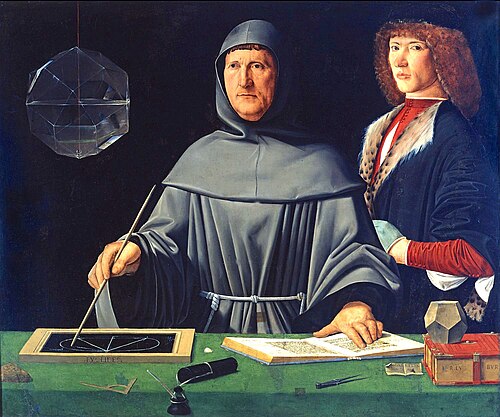
 Attributed to Jacopo de' Barbari · Public domain
Luca Pacioli
A Franciscan friar and wandering mathematics teacher, Pacioli published the first printed description of double-entry bookkeeping in his Summa de arithmetica, printed in Venice in 1494. He invented none of it — Italian merchants had used the method for two centuries — but his treatise carried it across Europe and earned him the title "father of accounting."
From 1496 to 1499 Pacioli lived at the Sforza court in Milan, where he taught mathematics to Leonardo da Vinci; Leonardo drew the sixty polyhedra illustrating Pacioli's next book, Divina proportione. The bookkeeping treatise, meanwhile, told merchants to record everything in the name of God and to stop working each night only when the books balanced — advice accounting trainees still hear, in secular form, five centuries later.
“You do not have to invent the method; writing it down clearly for everyone can be the greater contribution.”