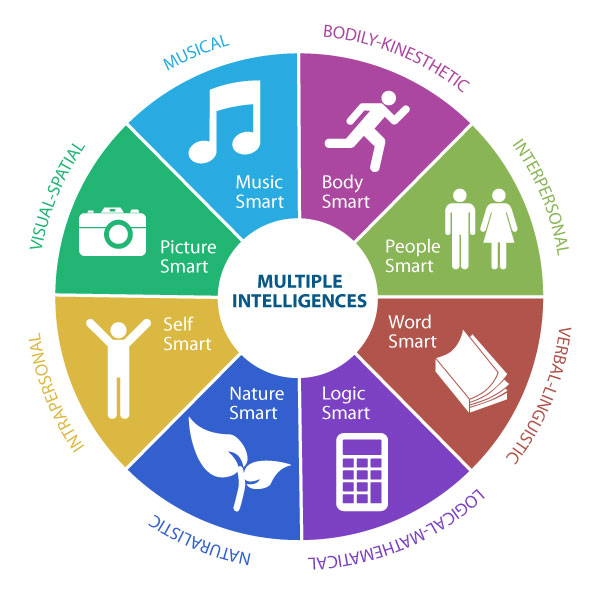
Howard Gardner’s Frames of Mind (1983) argued that a single general intelligence was too thin a story for schools, and offered several relatively autonomous intelligences — linguistic, logical-mathematical, musical, spatial, bodily-kinesthetic, interpersonal, intrapersonal, later naturalist.
As a reminder that children can be strong in different symbol systems, MI is a useful taxonomy. As a psychometric theory it is weak: Lynn Waterhouse (2006) and Beth Visser and colleagues (2006) argued that the “intelligences” are not independently measured the way Gardner’s claims require, and that g still organises test batteries.
This page treats MI as a curriculum conversation starter, not as a replacement for Spearman’s positive manifold and not as a new caste system. It also refuses to turn “intelligences” into group rankings.
How this talent is seen here
English-speaking systems · US, UK, Canada, Australia and related school markets
Multiple intelligences shows up here through tests, conservatories, academies and workplace stories — windows that already mix training with starting points.
What follows is a map of institutions, not a diagnosis. Selection usually measures current performance.
Links, glossary and adjacent themes around Multiple intelligences.
See also
Kinesthetic talentSame atlas neighbourhood as Multiple intelligences (science).
Culinary talentSame atlas neighbourhood as Multiple intelligences (science).
Spatial talentSame atlas neighbourhood as Multiple intelligences (science).
Leadership talentSame atlas neighbourhood as Multiple intelligences (science).
Key terms
Corridor
Route, season or institution that sets access.
Envelope
Safe operating band — speed, depth, load or dose.
Certification
Agency or type-approval gate before public use.
Transfer
Skill carry-over across domains; usually limited.
Era bound
Figures valid only inside a dated window.
Local lens
Country/language notes that must not stay English under a local URL.
Local lens
schools, clubs and labs.
selection systems without group rankings.
Field note
coaches, teachers and clinics.
conservatories, gyms and classrooms.
Caveat
Prefer dated bands over current live figures.
Scores here are browsing aids.
42innateWeightEditorial 0-100 browsing score
70trainabilityEditorial 0-100 browsing score
48earlyWindowEditorial 0-100 browsing score
40evidenceEditorial 0-100 browsing score
Multiple intelligences: concrete atlas depth on Tool-Lifes.
Frequently asked questions
Does this atlas rank groups by IQ, race or nation?
No. Pathways and evidence stay individual. Scores are browsing aids — never group biological or racial ranks.
Did Gardner refute g?
He argued g was too narrow for a human-worth story. He did not make the intercorrelations among tests disappear. Spearman’s positive manifold remains a psychometric fact.
What did Waterhouse 2006 argue?
That MI lacks the cognitive-neuroscience and psychometric support a new theory of intelligence would need, and that schools adopted it ahead of the evidence.
What did Visser, Ashton and Vernon 2006 find?
Tasks written to tap Gardner’s intelligences still loaded on general and broad factors rather than eight independent IQs.
Is MI the same as learning styles?
Gardner has rejected the popular “teach to visual/auditory styles” version. MI is about domains of competence, not preferred input channels — though schools often mash the two.
Why do teachers still like it?
It licenses music, movement and social work as serious. That institutional use can be good even if the psychometrics are thin.
Is Sternberg’s triarchic theory the same?
No. Robert Sternberg’s analytic/creative/practical is a different programme, also critical of thin IQ stories, with its own evidence fights.
Does this page rank races on MI?
No. Neither Gardner’s list nor g is used here as a group hierarchy.