Milestones in order. This is history, not a weekly activity grid.
- Boxing enters the ancient Olympics
- Broughton's Rules
- The Marquess of Queensberry Rules
- Corbett dethrones Sullivan with gloves
- Boxing joins the modern Olympics
- Jack Johnson breaks the color line
- The first million-dollar gate
- Joe Louis begins his reign
- Sugar Ray Robinson's middleweight era
- The alphabet era begins
- Clay shocks Liston
- The Fight of the Century
- The Rumble in the Jungle
- No Mas in New Orleans
Last reviewed Sources & creditsMedia creditsMethodology
Quick answers
How many rounds is a professional boxing match?
Professional bouts range from four to twelve rounds of three minutes each, separated by one-minute rests. World championship fights are twelve rounds. Non-title fights are shorter, typically four to ten rounds depending on the fighters' experience. Title bouts were traditionally fifteen rounds, but the sport reduced them to twelve after the South Korean fighter Kim Duk-koo died from injuries suffered in a fifteen-round lightweight title fight against Ray Mancini in 1982. The WBC led the change that year, and the other sanctioning bodies followed, with the last fifteen-round title fight held in 1988. Amateur and Olympic men's bouts are three rounds; women's professional championship fights are usually ten two-minute rounds, though there is a push to allow three-minute rounds.
What does undisputed champion mean in boxing?
An undisputed champion holds all four major world titles in a division simultaneously: the WBA, WBC, IBF and WBO belts. Because boxing is governed by these four rival sanctioning bodies rather than one league, each division can have four different 'world champions' at once, and unifying all of them is the sport's ultimate achievement. Fragmentation made it nearly impossible for decades, but a deliberate revival has produced modern undisputed champions such as Canelo Alvarez at super middleweight in 2021 and Oleksandr Usyk, who in 2024 became the first four-belt undisputed heavyweight champion and the first undisputed heavyweight since Lennox Lewis in 1999. Undisputed titles are prized but fragile, since the bodies' conflicting mandatory-defense rules often force a champion to vacate one belt soon after unifying.
Who is the greatest boxer of all time?
The most common answer is Sugar Ray Robinson, whom The Ring magazine and most historians rank as the greatest pound-for-pound fighter ever. Across a 25-year career he went roughly 173-19-6 with 108 knockouts, held the welterweight title and won the middleweight crown five times, and was unbeaten for 91 consecutive fights between 1943 and 1951. The phrase pound-for-pound, meaning greatness independent of weight, was coined to describe him. The debate's other leading names are Muhammad Ali, the most culturally significant boxer and a three-time heavyweight champion; Henry Armstrong, who held three world titles at once; and Joe Louis, whose heavyweight reign lasted nearly twelve years. Because fighters compete in different divisions and eras with no shared scoreboard, the ranking is a matter of informed judgment rather than settled fact.
What are the weight classes in boxing?
Professional boxing has seventeen weight divisions, matching fighters by size for safety and fairness. From lightest to heaviest they are: minimumweight (105 lb), light flyweight (108), flyweight (112), super flyweight (115), bantamweight (118), super bantamweight (122), featherweight (126), super featherweight (130), lightweight (135), super lightweight (140), welterweight (147), super welterweight (154), middleweight (160), super middleweight (168), light heavyweight (175), cruiserweight (200) and heavyweight (over 200 lb, with no upper limit). The 'super' and 'junior' prefixes denote in-between classes added over the decades. Fighters must make their division's weight limit at an official weigh-in, usually the day before the bout, and often rehydrate substantially before fighting. The proliferation of divisions is one reason boxing has so many world champions.
How is a boxing match scored?
Fights that go the distance are decided by three ringside judges using the 10-point must system. In each round, the judge awards 10 points to the fighter he believes won it and 9 or fewer to the other; a close round is 10-9, a round with a knockdown is usually 10-8, and a dominant round can be 10-8 or lower. Judges score clean, effective punching, ring generalship, defense and aggression, and they cannot see one another's cards during the fight, which is why split decisions happen. At the end, the scorecards are tallied: a fighter needs a majority of the three judges to win. Outcomes include unanimous decision (all three judges agree), split decision (two to one), majority decision (two judges plus one even card) and various draws. A knockout or stoppage ends the fight before the cards matter.
What is the difference between a KO and a TKO?
A knockout (KO) occurs when a fighter is knocked down and cannot rise before the referee counts to ten, ending the fight. A technical knockout (TKO) ends the fight while a fighter is still technically able to stand, when the referee decides he can no longer intelligently defend himself, when the ringside doctor halts the bout for injury, when a fighter's corner throws in the towel to protect him, or when a jurisdiction's three-knockdown rule triggers. Both count as stoppage wins and are recorded together in a fighter's knockout total. The distinction is essentially about how the stoppage happens: a full count for a KO, a judgment call by the referee, doctor or corner for a TKO. A related result is a retirement (RTD), when a fighter quits on his stool between rounds.
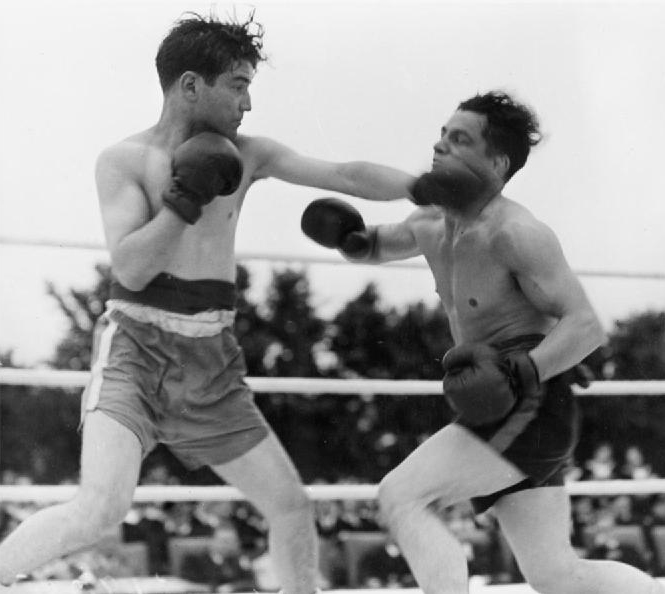
Boxing's documented history stretches back nearly three thousand years, to the pygmachia contested at the ancient Olympic Games in 688 BC, where fighters bound their hands in leather thongs and fought without rounds or weight classes until one man could no longer continue. The sport vanished with the fall of Rome and reappeared in 18th-century England as bare-knuckle prizefighting, a brutal, quasi-legal spectacle that produced the first champions, the first written rules, and the first attempts to make a lethal contest survivable.
The modern arc runs from Jack Broughton's protective rules of 1743 through the Marquess of Queensberry code of 1867, which mandated gloves and three-minute rounds and created the sport recognizable today. From there it is a story of champions who transcended the ring, Jack Johnson, Joe Louis, Muhammad Ali, and of a business that grew from smoky clubs to closed-circuit theaters, cable pay-per-view and, most recently, global streaming. What follows is that arc as landmark moments and as the broad eras that shaped them.
Timeline
Pygmachia is added to the Olympic Games at Olympia in 688 BC. Fighters wrap their hands in leather himantes and fight with no rounds, no ring and no weight divisions until one man submits or cannot go on.
English champion Jack Broughton codifies the first modern rules after his opponent George Stevenson dies of injuries. They ban hitting a downed man and introduce a 30-second count, the earliest formal safety measures in the sport.
Drafted by John Graham Chambers and endorsed by the 9th Marquess of Queensberry, the code mandates padded gloves, three-minute rounds, one-minute rests and a ten-second count, defining boxing as it is still fought.
James J. Corbett knocks out John L. Sullivan in the 21st round in New Orleans, the first world heavyweight title decided under gloved Queensberry rules and the symbolic end of the bare-knuckle era.
Boxing debuts at the St. Louis Games with seven weight classes, all entrants American. It becomes a permanent Olympic fixture and the primary pipeline of amateur talent into the professional ranks.
Johnson beats Tommy Burns in Sydney to become the first Black world heavyweight champion. His 1910 defeat of Jim Jeffries, the original 'Fight of the Century,' triggers riots and decades of racial controversy.
Jack Dempsey vs Georges Carpentier in Jersey City draws a $1.7 million gate, boxing's first, and is carried live by radio. The same year the National Boxing Association, forerunner of the WBA, is founded.
Louis wins the heavyweight title from James J. Braddock and holds it for a record 11 years and 8 months. His first-round demolition of Max Schmeling in 1938 becomes a global political symbol.
Robinson stops Jake LaMotta in the 'St. Valentine's Day Massacre' to win the middleweight crown, adding to a welterweight reign. He is later ranked by The Ring as the greatest pound-for-pound fighter ever.
The World Boxing Council is founded in Mexico City, splitting from the WBA and beginning the multiplication of sanctioning bodies that would give each weight class rival champions and belts.
A 22-year-old Cassius Clay upsets the fearsome Sonny Liston in Miami Beach, then announces his conversion to Islam and his name, Muhammad Ali, launching the most consequential career in the sport's history.
Joe Frazier hands Ali his first defeat over 15 rounds at Madison Square Garden, dropping him in the final round. It is the first of their three fights and boxing's biggest event to date.
In Kinshasa, Zaire, Ali reclaims the heavyweight title by knocking out the undefeated George Foreman in the eighth round, absorbing punishment on the ropes in the tactic dubbed rope-a-dope.
Sugar Ray Leonard batters Roberto Duran into quitting in the eighth round, avenging a loss five months earlier. The 'Four Kings' era of Leonard, Duran, Hagler and Hearns defines a golden middleweight age.
After Kim Duk-koo dies from injuries suffered against Ray Mancini, the WBC cuts championship fights from 15 rounds to 12. The other bodies follow, and the last 15-round title bout is held in 1988.
Mike Tyson, already the youngest heavyweight champion at 20, demolishes Michael Spinks in 91 seconds to reign as undisputed champion. The WBO is founded the same year, completing the modern four-belt structure.
Floyd Mayweather beats Oscar De La Hoya before a then-record 2.48 million pay-per-view buys, proving the cable model could out-earn any live gate and reshaping how elite fights are financed and marketed.
Mayweather outpoints Manny Pacquiao in Las Vegas after five years of demand, drawing roughly 4.6 million US PPV buys and over $410 million in PPV revenue, records that still stand.
Katie Taylor edges Amanda Serrano in a sold-out Madison Square Garden, the first time women have topped a bill at the venue, a landmark for a division booming in visibility and pay.
Oleksandr Usyk beats Tyson Fury to become the first four-belt undisputed heavyweight champion. Months later, Netflix streams Jake Paul vs Mike Tyson to about 108 million viewers.
The eras
The bare-knuckle age
English prizefighting emerged in the early 1700s as a bloody adjunct to the gambling and tavern culture of Georgian London. James Figg, recognized around 1719 as the first English champion, taught the trade at his amphitheater, but it was his successor Jack Broughton who gave the sport its conscience: after his opponent George Stevenson died in 1741, Broughton drafted the 1743 rules that banned striking a downed man and introduced a rudimentary count. Fights were bare-fisted, could run scores of rounds, each ending only when a man was knocked or thrown down, and were fought under the London Prize Ring Rules from 1838. Champions like Tom Cribb, who twice beat the formerly enslaved American Tom Molineaux in the 1810s, became national figures. The era's contests were tests of raw endurance and grappling as much as punching, semi-legal, often broken up by magistrates, and staged in fields to evade the law. By the 1880s the sport had outgrown its brutal folk form, and John L. Sullivan, the last great bare-knuckle champion, was already fighting most of his bouts with gloves under a new code that would soon replace the old one entirely.
The Queensberry code and the first golden age
The Marquess of Queensberry Rules of 1867, mandating gloves, three-minute rounds and a ten-count, took decades to fully displace bare-knuckle fighting, but by the time James J. Corbett outboxed John L. Sullivan in 1892 the transition was complete. Gloves made boxing faster, more scientific and more legally respectable, and the early 20th century produced its first transcendent figures. Jack Johnson broke the heavyweight color line in 1908 and defended it with a mastery that inflamed a racist establishment. After the First World War the sport entered a commercial boom driven by promoter Tex Rickard, radio broadcasting and the charisma of Jack Dempsey, whose 1921 bout with Carpentier drew boxing's first million-dollar gate and whose 1927 rematch with Gene Tunney, featuring the disputed 'long count,' was heard by tens of millions on radio. Weight divisions multiplied and stabilized, national commissions formed, and figures like Benny Leonard and Harry Greb elevated the lighter classes. By the 1930s boxing was among the most popular sports in America, its champions household names, its economics built on the gate and the airwaves.
Louis, Robinson and the television transition
Joe Louis's title win in 1937 opened boxing's most storied championship reign: 25 consecutive defenses over 11 years and 8 months, and a first-round knockout of Max Schmeling in their 1938 rematch that carried the weight of a nation on the brink of war. Louis restored the heavyweight title's prestige and became the first Black American embraced as a mainstream hero. Alongside him, Sugar Ray Robinson set a standard of skill still used as the benchmark for greatness, dominating the welterweight and middleweight divisions with a blend of power, speed and artistry that inspired the phrase pound-for-pound. Rocky Marciano closed the era by retiring in 1956 as the only heavyweight champion to finish undefeated, at 49-0. The decisive change, though, was technological: television brought boxing into living rooms, the Friday Night Fights becoming appointment viewing. Overexposure and the sport's entanglement with organized crime, exposed in the Kefauver hearings, would eventually thin the club circuit, but for two decades boxing rode the new medium to unprecedented reach.
The Ali era and boxing's second golden age
No athlete reshaped a sport like Muhammad Ali. His 1964 upset of Sonny Liston, his conversion and name change, his refusal of the Vietnam draft and three-and-a-half-year exile, and his three epic fights with Joe Frazier turned boxing into a global cultural and political stage. The heavyweight division of the 1970s, Ali, Frazier, Foreman, Ken Norton, was perhaps the deepest in history, its signature nights, the Rumble in the Jungle and the Thrilla in Manila, watched worldwide via satellite. As Ali faded, the lighter divisions produced the 'Four Kings,' Sugar Ray Leonard, Roberto Duran, Marvin Hagler and Thomas Hearns, whose round-robin of classics through the 1980s remains a high-water mark for skill and drama. Off the ring the business fragmented: the WBC (1963), IBF (1983) and WBO (1988) joined the WBA, so most divisions now had multiple champions. The decade ended with a young Mike Tyson unifying the heavyweight titles and, after Kim Duk-koo's death, the sport shortening title fights to twelve rounds in the name of safety.
Pay-per-view, Tyson and fragmentation
The 1990s were defined by spectacle and disorder. Mike Tyson's shocking 1990 loss to Buster Douglas, his imprisonment, his comeback and his 1997 disqualification for biting Evander Holyfield made him the sport's biggest and most volatile draw. Holyfield and Riddick Bowe waged a heavyweight trilogy of genuine grandeur, while Lennox Lewis eventually imposed order, unifying the titles by 2000. The era's real revolution was economic: pay-per-view, pioneered on cable, turned megafights into nine-figure businesses and shifted power to whoever could sell them. Oscar De La Hoya became the sport's crossover face and its top PPV attraction. Beneath the heavyweights, an extraordinary generation of smaller fighters, Roy Jones Jr., Pernell Whitaker, Julio Cesar Chavez, Felix Trinidad, Bernard Hopkins, kept the craft at its peak even as four sanctioning bodies, interim belts and mismatched rankings made the championship picture nearly incomprehensible to casual fans. The sport was richer at the top and more confusing than ever.
Pound-for-pound, streaming and the undisputed revival
The modern era has been shaped by two dominant pound-for-pound stars, the defensive genius Floyd Mayweather, who retired at 50-0 in 2017 after the richest fight ever against Manny Pacquiao, and the eight-division Pacquiao himself. Behind them, Canelo Alvarez became the sport's commercial center and the first undisputed super middleweight champion in 2021, part of a deliberate revival of the four-belt 'undisputed' concept: Oleksandr Usyk unified the heavyweight titles in 2024, Terence Crawford went undisputed in three weight classes, and Japan's Naoya Inoue did it in two. Women's boxing exploded in stature, with Katie Taylor and Amanda Serrano headlining Madison Square Garden in 2022 and Claressa Shields winning undisputed titles in multiple divisions. Distribution moved from pay-per-view toward streaming and, controversially, toward Saudi-financed Riyadh Season cards that finally forced long-avoided matchups. The Netflix broadcast of Tyson vs Jake Paul in 2024, drawing 108 million viewers, signaled both the sport's reach and its uneasy fusion with influencer entertainment.
Nearly three thousand years after two men bound their hands in leather at Olympia, boxing's essential appeal is unchanged: it is the most direct and honest test of nerve any sport offers, and its champions are made or unmade in full view. What has changed is scale and delivery, from field to stadium to satellite to stream, and the recurring tension between commerce and safety, between the fragmentation that dilutes its titles and the periodic hunger for a single undisputed champion. The sport has been declared dying for a century and keeps producing nights, Usyk conquering the heavyweights, a Garden full for Taylor and Serrano, that remind the world why it endures. Its next chapters, written across streaming platforms and Gulf-financed arenas, will be built on the same unchanging foundation of two fighters, four fists, and nowhere to hide.
Keep exploring
More sports
Soccer
The simplest game on Earth, played by hundreds of millions and argued over by half the planet.
🏀Basketball
Five players, 24 seconds, and geometry at full sprint — the city game that conquered the world.
⚾Baseball
The clockless chess match where a round bat meets a round ball and the best hitters on earth still fail seven times out of ten.
🎾Tennis
The loneliest duel in sport: no clock, no teammates, no place to hide until the last point is won.
🏎️F1
Twenty drivers, a thousand horsepower, and the most expensive engineering arms race in sport.
⛳Golf
A six-century test of nerve where the only opponent is the ground, the wind, and yourself.
🏈Football
Four downs, ten yards, one end zone: the ultimate game of territory, collision, and coaching.
🏏Cricket
The bat-and-ball contest where a single match can last five days and still turn on one ball.